REVIEW 2 minor 3 cited by
Wireless Federated Distillation for Distributed Edge Learning with Heterogeneous Data
T0 review · 0 major / 2 minor · reviewed 2026-05-25 · grok-4.3
Pith's one-line read A hybrid federated distillation scheme enables wireless implementations of distributed edge learning over Gaussian channels.
desk verdict This paper introduces a hybrid federated distillation scheme for wireless edge learning but provides no equations or results to check the claims. read the letter →
The pith
A machine-rendered reading of the paper's core claim, the machinery that carries it, and where it could break.
The reading
What carries the argument
The hybrid federated distillation (HFD) scheme, which integrates model parameter exchange from federated learning with knowledge distillation via logits to manage data heterogeneity in a wireless setting.
What would settle it
An experiment on actual wireless hardware showing that the digital or over-the-air HFD schemes fail to reach the reported accuracy levels due to timing offsets or power constraints not captured in the Gaussian model.
Extended reading notes
Core claim
The authors claim that wireless federated learning, federated distillation, and the new hybrid federated distillation scheme can be realized over Gaussian multiple-access channels through either separate source-channel coding for digital transmission or joint source-channel coding for over-the-air computing, thereby addressing the challenges of noisy wireless links in distributed edge learning with heterogeneous data.
Load-bearing premise
Wireless links can be accurately represented by Gaussian multiple-access channels and the proposed schemes can be implemented without unstated practical impairments such as synchronization errors or hardware constraints.
Editorial extensions
If this is right
- Digital implementations transmit quantized model updates or logits using separate source and channel coding.
- Over-the-air implementations allow simultaneous analog transmission of updates with natural superposition at the receiver.
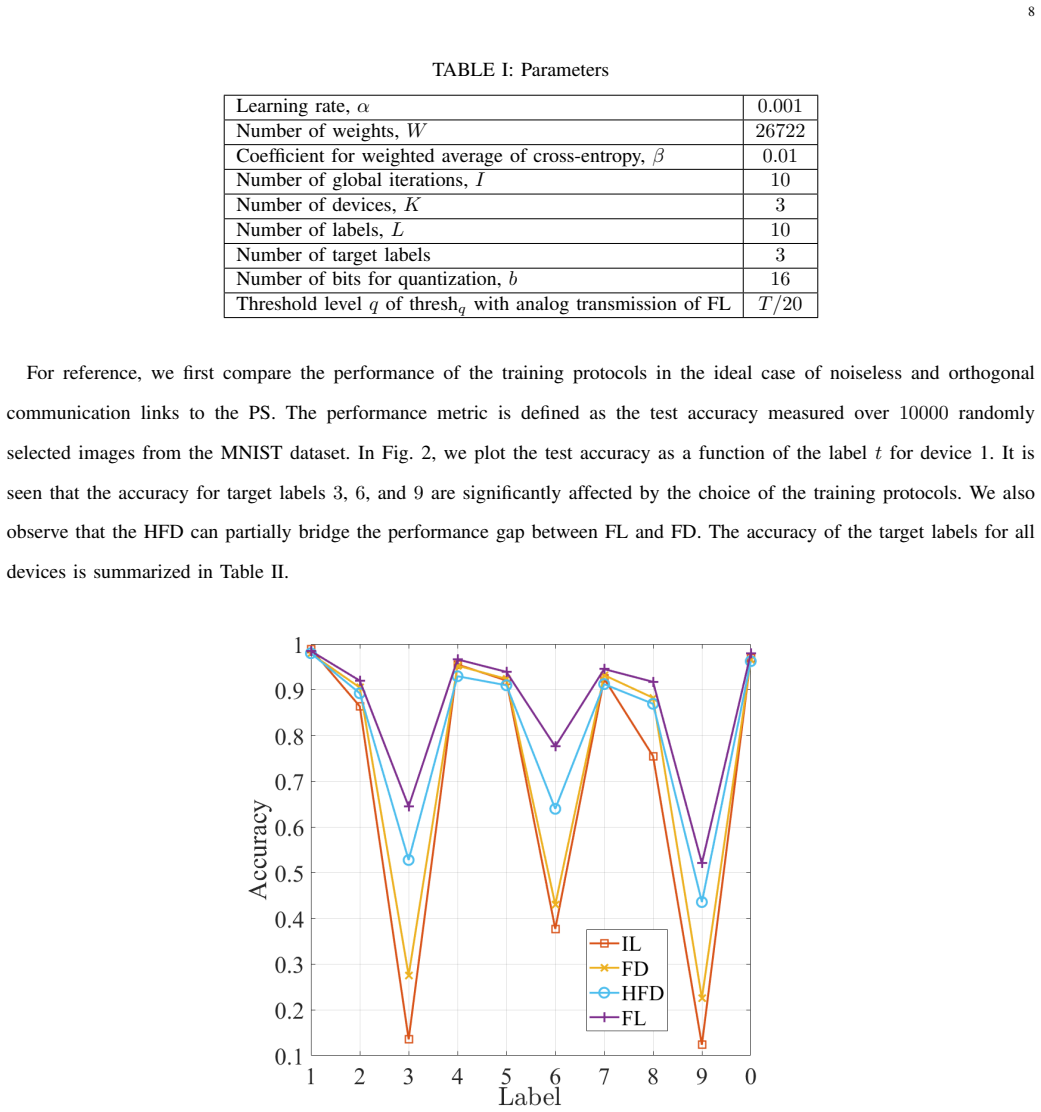
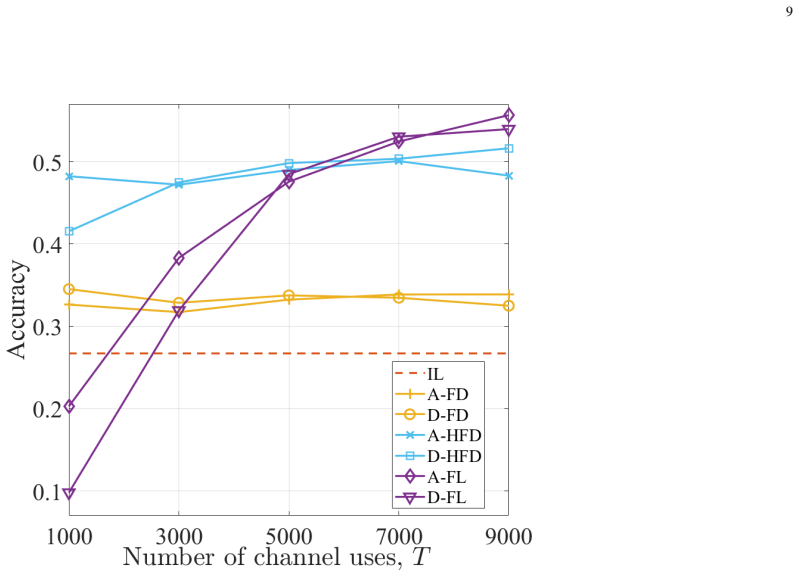
- The HFD scheme achieves improved accuracy compared to standalone FL or FD when data distributions differ across devices.
- Both implementation types are directly evaluable for convergence and communication cost over Gaussian multiple-access channels.
Reading between the lines
- The joint source-channel coding approach may lower communication latency in time-sensitive edge applications beyond what separate coding achieves.
- The framework could be tested on fading or interference-limited channels to check robustness outside the Gaussian assumption.
- Device selection or power allocation rules might be added to further optimize the over-the-air aggregation step.
Signed reviews
Editorial analysis
A structured set of objections, weighed in public.
Referee Report
Summary. The paper studies opportunities and challenges of wireless links in cooperative distributed machine learning. It considers wireless implementations of Federated Learning (FL) and Federated Distillation (FD), introduces a novel Hybrid Federated Distillation (HFD) scheme, and proposes both digital (separate source-channel coding) and over-the-air (joint source-channel coding) realizations, all evaluated over Gaussian multiple-access channels for heterogeneous data.
Significance. If the derivations and numerical results hold, the work is significant because it directly addresses the interface between wireless communications and distributed edge learning, a practically relevant setting. The introduction of HFD and the explicit comparison of digital versus OTA schemes provide concrete design insights that go beyond ideal-channel assumptions common in the FL literature.
minor comments (2)
- [Abstract] Abstract: the claim that the schemes are 'proposed and evaluated' would be strengthened by naming the key performance metrics (e.g., test accuracy vs. communication rounds or vs. transmit power) already in the abstract.
- [System Model] The modeling assumption that the wireless links are accurately captured by ideal Gaussian MACs without synchronization or hardware impairments is standard but should be stated explicitly as an idealization in the system model section.
Simulated Author's Rebuttal
We thank the referee for the positive evaluation of the manuscript, the accurate summary of its contributions, and the recommendation for minor revision. No specific major comments were provided in the report.
Circularity Check
No significant circularity detected
full rationale
The paper proposes and evaluates wireless implementations of FL, FD, and a novel HFD scheme using digital and over-the-air methods over Gaussian MACs. The abstract and described content contain no equations, derivations, fitted parameters presented as predictions, or self-citation chains that reduce a central claim to its own inputs by construction. This is an applied engineering study of communication schemes rather than a mathematical derivation whose result is equivalent to its assumptions; the modeling choices are standard idealizations in the field and do not create circularity.
Assumptions & free parameters
Cite this review
Pith. "Pith review of Wireless Federated Distillation for Distributed Edge Learning with Heterogeneous Data." pith.science (2026). https://pith.science/paper/CCE3E7CM
@misc{pith2026190702745,
  author       = {Pith},
  title        = {Pith review of: Wireless Federated Distillation for Distributed Edge Learning with Heterogeneous Data},
  year         = {2026},
  howpublished = {\url{https://pith.science/paper/CCE3E7CM}},
  note         = {Machine review of arXiv:1907.02745}
}
read the original abstract
Cooperative training methods for distributed machine learning typically assume noiseless and ideal communication channels. This work studies some of the opportunities and challenges arising from the presence of wireless communication links. We specifically consider wireless implementations of Federated Learning (FL) and Federated Distillation (FD), as well as of a novel Hybrid Federated Distillation (HFD) scheme. Both digital implementations based on separate source-channel coding and over-the-air computing implementations based on joint source-channel coding are proposed and evaluated over Gaussian multiple-access channels.
Figures

Figures from the paper (1 more)

Forward citations
Cited by 3 Pith papers
-
Hierarchical Federated Learning Across Heterogeneous Cellular Networks
A hierarchical federated learning framework with gradient sparsification reduces modeled communication latency in heterogeneous cellular networks while keeping CIFAR-10 accuracy close to a flat baseline.
-
Over-the-Air Computation Systems: Optimization, Analysis and Scaling Laws
For a single-antenna over-the-air computation system, the paper gives a closed-form optimal transmit-receive policy and proves the average computation error decays as O(1/√K).
-
Edge Intelligence: The Confluence of Edge Computing and Artificial Intelligence
The paper proposes a taxonomy and research roadmap for Edge Intelligence, dividing it into AI for edge and AI on edge, without presenting new empirical results.
Reference graph
Works this paper leans on
-
[1]
Communication-efficient learning of deep networks from decentralized data,
H. B. McMahan, E. Moore, D. Ramage, S. Hampson, and B. A. y Arcas, “Communication-efficient learning of deep networks from decentralized data,” in Proc. Int. Conf. on AISTATS , Fort Lauderdale, Florida, Apr. 2017
work page 2017
-
[2]
E. Jeong, S. Oh, H. Kim, J. Park, M. Bennis, and S. Kim, “Communication-efficient on-device machine learning: federated distillation and augmentation under Non-IID private data,” in Proc. NIPS, 2018
work page 2018
-
[3]
Distilling the knowledge in a neural network,
G. Hinton, O. Vinyals, and J. Dean, “Distilling the knowledge in a neural network,” in Proc. NIPS, 2014
work page 2014
-
[4]
Large scale distributed neural network training through online distillation,
R. Anil, G. Pereyra, A. Passos, R. Ormandi, G. E. Dahl, and G. Hinton, “Large scale distributed neural network training through online distillation,” in Proc. Int. Conf. on Learning Representations (ICLR) , 2018
work page 2018
-
[5]
Y . Zhang, T. Xiang, T. M. Hospedales, and H. Lu, “Deep mutual learning,” in IEEE Conference on Computer Vision and Pattern Recognition (CVPR) , 2018
work page 2018
-
[6]
Computation over multiple-access channels,
B. Nazer and M. Gastpar, “Computation over multiple-access channels,” IEEE Trans. Inf. Theory , vol. 53, pp. 3498-3516, Oct. 2007
work page 2007
-
[7]
Harnessing interference for analog function computation in wireless sensor networks,
M. Goldenbaum, H. Boche, and S. Sta ´nczak, “Harnessing interference for analog function computation in wireless sensor networks,” IEEE Trans. Signal Process., vol. 61, pp. 4893-4906, Oct. 2013
work page 2013
-
[8]
MIMO over-the-air computation for high mobility multi-modal sensing,
G. Zhu and K. Huang, “MIMO over-the-air computation for high mobility multi-modal sensing,” IEEE Internet Things J. , 2018
work page 2018
Show all 13 references
-
[9]
Low-latency broadband analog aggregation for federated edge learning,
G. Zhu, Y . Wang, and K. Huang, “Low-latency broadband analog aggregation for federated edge learning,” ArXiv e-prints , Jan. 2019
2019
-
[10]
Machine learning at the wireless edge: Distributed stochastic gradient descent over-the-air,
M. M. Amiri and D. G ¨und¨uz, “Machine learning at the wireless edge: Distributed stochastic gradient descent over-the-air,” ArXiv e-prints , Jan. 2019
2019
-
[11]
Sparse binary compression: Towards distributed deep learning with minimal communication,
F. Sattler, S. Wiedemann, K.-R. M ¨uller, W. Samek, “Sparse binary compression: Towards distributed deep learning with minimal communication,” ArXiv e-prints, May 2018
2018
-
[12]
T. M. Cover and J. A. Thomas, Elements of Information Theory . New York: John Wiley & Sons, 2006. 11
2006
-
[13]
Message-passing algorithms for compressed sensing,
D. L. Donoho, A. Maleki, and A. Montanari, “Message-passing algorithms for compressed sensing,” Proc. Nat. Acad. Sci. USA , vol. 106, no. 45, pp. 18914-18919, Nov. 2009
2009
Reviewed May 25, 2026 · model on record in the stance chip above.
Discussion (0). Continue with ORCID to comment.