REVIEW 2 major objections 1 minor 2 cited by
Roots of polynomials under repeated differentiation and repeated applications of fractional differential operators
T0 review · 2 major / 1 minor · reviewed 2026-05-24 · grok-4.3
Pith's one-line read The limiting root distribution after repeated applications of a fractional differential operator is the push-forward of the initial distribution under a transport map from PDE characteristics.
desk verdict The paper gives a transport map for root measures evolving under fractional operators via log-potential PDE characteristics, plus a free-probability reading as R-diagonal multiplication, but the initial limiting distribution for general independent coefficients is assumed rather than derived. read the letter →
The pith
A machine-rendered reading of the paper's core claim, the machinery that carries it, and where it could break.
The reading
What carries the argument
The transport map T_t obtained by flowing along the characteristic curves of the PDE satisfied by the logarithmic potential of the evolving measure.
What would settle it
For a concrete initial distribution such as the circular law, compute the empirical roots of large-N polynomials after exactly floor(Nt) applications of the operator and test whether their empirical measure converges to the predicted push-forward.
Extended reading notes
Core claim
Starting from a random polynomial P^N of degree N with independent coefficients that possesses a limiting root distribution ν, the polynomial obtained after roughly Nt applications of z^a (d/dz)^b has limiting root distribution μ_t equal to the push-forward of ν under the map T_t, where T_t is the flow along the characteristic curves of the PDE satisfied by the logarithmic potential of μ_t.
Load-bearing premise
The initial random polynomial of degree N with independent coefficients possesses a limiting root distribution as N tends to infinity.
Editorial extensions
If this is right
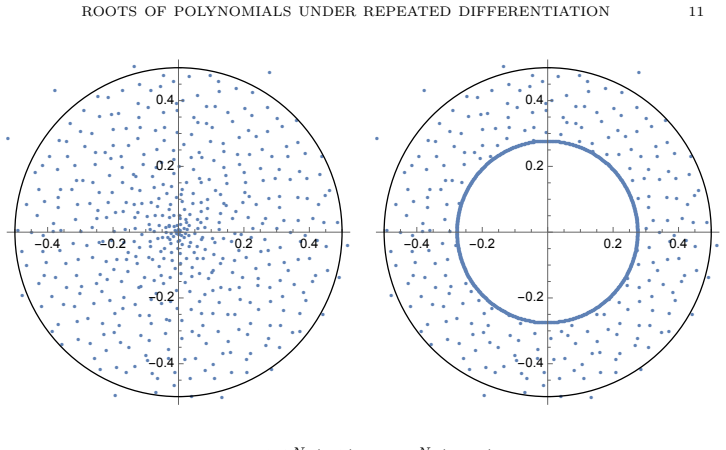
- For repeated differentiation the roots move radially inward at constant speed until they reach the origin and disappear.
- The transport map admits an interpretation in free probability as multiplication of an R-diagonal operator by an R-diagonal transport operator.
- The construction supplies a push-forward characterization of the free self-convolution semigroup of radial measures on the complex plane.
- When the operator involves integration the root dynamics become more complicated than simple transport.
Reading between the lines
- The same characteristic-flow method could be applied to other families of linear operators on polynomials whose action on the log-potential yields a closed PDE.
- The free-probability multiplication rule may connect the root evolution to the multiplicative free convolution of circular elements.
- Numerical checks on finite-N polynomials with Gaussian coefficients could confirm the predicted speed of radial motion before the large-N limit is taken.
Signed reviews
Editorial analysis
A structured set of objections, weighed in public.
Referee Report
Summary. The paper starts with a random polynomial P^N(z) of degree N with independent coefficients and considers the polynomial obtained after applying the fractional differential operator z^a (d/dz)^b a total of ⌈Nt⌉ times. It claims to compute the limiting root distribution μ_t as N→∞, showing that μ_t is the push-forward of the initial limiting root distribution under a transport map T_t obtained by flowing along characteristics of a PDE satisfied by the log potential of μ_t. Special cases include repeated differentiation (roots move radially at constant speed until reaching the origin) and a free-probability interpretation as multiplication by an R-diagonal transport operator; an application yields a push-forward characterization of the free self-convolution semigroup of radial measures on ℂ. The case b<0 (including repeated integration) is also treated.
Significance. If the claims hold under appropriate conditions, the work supplies a dynamical description of root evolution under fractional operators that links random polynomials to free probability and gives an explicit characterization of the radial free self-convolution semigroup. The transport-map construction via PDE characteristics is a potentially useful technical contribution when the initial limiting measure exists.
major comments (2)
- [Abstract] Abstract and opening paragraphs: the central claim that μ_t is computed for general independent coefficients presupposes the existence of a limiting root distribution μ_0 for the initial P^N. No moment or distributional hypotheses are stated, yet existence of such limits is a non-trivial prerequisite (typically requiring e.g. finite log-moments or Gaussianity) that is not proved or even explicitly assumed in the manuscript; without it the push-forward construction cannot be applied.
- [Abstract] The derivation that the evolved measure is exactly the push-forward under the characteristic flow T_t of the log-potential PDE is presented as the main result, but the manuscript supplies no error estimates, tightness arguments, or verification that the limiting empirical measure converges to this transported measure; the soundness of the transport step therefore cannot be assessed from the given text.
minor comments (1)
- The notation for the fractional operator z^a (d/dz)^b should include an explicit definition or reference for non-integer exponents a and b.
Simulated Author's Rebuttal
We thank the referee for the careful reading and constructive comments on the assumptions and rigor. We address the two major comments point by point below.
read point-by-point responses
-
Referee: [Abstract] Abstract and opening paragraphs: the central claim that μ_t is computed for general independent coefficients presupposes the existence of a limiting root distribution μ_0 for the initial P^N. No moment or distributional hypotheses are stated, yet existence of such limits is a non-trivial prerequisite (typically requiring e.g. finite log-moments or Gaussianity) that is not proved or even explicitly assumed in the manuscript; without it the push-forward construction cannot be applied.
Authors: We agree that existence of the initial limiting measure μ_0 is a prerequisite not proved in the paper. The abstract and main text presuppose this limit exists when they refer to computing μ_t as its push-forward under T_t. The manuscript's focus is the evolution step assuming μ_0 is given, rather than proving existence (which is known in the literature under conditions such as i.i.d. Gaussian coefficients or finite log-moments). In revision we will explicitly state the assumption in the abstract and introduction, with a brief reference to standard sufficient conditions from the random-polynomial literature. revision: yes
-
Referee: [Abstract] The derivation that the evolved measure is exactly the push-forward under the characteristic flow T_t of the log-potential PDE is presented as the main result, but the manuscript supplies no error estimates, tightness arguments, or verification that the limiting empirical measure converges to this transported measure; the soundness of the transport step therefore cannot be assessed from the given text.
Authors: The derivation obtains the explicit form of μ_t by evolving the log-potential, deriving the associated PDE, and solving along characteristics to produce the transport map T_t; the limiting distribution is then defined as the push-forward of μ_0. We acknowledge that the manuscript contains no quantitative error bounds, tightness proofs, or direct verification that the empirical measures converge to this transported limit. The result is therefore formal in the sense that it describes the candidate limit under the standing assumption that the initial empirical measures converge to μ_0 and that the transport applies in the limit. In revision we will add a clarifying remark in the introduction and main theorem statement to this effect, and we will indicate the additional analytic work that would be needed for a fully rigorous convergence proof. revision: yes
Circularity Check
No circularity; forward evolution from assumed initial limit
full rationale
The paper assumes existence of the initial limiting root measure μ_0 for P^N with independent coefficients (a standard external prerequisite in random polynomial theory) and derives the evolved measure μ_t as its push-forward under the characteristic flow of the log-potential PDE. No equation reduces the transport map T_t or μ_t to a fitted quantity or self-definition; the construction is explicit from the PDE and free-probability interpretation. No self-citations are invoked as load-bearing uniqueness results. The derivation chain is therefore self-contained once the initial convergence (independent of the present work) is granted.
Assumptions & free parameters
assumptions (2)
- domain assumption A random polynomial of degree N with independent coefficients possesses a limiting empirical root measure as N tends to infinity.
- domain assumption The fractional differential operator z^a (d/dz)^b generates a well-defined evolution of the root measure via the stated PDE.
Cite this review
Pith. "Pith review of Roots of polynomials under repeated differentiation and repeated applications of fractional differential operators." pith.science (2026). https://pith.science/paper/2312.14883
@misc{pith2026231214883,
  author       = {Pith},
  title        = {Pith review of: Roots of polynomials under repeated differentiation and repeated applications of fractional differential operators},
  year         = {2026},
  howpublished = {\url{https://pith.science/paper/2312.14883}},
  note         = {Machine review of arXiv:2312.14883}
}
abstract
We start with a random polynomial $P^{N}(z)$ of degree $N$ with independent coefficients. We then consider a new polynomial $P_{t}^{N}$ obtained by $\lceil Nt\rceil$ applications of a fractional differential operator of the form $z^{a} (d/dz)^{b},$ where $a$ and $b$ are real numbers. When $b>0,$ we compute the limiting root distribution $\mu_{t}$ of $P_{t}^{N}$ as $N\rightarrow\infty.$ We show that $\mu_{t}$ is the push-forward of the limiting root distribution of $P^{N}$ under a transport map $T_{t}$. The map $T_{t}$ is defined by flowing along the characteristic curves of a PDE satisfied by the log potential of $\mu_{t}.$ In the special case of repeated differentiation, our results may be interpreted as saying that the roots evolve radially \textit{with constant speed} until they hit the origin, at which point, they cease to exist. For general $a$ and $b,$ the transport map $T_{t}$ has a free probability interpretation as multiplication of an $R$-diagonal operator by an $R$-diagonal \textquotedblleft transport operator.\textquotedblright As an application, we obtain a push-forward characterization of the free self-convolution semigroup $\oplus$ of radial measures on $\mathbb{C}$. We also consider the case $b<0,$ which includes the case of repeated integration. More complicated behavior of the roots can occur in this case.
Figures


Figures from the paper (3 more)


Forward citations
Cited by 2 Pith papers
-
Asymptotic root distribution of polynomials under repeated polar differentiation
Repeated polar differentiation of a polynomial sequence yields, in the large-degree limit, a polar free convolution power F^a_t, and these powers satisfy a Belinschi-Nica type commutation relation.
-
Critical points of random polynomials and finite free cumulants
The paper proves central limit theorems for fluctuations of repeatedly differentiated random polynomials and a heavy-tailed analogue with random Appell limits, but the polynomial CLT has a factor error.
Reference graph
Works this paper leans on
-
[1]
T. Alazard, O. Lazar, Q.-H. Nguyen, On the dynamics of the roots of polynomials under differentiation, arXiv:2104.06921 [math.AP]
- [2]
-
[3]
O. Arizmendi, J. Garza-Vargas, and D. Perales, Finite free cumulants: Multiplicative convo- lutions, genus expansion and infinitesimal distributions, arXiv:2108.08489 [math.CO]
-
[4]
S. T. Belinschi and H. Bercovici, Partially defined semigroups relative to multiplicative free convolution, Int. Math. Res. Not. (2005), 65–101
work page 2005
-
[5]
E. W. Benz, ¨Uber lineare verschiebungstreue Funktionaloperatoren und die Nullstellen ganzer Funktionen, Comment. Math. Helv. 7 (1934), 243–289
work page 1934
-
[6]
H. Bercovici and D. Voicolescu, L´ evy–Hinˇ cin type theorems for multiplicative and additive free convolution, Pacific J. Math. 153 (1992), 217–248
work page 1992
-
[7]
H. Bercovici and D. Voicolescu, Free convolution of measures with unbounded support, In- diana Univ. Math. J. 42 (1993), 733–773
work page 1993
-
[8]
H. Bercovici and D. Voicolescu, Superconvergence to the central limit and failure of the Cramer theorem for free random variables, Probab. Theory Related Fields 103 (1995), 215– 222
work page 1995
Show all 52 references
-
[9]
Bøgvad, C
R. Bøgvad, C. H¨ agg, B. Shapiro, Rodrigues’ descendants of a polynomial and Boutroux curves, Constr. Approx. 59 (2024), 737–798
2024
-
[10]
S.-S. Byun, J. Lee, and T. R. Reddy. Zeros of random polynomials and their higher derivatives, Trans. Amer. Math. Soc., 375 (2022), 6311–6335
2022
-
[11]
Campbell, S
A. Campbell, S. O’Rourke, and D. Renfrew, The fractional free convolution of R-diagonal op- erators and random polynomials under repeated differentiation, arXiv:2307.11935 [math.PR]
-
[12]
Castin, Z
Y. Castin, Z. Hadzibabic, S. Stock, J. Dalibard, and S. Stringari, Quantized vortices in the ideal Bose gas: a physical realization of random polynomials, Phys. Rev. Lett. 96 (2006), Article 040405
2006
-
[13]
B. K. Driver, B. C. Hall, and T. Kemp, The Brown measure of the free multiplicative Brow- nian motion, Probab. Theory Related Fields 184 (2022), 209–273
2022
-
[14]
Dennis and J
M. Dennis and J. Hannay, Saddle points in the chaotic analytic function and Ginibre char- acteristic polynomial, J. Phys. A 36 (2003), 3379–3384
2003
-
[15]
L. C. Evans, Partial differential equations. Second edition. Graduate Studies in Mathematics,
-
[16]
xxii+749 pp
American Mathematical Society, Providence, RI, 2010. xxii+749 pp
2010
-
[17]
Feng and D
R. Feng and D. Yao, Zeros of repeated derivatives of random polynomials, Anal. PDE 12 (2019), 1489-1512
2019
-
[18]
A. Galligo. Modeling complex root motion of real random polynomials under differentiation. In ISSAC 22—Proceedings of the 2022 International Symposium on Symbolic and Algebraic Computation, pp. 245–253. ACM, New York, 2022
2022
-
[19]
B. C. Hall and C.-W. Ho, The Brown measure of a family of free multiplicative Brownian motions, Probab. Theory Related Fields 186 (2023), 1081–1166
2023
-
[20]
B. C. Hall and C.-W. Ho, The heat flow conjecture for random matrices, preprint arXiv:2202.09660 [math.PR]
-
[21]
Haagerup and F
U. Haagerup and F. Larsen, Brown’s spectral distribution measure for R-diagonal elements in finite von Neumann algebras, J. Funct. Anal. 176 (2000), 331–367
2000
-
[22]
B. C. Hall, C.-W. Ho, J. Jalowy, and Z. Kabluchko, The heat flow, GAF, and SL(2;R), Indiana Univ. Math. J. , to appear, arXiv:2304.06665 [math.PR]. ROOTS OF POLYNOMIALS UNDER REPEATED DIFFERENTIATION 47
-
[23]
B. C. Hall, C.-W. Ho, J. Jalowy, and Z. Kabluchko, Zeros of random polynomials undergoing the heat flow, arXiv:2308.11685 [math.PR]
-
[24]
B. Hanin. Correlations and pairing between zeros and critical points of Gaussian random polynomials, Int. Math. Res. Not. IMRN (2015), 381–421
2015
-
[25]
B. Hanin. Pairing of zeros and critical points for random polynomials, Ann. Inst. H. Poincar´ e Probab. Statist., 53 (2017)1498–1511
2017
-
[26]
Hoskins and Z
J. Hoskins and Z. Kabluchko, Dynamics of zeroes under repeated differentiation, Exp. Math. 32 (2023), 573–599
2023
-
[27]
Kabluchko, Critical points of random polynomials with independent identically distributed roots, Proc
Z. Kabluchko, Critical points of random polynomials with independent identically distributed roots, Proc. Amer. Math. Soc. , 143 (2015), 695–702
2015
-
[28]
Kabluchko, Repeated differentiation and free unitary Poisson process, arXiv:2112.14729 [math.PR]
Z. Kabluchko, Repeated differentiation and free unitary Poisson process, arXiv:2112.14729 [math.PR]
-
[29]
Kabluchko, Lee-Yang zeroes of the Curie-Weiss ferromagnet, unitary Hermite polynomials, and the backward heat flow, arXiv:2203.05533 [math.PR]
Z. Kabluchko, Lee-Yang zeroes of the Curie-Weiss ferromagnet, unitary Hermite polynomials, and the backward heat flow, arXiv:2203.05533 [math.PR]
-
[30]
Kabluchko and H
Z. Kabluchko and H. Seidel, Distances between zeroes and critical points for random poly- nomials with i.i.d. zeroes, Electron. J. Probab., 24 (2019), Paper No. 34
2019
-
[31]
Kabluchko and D
Z. Kabluchko and D. Zaporozhets, Asymptotic distribution of complex zeros of random an- alytic functions, Ann. Probab. 42 (2014), 1374–1395
2014
-
[32]
A. A. Kilbas, H. M. Srivastava and J. J. Trujillo, Theory and applications of fractional differential equations (Vol. 204). elsevier. (2006)
2006
-
[33]
Kiselev and C
A. Kiselev and C. Tan, The flow of polynomial roots under differentiation, Ann. PDE 8 (2022), Paper No. 16, 69 pp
2022
-
[34]
K¨ osters and A
H. K¨ osters and A. Tikhomirov, Limiting spectral distributions of sums of products of non- Hermitian random matrices, arXiv:1506.04436
-
[35]
Marcus, Polynomial convolutions and (finite) free probability, arXiv:2108.07054 [math.CO]
A. Marcus, Polynomial convolutions and (finite) free probability, arXiv:2108.07054 [math.CO]
-
[36]
Marcus, D
A. Marcus, D. A. Spielman, and N. Srivastava, Finite free convolutions of polynomials, Probab. Theory Related Fields 182 (2022), 807–848
2022
-
[37]
Michelen and X.-T
M. Michelen and X.-T. Vu., Zeros of a growing number of derivatives of random polynomials with independent roots, arXiv:2212.11867 [math.PR]
-
[38]
Mingo and R
J. Mingo and R. Speicher, Free probability and random matrices, Springer, 2016
2016
-
[39]
Nica and R
A. Nica and R. Speicher. On the multiplication of free N-tuples of noncommutative random variables, Amer. J. Math. , 118 (1996), 799–837
1996
-
[40]
Nica and R
A. Nica and R. Speicher. Lectures on the combinatorics of free probability, London Math. Soc. Lecture Note Ser., 335, Cambridge University Press (2006)
2006
-
[41]
Olver, ed
F. Olver, ed. NIST handbook of mathematical functions, Cambridge university press. (2010)
2010
-
[42]
O’Rourke and S
S. O’Rourke and S. Steinerberger, A nonlocal transport equation modeling complex roots of polynomials under differentiation, Proc. Amer. Math. Soc. 149 (2021), 1581–1592
2021
-
[43]
O’Rourke, Critical points of random polynomials and characteristic polynomials of random matrices, Int
S. O’Rourke, Critical points of random polynomials and characteristic polynomials of random matrices, Int. Math. Res. Not. 18 (2016), 5616–5651
2016
-
[44]
O’Rourke and N
S. O’Rourke and N. Williams, On the local pairing behavior of critical points and roots of random polynomials, Electron. J. Probab. 25(2020), Paper No. 100
2020
-
[45]
Pemantle and I
R. Pemantle and I. Rivin, The distribution of zeros of the derivative of a random polynomial, in: Advances in combinatorics (2013), 259–273, in part based on the 3rd Waterloo workshop on computer algebra (WWCA, W80), Waterloo, Canada, 2011. Berlin: Springer
2013
-
[46]
Petz and J
D. Petz and J. R´ effy, Large deviation for the empirical eigenvalue density of truncated Haar unitary matrices, Probab. Theory Related Fields, 133 (2005), 175–189
2005
-
[47]
Shlyakhtenko and T
D. Shlyakhtenko and T. Tao, Fractional free convolution powers, Indiana Univ. Math. J. 71(2022), 2551–2594
2022
-
[48]
Steinerberger, A nonlocal transport equation describing roots of polynomials under differ- entiation, Proc
S. Steinerberger, A nonlocal transport equation describing roots of polynomials under differ- entiation, Proc. Amer. Math. Soc. 147 (2019), 4733–4744
2019
-
[49]
S. D. Subramanian, On the distribution of critical points of a polynomial, Electron. Commun. Probab. 17 (2012), Paper No. 37
2012
-
[50]
Voiculescu, Multiplication of certain noncommuting random variables, J
D. Voiculescu, Multiplication of certain noncommuting random variables, J. Operator Theory 18 (1987), 223–235
1987
-
[51]
Bercovici and D
H. Bercovici and D. Voiculescu, Free convolution of measures with unbounded support, In- diana Univ. Math. J. 42 (1993), 733–773. 48 BRIAN C. HALL, CHING-WEI HO, JONAS JALOWY, AND ZAKHAR KABLUCHKO
1993
-
[52]
˙Zyczkowski and H-J
K. ˙Zyczkowski and H-J. Sommers, Truncations of random unitary matrices, J. Phys. A , 33 (2000), 2045–2057. Brian C. Hall: University of Notre Dame, Notre Dame, IN 46556, USA Email address: bhall@nd.edu Ching-Wei Ho: Institute of Mathematics, Academia Sinica, Taipei 10617, Tai...
2000
Reviewed May 24, 2026 · model on record in the stance chip above.
Discussion (0). Continue with ORCID to comment.