Energetics of Trapped-Ion Quantum Computation
Pith reviewed 2026-05-24 01:38 UTC · model grok-4.3
The pith
Trapped-ion quantum computers may reach an energetic advantage over classical supercomputers at smaller sizes than required for a computational time advantage.
A machine-rendered reading of the paper's core claim, the machinery that carries it, and where it could break.
Core claim
By itemizing every subsystem in a trapped-ion quantum Fourier transform experiment and scaling the measured power draws with ion number, the work obtains a concrete functional form for total energy per computation in the NISQ regime; this form crosses below the energy of state-of-the-art classical supercomputers at a qubit count lower than the count needed for a runtime advantage.
What carries the argument
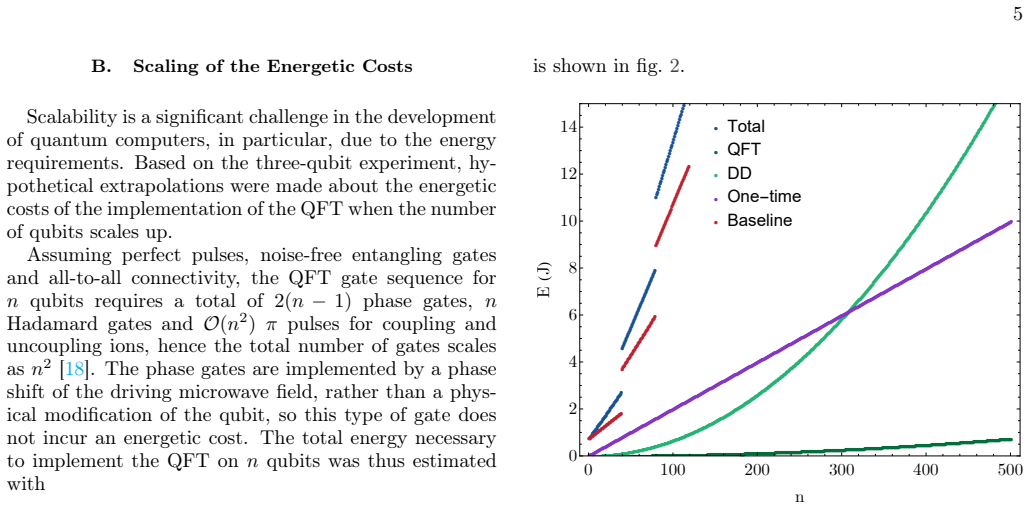
The scaling relation for total energetic cost with ion number, obtained by summing measured power contributions from Doppler cooling, sideband cooling, laser gates, and fluorescence detection in a trapped-ion apparatus.
If this is right
- Energetic quantum advantage against classical supercomputers becomes possible at smaller system sizes than runtime advantage.
- Total energy per computation, rather than gate count alone, sets a practical limit on NISQ scalability.
- Component-level budgeting (cooling, lasers, detection) becomes a necessary design step for any energetic-advantage claim.
- The same breakdown can be repeated for other algorithms once their gate sequences are mapped to the same hardware.
Where Pith is reading between the lines
- Energy accounting may become a standard benchmark alongside runtime and fidelity when comparing quantum platforms.
- If the scaling is confirmed, device designers could optimize cooling and detection power first to push the energetic threshold even lower.
- Similar component audits on superconducting or photonic processors would test whether the advantage threshold is platform-dependent.
Load-bearing premise
The measured energy costs per component on one trapped-ion machine can be extrapolated linearly or with a simple power law to larger but still NISQ-sized systems of the same type.
What would settle it
A direct measurement of wall-plug energy on a trapped-ion processor with 20–30 ions executing the quantum Fourier transform that lies more than a factor of two above or below the extrapolated curve would falsify the claimed threshold.
Figures



read the original abstract
The question of the energetic efficiency of quantum computers has gained increasing attention recently. A precise understanding of the resources required to operate a quantum computer with a targeted computational performance and how the energy requirements can impact the scalability is still missing. In this work, one implementation of the quantum Fourier transform algorithm in a trapped-ion setup was studied. The main focus was to obtain a theoretical characterization of the energetic costs of quantum computation, based on actual experimental measurements performed on a similar trapped-ion setup.The energetic cost of the computation was estimated by analyzing the components of the setup and all the steps involved, from the cooling and preparation of the ions to the execution of the algorithm and readout of the result. In the Noisy Intermediate-Scale Quantum regime, a potential scaling of the energetic costs was argued and used to find a possible threshold for an energetic quantum advantage against state-of-the-art classical supercomputers. Remarkably, this threshold appears to be lower than the one for which computational time advantage is expected.
Editorial analysis
A structured set of objections, weighed in public.
Referee Report
Summary. The manuscript analyzes the energetic costs of implementing the quantum Fourier transform on a trapped-ion platform. It decomposes the energy consumption across cooling, ion preparation, gate execution, and readout using experimental measurements from a similar (but not identical) trapped-ion apparatus, argues for a scaling relation in the NISQ regime, and derives a numerical threshold for energetic quantum advantage versus classical supercomputers that is stated to lie below the corresponding threshold for runtime advantage.
Significance. If the extrapolated scaling relation is shown to be robust, the work supplies a concrete, component-resolved estimate of energy requirements that could inform hardware design choices and highlights the possibility that energetic efficiency advantages precede computational time advantages. The explicit accounting of all operational steps is a methodological strength.
major comments (2)
- [NISQ scaling and threshold section] NISQ-regime scaling argument (the section deriving the energetic-cost scaling and the subsequent threshold calculation): the scaling relation and prefactors are obtained by fitting data from a similar but non-identical trapped-ion setup; the manuscript provides neither direct validation measurements on the QFT configuration under study nor a sensitivity analysis showing how variations in ion number, cooling parameters, or readout chain would shift the reported threshold. Because this extrapolated relation is the sole quantitative basis for the claimed energetic-advantage crossover point, the central numerical result lacks independent grounding.
- [threshold comparison paragraph] Threshold comparison paragraph: the statement that the energetic threshold is lower than the runtime threshold rests entirely on the above scaling; without an explicit propagation of the uncertainty arising from the non-identical hardware parameters, it is not possible to assess whether the inequality is robust or an artifact of the particular fit.
minor comments (2)
- Notation for energy components should be defined once in a table or equation block rather than re-introduced inline in multiple sections.
- The abstract states that the scaling was 'argued'; the corresponding section should explicitly label which quantities are taken from experiment, which are modeled, and which are extrapolated.
Simulated Author's Rebuttal
We thank the referee for the constructive feedback and for recognizing the explicit accounting of operational steps as a methodological strength. We address the two major comments point by point below and outline revisions that will strengthen the quantitative grounding of the scaling relation and threshold comparison.
read point-by-point responses
-
Referee: [NISQ scaling and threshold section] NISQ-regime scaling argument (the section deriving the energetic-cost scaling and the subsequent threshold calculation): the scaling relation and prefactors are obtained by fitting data from a similar but non-identical trapped-ion setup; the manuscript provides neither direct validation measurements on the QFT configuration under study nor a sensitivity analysis showing how variations in ion number, cooling parameters, or readout chain would shift the reported threshold. Because this extrapolated relation is the sole quantitative basis for the claimed energetic-advantage crossover point, the central numerical result lacks independent grounding.
Authors: We agree that the scaling is derived from measurements on a similar but non-identical apparatus and that direct validation on the exact QFT configuration is not provided. The chosen data set reflects representative values for ion number, laser cooling rates, gate durations, and readout fidelity that are standard in current trapped-ion experiments; the QFT circuit itself uses the same native gate set. In the revised manuscript we will add an explicit sensitivity analysis that varies ion number (N=10–100), cooling overhead, and readout-chain efficiency within experimentally reported ranges, showing the resulting spread in the energetic threshold. This will quantify how the crossover point shifts under plausible parameter variations and thereby provide additional grounding for the extrapolation. revision: yes
-
Referee: [threshold comparison paragraph] Threshold comparison paragraph: the statement that the energetic threshold is lower than the runtime threshold rests entirely on the above scaling; without an explicit propagation of the uncertainty arising from the non-identical hardware parameters, it is not possible to assess whether the inequality is robust or an artifact of the particular fit.
Authors: The comparison between energetic and runtime advantage thresholds is indeed based on the fitted scaling. In the revision we will propagate the uncertainties from the fit (including covariance of prefactors) together with the parameter variations introduced in the new sensitivity analysis. This will yield ranges or error bands on both thresholds, allowing a direct assessment of whether the energetic threshold remains below the runtime threshold across the explored parameter space. revision: yes
Circularity Check
No significant circularity in derivation chain; scaling extrapolation is an independent assumption, not a reduction by construction.
full rationale
The paper's central quantitative claim rests on an extrapolation of energetic scaling from measurements on a similar (but non-identical) trapped-ion apparatus to estimate a NISQ advantage threshold. This is presented as an argued scaling relation applied to the QFT implementation, not as a fitted parameter that is then renamed or re-derived as the output. No equations or steps reduce the threshold to the input data by definition (e.g., no self-definitional loop where the predicted ratio equals the fitted quantity). The derivation chain uses standard component accounting plus the extrapolation assumption; the latter may be weak or unvalidated but does not constitute circularity under the enumerated patterns. No self-citation load-bearing steps or ansatz smuggling are evident from the abstract and context. The result is therefore self-contained against external benchmarks for the purpose of this analysis.
Axiom & Free-Parameter Ledger
free parameters (1)
- energetic scaling factor with system size
axioms (1)
- domain assumption Energetic costs of the full experimental stack (cooling, preparation, gates, readout) can be accurately estimated from measurements on a similar trapped-ion apparatus.
Forward citations
Cited by 6 Pith papers
-
Magic states are rarely the best resource to optimize: An analytical tool for qubit resource estimation in concatenated codes
A closed-form resource estimation tool for concatenated quantum error correction reveals that magic-state operations rarely dominate qubit costs, with general optimizations providing orders-of-magnitude larger reducti...
-
Generalized multilevel amplitude damping channels and their thermodynamic performances
Introduces generalized multilevel amplitude damping channels and reports that their ergotropic capacitance is non-monotonic in bath temperature while iteration produces a Markovian Mpemba effect.
-
Energy shortcut of N-level quantum protocols by optimal control
QOSTE derives minimal-energy controls for N-level quantum protocols by finding geodesics in the rotating frame, yielding quadratic energy improvement over STA for long times.
-
Unveiling Energetic Advantage in Superconducting Cat-Qubits Quantum Computation
Energy modeling and parameter optimization for cat-qubit superconducting quantum computers performing semiclassical QFT with error correction indicates an energetic advantage over classical systems for more than 26 qu...
-
Optimizing resource allocation for accuracy in noisy variational quantum algorithms
A simulation-derived phenomenological model optimizes the trade-off between quantum circuit size and iteration count to minimize total gate operations for a desired accuracy in noisy VQE algorithms.
-
Energetics of Rydberg-atom Quantum Computing
Provides component-wise energy estimates for Rydberg quantum computers and reports a potential energy advantage over classical DFT execution for the Quantum Fourier Transform under ideal error-free conditions.
Reference graph
Works this paper leans on
-
[1]
Auffeves, Quantum technologies need a quantum en- ergy initiative, PRX Quantum3, 020101 (2022)
A. Auffeves, Quantum technologies need a quantum en- ergy initiative, PRX Quantum3, 020101 (2022)
work page 2022
-
[2]
D. Jaschke and S. Montangero, Is quantum computing green? An estimate for an energy-efficiency quantum ad- vantage (2022), arXiv:2205.12092
-
[3]
O. Abah, R. Puebla, A. Kiely, G. De Chiara, M. Pater- nostro, and S. Campbell, Energetic cost of quantum con- trol protocols, New Journal of Physics21, 103048 (2019)
work page 2019
-
[4]
Y. Guryanova, N. Friis, and M. Huber, Ideal projective measurements have infinite resource costs, Quantum4, 222 (2020)
work page 2020
-
[5]
J. Gea-Banacloche, Minimum energy requirements for quantum computation, Physical Review Letters 89, 217901 (2002)
work page 2002
- [6]
-
[7]
J. Stevens, D. Szombati, M. Maffei, C. Elouard, R. As- souly, N. Cottet, R. Dassonneville, Q. Ficheux, S. Zep- petzauer, A. Bienfait, A. Jordan, A. Auffèves, and B. Huard, Energetics of a single qubit gate, Physical Re- view Letters 129 (2022)
work page 2022
-
[8]
S. Silva Pratapsi, P. H. Huber, P. Barthel, S. Bose, C. Wunderlich, and Y. Omar, Classical half-adder using trapped-ion quantum bits: Toward energy-efficient com- putation, Applied Physics Letters123, 154003 (2023)
work page 2023
-
[9]
J. P. Moutinho, M. Pezzutto, S. S. Pratapsi, F. F. da Silva, S. De Franceschi, S. Bose, A. T. Costa, and Y. Omar, Quantum dynamics for energetic advantage in a charge-based classical full adder, PRX Energy 2, 033002 (2023)
work page 2023
- [10]
-
[11]
M. J. Martin, C. Hughes, G. Moreno, E. B. Jones, D.Sickinger, S.Narumanchi,andR.Grout,Energyusein quantum data centers: Scaling the impact of computer architecture, qubit performance, size, and thermal pa- rameters, IEEE Transactions on Sustainable Computing 7, 864 (2022)
work page 2022
-
[12]
G. T. Landi, A. L. F. de Oliveira, and E. Buksman, Ther- modynamic analysis of quantum error-correcting engines, Physical Review A101, 042106 (2020)
work page 2020
-
[13]
M. Fellous-Asiani, J. H. Chai, Y. Thonnart, H. K. Ng, R. S. Whitney, and A. Auffèves, Optimizing resource effi- ciencies for scalable full-stack quantum computers, PRX Quantum 4, 040319 (2023)
work page 2023
- [14]
- [15]
-
[17]
A. Khromova, C. Piltz, B. Scharfenberger, T. F. Gloger, M. Johanning, A. F. Varón, and C. Wunderlich, Designer spin pseudomolecule implemented with trapped ions in a 8 magnetic gradient, Phys. Rev. Lett.108, 220502 (2012)
work page 2012
-
[18]
S. S. Ivanov, M. Johanning, and C. Wunderlich, Sim- plified implementation of the quantum fourier transform with ising-type hamiltonians: Example with ion traps, arXiv preprint arXiv:1503.08806 (2015)
work page internal anchor Pith review Pith/arXiv arXiv 2015
-
[19]
F. Mintert and C. Wunderlich, Ion-trap quantum logic using long-wavelength radiation, Phys. Rev. Lett. 87, 257904 (2001)
work page 2001
-
[20]
C. D. Bruzewicz, J. Chiaverini, R. McConnell, and J. M. Sage, Trapped-ion quantum computing: Progress and challenges, Applied Physics Reviews6 (2019)
work page 2019
-
[21]
Top 500 project, https://www.top500.org/project/, accessed: April 2024
work page 2024
-
[22]
C. Gidney and M. Ekerå, How to factor 2048 bit rsa in- tegers in 8 hours using 20 million noisy qubits, Quantum 5, 433 (2021)
work page 2048
-
[23]
J. Preskill, Lecture notes for physics 219: Quantum com- putation, California Institute of Technology (2024)
work page 2024
-
[24]
S. Majumder, C. G. Yale, T. D. Morris, D. S. Lobser, A. D. Burch, M. N. Chow, M. C. Revelle, S. M. Clark, andR.C.Pooser,Characterizingandmitigatingcoherent errors in a trapped ion quantum processor using hidden inverses, Quantum7, 1006 (2023). Appendix A: Quantum F ourier T ransform Simulation To validate the gate sequence (11) in performing a QFT, a simu...
work page 2023
-
[25]
Circuit simulation TheoperationthatrealizestheQFT,appliedtoagiven input state |ψ⟩, is given by |ψ⟩ 7→ SW AP13 · U opt QFT |ψ⟩ . (A1) This operation was simulated numerically by applying the gate sequence SW AP13 · U opt QFT to the input states |ψ⟩ ∈ {| 111⟩ , |+11⟩ , |+ + 1⟩ , |+ + +⟩}, represented by the respective state vectors. The output state was giv...
-
[26]
To simulate these effects, different noise models were used
Noisy simulations Experimental imperfections in the setup introduce er- rors that affect the performance of the QFT. To simulate these effects, different noise models were used. Coherent errors were introduced in the simulation with an ion-trap model of noisy phased rotations parameter- ized by an over-rotation error,ε, and a detuning error,δ [24]. In thi...
discussion (0)
Sign in with ORCID, Apple, or X to comment. Anyone can read and Pith papers without signing in.