Existence of nonlinearly scalarized black holes in Einstein-scalar-Gauss-Bonnet theory with polynomial couplings
Pith reviewed 2026-05-24 01:47 UTC · model grok-4.3
The pith
Nonlinearly scalarized black holes exist for polynomial couplings with ζ''(0)=0 in Einstein-scalar-Gauss-Bonnet theory.
A machine-rendered reading of the paper's core claim, the machinery that carries it, and where it could break.
Core claim
In Einstein-scalar-Gauss-Bonnet theory with polynomial coupling functions ζ(φ) satisfying ζ''(0)=0, where ζ'(φ)=0 admits nonzero constant solutions φ_s, nonlinearly scalarized black holes exist as solution branches. For ζ(φ)=αφ^4−βφ^8 and ζ(φ)=αφ^4−βφ^6, Schwarzschild black holes become unstable above threshold Gaussian pulse amplitudes and transition to scalarized states, while for ζ(φ)=αφ^4 they remain stable. The term ζ(φ)R_GB^2 functions as an effective potential that accounts for plateaus and divergences in the evolution. Branches constructed in the probe limit display universal features, whereas inclusion of backreaction produces a distinct dependence on the coupling strength β.
What carries the argument
Polynomial coupling functions ζ(φ) with ζ''(0)=0 that admit constant scalar solutions φ_s ≠ 0, used to construct branches of nonlinearly scalarized black holes in the probe limit and with backreaction.
If this is right
- Schwarzschild black holes are unstable to scalarization above threshold Gaussian pulse amplitudes for the couplings αφ^4−βφ^8 and αφ^4−βφ^6.
- Solution branches of nonlinearly scalarized black holes exhibit universal patterns in the probe limit.
- With backreaction included, the solution branches show a distinct dependence on the coupling strength β.
- The coupling term ζ(φ)R_GB^2 treated as an effective potential explains plateaus and divergences seen in the time evolution.
Where Pith is reading between the lines
- The requirement that the coupling admit constant nonzero scalar solutions may generalize to other curvature-based modifications of gravity.
- Different choices of the higher-order coefficients in the polynomial could systematically control the number and stability of scalarized branches.
- The observed universal features in the probe limit suggest that backreaction effects could be approximated perturbatively for small β.
Load-bearing premise
The polynomial coupling functions are chosen such that their second derivative vanishes at zero and they admit nonzero constant scalar solutions.
What would settle it
Failure to numerically locate scalarized black hole branches for the couplings ζ(φ)=αφ^4−βφ^8 and ζ(φ)=αφ^4−βφ^6 in either the probe limit or with backreaction would falsify the existence claim.
Figures




read the original abstract
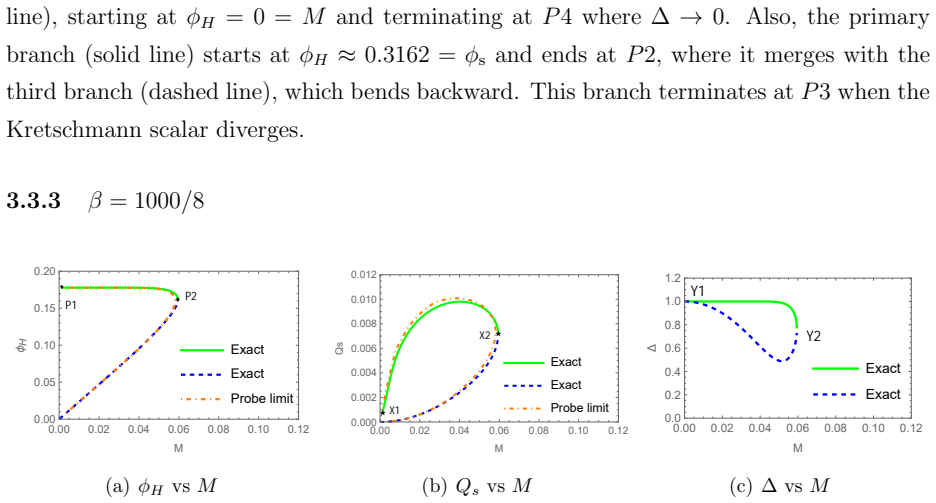
Nonlinearly scalarized black holes are investigated in Einstein-scalar-Gauss-Bonnet (EsGB) theory with polynomial coupling functions $\zeta(\phi)$ satisfying $\zeta''(0) = 0$, where $\zeta'(\phi) = 0$ features besides $\phi=0$ solutions with constant $\phi_{\rm s} \ne 0$. We determine the threshold amplitudes for Gaussian pulses, above which Schwarzschild black holes (SBHs) %become unstable and may transition to scalarized black holes for two coupling functions: $\zeta(\phi)=\alpha\phi^4-\beta\phi^8$ and $\zeta(\phi)=\alpha\phi^4-\beta\phi^6$. In contrast, for the quartic coupling function $\zeta(\phi)=\alpha\phi^4$ SBHs are stable. Treating $\zeta(\phi)R_{GB}^2$ as an effective potential $V_\text{eff}$ provides an explanation for the ``plateau" and the divergence observed in the time evolution. We then construct the branches of nonlinearly scalarized black holes in the probe limit and with backreaction. While the pattern of the solution branches in the probe limit exhibits universal features, the presence of backreaction reveals a distinct dependence on the coupling strength $\beta$.
Editorial analysis
A structured set of objections, weighed in public.
Referee Report
Summary. The manuscript investigates nonlinear scalarization of Schwarzschild black holes in Einstein-scalar-Gauss-Bonnet theory for two explicit polynomial couplings, ζ(φ)=αφ⁴−βφ⁸ and ζ(φ)=αφ⁴−βφ⁶, chosen so that ζ''(0)=0 while ζ'(φ)=0 admits nonzero constant roots φ_s. It reports threshold amplitudes for Gaussian initial data above which time evolution produces scalarized solutions, uses an effective-potential interpretation for observed plateaus and divergences, and constructs the corresponding static branches both in the probe limit (universal pattern) and with backreaction (β-dependent). The pure quartic coupling yields stable Schwarzschild solutions.
Significance. If the numerical constructions hold, the work supplies concrete existence results for nonlinearly scalarized black holes in EsGB theory outside the linear tachyonic regime. The contrast between universal probe-limit branches and backreaction-induced β dependence, together with the effective-potential heuristic, provides useful interpretive insight. The paper earns credit for explicit branch construction in both limits and for restricting attention to couplings that satisfy the stated algebraic conditions rather than claiming generality.
minor comments (3)
- The abstract states that thresholds and branches are determined numerically, yet the manuscript does not appear to include a dedicated methods subsection specifying the discretization scheme, grid resolution, convergence tests, or error estimates used for the time evolutions and static solutions; adding this would strengthen verifiability of the central existence claims.
- Figure captions and text should explicitly state the ranges of α and β explored and whether results are shown for representative values or across a scan; this affects assessment of the reported β dependence with backreaction.
- The phrase 'universal features' in the probe-limit branch pattern is used without a precise definition; a short clarification of what is meant by universality (e.g., independence of β or scaling collapse) would improve clarity.
Simulated Author's Rebuttal
We thank the referee for the positive assessment of our manuscript and the recommendation for minor revision. The referee's summary correctly captures the scope and results of the work on nonlinear scalarization in EsGB theory with the specified polynomial couplings.
Circularity Check
No significant circularity; numerical constructions are independent of inputs
full rationale
The paper selects explicit polynomial couplings satisfying ζ''(0)=0 and admitting nonzero constant roots of ζ'(φ) as model setup, then numerically evolves Gaussian pulses to find instability thresholds and constructs static branches in probe limit and with backreaction. These steps solve the field equations directly for the chosen ζ(φ); no parameter is fitted to a data subset and then relabeled as a prediction, no result is defined in terms of itself, and no load-bearing uniqueness theorem or ansatz is imported via self-citation. The reported universal probe-limit patterns and β-dependent backreaction effects follow from the explicit integrations rather than reducing to the input assumptions by construction.
Axiom & Free-Parameter Ledger
free parameters (2)
- α
- β
axioms (1)
- domain assumption The theory is defined by the Einstein-scalar-Gauss-Bonnet action with polynomial coupling ζ(φ)
Forward citations
Cited by 2 Pith papers
-
Spin-Induced Nonlinear Scalarization of Kerr Black Holes in Einstein-scalar-Gauss-Bonnet Gravity
Kerr black holes in an EsGB model without linear instability undergo nonlinear scalarization above spin 0.5, existing in a finite low-mass high-spin wedge rather than a narrow band.
-
Thermodynamics and phase transitions of nonlinearly scalarized black holes in Einstein-scalar-Gauss-Bonnet theory
Nonlinearly scalarized black holes in Einstein-scalar-Gauss-Bonnet theory undergo a first-order phase transition from Schwarzschild black holes with non-zero latent heat.
Reference graph
Works this paper leans on
-
[1]
Exact solutions of Einstein conformal scalar equations,
J. D. Bekenstein, “Exact solutions of Einstein conformal scalar equations,” Annals Phys.82, 535 (1974)
work page 1974
-
[2]
Black Holes with Scalar Charge,
J. D. Bekenstein, “Black Holes with Scalar Charge,” Annals Phys.91, 75 (1975)
work page 1975
-
[3]
Instability of Black Holes with Scalar Charge,
K. A. Bronnikov and Y. .N. Kireev, “Instability of Black Holes with Scalar Charge,” Phys. Lett. A67, 95 (1978)
work page 1978
-
[4]
Novel ‘‘no-scalar-hair’’ theorem for black holes,
J. D. Bekenstein, “Novel ‘‘no-scalar-hair’’ theorem for black holes,” Phys. Rev. D51 (1995) no.12, R6608
work page 1995
-
[5]
C. A. R. Herdeiro and E. Radu, Int. J. Mod. Phys. D24, no.09, 1542014 (2015) [arXiv:1504.08209 [gr-qc]]
work page internal anchor Pith review Pith/arXiv arXiv 2015
-
[6]
Nonperturbative strong field effects in tensor - scalar theories of gravitation,
T. Damour and G. Esposito-Farese, “Nonperturbative strong field effects in tensor - scalar theories of gravitation,” Phys. Rev. Lett.70(1993), 2220-2223
work page 1993
-
[7]
D. D. Doneva and S. S. Yazadjiev, “New Gauss-Bonnet Black Holes with Curvature- Induced Scalarization in Extended Scalar-Tensor Theories,” Phys. Rev. Lett.120, no.13, 131103 (2018) [arXiv:1711.01187 [gr-qc]]
work page internal anchor Pith review Pith/arXiv arXiv 2018
-
[8]
Spontaneous scalarization of black holes and compact stars from a Gauss-Bonnet coupling
H. O. Silva, J. Sakstein, L. Gualtieri, T. P. Sotiriou and E. Berti, “Spontaneous scalar- ization of black holes and compact stars from a Gauss-Bonnet coupling,” Phys. Rev. Lett.120, no.13, 131104 (2018) [arXiv:1711.02080 [gr-qc]]
work page internal anchor Pith review Pith/arXiv arXiv 2018
-
[9]
Evasion of No-Hair Theorems and Novel Black-Hole Solutions in Gauss-Bonnet Theories
G. Antoniou, A. Bakopoulos and P. Kanti, “Evasion of No-Hair Theorems and Novel Black-Hole Solutions in Gauss-Bonnet Theories,” Phys. Rev. Lett.120, no.13, 131102 (2018) [arXiv:1711.03390 [hep-th]]
work page internal anchor Pith review Pith/arXiv arXiv 2018
-
[10]
Black-Hole Solutions with Scalar Hair in Einstein-Scalar-Gauss-Bonnet Theories
G. Antoniou, A. Bakopoulos and P. Kanti, “Black-Hole Solutions with Scalar Hair in Einstein-Scalar-Gauss-Bonnet Theories,” Phys. Rev. D97(2018) no.8, 084037 [arXiv:1711.07431 [hep-th]]
work page internal anchor Pith review Pith/arXiv arXiv 2018
-
[11]
J. L. Bl´ azquez-Salcedo, D. D. Doneva, J. Kunz and S. S. Yazadjiev, Phys. Rev. D98, 084011 (2018) [arXiv:1805.05755 [gr-qc]]. 24
work page internal anchor Pith review Pith/arXiv arXiv 2018
-
[12]
Gregory-Laflamme instability of black hole in Einstein-scalar-Gauss-Bonnet theories
Y. S. Myung and D. C. Zou, “Gregory-Laflamme instability of black hole in Einstein-scalar-Gauss-Bonnet theories,” Phys. Rev. D98, no. 2, 024030 (2018) [arXiv:1805.05023 [gr-qc]]
work page internal anchor Pith review Pith/arXiv arXiv 2018
-
[13]
H. O. Silva, C. F. B. Macedo, T. P. Sotiriou, L. Gualtieri, J. Sakstein and E. Berti, Phys. Rev. D99, 064011 (2019) [arXiv:1812.05590 [gr-qc]]
work page internal anchor Pith review Pith/arXiv arXiv 2019
-
[14]
C. F. B. Macedo, J. Sakstein, E. Berti, L. Gualtieri, H. O. Silva and T. P. Sotiriou, Phys. Rev. D99, 104041 (2019) [arXiv:1903.06784 [gr-qc]]
work page internal anchor Pith review Pith/arXiv arXiv 2019
-
[15]
P. V. P. Cunha, C. A. R. Herdeiro and E. Radu, Phys. Rev. Lett.123, 011101 (2019) [arXiv:1904.09997 [gr-qc]]
work page internal anchor Pith review Pith/arXiv arXiv 2019
- [16]
- [17]
- [18]
- [19]
- [20]
- [21]
- [22]
- [23]
- [24]
-
[25]
Spontaneous scalarisation of charged black holes
C. A. R. Herdeiro, E. Radu, N. Sanchis-Gual and J. A. Font, “Spontaneous Scalar- ization of Charged Black Holes,” Phys. Rev. Lett.121, no.10, 101102 (2018) [arXiv:1806.05190 [gr-qc]]
work page internal anchor Pith review Pith/arXiv arXiv 2018
-
[26]
Spontaneous Scalarisation of Charged Black Holes: Coupling Dependence and Dy- namical Features,
P. G. S. Fernandes, C. A. R. Herdeiro, A. M. Pombo, E. Radu and N. Sanchis-Gual, “Spontaneous Scalarisation of Charged Black Holes: Coupling Dependence and Dy- namical Features,” Class. Quant. Grav.36(2019) no.13, 134002 [erratum: Class. Quant. Grav.37(2020) no.4, 049501] [arXiv:1902.05079 [gr-qc]]
-
[27]
Instability of Reissner-Nordstr\"{o}m black hole in Einstein-Maxwell-scalar theory
Y. S. Myung and D. C. Zou, “Instability of Reissner–Nordstr¨ om black hole in Einstein- Maxwell-scalar theory,” Eur. Phys. J. C79, no. 3, 273 (2019) [arXiv:1808.02609 [gr- qc]]
work page internal anchor Pith review Pith/arXiv arXiv 2019
-
[28]
D. C. Zou and Y. S. Myung, “Radial perturbations of the scalarized black holes in Einstein-Maxwell-conformally coupled scalar theory,” Phys. Rev. D102, no. 6, 064011 (2020) [arXiv:2005.06677 [gr-qc]]
-
[29]
Quasinormal modes of scalarized black holes in the Einstein-Maxwell-Scalar theory
Y. S. Myung and D. C. Zou, “Quasinormal modes of scalarized black holes in the Einstein–Maxwell–Scalar theory,” Phys. Lett. B790(2019), 400-407 [arXiv:1812.03604 [gr-qc]]
work page internal anchor Pith review Pith/arXiv arXiv 2019
- [30]
- [31]
-
[32]
Scalarization of planar anti–de Sitter charged black holes in Einstein-Maxwell-scalar theory,
C. Promsiri, T. Tangphati, E. Hirunsirisawat and S. Ponglertsakul, “Scalarization of planar anti–de Sitter charged black holes in Einstein-Maxwell-scalar theory,” Phys. Rev. D108(2023) no.2, 024015 [arXiv:2302.04654 [gr-qc]]
-
[33]
D. D. Doneva and S. S. Yazadjiev, “Beyond the spontaneous scalarization: New fully nonlinear mechanism for the formation of scalarized black holes and its dynamical development,” Phys. Rev. D105(2022) no.4, L041502 [arXiv:2107.01738 [gr-qc]]
-
[34]
S. J. Zhang, “Nonlinear instability and scalar clouds of spherical exotic compact objects in scalar-Gauss-Bonnet theory,” Eur. Phys. J. C83(2023) no.10, 950 [arXiv:2304.08092 [gr-qc]]. 26
-
[35]
Mixed scalarization of charged black holes: From spontaneous to nonlinear scalarization,
Z. Belkhadria and A. M. Pombo, “Mixed scalarization of charged black holes: From spontaneous to nonlinear scalarization,” Phys. Rev. D110(2024) no.4, 044014 [arXiv:2311.15850 [gr-qc]]
-
[36]
J. L. Bl´ azquez-Salcedo, D. D. Doneva, J. Kunz and S. S. Yazadjiev, Phys. Rev. D105, 124005 (2022)
work page 2022
-
[37]
Effects of mass and self-interaction on nonlinear scalarization of scalar-Gauss-Bonnet black holes,
A. M. Pombo and D. D. Doneva, “Effects of mass and self-interaction on nonlinear scalarization of scalar-Gauss-Bonnet black holes,” Phys. Rev. D108(2023) no.12, 124068 [arXiv:2310.08638 [gr-qc]]
-
[38]
Nonlinear black hole scalarization in multi-scalar Gauss-Bonnet gravity,
K. V. Staykov and D. D. Doneva, “Nonlinear black hole scalarization in multi-scalar Gauss-Bonnet gravity,” J. Phys. Conf. Ser.2719(2024) no.1, 012007
work page 2024
-
[39]
Multiscalar Gauss-Bonnet gravity: Scalarized black holes beyond spontaneous scalarization,
K. V. Staykov and D. D. Doneva, “Multiscalar Gauss-Bonnet gravity: Scalarized black holes beyond spontaneous scalarization,” Phys. Rev. D106(2022) no.10, 104064 [arXiv:2209.01038 [gr-qc]]
-
[40]
Nonlinear scalar- ization of Schwarzschild black holes in scalar-torsion teleparallel gravity,
P. A. Gonz´ alez, E. Papantonopoulos, J. Robledo and Y. V´ asquez, “Nonlinear scalar- ization of Schwarzschild black holes in scalar-torsion teleparallel gravity,” Phys. Rev. D111(2025) no.4, 044064 [arXiv:2407.13557 [gr-qc]]
-
[41]
Spontaneous nonlinear scalarization of Kerr black holes,
D. D. Doneva, L. G. Collodel and S. S. Yazadjiev, “Spontaneous nonlinear scalarization of Kerr black holes,” Phys. Rev. D106(2022) no.10, 104027 [arXiv:2208.02077 [gr-qc]]
-
[42]
Nonlinearly scalarized rotating black holes in Einstein-scalar-Gauss-Bonnet theory,
M. Y. Lai, D. C. Zou, R. H. Yue and Y. S. Myung, “Nonlinearly scalarized rotating black holes in Einstein-scalar-Gauss-Bonnet theory,” Phys. Rev. D108(2023) no.8, 084007 [arXiv:2304.08012 [gr-qc]]
-
[43]
Non-linearly scalarized supermassive black holes,
S. Liu, Y. Liu, Y. Peng and C. Y. Zhang, “Non-linearly scalarized supermassive black holes,” Eur. Phys. J. C85(2025) no.12, 1370 [arXiv:2509.17892 [gr-qc]]
-
[44]
The rotating solutions beyond the spontaneous scalarization in Einstein-Maxwell-scalar theory,
W. Xiong, C. Y. Zhang and P. C. Li, “The rotating solutions beyond the spontaneous scalarization in Einstein-Maxwell-scalar theory,” [arXiv:2312.11879 [gr-qc]]
-
[45]
Action Integrals and Partition Functions in Quantum Gravity,
G. W. Gibbons and S. W. Hawking, “Action Integrals and Partition Functions in Quantum Gravity,” Phys. Rev. D15(1977), 2752-2756 27
work page 1977
-
[46]
Black holes in the Einstein-Born-Infeld- Weyl gravity,
D. C. Zou, C. Wu, M. Zhang and R. H. Yue, “Black holes in the Einstein-Born-Infeld- Weyl gravity,” EPL128(2019) no.4, 40006
work page 2019
-
[47]
Phase transitions of scalarized Einstein-scalar-Gauss-Bonnet Black Holes,
C. Herdeiro, H. Huang, J. Kunz, M.-Y. Lai, E. Radu, D.-C. Zou, “Phase transitions of scalarized Einstein-scalar-Gauss-Bonnet Black Holes,” in preparation 28
discussion (0)
Sign in with ORCID, Apple, or X to comment. Anyone can read and Pith papers without signing in.