REVIEW 2 major objections 2 minor 2 cited by
Neural Surface Reconstruction from Sparse Views Using Epipolar Geometry
T0 review · 2 major / 2 minor · reviewed 2026-05-24 · grok-4.3
Pith's one-line read EpiS reconstructs surfaces from sparse multi-view images by guiding fine-grained epipolar feature aggregation with coarse cost-volume features.
desk verdict EpiS uses cost-volume-guided epipolar sampling plus monocular depth reg to target over-smoothing in sparse-view SDF recon, but the monocular step is the part that needs checking. read the letter →
The pith
A machine-rendered reading of the paper's core claim, the machinery that carries it, and where it could break.
The reading
What carries the argument
Epipolar feature aggregation guided by cost-volume features, which samples and fuses view-dependent geometry along epipolar lines before producing SDF-aware outputs.
What would settle it
On the DTU dataset using three input views, EpiS produces higher Chamfer distance or lower F-score than prior generalizable cost-volume baselines.
Extended reading notes
Core claim
The authors present EpiS as a generalizable framework that uses coarse cost-volume features to guide aggregation of fine-grained epipolar features sampled along corresponding epipolar lines across source views. An epipolar transformer fuses the multi-view information, followed by ray-wise aggregation to produce SDF-aware features for surface estimation. A geometry regularization strategy that leverages a pretrained monocular depth model through scale-invariant global and local constraints further mitigates information loss under sparse views.
Load-bearing premise
Coarse cost-volume features can reliably guide fine-grained epipolar feature aggregation while a pretrained monocular depth model supplies unbiased scale-invariant constraints that align with multi-view epipolar geometry.
Editorial extensions
If this is right
- Outperforms state-of-the-art generalizable surface reconstruction methods on DTU and BlendedMVS under sparse-view settings.
- Maintains strong generalization without per-scene optimization.
- Reduces over-smoothing by preserving view-dependent geometric structure that simple cost-volume statistics discard.
- Handles occlusions and geometric ambiguity more effectively through explicit epipolar sampling and depth-based regularization.
Reading between the lines
- The hybrid cost-volume plus epipolar strategy could transfer to other sparse multi-view tasks such as depth estimation or novel-view synthesis.
- Similar monocular priors might regularize reconstruction in dynamic or non-rigid scenes where epipolar consistency still holds across frames.
- The design implies that learned priors aligned with epipolar geometry can substitute for additional views in extremely sparse regimes.
Editorial analysis
A structured set of objections, weighed in public.
Referee Report
Summary. The paper proposes EpiS, a generalizable neural surface reconstruction framework for sparse multi-view inputs. It replaces direct regression from cost-volume statistics with coarse cost-volume features guiding aggregation of fine-grained epipolar features sampled along epipolar lines, fused via an epipolar transformer and ray-wise aggregation to produce SDF-aware features. A geometry regularization strategy adds scale-invariant global and local constraints from a pretrained monocular depth model. Experiments on DTU and BlendedMVS report significant outperformance over prior generalizable methods under sparse views without per-scene optimization.
Significance. If the reported gains hold after verification of implementation details and ablations, the explicit use of epipolar geometry for feature aggregation combined with monocular regularization could advance sparse-view surface reconstruction by preserving view-dependent structure that simple cost-volume statistics discard.
major comments (2)
- [Abstract] Abstract (geometry regularization strategy paragraph): The central performance claim depends on the monocular depth constraints supplying unbiased signals that align with multi-view epipolar geometry after scale normalization. No analysis or test is described showing that systematic errors in the pretrained model (e.g., in low-texture or view-dependent regions under 3-view DTU/BlendedMVS protocols) do not pull ray-wise SDF features toward inconsistent surfaces, which directly risks undermining the reported gains over cost-volume baselines.
- [Method] Method description (epipolar feature aggregation): The claim that coarse cost-volume features reliably guide fine-grained epipolar aggregation is load-bearing for the outperformance result, yet the manuscript provides no quantitative measure (e.g., alignment error or ablation removing the guidance) of how well this guidance functions when the cost volume itself is severely under-constrained by only three views.
minor comments (2)
- [Abstract] The abstract and method sections use 'SDF-aware features' without an explicit definition or equation linking the ray-wise aggregation output to the signed distance function used for surface extraction.
- [Experiments] Dataset splits, number of views (e.g., exact 3-view protocol), and whether error bars or multiple runs are reported are not mentioned in the provided abstract; these details are needed for reproducibility of the 'significantly outperforms' claim.
Simulated Author's Rebuttal
We thank the referee for the constructive feedback highlighting two important aspects of our method that warrant further clarification. We address each major comment below and indicate where revisions will be made.
read point-by-point responses
-
Referee: [Abstract] Abstract (geometry regularization strategy paragraph): The central performance claim depends on the monocular depth constraints supplying unbiased signals that align with multi-view epipolar geometry after scale normalization. No analysis or test is described showing that systematic errors in the pretrained model (e.g., in low-texture or view-dependent regions under 3-view DTU/BlendedMVS protocols) do not pull ray-wise SDF features toward inconsistent surfaces, which directly risks undermining the reported gains over cost-volume baselines.
Authors: We agree that an explicit analysis of potential systematic biases in the pretrained monocular depth model under the 3-view protocols would strengthen the paper. The scale-invariant global and local constraints are intended to reduce sensitivity to absolute scale and local inconsistencies, and the reported gains over pure cost-volume baselines on both DTU and BlendedMVS provide indirect evidence that any residual biases do not dominate. Nevertheless, we will add a dedicated paragraph in the revised manuscript discussing known limitations of monocular depth estimators in low-texture and view-dependent regions, together with qualitative visualizations of the depth predictions used during training on the evaluation scenes. revision: partial
-
Referee: [Method] Method description (epipolar feature aggregation): The claim that coarse cost-volume features reliably guide fine-grained epipolar aggregation is load-bearing for the outperformance result, yet the manuscript provides no quantitative measure (e.g., alignment error or ablation removing the guidance) of how well this guidance functions when the cost volume itself is severely under-constrained by only three views.
Authors: The guidance mechanism is indeed central. While the current manuscript does not report a direct alignment-error metric between coarse cost-volume features and the sampled epipolar features, the ablation studies already isolate the contribution of the epipolar transformer and ray-wise aggregation. To directly quantify the guidance quality under three-view sparsity, we will add a new ablation that replaces the learned guidance with uniform or random sampling along epipolar lines and report the resulting surface reconstruction metrics on DTU. revision: yes
Circularity Check
No circularity: derivation uses external epipolar geometry and pretrained monocular model without self-referential reduction
full rationale
The paper's central claims rest on standard external components (epipolar geometry for feature aggregation along lines, coarse cost-volume guidance, and scale-invariant constraints from a pretrained monocular depth model) that are not defined in terms of the method's outputs or fitted parameters. No equations, self-citations, or uniqueness theorems are presented that reduce the performance gains or regularization strategy to a fit or renaming of the inputs themselves. The abstract and description treat these as independent priors, making the derivation self-contained against external benchmarks.
Assumptions & free parameters
Cite this review
Pith. "Pith review of Neural Surface Reconstruction from Sparse Views Using Epipolar Geometry." pith.science (2026). https://pith.science/paper/4EZO73MZ
@misc{pith2026240604301,
  author       = {Pith},
  title        = {Pith review of: Neural Surface Reconstruction from Sparse Views Using Epipolar Geometry},
  year         = {2026},
  howpublished = {\url{https://pith.science/paper/4EZO73MZ}},
  note         = {Machine review of arXiv:2406.04301}
}
read the original abstract
Reconstructing accurate surfaces from sparse multi-view images remains challenging due to severe geometric ambiguity and occlusions. Existing generalizable neural surface reconstruction methods primarily rely on cost volumes that summarize multi-view features using simple statistics (e.g., mean and variance), which discard critical view-dependent geometric structure and often lead to over-smoothed reconstructions. We propose EpiS, a generalizable neural surface reconstruction framework that explicitly leverages epipolar geometry for sparse-view inputs. Instead of directly regressing geometry from cost-volume statistics, EpiS uses coarse cost-volume features to guide the aggregation of fine-grained epipolar features sampled along corresponding epipolar lines across source views. An epipolar transformer fuses multi-view information, followed by ray-wise aggregation to produce SDF-aware features for surface estimation. To further mitigate information loss under sparse views, we introduce a geometry regularization strategy that leverages a pretrained monocular depth model through scale-invariant global and local constraints. Extensive experiments on DTU and BlendedMVS demonstrate that EpiS significantly outperforms state-of-the-art generalizable surface reconstruction methods under sparse-view settings, while maintaining strong generalization without per-scene optimization.
Figures
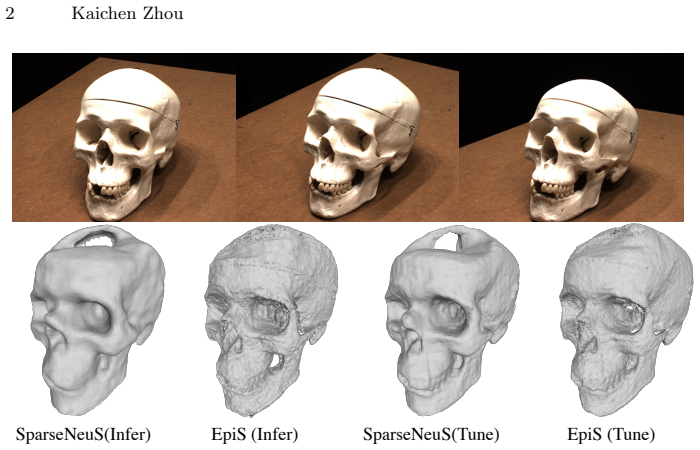


Figures from the paper (2 more)


Lean theorems connected to this paper
-
IndisputableMonolith/Cost/FunctionalEquation.leanwashburn_uniqueness_aczel unclear?
unclearRelation between the paper passage and the cited Recognition theorem.
EpiS uses coarse cost-volume features to guide the aggregation of fine-grained epipolar features sampled along corresponding epipolar lines... epipolar transformer fuses multi-view information, followed by ray-wise aggregation to produce SDF-aware features... geometry regularization strategy that leverages a pretrained monocular depth model through scale-invariant global and local constraints (global triplet loss, local gradient loss).
-
IndisputableMonolith/Foundation/AbsoluteFloorClosure.leanabsolute_floor_iff_bare_distinguishability unclear?
unclearRelation between the paper passage and the cited Recognition theorem.
Epipolar & Ray Information Aggregation... Linearized Attention mechanism... Geometry Decoder & Weights Decoder... Lglobal = ((d̂1 − d̂s) × (d̃2 − d̃s) − (d̂2 − d̂s) × (d̃1 − d̃s))², Llocal = (1 − v̂ · ṽ / ||v̂||·||ṽ||)²
What do these tags mean?
- matches
- The paper's claim is directly supported by a theorem in the formal canon.
- supports
- The theorem supports part of the paper's argument, but the paper may add assumptions or extra steps.
- extends
- The paper goes beyond the formal theorem; the theorem is a base layer rather than the whole result.
- uses
- The paper appears to rely on the theorem as machinery.
- contradicts
- The paper's claim conflicts with a theorem or certificate in the canon.
- unclear
- Pith found a possible connection, but the passage is too broad, indirect, or ambiguous to say the theorem truly supports the claim.
Forward citations
Cited by 2 Pith papers
-
Adversarial Activation Patching: A Framework for Detecting and Mitigating Emergent Deception in Safety-Aligned Transformers
A framework that borrows activation patching to adversarially induce and measure deception, supported only by an underspecified toy network simulation.
-
Sparse-View 3D Reconstruction: Recent Advances and Open Challenges
A comprehensive survey that organizes sparse-view 3D reconstruction methods into geometry-based, NeRF, 3DGS, and diffusion-based categories, with benchmarks and open challenges.
Reviewed May 24, 2026 · model on record in the stance chip above.
Discussion (0). Sign in to comment.