REVIEW 3 major objections 4 minor 1 cited by
Certified Learning of Incremental ISS Controllers for Unknown Nonlinear Polynomial Dynamics
T0 review · 3 major / 4 minor · reviewed 2026-08-11 · deepseek-v4-flash
Pith's one-line read The paper establishes that for continuous-time input-affine nonlinear systems with polynomial dynamics but unknown matrices A, B, and monomial map F, a δ-ISS Lyapunov function and controller can be designed directly from two recorded…
desk verdict A genuinely new two-trajectory delta-ISS synthesis result with a sound proof, but the existence condition secretly demands exact feedback linearization and the abstract overstates the scope. read the letter →
The pith
A machine-rendered reading of the paper's core claim, the machinery that carries it, and where it could break.
The reading
What carries the argument
The load-bearing object is the data-driven closed-loop representation of Lemma 3.2: from the recorded trajectories one has $X_{1,T} = A J_{0,T} + B U_{0,T}$ and $\tilde X_{1,T} = A \tilde J_{0,T} + B U_{0,T}$, and by choosing $G(x)$ with $J_{0,T} G(x) = \aleph(x)$, the unknown drift $AF(x) + Bu$ becomes $X_{1,T} G(x) x + B\hat u$. Here $\aleph(x)$ is the monomial factor matrix satisfying $F(x) = \aleph(x) x$, and full row-rank of the monomial data matrices $J_{0,T}$ and $\tilde J_{0,T}$ is the persistence-of-excitation condition that makes the factorization possible. The certificate itself is the simultaneous set of equalities and inequality in (12), which is posed as a sum-of-squares feasibility program over polynomial matrices $Y(x)$, $Y(\tilde x)$ and a constant matrix $\Sigma$, with $\Theta = P^{-1}$ required symmetric positive definite.
What would settle it
Record real trajectories of a known polynomial input-affine system using finite-difference derivative estimates, solve the SOS program for $P$ and $K(x)$, then test the closed loop under the true dynamics with a small difference between $\hat u$ and $\hat{\tilde u}$; if the state deviation fails to obey the δ-ISS bound, the exact-derivative equalities are load-bearing and the certificate is not noise-robust.
Extended reading notes
Core claim
The central claim is Theorem 3.5: for a continuous-time input-affine nonlinear system with polynomial dynamics whose matrices A, B and monomial map F are unknown, if recorded data satisfy conditions (12a)–(12e), then $V(x, \tilde x) = (x - \tilde x)^\top P (x - \tilde x)$ with $P \succ 0$ is a δ-ISS Lyapunov function and $u = U_{0,T} Y(x) P x + \hat u$ is a δ-ISS controller with respect to the external input $\hat u$. Conditions (12a)–(12b) match the data to the factorization $F(x) = \aleph(x) x$, conditions (12c)–(12d) force the sampled closed-loop drift on both trajectories to equal a common constant matrix $\Sigma$, and condition (12e) is a dissipation inequality that yields $\mathcal{L}V \le -\epsilon V + (\|B\|^2/\vartheta)|\hat u - \hat{\tilde u}|^2$. The theorem also states that when $\hat u = \hat{\tilde u}$, the closed loop is incrementally globally asymptotically stable. The proof replaces the unknown open-loop matrices with the data-driven representation $X_{1,T} G(x) x + B\hat u$ and then bounds the cross term with Young's inequality.
Load-bearing premise
The load-bearing premise is that the sampled state derivatives $X_{1,T}$ and $\tilde X_{1,T}$ are exact, noiseless data, because conditions (12c)–(12d) are equalities and any numerical differentiation or filtering error makes the certified inequality apply to a data set different from the one measured.
Editorial extensions
If this is right
- No system identification step is needed: the controller and Lyapunov function are read directly from two recorded trajectories and the corresponding derivative samples.
- The certificate is checkable by semidefinite programming, so the practical bottleneck is the size of the monomial dictionary rather than the dimension of the state alone.
- The designed controller guarantees a quantitative robustness bound: bounded differences between the external inputs $\hat u$ and $\hat{\tilde u}$ produce state deviations bounded by a class-K function of the input difference.
- When the external inputs coincide, all trajectories converge to each other, giving incremental global asymptotic stability for an unknown plant.
- The method works with an exaggerated dictionary containing the active monomials plus irrelevant terms, so exact knowledge of the dynamics is never required.
Reading between the lines
- The noiseless-derivative assumption is the practical bottleneck: applying finite differences to real sampled data will generally violate the exact equalities in (12c)–(12d), and a noise-aware reformulation would need to relax these to set-membership or robustness constraints.
- Full row-rank of $J_{0,T}$ and $\tilde J_{0,T}$ guarantees existence of some data factor $G(x)$, but it does not by itself certify global polynomial solutions $Y(x)$, $Y(\tilde x)$ to all of (12); feasibility of the SOS program is the real existence test.
- The same data representation could be adapted to certify other trajectory-pair properties, such as contraction or incremental dissipativity, by keeping (12a)–(12d) and only replacing the dissipation inequality (12e).
- Because the gain constant $\rho = \|B\|^2/\vartheta$ is never needed to construct the controller, the method never requires estimating $B$; if the gain value is later wanted, only an upper bound on the induced norm of $B$ is needed.
Editorial analysis
A structured set of objections, weighed in public.
Referee Report
Summary. The manuscript develops a direct data-driven method for synthesizing incremental input-to-state stability (delta-ISS) Lyapunov functions and controllers for continuous-time input-affine nonlinear systems with polynomial dynamics and unknown matrices A, B, and monomial dictionary F. The method collects two input-state trajectories, forms data matrices J0,T, J~0,T, X1,T, and X~1,T, and then enforces conditions (12a)-(12e) through a sum-of-squares program. Under these conditions, Theorem 3.5 proves that V(x,x~) = (x-x~)^T P (x-x~) is a delta-ISS Lyapunov function and that u = U0,T Y(x)P x + u-hat is the corresponding delta-ISS controller. A rotating rigid spacecraft example illustrates the approach. The algebraic derivation is internally valid, but the feasibility conditions are restrictive and are not implied by the stated data-rank assumption.
Significance. If the result holds, the paper provides a data-based certificate that bypasses system identification for a class of polynomial systems, and the proof is explicit and checkable. The main limitation is that conditions (12) effectively require exact feedback linearization of the drift, which is a strong structural assumption that the stated rank condition does not guarantee. The paper also assumes exact state derivatives and gives no verifiable characterization of the systems for which the SOS program is feasible. These issues limit the scope of the claim that delta-ISS is 'ensured' for unknown polynomial dynamics and need to be addressed.
major comments (3)
- [Section III, Theorem 3.5, conditions (12a)-(12d)] Conditions (12a)-(12d) force the closed-loop state matrix to be constant. Indeed, from (10), (12a), and (12c), one obtains (A*Aleph(x) + B*K(x)) P^{-1} = Sigma, so the closed-loop dynamics reduce to x_dot = Sigma P x + B*u-hat, which is an exact feedback linearization. Full row-rank of J0,T (Remark 3.3) does not imply that such a cancellation is possible. For example, the incrementally stabilizable system x_dot_1 = x_1^2 + x_2, x_dot_2 = u with B = [0;1]^T cannot satisfy (12), because the first row of A*Aleph(x) + B*K(x) is [x_1, 1] for any K(x) entering only the second channel. The abstract and Problem 2.4 claims that the method 'ensures' delta-ISS should therefore be qualified to the class of systems satisfying this hidden feedback-linearization condition.
- [Section III, Remark 3.1 and Theorem 3.5] Conditions (12c) and (12d) require the sampled derivative matrices X1,T and X~1,T to be exact. Remark 3.1 acknowledges that numerical differentiation or filtering introduces approximation errors but explicitly defers the noise analysis. Because the proof of Theorem 3.5 relies on the exact equalities (10) and (12c)-(12d), the 'certified' guarantee does not apply when derivatives are approximated by the procedures suggested in Remark 3.1. The paper should either provide a robustness result for bounded derivative errors or clearly restrict the certification claim to exact derivative measurements.
- [Section III, Theorem 3.5 and Algorithm 1] The theorem assumes the existence of global polynomial matrices Y(x) and Y(x~) satisfying (12a)-(12d), but no data-dependent condition beyond full row-rank is given that would certify this existence. Consequently, the SOS program in Algorithm 1 may be infeasible even when the rank condition is satisfied. The authors should provide a verifiable feasibility characterization or state explicitly that the method applies only when a solution to (12) is found.
minor comments (4)
- [Page 3, after Definition 2.1] The notation F(x) is used both for the true monomial vector and for an exaggerated dictionary; the overloading is acknowledged, but it would help to denote the dictionary explicitly (for example, F_d(x)) to avoid ambiguity in conditions (12).
- [Section IV, simulation setup] The input signal is typed as "sin 2(t)" and should be "sin^2(t)" for consistency with standard notation and the surrounding text.
- [Remark 3.4] Remark 3.4 states that a transformation matrix Aleph(x) can always be constructed, but this matrix is not unique; since conditions (12a)-(12b) depend on the chosen Aleph, the paper should discuss how the choice of Aleph affects feasibility.
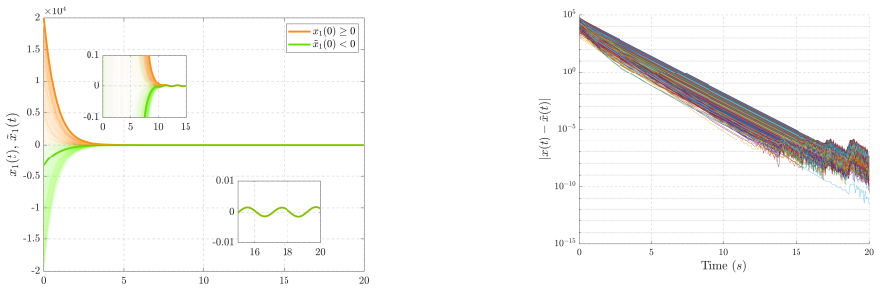
- [Figure 2] The y-axis label "Norm of the difference" is incomplete; it should specify which norm and between which trajectories (for example, |x(t)-x~(t)| in logarithmic scale).
Circularity Check
No significant circularity: the delta-ISS certificate is a conditional SOS search, not a fitted prediction.
full rationale
The derivation is conditional and non-circular. Lemma 3.2 uses the sampled data identity X1,T = A J0,T + B U0,T to replace the unknown open-loop dynamics in the closed-loop representation, after which Theorem 3.5 proves that feasibility of the SOS conditions (12a)-(12e) yields a quadratic delta-ISS Lyapunov function and a controller. The proof is a direct Lyapunov computation: conditions (12c)-(12d) force the data-driven closed-loop drift to the constant matrix Sigma, and (12e) then gives the dissipation inequality. The conclusion is not equivalent to the certificate by construction; the matrix conditions are stronger sufficient conditions, and neither P nor Sigma nor Y(x) is a parameter fitted to the output it later 'predicts'. The only self-citation is Angeli's classical Lyapunov criterion in [1], restated as Theorem 2.3, which is a standard external sufficient condition rather than a uniqueness claim or ansatz used to exclude alternatives. No load-bearing circularity is present.
Assumptions & free parameters
free parameters (2)
- epsilon =
0.9 in the simulation
- vartheta =
0.44 in the simulation
assumptions (5)
- domain assumption The system dynamics are exactly input-affine polynomial with a known or overapproximated monomial dictionary F and a known transformation matrix N(x) satisfying F(x)=N(x)x.
- domain assumption State derivatives in X1,T and X-tilde1,T are available exactly, or derivative estimation errors are negligible.
- ad hoc to paper The data matrix J0,T and J-tilde0,T have full row rank, and moreover there exist global polynomial matrices Y(x), Y(x-tilde) satisfying (12a)-(12d).
- domain assumption The same input sequence U0,T is applied in both data collection experiments, from different initial conditions.
- standard math The delta-ISS Lyapunov sufficient condition of Angeli [1] is accepted as the certification criterion.
Cite this review
Pith. "Pith review of Certified Learning of Incremental ISS Controllers for Unknown Nonlinear Polynomial Dynamics." pith.science (2026). https://pith.science/paper/EGYVWXBV
@misc{pith2026241203901,
  author       = {Pith},
  title        = {Pith review of: Certified Learning of Incremental ISS Controllers for Unknown Nonlinear Polynomial Dynamics},
  year         = {2026},
  howpublished = {\url{https://pith.science/paper/EGYVWXBV}},
  note         = {Machine review of arXiv:2412.03901}
}
read the original abstract
Incremental input-to-state stability (delta-ISS) offers a robust framework to ensure that small input variations result in proportionally minor deviations in the state of a nonlinear system. This property is essential in practical applications where input precision cannot be guaranteed. However, analyzing delta-ISS demands precise knowledge of system dynamics to assess the state's incremental response to input changes, posing a challenge in real-world scenarios where mathematical models are unknown. In this work, we develop a data-driven approach to design delta-ISS Lyapunov functions together with their corresponding delta-ISS controllers for continuous-time input-affine nonlinear systems with polynomial dynamics, ensuring the delta-ISS property is achieved without requiring knowledge of the system dynamics. In our data-driven scheme, we collect only two sets of input-state trajectories from sufficiently excited dynamics. By fulfilling a specific rank condition, we design delta-ISS controllers using the collected samples through formulating a sum-of-squares optimization program. The effectiveness of our data-driven approach is evidenced by its application to a physical case study.
Figures

Forward citations
Cited by 1 Pith paper
-
Learning k-Inductive Control Barrier Certificates for Unknown Nonlinear Dynamics Beyond Polynomials
A single trajectory of input-state data is enough to synthesize k-inductive safety certificates and controllers for unknown discrete-time nonlinear systems, including nonpolynomial ones.
Reference graph
Works this paper leans on
-
[19]
Data-driven stabilization of nonlinear polynomial systems with noisy data,
M. Guo, C. De Persis, and P. Tesi, “Data-driven stabilization of nonlinear polynomial systems with noisy data,” IEEE Transactions on Automatic Control, vol. 67, no. 8, pp. 4210–4217, 2021
2021
-
[28]
Data-driven input-to-state stabilization,
H. Chen, A. Bisoffi, and C. De Persis, “Data-driven input-to-state stabilization,” arXiv:2407.06044, 2024
arXiv 2024
-
[30]
M. Zaker, D. Angeli, and A. Lavaei, “Data-driven incremental GAS certificate of nonlinear homogeneous networks: A formal modular approach,” arXiv:2507.18141, 2025
work page Pith review arXiv 2025
-
[1]
A Lyapunov approach to incremental stability properties,
D. Angeli, “A Lyapunov approach to incremental stability properties,” IEEE Transactions on Automatic Control , vol. 47, no. 3, pp. 410–421, 2002
2002
-
[2]
Analysis of interconnected oscillators by dissipativity theory,
G.-B. Stan and R. Sepulchre, “Analysis of interconnected oscillators by dissipativity theory,” IEEE Transactions on Automatic Control , vol. 52, no. 2, pp. 256–270, 2007
work page 2007
-
[3]
Approximately bisimilar symbolic models for nonlinear control systems,
G. Pola, A. Girard, and P. Tabuada, “Approximately bisimilar symbolic models for nonlinear control systems,” Automatica, vol. 44, no. 10, pp. 2508–2516, 2008
2008
-
[4]
B. N. Bond, Z. Mahmood, Y . Li, R. Sredojevic, A. Megretski, V . Stojanovi, Y . Avniel, and L. Daniel, “Compact modeling of nonlinear analog circuits using system identification via semidefinite programming and incremental stability certification,” IEEE Transactions on Computer-Aided Design of Integrated Circuits and Systems , vol. 29, no. 8, pp. 1149–1162, 2010
work page 2010
-
[5]
Global state synchronization in networks of cyclic feedback systems,
A. Hamadeh, G.-B. Stan, R. Sepulchre, and J. Gonçalves, “Global state synchronization in networks of cyclic feedback systems,” IEEE Transactions on Automatic Control , vol. 57, no. 2, pp. 478–483, 2011
work page 2011
Show all 37 references
-
[6]
Bridging direct and indirect data-driven control formulations via regularizations and relaxations,
F. Dörfler, J. Coulson, and I. Markovsky, “Bridging direct and indirect data-driven control formulations via regularizations and relaxations,” IEEE Transactions on Automatic Control , vol. 68, no. 2, pp. 883–897, 2022
2022
-
[7]
From model-based control to data-driven control: Survey, classification and perspective,
Z. Hou and Z. Wang, “From model-based control to data-driven control: Survey, classification and perspective,” Information Sciences, vol. 235, pp. 3–35, 2013
2013
-
[8]
Incremental stability properties for discrete-time systems,
D. N. Tran, B. S. Rüffer, and C. M. Kellett, “Incremental stability properties for discrete-time systems,” in Proceedings of the 55th Conference on Decision and Control (CDC) , pp. 477–482, IEEE, 2016
2016
-
[9]
Incremental stability of hybrid dynamical systems,
J. J. B. Biemond, R. Postoyan, W. P. M. H. Heemels, and N. Van De Wouw, “Incremental stability of hybrid dynamical systems,” IEEE Transactions on Automatic Control , vol. 63, no. 12, pp. 4094–4109, 2018
2018
-
[10]
A small-gain approach to incremental input-to-state stability analysis of hybrid integrator-gain systems,
S. J. A. M. Van Den Eijnden, M. F. Heertjes, H. Nijmeijer, and W. P. M. H. Heemels, “A small-gain approach to incremental input-to-state stability analysis of hybrid integrator-gain systems,” IEEE Control Systems Letters, vol. 7, pp. 2443–2448, 2023
2023
-
[11]
An incremental input-to- state stability condition for a class of recurrent neural networks,
W. D’Amico, A. La Bella, and M. Farina, “An incremental input-to- state stability condition for a class of recurrent neural networks,” IEEE Transactions on Automatic Control , 2023
2023
-
[12]
Incremental stability analysis of Lurie systems,
L. Su, R. Drummond, and S. Z. Khong, “Incremental stability analysis of Lurie systems,” in Proceedings of European Control Conference (ECC), pp. 3015–3020, IEEE, 2024
2024
-
[13]
Stochastic incremental input-to-state stability of nonlinear switched systems with Brownian motions,
Y . Ren, W. Wang, W. Zhou, and M. Shen, “Stochastic incremental input-to-state stability of nonlinear switched systems with Brownian motions,” Circuits, Systems, and Signal Processing , vol. 40, no. 5, pp. 2242–2266, 2021
2021
-
[14]
Incremental stabilization of cascade nonlinear systems and harmonic regulation: a forwarding-based design,
M. Giaccagli, D. Astolfi, V . Andrieu, and L. Marconi, “Incremental stabilization of cascade nonlinear systems and harmonic regulation: a forwarding-based design,” IEEE Transactions on Automatic Control , 2024
2024
-
[15]
Backstepping design for incremental stability,
M. Zamani and P. Tabuada, “Backstepping design for incremental stability,” IEEE Transactions on Automatic Control , vol. 56, no. 9, pp. 2184–2189, 2011
2011
-
[16]
Controller synthesis for incremental stability: Application to symbolic controller synthesis,
M. Zamani and N. van de Wouw, “Controller synthesis for incremental stability: Application to symbolic controller synthesis,” in Proceedings of European Control Conference (ECC) , pp. 2198–2203, IEEE, 2013
2013
-
[17]
Backstepping design for incremental stability of stochastic Hamiltonian systems with jumps,
P. Jagtap and M. Zamani, “Backstepping design for incremental stability of stochastic Hamiltonian systems with jumps,” IEEE Transactions on Automatic Control, vol. 63, no. 1, pp. 255–261, 2017
2017
-
[18]
Constructive nonlinear control: a historical perspective,
P. Kokotovi´c and M. Arcak, “Constructive nonlinear control: a historical perspective,” Automatica, vol. 37, no. 5, pp. 637–662, 2001
2001
-
[20]
Data-driven model predictive control with stability and robustness guarantees,
J. Berberich, J. Köhler, M. A. Müller, and F. Allgöwer, “Data-driven model predictive control with stability and robustness guarantees,”IEEE Transactions on Automatic Control , vol. 66, no. 4, pp. 1702–1717, 2020
2020
-
[21]
Towards robust data-driven control synthesis for nonlinear systems with actuation uncertainty,
A. J. Taylor, V . D. Dorobantu, S. Dean, B. Recht, Y . Yue, and A. D. Ames, “Towards robust data-driven control synthesis for nonlinear systems with actuation uncertainty,” in Proceedings of the 60th Conference on Decision and Control (CDC) , pp. 6469–6476, IEEE, 2021
2021
-
[22]
Control adaptation via meta-learning dynamics,
J. Harrison, A. Sharma, R. Calandra, and M. Pavone, “Control adaptation via meta-learning dynamics,” in Workshop on Meta-Learning at NeurIPS, vol. 2018, 2018
2018
-
[23]
Compositional policy learning in stochastic control systems with formal guarantees,
Ð. Žikeli ´c, M. Lechner, A. Verma, K. Chatterjee, and T. Henzinger, “Compositional policy learning in stochastic control systems with formal guarantees,” Advances in Neural Information Processing Systems , vol. 36, 2024
2024
-
[24]
Data driven stability analysis of black-box switched linear systems,
J. Kenanian, A. Balkan, R. M. Jungers, and P. Tabuada, “Data driven stability analysis of black-box switched linear systems,” Automatica, vol. 109, 2019
2019
-
[25]
Learning stability certificates from data,
N. Boffi, S. Tu, N. Matni, J. J. Slotine, and V . Sindhwani, “Learning stability certificates from data,” in Proceedings of Conference on Robot Learning, pp. 1341–1350, PMLR, 2021
2021
-
[26]
Data-driven stability verification of homogeneous nonlinear systems with unknown dynamics,
A. Lavaei, P. Mohajerin Esfahani, and M. Zamani, “Data-driven stability verification of homogeneous nonlinear systems with unknown dynamics,” in Proceedings of the 61st Conference on Decision and Control (CDC), pp. 7296–7301, IEEE, 2022
2022
-
[27]
Neural Lyapunov control of unknown nonlinear systems with stability guarantees,
R. Zhou, T. Quartz, H. De Sterck, and J. Liu, “Neural Lyapunov control of unknown nonlinear systems with stability guarantees,” Advances in Neural Information Processing Systems , vol. 35, pp. 29113–29125, 2022
2022
-
[29]
Backstepping design for incremental input-to-state stabilization of unknown systems,
D. S. Sundarsingh, B. S. Dey, and P. Jagtap, “Backstepping design for incremental input-to-state stabilization of unknown systems,” arXiv:2411.01872, 2024
2024 arXiv
-
[31]
Estimation of continuous-time stochastic system parameters,
E. K. Larsson, M. Mossberg, and T. Söderström, “Estimation of continuous-time stochastic system parameters,” in Identification of continuous-time models from sampled data , pp. 31–66, Springer, 2008
2008
-
[32]
Towards deterministic subspace identifica- tion for autonomous nonlinear systems,
A. Padoan and A. Astolfi, “Towards deterministic subspace identifica- tion for autonomous nonlinear systems,” in Proceedings of the 54th Conference on Decision and Control (CDC) , pp. 127–132, IEEE, 2015
2015
-
[33]
A cauchy-schwarz inequality for operators with applications,
R. Bhatia and C. Davis, “A cauchy-schwarz inequality for operators with applications,” Linear algebra and its applications , vol. 223, pp. 119– 129, 1995
1995
-
[34]
On classes of summable functions and their fourier series,
W. H. Young, “On classes of summable functions and their fourier series,” Proceedings of the Royal Society of London. Series A, Containing Papers of a Mathematical and Physical Character , vol. 87, no. 594, pp. 225–229, 1912
1912
-
[35]
SOSTOOLS version 3.00 sum of squares optimization toolbox for MATLAB,
A. Papachristodoulou, J. Anderson, G. Valmorbida, S. Prajna, P. Seiler, and P. Parrilo, “SOSTOOLS version 3.00 sum of squares optimization toolbox for MATLAB,” arXiv:1310.4716, 2013
2013 arXiv
-
[36]
Using SeDuMi 1.02, a MATLAB toolbox for optimization over symmetric cones,
J. F. Sturm, “Using SeDuMi 1.02, a MATLAB toolbox for optimization over symmetric cones,” Optimization methods and software , vol. 11, no. 1-4, pp. 625–653, 1999
1999
-
[37]
H. K. Khalil, Control of nonlinear systems . Prentice Hall, 2002
2002
Reviewed August 11, 2026 · model on record in the stance chip above.
Discussion (0). Continue with ORCID to comment.