REVIEW 3 major objections 3 minor 1 cited by
LIVE-GS: LLM Powers Interactive VR Experience with Physics-Aware Gaussian Splatting
T0 review · 3 major / 3 minor · reviewed 2026-05-23 · grok-4.3
Pith's one-line read An LLM assigns physical parameters to static 3D Gaussian assets in 10 seconds for realistic VR interactions.
desk verdict LIVE-GS shows a working pipeline that feeds static Gaussian assets to GPT-4o for quick physics parameter guesses, then compares the result to manual tuning in a user study. read the letter →
The pith
A machine-rendered reading of the paper's core claim, the machinery that carries it, and where it could break.
The reading
What carries the argument
GPT-4o inference of physical simulation parameters (mass, friction, and similar) for Gaussian Splatting objects to drive real-time physics in VR.
What would settle it
A side-by-side VR test where objects with LLM-predicted parameters behave differently from objects with parameters measured from real physical counterparts.
Extended reading notes
Core claim
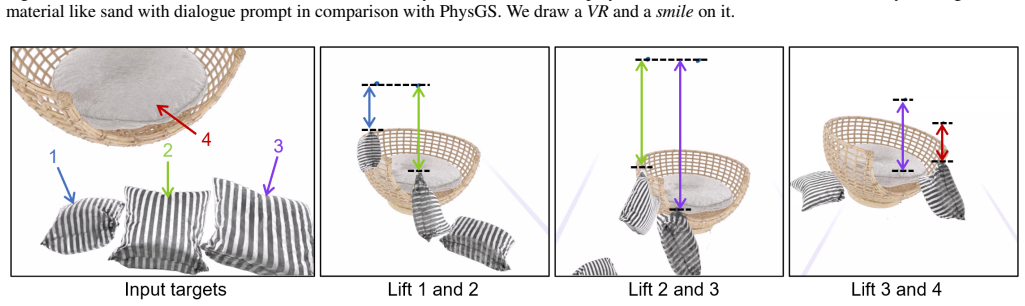
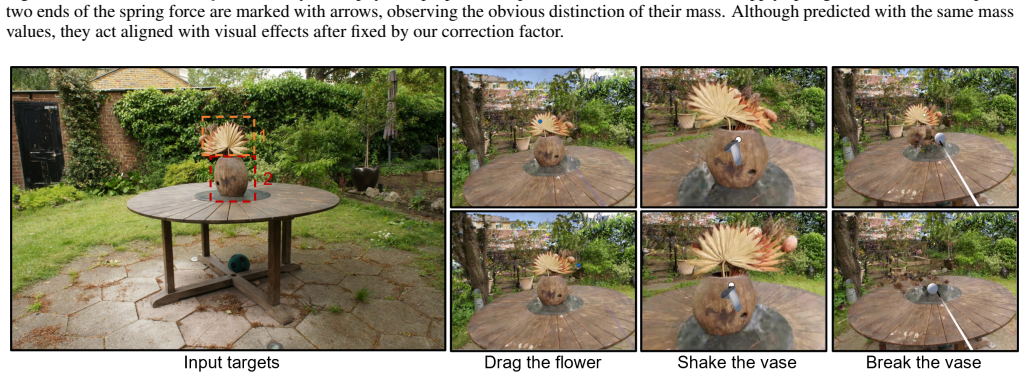
LIVE-GS shows that GPT-4o, informed by interviews and visual input from static Gaussian assets, can predict physical parameters that support realistic VR interactions in about 10 seconds. The approach replaces manual design or annotation, with results demonstrating that LLM-derived values produce interactions aligned with real-world phenomena while preserving high-quality rendering.
Load-bearing premise
The LLM produces physical parameters that match real-world dynamics from only visual input and interview insights, without per-asset calibration.
Editorial extensions
If this is right
- Static Gaussian assets can be converted to interactive dynamic assets without manual parameter tuning.
- VR interactions reflect real-world physical behavior based on the inferred parameters.
- Visual quality and rendering performance remain high during real-time physics simulation.
- Authoring time drops to seconds compared with expert manual adjustment.
- User studies confirm improved efficiency and satisfaction for non-expert creators.
Reading between the lines
- The same inference approach could extend to other 3D scene representations beyond Gaussian Splatting.
- Automated physics assignment might support large-scale libraries of ready-to-use interactive VR assets.
- Limits of the method could be tested by applying it to scenes with many interacting objects or unusual materials.
Editorial analysis
A structured set of objections, weighed in public.
Referee Report
Summary. The paper presents LIVE-GS, a VR system that uses GPT-4o to analyze static 3D Gaussian Splatting assets and predict physical parameters (mass, friction, restitution, etc.) for real-time physics-aware interactions. The design is informed by user interviews on GS-VR challenges; the system claims to produce 'reasonable' parameters in 10 seconds. Validation consists of a baseline comparison against expert manual parameter tuning (authoring time and perceived quality) plus a usability/user-satisfaction study with experienced participants.
Significance. If the LLM-derived parameters can be shown to produce physically plausible dynamics without per-asset calibration, the work would lower the barrier for non-experts to turn static GS reconstructions into interactive VR assets, with potential impact on asset libraries and content pipelines.
major comments (3)
- [Abstract / Evaluation] Abstract and Evaluation section: the central claim that GPT-4o 'predict[s] reasonable parameters' whose VR interactions 'align with real-world phenomena' rests on subjective ratings and authoring-time comparison only; no quantitative error metrics, ground-truth measurements of predicted values (mass, friction, restitution), or controlled roll-outs against independent physics data are reported, leaving the modeling assumption untested.
- [Abstract] Abstract: the headline efficiency claim ('predict reasonable parameters in just 10 seconds') is stated without supporting timing data, measurement protocol, or variance across assets, so the 10-second figure cannot be assessed as load-bearing evidence.
- [Evaluation / User Study] Evaluation description: the baseline comparison with 'participants experienced in physical simulation' who 'manually adjust physical parameters' supplies no details on how 'reasonable' was judged, no inter-rater reliability, and no error bars or statistical tests, undermining the cross-condition claim of superior efficiency and quality.
minor comments (3)
- [System Design] Notation for physical parameters (mass, friction, restitution) is introduced without explicit equations or ranges used by the physics engine.
- [LLM Integration] The paper would benefit from a table listing the exact parameter set predicted by GPT-4o and the prompt template employed.
- [Figures] Figure captions and axis labels in the user-study results should be expanded for standalone readability.
Simulated Author's Rebuttal
We thank the referee for the constructive feedback on our manuscript. We address each major comment below, indicating where revisions will be incorporated.
read point-by-point responses
-
Referee: [Abstract / Evaluation] Abstract and Evaluation section: the central claim that GPT-4o 'predict[s] reasonable parameters' whose VR interactions 'align with real-world phenomena' rests on subjective ratings and authoring-time comparison only; no quantitative error metrics, ground-truth measurements of predicted values (mass, friction, restitution), or controlled roll-outs against independent physics data are reported, leaving the modeling assumption untested.
Authors: We acknowledge that the evaluation relies on subjective user ratings and authoring-time comparisons rather than quantitative physical error metrics or ground-truth comparisons. Obtaining precise ground-truth values for parameters such as mass, friction, and restitution from real-world counterparts of the Gaussian assets would require additional experimental apparatus not included in the original study. We will revise the manuscript to explicitly discuss this methodological choice and its limitations while retaining the user-study validation approach. revision: partial
-
Referee: [Abstract] Abstract: the headline efficiency claim ('predict reasonable parameters in just 10 seconds') is stated without supporting timing data, measurement protocol, or variance across assets, so the 10-second figure cannot be assessed as load-bearing evidence.
Authors: The 10-second figure is the observed average processing time for GPT-4o inference on asset descriptions in our implementation. We will add the measurement protocol, including how timing was recorded and variance across assets, to the revised manuscript. revision: yes
-
Referee: [Evaluation / User Study] Evaluation description: the baseline comparison with 'participants experienced in physical simulation' who 'manually adjust physical parameters' supplies no details on how 'reasonable' was judged, no inter-rater reliability, and no error bars or statistical tests, undermining the cross-condition claim of superior efficiency and quality.
Authors: We agree that further details are warranted. In the revision we will specify the judgment criteria for 'reasonable' parameters, report inter-rater reliability where applicable, and include error bars together with statistical tests supporting the efficiency and quality comparisons. revision: yes
Circularity Check
No significant circularity; system uses external LLM inference validated against independent human baselines
full rationale
The paper presents an applied VR system that feeds scene descriptions and interview insights into GPT-4o to infer physical parameters for Gaussian assets. Validation consists of (a) timing and quality comparisons against separate human experts who manually tune the same parameters and (b) a usability survey. No equations, fitted parameters, or self-citations appear in the provided text; the central claim that the LLM produces 'reasonable' parameters is tested against external human judgment rather than being defined by the authors' own outputs or prior self-referential results. The derivation chain therefore remains self-contained against external benchmarks.
Assumptions & free parameters
assumptions (1)
- domain assumption GPT-4o possesses sufficient commonsense physical knowledge to map object appearance to interaction parameters that match real-world behavior.
Cite this review
Pith. "Pith review of LIVE-GS: LLM Powers Interactive VR Experience with Physics-Aware Gaussian Splatting." pith.science (2026). https://pith.science/paper/2412.09176
@misc{pith2026241209176,
  author       = {Pith},
  title        = {Pith review of: LIVE-GS: LLM Powers Interactive VR Experience with Physics-Aware Gaussian Splatting},
  year         = {2026},
  howpublished = {\url{https://pith.science/paper/2412.09176}},
  note         = {Machine review of arXiv:2412.09176}
}
read the original abstract
As 3D Gaussian Splatting (3DGS) emerges as a leading approach for novel view synthesis and scene reconstruction, its potential in digital asset creation has gained significant attention. An increasing number of asset libraries based on GS are being established. However, generating physics-based dynamic assets remains a time-consuming and expertise-intensive task, especially for non-experts. In this paper, we propose LIVE-GS, a highly realistic Virtual Reality (VR) system powered by Large Language Models (LLMs), which enables rapid creation of dynamic Gaussian assets and real-time VR interactions. To inform our system design, we conducted interviews to examine challenges faced by current GS-based VR systems and the specific demands of users. Based on these insights, we employed GPT-4o to analyze key physical properties of objects that significantly impact user interactions, ensuring physics-based interactions in VR align with real-world phenomena. A key innovation of LIVE-GS is its ability to predict reasonable parameters in just 10 seconds from static Gaussian assets while maintaining high-quality VR interactions. To validate our approach, we invited participants experienced in physical simulation to manually adjust physical parameters, providing a baseline for comparison in both asset quality and authoring efficiency. We also conducted a comprehensive user study to evaluate system usability and user satisfaction. Experimental results demonstrate that LIVE-GS, leveraging LLMs' scene understanding capabilities, can achieve efficient physical scene creation and natural interactions without requiring manual design or annotation.
Figures


Figures from the paper (8 more)



Forward citations
Cited by 1 Pith paper
-
Semantic-Guided Progressive Object Removal with Gaussian Splatting
Semantic block matching via DINOv2 plus selective high-frequency refinement yields higher-fidelity, multi-view-consistent object removal inside 3D Gaussian Splatting than prior one-shot Gaussian or NeRF inpainters.
Reference graph
Works this paper leans on
- [1]
-
[2]
J. Cen, J. Fang, C. Yang, L. Xie, X. Zhang, W. Shen, and Q. Tian. Segment any 3d gaussians, 2024. 2
work page 2024
-
[3]
H. K. Cheng, S. W. Oh, B. Price, A. Schwing, and J.-Y . Lee. Tracking anything with decoupled video segmentation. In Proceedings of the IEEE/CVF International Conference on Computer Vision , pp. 1316– 1326, 2023. 2, 3, 5
work page 2023
- [4]
-
[5]
N. Deng, Z. He, J. Ye, B. Duinkharjav, P. Chakravarthula, X. Yang, and Q. Sun. Fov-nerf: Foveated neural radiance fields for virtual re- ality. IEEE Transactions on Visualization and Computer Graphics , 28(11):3854–3864, 2022. 1
work page 2022
-
[6]
R. Ding, J. Yang, C. Xue, W. Zhang, S. Bai, and X. Qi. Pla: Language- driven open-vocabulary 3d scene understanding. InProceedings of the IEEE/CVF conference on computer vision and pattern recognition , pp. 7010–7019, 2023. 2
work page 2023
- [7]
- [8]
Show all 65 references
-
[9]
L. Fan, Y . Yang, M. Li, H. Li, and Z. Zhang. Trim 3d gaus- sian splatting for accurate geometry representation. arXiv preprint arXiv:2406.07499, 2024. 2
2024
-
[10]
Geiger, S
A. Geiger, S. Gao, A. Chen, Z. Yu, and B. Huang. 2d gaussian splat- ting for geometrically accurate radiance fields. 2024. 2
2024
-
[11]
Girdhar, A
R. Girdhar, A. El-Nouby, Z. Liu, M. Singh, K. V . Alwala, A. Joulin, and I. Misra. Imagebind: One embedding space to bind them all. In Proceedings of the IEEE/CVF Conference on Computer Vision and Pattern Recognition, pp. 15180–15190, 2023. 2
2023
-
[12]
S. Guan, H. Deng, Y . Wang, and X. Yang. Neurofluid: Fluid dynamics grounding with particle-driven neural radiance fields. InInternational Conference on Machine Learning, pp. 7919–7929. PMLR, 2022. 2
2022
-
[13]
Gu ´edon and V
A. Gu ´edon and V . Lepetit. Sugar: Surface-aligned gaussian splatting for efficient 3d mesh reconstruction and high-quality mesh rendering. In Proceedings of the IEEE/CVF Conference on Computer Vision and Pattern Recognition, pp. 5354–5363, 2024. 2
2024
-
[14]
Z. Guo, W. Zhou, L. Li, M. Wang, and H. Li. Motion-aware 3d gaussian splatting for efficient dynamic scene reconstruction. arXiv preprint arXiv:2403.11447, 2024. 2
2024
-
[15]
X. Hu, Y . Wang, L. Fan, J. Fan, J. Peng, Z. Lei, Q. Li, and Z. Zhang. Semantic anything in 3d gaussians. arXiv preprint arXiv:2401.17857,
-
[16]
Huang, H
J. Huang, H. Yu, J. Zhang, and H. Nait-Charif. Point’n move: Inter- active scene object manipulation on gaussian splatting radiance fields. IET Image Processing, 2023. 2
2023
-
[17]
Huang, Y .-T
Y .-H. Huang, Y .-T. Sun, Z. Yang, X. Lyu, Y .-P. Cao, and X. Qi. Sc- gs: Sparse-controlled gaussian splatting for editable dynamic scenes. In Proceedings of the IEEE/CVF Conference on Computer Vision and Pattern Recognition, pp. 4220–4230, 2024. 2
2024
-
[18]
C. Jia, Y . Yang, Y . Xia, Y .-T. Chen, Z. Parekh, H. Pham, Q. Le, Y .-H. Sung, Z. Li, and T. Duerig. Scaling up visual and vision-language representation learning with noisy text supervision. In International conference on machine learning, pp. 4904–4916. PMLR, 2021. 2
2021
-
[19]
Jiang, C
Y . Jiang, C. Yu, T. Xie, X. Li, Y . Feng, H. Wang, M. Li, H. Lau, F. Gao, Y . Yang, et al. Vr-gs: A physical dynamics-aware interactive gaussian splatting system in virtual reality. arXiv preprint arXiv:2401.16663,
-
[20]
Kavan, S
L. Kavan, S. Collins, J. ˇZ´ara, and C. O’Sullivan. Skinning with dual quaternions. In Proceedings of the 2007 symposium on Interactive 3D graphics and games, pp. 39–46, 2007. 2
2007
-
[21]
Kerbl, G
B. Kerbl, G. Kopanas, T. Leimk ¨uhler, and G. Drettakis. 3d gaussian splatting for real-time radiance field rendering. ACM Transactions on Graphics, 42(4):1–14, 2023. 1, 2, 3
2023
-
[22]
Kirillov, E
A. Kirillov, E. Mintun, N. Ravi, H. Mao, C. Rolland, L. Gustafson, T. Xiao, S. Whitehead, A. C. Berg, W.-Y . Lo, et al. Segment any- thing. In Proceedings of the IEEE/CVF International Conference on Computer Vision, pp. 4015–4026, 2023. 2, 3
2023
-
[23]
Li, Y .-L
X. Li, Y .-L. Qiao, P. Y . Chen, K. M. Jatavallabhula, M. Lin, C. Jiang, and C. Gan. Pac-nerf: Physics augmented continuum neural radi- ance fields for geometry-agnostic system identification.arXiv preprint arXiv:2303.05512, 2023. 2
2023
-
[24]
Liang, Y
H. Liang, Y . Yin, D. Xu, H. Liang, Z. Wang, K. N. Plataniotis, Y . Zhao, and Y . Wei. Diffusion4d: Fast spatial-temporal consistent 4d gener- ation via video diffusion models. arXiv preprint arXiv:2405.16645 ,
-
[25]
G. Liao, J. Li, Z. Bao, X. Ye, J. Wang, Q. Li, and K. Liu. Clip-gs: Clip-informed gaussian splatting for real-time and view-consistent 3d semantic understanding. arXiv preprint arXiv:2404.14249, 2024. 2
2024
-
[26]
G. Liao, K. Zhou, Z. Bao, K. Liu, and Q. Li. Ov-nerf: Open- vocabulary neural radiance fields with vision and language foun- dation models for 3d semantic understanding. arXiv preprint arXiv:2402.04648, 2024. 2
2024
-
[27]
Z. Liu, H. Ouyang, Q. Wang, K. L. Cheng, J. Xiao, K. Zhu, N. Xue, Y . Liu, Y . Shen, and Y . Cao. Infusion: Inpainting 3d gaussians via learning depth completion from diffusion prior. arXiv preprint arXiv:2404.11613, 2024. 2
2024
-
[28]
Loper, N
M. Loper, N. Mahmood, J. Romero, G. Pons-Moll, and M. J. Black. Smpl: A skinned multi-person linear model. In Seminal Graphics Papers: Pushing the Boundaries, Volume 2, pp. 851–866. 2023. 2
2023
-
[29]
T. Lu, M. Yu, L. Xu, Y . Xiangli, L. Wang, D. Lin, and B. Dai. Scaffold- gs: Structured 3d gaussians for view-adaptive rendering. In Proceed- ings of the IEEE/CVF Conference on Computer Vision and Pattern Recognition, pp. 20654–20664, 2024. 2
2024
-
[30]
Y . Lu, C. Xu, X. Wei, X. Xie, M. Tomizuka, K. Keutzer, and S. Zhang. Open-vocabulary point-cloud object detection without 3d annotation. In Proceedings of the IEEE/CVF conference on computer vision and pattern recognition, pp. 1190–1199, 2023. 2
2023
-
[31]
Mildenhall, P
B. Mildenhall, P. P. Srinivasan, M. Tancik, J. T. Barron, R. Ramamoor- thi, and R. Ng. Nerf: Representing scenes as neural radiance fields for view synthesis. Communications of the ACM, 65(1):99–106, 2021. 1
2021
-
[32]
M ¨uller, B
M. M ¨uller, B. Heidelberger, M. Hennix, and J. Ratcliff. Position based dynamics. Journal of Visual Communication and Image Representa- tion, 18(2):109–118, 2007. 2, 5
2007
-
[33]
M ¨uller, A
T. M ¨uller, A. Evans, C. Schied, and A. Keller. Instant neural graphics primitives with a multiresolution hash encoding. ACM transactions on graphics (TOG), 41(4):1–15, 2022. 6
2022
-
[34]
S. Peng, K. Genova, C. Jiang, A. Tagliasacchi, M. Pollefeys, T. Funkhouser, et al. Openscene: 3d scene understanding with open vocabularies. In Proceedings of the IEEE/CVF conference on com- puter vision and pattern recognition, pp. 815–824, 2023. 2
2023
-
[35]
Y .-L. Qiao, A. Gao, and M. Lin. Neuphysics: Editable neural geome- try and physics from monocular videos. Advances in Neural Informa- tion Processing Systems, 35:12841–12854, 2022. 2
2022
-
[36]
M. Qin, W. Li, J. Zhou, H. Wang, and H. Pfister. Langsplat: 3d lan- guage gaussian splatting. InProceedings of the IEEE/CVF Conference on Computer Vision and Pattern Recognition, pp. 20051–20060, 2024. 2
2024
-
[37]
R.-Z. Qiu, G. Yang, W. Zeng, and X. Wang. Feature splatting: Language-driven physics-based scene synthesis and editing. arXiv preprint arXiv:2404.01223, 2024. 2
2024
-
[38]
Radford, J
A. Radford, J. W. Kim, C. Hallacy, A. Ramesh, G. Goh, S. Agarwal, G. Sastry, A. Askell, P. Mishkin, J. Clark, et al. Learning transfer- able visual models from natural language supervision. InInternational conference on machine learning, pp. 8748–8763. PMLR, 2021. 2
2021
-
[39]
J. Ren, L. Pan, J. Tang, C. Zhang, A. Cao, G. Zeng, and Z. Liu. Dreamgaussian4d: Generative 4d gaussian splatting. arXiv preprint arXiv:2312.17142, 2023. 2
2023
-
[40]
K. Ren, L. Jiang, T. Lu, M. Yu, L. Xu, Z. Ni, and B. Dai. Octree-gs: Towards consistent real-time rendering with lod-structured 3d gaus- sians. arXiv preprint arXiv:2403.17898, 2024. 2
2024
-
[41]
J.-C. Shi, M. Wang, H.-B. Duan, and S.-H. Guan. Language embedded 3d gaussians for open-vocabulary scene understanding. In Proceed- ings of the IEEE/CVF Conference on Computer Vision and Pattern Recognition, pp. 5333–5343, 2024. 2
2024
-
[42]
Siddiqui, L
Y . Siddiqui, L. Porzi, S. R. Bul ´o, N. M ¨uller, M. Nießner, A. Dai, and P. Kontschieder. Panoptic lifting for 3d scene understanding with neu- ral fields. In Proceedings of the IEEE/CVF Conference on Computer Vision and Pattern Recognition, pp. 9043–9052, 2023. 2
2023
-
[43]
M. C. Silva, M. Dahaghin, M. Toso, and A. Del Bue. Contrastive gaussian clustering: Weakly supervised 3d scene segmentation. arXiv preprint arXiv:2404.12784, 2024. 2
2024
-
[44]
Snavely, S
N. Snavely, S. M. Seitz, and R. Szeliski. Photo tourism: exploring photo collections in 3d. In ACM siggraph 2006 papers, pp. 835–846
2006
-
[45]
Suvorov, E
R. Suvorov, E. Logacheva, A. Mashikhin, A. Remizova, A. Ashukha, A. Silvestrov, N. Kong, H. Goka, K. Park, and V . Lempitsky. Resolution-robust large mask inpainting with fourier convolutions. In Proceedings of the IEEE/CVF winter conference on applications of computer vision,...
2022
-
[46]
Takmaz, E
A. Takmaz, E. Fedele, R. W. Sumner, M. Pollefeys, F. Tombari, and F. Engelmann. Openmask3d: Open-vocabulary 3d instance segmen- tation. arXiv preprint arXiv:2306.13631, 2023. 2
2023
-
[47]
O. S. D. Team. Obi solver. https://obi.virtualmethodstudio. com/, 2024. 5
2024
-
[48]
Topsakal and T
O. Topsakal and T. C. Akinci. Creating large language model applica- tions utilizing langchain: A primer on developing llm apps fast. In In- ternational Conference on Applied Engineering and Natural Sciences, vol. 1, pp. 1050–1056, 2023. 5
2023
-
[49]
Turkulainen, X
M. Turkulainen, X. Ren, I. Melekhov, O. Seiskari, E. Rahtu, and J. Kannala. Dn-splatter: Depth and normal priors for gaussian splat- ting and meshing. arXiv preprint arXiv:2403.17822, 2024. 2
2024
-
[50]
J. Wang, J. Fang, X. Zhang, L. Xie, and Q. Tian. Gaussianeditor: Edit- ing 3d gaussians delicately with text instructions. In Proceedings of the IEEE/CVF Conference on Computer Vision and Pattern Recogni- tion, pp. 20902–20911, 2024. 2
2024
-
[51]
Y . Wolf, A. Bracha, and R. Kimmel. Surface reconstruction from gaussian splatting via novel stereo views. arXiv preprint arXiv:2404.01810, 2024. 2
2024
-
[52]
T. Xie, Z. Zong, Y . Qiu, X. Li, Y . Feng, Y . Yang, and C. Jiang. Phys- gaussian: Physics-integrated 3d gaussians for generative dynamics. In Proceedings of the IEEE/CVF Conference on Computer Vision and Pattern Recognition, pp. 4389–4398, 2024. 2, 3, 5, 6
2024
-
[53]
L. Xu, V . Agrawal, W. Laney, T. Garcia, A. Bansal, C. Kim, S. Rota Bul `o, L. Porzi, P. Kontschieder, A. Bo ˇziˇc, et al. Vr-nerf: High-fidelity virtualized walkable spaces. In SIGGRAPH Asia 2023 Conference Papers, pp. 1–12, 2023. 1
2023
-
[54]
S. Yan, T. Zhu, Z. Wang, Y . Cao, M. Zhang, S. Ghosh, Y . Wu, and J. Yu. Videococa: Video-text modeling with zero-shot transfer from contrastive captioners. arXiv preprint arXiv:2212.04979, 2022. 2
2022
-
[55]
Z. Yang, X. Gao, W. Zhou, S. Jiao, Y . Zhang, and X. Jin. Deformable 3d gaussians for high-fidelity monocular dynamic scene reconstruc- tion. In Proceedings of the IEEE/CVF Conference on Computer Vision and Pattern Recognition, pp. 20331–20341, 2024. 2
2024
-
[56]
M. Ye, M. Danelljan, F. Yu, and L. Ke. Gaussian grouping: Segment and edit anything in 3d scenes. arXiv preprint arXiv:2312.00732 ,
-
[57]
Y . Yin, D. Xu, Z. Wang, Y . Zhao, and Y . Wei. 4dgen: Grounded 4d content generation with spatial-temporal consistency. arXiv preprint arXiv:2312.17225, 2023. 2
2023
-
[58]
Yuan, Y .-T
Y .-J. Yuan, Y .-T. Sun, Y .-K. Lai, Y . Ma, R. Jia, and L. Gao. Nerf- editing: geometry editing of neural radiance fields. In Proceedings of the IEEE/CVF Conference on Computer Vision and Pattern Recogni- tion, pp. 18353–18364, 2022. 2
2022
-
[59]
A. Zeng, M. Attarian, B. Ichter, K. Choromanski, A. Wong, S. Welker, F. Tombari, A. Purohit, M. Ryoo, V . Sindhwani, et al. Socratic mod- els: Composing zero-shot multimodal reasoning with language. arXiv preprint arXiv:2204.00598, 2022. 2
2022 arXiv
-
[60]
Zhang, F
H. Zhang, F. Li, S. Liu, L. Zhang, H. Su, J. Zhu, L. M. Ni, and H.-Y . Shum. Dino: Detr with improved denoising anchor boxes for end-to- end object detection. arXiv preprint arXiv:2203.03605, 2022. 2
2022 arXiv
-
[61]
Zhang, X
H. Zhang, X. Li, and L. Bing. Video-llama: An instruction-tuned audio-visual language model for video understanding. arXiv preprint arXiv:2306.02858, 2023. 2
2023 arXiv
-
[62]
Zhang, H.-X
T. Zhang, H.-X. Yu, R. Wu, B. Y . Feng, C. Zheng, N. Snavely, J. Wu, and W. T. Freeman. Physdreamer: Physics-based interaction with 3d objects via video generation. arXiv preprint arXiv:2404.13026, 2024. 2, 4
2024
-
[63]
S. Zhi, T. Laidlow, S. Leutenegger, and A. J. Davison. In-place scene labelling and understanding with implicit scene representation. InPro- ceedings of the IEEE/CVF International Conference on Computer Vi- sion, pp. 15838–15847, 2021. 2
2021
-
[64]
H. Zhou, J. Shao, L. Xu, D. Bai, W. Qiu, B. Liu, Y . Wang, A. Geiger, and Y . Liao. Hugs: Holistic urban 3d scene understanding via gaussian splatting. In Proceedings of the IEEE/CVF Conference on Computer Vision and Pattern Recognition, pp. 21336–21345, 2024. 2
2024
-
[65]
Zwicker, H
M. Zwicker, H. Pfister, J. Van Baar, and M. Gross. Ewa volume splat- ting. In Proceedings Visualization, 2001. VIS’01., pp. 29–538. IEEE,
2001
Reviewed May 23, 2026 · model on record in the stance chip above.
Discussion (0). Continue with ORCID to comment.