REVIEW 2 major objections 8 minor 2 cited by
UniRestore: Unified Perceptual and Task-Oriented Image Restoration Model Using Diffusion Prior
T0 review · 2 major / 8 minor · reviewed 2026-08-10 · deepseek-v4-flash
Pith's one-line read UniRestore claims that a single diffusion-based model can restore images in a way that is both perceptually appealing to humans and useful for downstream computer-vision tasks, by injecting two lightweight feature modules into a frozen…
desk verdict Solid unified restoration system with a genuinely new adapter combination, but the 'any task' extensibility claim rests on one prompt-tuning experiment without the needed controls. read the letter →
The pith
A machine-rendered reading of the paper's core claim, the machinery that carries it, and where it could break.
The reading
What carries the argument
The load-bearing components are the Complementary Feature Restoration Module (CFRM) and the Task Feature Adapter (TFA), both inserted into the frozen latent-diffusion autoencoder. CFRM, placed at each encoder layer, reconstructs clear features from degraded ones through four steps: feature enhancement, intra-group channel attention, inter-group channel integration, and feature recovery. TFA, placed at each decoder layer, uses an LSTM-style prompt-update mechanism: a task-specific learnable vector is updated layer by layer and, together with the CFRM-restored features, is fused into the diffusion features via a tuner operator. This two-module design lets the model keep the diffusion prior fixed and adapt only the lightweight prompt, giving task-specific control while preserving the perceptual quality the prior already provides.
What would settle it
Evaluate the prompt-only extension on a spatially dense, geometry-oriented task such as monocular depth estimation under the same protocol; if the frozen TFA cannot yield competitive results without extra trainable modules, then the paper's 'any task' extensibility claim would be refuted.
Extended reading notes
Core claim
The central discovery is that the encoder features of the diffusion autoencoder, after being restored by the Complementary Feature Restoration Module (CFRM), carry complementary information that a Task Feature Adapter (TFA) can fuse into the decoder's diffusion features under the control of a per-task prompt vector. The paper shows that with this design, the same frozen diffusion decoder can be adapted to produce restorations that serve both perceptual metrics (PSNR/SSIM) and the accuracy of a recognition network. In experiments, UniRestore achieves 71.65% classification accuracy on degraded ImageNet compared to 72.80% for high-quality inputs, and 66.05 mIoU on degraded Cityscapes compared to 75.64 for high-quality inputs, with larger gains on unseen datasets. The paper also demonstrates that adding object detection as a third downstream task requires only optimizing a new prompt, supporting the claim of extensibility.
Load-bearing premise
The paper assumes that a single frozen TFA and the frozen diffusion decoder can be steered to any new downstream task using only a freshly optimized prompt vector, yet this is validated on exactly one additional task beyond classification and segmentation.
Editorial extensions
If this is right
- If the claims hold, one unified restoration model can replace separate PIR and TIR pipelines, reducing system redundancy in applications such as autonomous driving that need both human-facing output and machine-facing input.
- Adding a new downstream task reduces to optimizing a new prompt vector on that task's data, so extending UniRestore to new tasks is cheaper than retraining a full model.
- The success of injecting CFRM-restored encoder features suggests that degradation compensation at the encoder level is an effective place to reconcile perceptual and task objectives.
- UniRestore's gains on unseen datasets (e.g., 20.01% accuracy improvement on CUB for ResNet-50) indicate that the approach generalizes beyond the synthetic degradations seen in training.
- The shared TFA across tasks implies that multi-task training can transfer knowledge between tasks, as the paper notes when comparing to task-specific TFA variants.
Reading between the lines
- The paper's 'any task' claim is extrapolated from a single additional detection experiment; a more stringent test would be a task with radically different feature demands, such as monocular depth estimation or instance segmentation, using the same frozen TFA and only a new prompt.
- The prompt vector likely acts as a soft selector for how much of the CFRM-restored features to blend in at each decoder layer, which suggests the approach could be interpreted as a form of input-conditional feature merging; comparing against other parameter-efficient adaptation methods would clarify the source of the gain.
- Because the diffusion prior is frozen, the model's ceiling for tasks that require hallucinating fine structure (e.g., text or faces) may be limited by the prior; a testable extension would be to unfreeze the decoder for a new task and measure the resulting PIR/TIR trade-off.
Signed reviews
Editorial analysis
A structured set of objections, weighed in public.
Referee Report
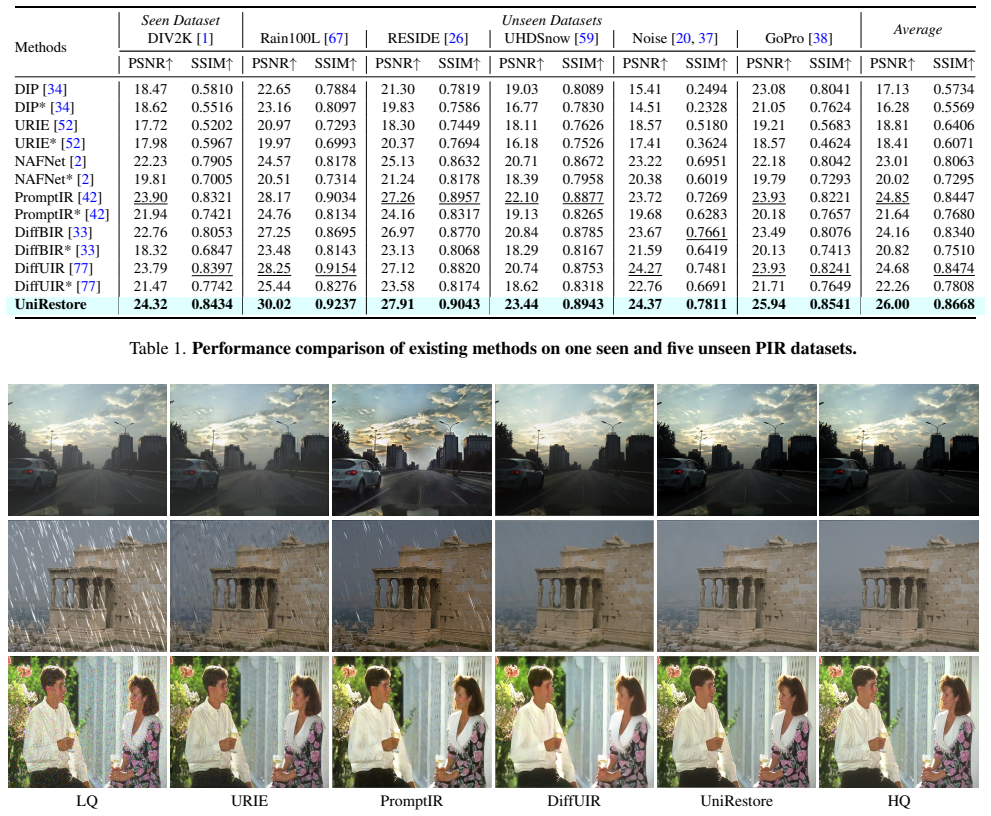
Summary. The paper presents UniRestore, a unified image restoration model built on a latent diffusion prior (Stable Diffusion) with two new components: a Complementary Feature Restoration Module (CFRM) that reconstructs encoder features from degraded inputs, and a Task Feature Adapter (TFA) that fuses these restored features into the decoder under the control of lightweight task prompts. Training proceeds in two stages: first, the CFRM, Controller, and SC-Tuner are trained with a PIR feature-matching loss and latent alignment loss; second, the TFA and task prompts are trained with a multi-task loss combining MSE for PIR, cross-entropy for ImageNet classification, and cross-entropy for Cityscapes segmentation, while earlier modules are frozen. The experiments compare UniRestore against DIP, URIE, NAFNet, PromptIR, DiffBIR, and DiffUIR on PIR benchmarks (DIV2K, Rain100L, RESIDE, UHDSnow, Noise, GoPro) and TIR benchmarks (ImageNet/CUB classification, Cityscapes/FoggyCityscapes/ACDC segmentation), plus an object-detection extension on RTTS. UniRestore reports the best PSNR/SSIM and highest ACC/mIoU on most metrics, and the ablations isolate contributions of CFRM and TFA.
Significance. If the central claims hold, UniRestore is a strong engineering contribution: it demonstrates a single diffusion-based restoration model that serves both perceptual and task-oriented objectives, with a parameter-efficient prompt-based mechanism for adding new tasks. The experimental design includes unseen-domain TIR benchmarks and a multi-task fine-tuning baseline protocol, which is valuable. The main caveats are that the headline extensibility claim rests on a single prompt-only experiment without the controls necessary to attribute the gain to the task prompt, and the primary PIR table contains arithmetic errors in its average columns. Correcting these issues would make the paper a solid contribution to the restoration and low-level vision community.
major comments (2)
- [Table 1] The reported Average PSNR and SSIM values are arithmetically inconsistent with the six per-dataset entries. For DIP, the listed PSNR values (18.47, 22.65, 21.30, 19.03, 15.41, 23.08) average to 19.99, not 17.13, and the SSIM values average to 0.669, not 0.5734. The DIP* row has the same problem (PSNR average 18.99 vs. reported 16.28). Since the average column is used to support the claim that UniRestore achieves the best overall performance, these errors must be corrected and the table regenerated before the comparison can be trusted.
- [Section 3.4, Table 6] The claim that adding a new TIR task requires only a new task-specific prompt is load-bearing for the paper's extensibility and efficiency contributions, but the evidence is insufficient. Table 6 reports a single object-detection result on RTTS (58.06 mAP) against DIP and PromptIR, yet it provides no control using UniRestore with an already-learned prompt (e.g., the PIR prompt) on RTTS, and it does not re-report the original-task metrics (DIV2K PSNR/SSIM, ImageNet ACC, Cityscapes mIoU) after the detection prompt is added. Without these controls, the gain cannot be attributed to the new task prompt as opposed to the frozen restoration backbone and TFA, and we cannot know whether prior-task performance is retained. In addition, one detection benchmark is too narrow to support the 'Any Task' generalization in Figure 1(c).
minor comments (8)
- [Abstract] In the Abstract, 'expertments' should be 'experiments'; in the same paragraph, 'adapability' should be 'adaptability'.
- [Equation (2)] Equation (2) defines L_CFRM as a sum of vector differences; a norm (e.g., L1 or L2) is needed to produce a scalar loss, and the text should specify which norm is used.
- [Table 3] In Table 3, the header 'Cityscapes [47]' is wrong: the Cityscapes dataset should be cited as [11], while [47] refers to FoggyCityscapes; the current citation is misleading.
- [Section 5.3] In Section 5.3, the phrase 'enhances classification accuracy by 20.01%' should be 'by 20.01 percentage points,' since the metric is absolute accuracy.
- [Sections 4.2 and 5.2] The term 'seen dataset' should be clarified: the model has seen the same image distribution during training but not the specific test images; this is standard but deserves a sentence to avoid confusion.
- [Reproducibility] No code or project link with code is provided, which limits reproducibility; the project page is mentioned but one would expect a code release.
- [Table 5] In Table 5, UniRestore's PIR PSNR (24.32) is lower than Multi-TFA (25.48), so the text's statement that UniRestore delivers 'comparable' PIR performance should be refined or explained.
- [Figure 2] Figure 2 is very dense; adding explicit labels for Stage 1 versus Stage 2 freezing would make the training pipeline easier to follow.
Circularity Check
No significant circularity: UniRestore's losses use external supervision, and its reported TIR numbers are held-out evaluations, not fitted quantities.
full rationale
The central derivation chain is not circular. CFRM is trained by Eq. (2), L_CFRM = sum_i lambda_i (f_Clear_i - f_Restored_i), where f_Clear_i comes from a clean image through the vanilla encoder and f_Restored_i from a degraded input through the CFRM-augmented encoder. This is a direct feature-supervision objective; the clean features are not the method's own predicted output, and no evaluated metric is reused as a training target. The TFA is trained in Stage 2 with Eq. (6) using cross-entropy on segmentation and classification labels and MSE on PIR ground truth; the downstream recognition and segmentation models are pre-trained independently without degradation synthesis, and evaluation is on held-out test sets (ImageNet test, CUB, Cityscapes test, FoggyCityscapes, ACDC, RTTS). The Table 6 extendability experiment optimizes a new prompt with an object-detection loss and then measures mAP, which is standard task-specific adaptation rather than a prediction forced by a fitted parameter. The 'any task' generalization in Fig. 1(c) is an extrapolation beyond the tested detection task, and the extendability section lacks a no-new-prompt control and does not re-report original-task metrics; that is an evidence or ablation gap, not circularity. Self-citations in the related-work section (e.g., refs. [4, 5, 21]) motivate the TIR setting but are not load-bearing for the architecture or the numerical claims. No equation or table in the paper reduces a claimed result to its own input.
Assumptions & free parameters
free parameters (4)
- Layer-wise scaling weights λ_i in L_CFRM =
not reported
- Task weighting coefficients β_PIR, β_Seg, β_Cls =
not reported
- Group number l in CFRM channel attention =
not reported
- Learnable task prompt vectors C^k_0 =
trained per task
assumptions (4)
- domain assumption Pretrained Stable Diffusion provides a strong image prior for restoration
- domain assumption Encoder features from the clean image are a valid feature-restoration target
- domain assumption Synthetic degradations from Hendrycks and Dietterich are representative
- ad hoc to paper A single frozen TFA with task-specific prompts generalizes to new tasks
Cite this review
Pith. "Pith review of UniRestore: Unified Perceptual and Task-Oriented Image Restoration Model Using Diffusion Prior." pith.science (2026). https://pith.science/paper/S2M5DGBK
@misc{pith2026250113134,
  author       = {Pith},
  title        = {Pith review of: UniRestore: Unified Perceptual and Task-Oriented Image Restoration Model Using Diffusion Prior},
  year         = {2026},
  howpublished = {\url{https://pith.science/paper/S2M5DGBK}},
  note         = {Machine review of arXiv:2501.13134}
}
read the original abstract
Image restoration aims to recover content from inputs degraded by various factors, such as adverse weather, blur, and noise. Perceptual Image Restoration (PIR) methods improve visual quality but often do not support downstream tasks effectively. On the other hand, Task-oriented Image Restoration (TIR) methods focus on enhancing image utility for high-level vision tasks, sometimes compromising visual quality. This paper introduces UniRestore, a unified image restoration model that bridges the gap between PIR and TIR by using a diffusion prior. The diffusion prior is designed to generate images that align with human visual quality preferences, but these images are often unsuitable for TIR scenarios. To solve this limitation, UniRestore utilizes encoder features from an autoencoder to adapt the diffusion prior to specific tasks. We propose a Complementary Feature Restoration Module (CFRM) to reconstruct degraded encoder features and a Task Feature Adapter (TFA) module to facilitate adaptive feature fusion in the decoder. This design allows UniRestore to optimize images for both human perception and downstream task requirements, addressing discrepancies between visual quality and functional needs. Integrating these modules also enhances UniRestore's adapability and efficiency across diverse tasks. Extensive expertments demonstrate the superior performance of UniRestore in both PIR and TIR scenarios.
Figures


Figures from the paper (2 more)

Forward citations
Cited by 2 Pith papers
-
DiffVQA: Video Quality Assessment Using Diffusion Feature Extractor
Using an adapted Stable Diffusion model as a spatial feature extractor with a Mamba temporal coherence module, DiffVQA reports top SRCC and PLCC scores on KoNViD-1k, LIVE-VQC, YouTube-UGC, LSVQ, and KVQ, with improved...
-
Unpaired Deblurring via Decoupled Diffusion Model
A diffusion model that decouples structural features from blur patterns using unpaired target-domain images can deblur photos in unseen domains without paired training data.
Reference graph
Works this paper leans on
-
[1]
Ntire 2017 challenge on single image super-resolution: Dataset and study
Eirikur Agustsson and Radu Timofte. Ntire 2017 challenge on single image super-resolution: Dataset and study. In CVPRW, 2017. 5, 6, 7
work page 2017
-
[2]
Simple baselines for image restoration
Liangyu Chen, Xiaojie Chu, Xiangyu Zhang, and Jian Sun. Simple baselines for image restoration. In ECCV, 2022. 2, 5, 6, 7
work page 2022
-
[3]
Rethinking atrous convolution for semantic image segmentation
Liang-Chieh Chen. Rethinking atrous convolution for semantic image segmentation. arXiv preprint arXiv:1706.05587, 2017. 7
arXiv 2017
-
[4]
Rvsl: Robust vehicle similarity learning in real hazy scenes based on semi-supervised learning
Wei-Ting Chen, I-Hsiang Chen, Chih-Yuan Yeh, Hao- Hsiang Yang, Hua-En Chang, Jian-Jiun Ding, and Sy-Yen Kuo. Rvsl: Robust vehicle similarity learning in real hazy scenes based on semi-supervised learning. In ECCV, 2022. 2
2022
-
[5]
Sjdl-vehicle: Semi-supervised joint defogging learning for foggy vehicle re-identification
Wei-Ting Chen, I-Hsiang Chen, Chih-Yuan Yeh, Hao- Hsiang Yang, Jian-Jiun Ding, and Sy-Yen Kuo. Sjdl-vehicle: Semi-supervised joint defogging learning for foggy vehicle re-identification. In AAAI, 2022. 2
2022
-
[6]
Pms-net: Robust haze removal based on patch map for single images
Wei-Ting Chen, Jian-Jiun Ding, and Sy-Yen Kuo. Pms-net: Robust haze removal based on patch map for single images. In CVPR, 2019. 2
work page 2019
-
[7]
Wei-Ting Chen, Hao-Yu Fang, Cheng-Lin Hsieh, Cheng-Che Tsai, I Chen, Jian-Jiun Ding, Sy-Yen Kuo, et al. All snow re- moved: Single image desnowing algorithm using hierarchi- cal dual-tree complex wavelet representation and contradict channel loss. In ICCV, 2021. 2
work page 2021
-
[8]
When self-supervised pre-training meets single image denoising
Hamadi Chihaoui and Paolo Favaro. When self-supervised pre-training meets single image denoising. In ICIP, 2024. 1, 2
work page 2024
Show all 78 references
-
[9]
Nafssr: Stereo image super-resolution using nafnet
Xiaojie Chu, Liangyu Chen, and Wenqing Yu. Nafssr: Stereo image super-resolution using nafnet. In CVPRW, 2022. 3
2022
-
[10]
Come-closer-diffuse-faster: Accelerating conditional diffu- sion models for inverse problems through stochastic contrac- tion
Hyungjin Chung, Byeongsu Sim, and Jong Chul Ye. Come-closer-diffuse-faster: Accelerating conditional diffu- sion models for inverse problems through stochastic contrac- tion. In CVPR, 2022. 3
2022
-
[11]
The cityscapes dataset for semantic urban scene understanding
Marius Cordts, Mohamed Omran, Sebastian Ramos, Timo Rehfeld, Markus Enzweiler, Rodrigo Benenson, Uwe Franke, Stefan Roth, and Bernt Schiele. The cityscapes dataset for semantic urban scene understanding. In CVPR,
-
[12]
Imagenet: A large-scale hierarchical image database
Jia Deng, Wei Dong, Richard Socher, Li-Jia Li, Kai Li, and Li Fei-Fei. Imagenet: A large-scale hierarchical image database. In CVPR, 2009. 5, 7
2009
-
[13]
Learning a deep convolutional network for image super-resolution
Chao Dong, Chen Change Loy, Kaiming He, and Xiaoou Tang. Learning a deep convolutional network for image super-resolution. In ECCV, 2014. 2
2014
-
[14]
An image is worth 16x16 words: Transformers for image recognition at scale
Alexey Dosovitskiy. An image is worth 16x16 words: Transformers for image recognition at scale. arXiv preprint arXiv:2010.11929, 2020. 6, 7
2010 arXiv
-
[15]
Deep residual learning for image recognition
Kaiming He, Xiangyu Zhang, Shaoqing Ren, and Jian Sun. Deep residual learning for image recognition. InICPR, 2016. 6, 7
2016
-
[16]
Benchmarking neu- ral network robustness to common corruptions and perturba- tions
Dan Hendrycks and Thomas Dietterich. Benchmarking neu- ral network robustness to common corruptions and perturba- tions. arXiv preprint arXiv:1903.12261, 2019. 5
1903 arXiv
-
[17]
Gaussian error linear units (gelus)
Dan Hendrycks and Kevin Gimpel. Gaussian error linear units (gelus). arXiv preprint arXiv:1606.08415, 2016. 3
2016 arXiv
-
[18]
Denoising diffu- sion probabilistic models
Jonathan Ho, Ajay Jain, and Pieter Abbeel. Denoising diffu- sion probabilistic models. NIPS, 2020. 2
2020
-
[19]
Long short-term memory
S Hochreiter. Long short-term memory. NC, 1997. 4
1997
-
[20]
Single image super-resolution from transformed self-exemplars
Jia-Bin Huang, Abhishek Singh, and Narendra Ahuja. Single image super-resolution from transformed self-exemplars. In CVPR, 2015. 5, 6
2015
-
[21]
Counting crowds in bad weather
Zhi-Kai Huang, Wei-Ting Chen, Yuan-Chun Chiang, Sy- Yen Kuo, and Ming-Hsuan Yang. Counting crowds in bad weather. In ICCV, 2023. 2
2023
-
[22]
Vi- sual prompt tuning
Menglin Jia, Luming Tang, Bor-Chun Chen, Claire Cardie, Serge Belongie, Bharath Hariharan, and Ser-Nam Lim. Vi- sual prompt tuning. In ECCV, 2022. 4
2022
-
[23]
Scedit: Efficient and controllable image diffusion generation via skip connection editing
Zeyinzi Jiang, Chaojie Mao, Yulin Pan, Zhen Han, and Jingfeng Zhang. Scedit: Efficient and controllable image diffusion generation via skip connection editing. In CVPR,
-
[24]
Imagenet classification with deep convolutional neural net- works
Alex Krizhevsky, Ilya Sutskever, and Geoffrey E Hinton. Imagenet classification with deep convolutional neural net- works. NIPS, 2012. 3
2012
-
[25]
Fifo: Learn- ing fog-invariant features for foggy scene segmentation
Sohyun Lee, Taeyoung Son, and Suha Kwak. Fifo: Learn- ing fog-invariant features for foggy scene segmentation. In CVPR, 2022. 2
2022
-
[26]
Benchmarking single- image dehazing and beyond
Boyi Li, Wenqi Ren, Dengpan Fu, Dacheng Tao, Dan Feng, Wenjun Zeng, and Zhangyang Wang. Benchmarking single- image dehazing and beyond. TIP, 2018. 5, 6, 8
2018
-
[27]
Srdiff: Single image super-resolution with diffusion probabilistic models
Haoying Li, Yifan Yang, Meng Chang, Shiqi Chen, Huajun Feng, Zhihai Xu, Qi Li, and Yueting Chen. Srdiff: Single image super-resolution with diffusion probabilistic models. IJON, 2022. 2
2022
-
[28]
All in one bad weather removal using architectural search
Ruoteng Li, Robby T Tan, and Loong-Fah Cheong. All in one bad weather removal using architectural search. In CVPR, 2020. 1, 2
2020
-
[29]
Swinir: Image restoration us- ing swin transformer
Jingyun Liang, Jiezhang Cao, Guolei Sun, Kai Zhang, Luc Van Gool, and Radu Timofte. Swinir: Image restoration us- ing swin transformer. In ICCV, 2021. 2
2021
-
[30]
Enhanced deep residual networks for single image super-resolution
Bee Lim, Sanghyun Son, Heewon Kim, Seungjun Nah, and Kyoung Mu Lee. Enhanced deep residual networks for single image super-resolution. In CVPRW, 2017. 5
2017
-
[31]
Refinenet: Multi-path refinement networks for high- resolution semantic segmentation
Guosheng Lin, Anton Milan, Chunhua Shen, and Ian Reid. Refinenet: Multi-path refinement networks for high- resolution semantic segmentation. In Proceedings of the IEEE conference on computer vision and pattern recogni- tion, 2017. 8
2017
-
[32]
Microsoft coco: Common objects in context
Tsung-Yi Lin, Michael Maire, Serge Belongie, James Hays, Pietro Perona, Deva Ramanan, Piotr Dollár, and C Lawrence Zitnick. Microsoft coco: Common objects in context. In ECCV, 2014. 8
2014
-
[33]
Diff- bir: Towards blind image restoration with generative diffu- sion prior
Xinqi Lin, Jingwen He, Ziyan Chen, Zhaoyang Lyu, Bo Dai, Fanghua Yu, Wanli Ouyang, Yu Qiao, and Chao Dong. Diff- bir: Towards blind image restoration with generative diffu- sion prior. arXiv preprint arXiv:2308.15070, 2023. 3, 5, 6, 7
2023 arXiv
-
[34]
Image-adaptive yolo for object detec- tion in adverse weather conditions
Wenyu Liu, Gaofeng Ren, Runsheng Yu, Shi Guo, Jianke Zhu, and Lei Zhang. Image-adaptive yolo for object detec- tion in adverse weather conditions. In AAAI, 2022. 2, 5, 6, 7, 8
2022
-
[35]
Desnownet: Context-aware deep network for snow removal
Yun-Fu Liu, Da-Wei Jaw, Shih-Chia Huang, and Jenq-Neng Hwang. Desnownet: Context-aware deep network for snow removal. TIP, 2018. 2
2018
-
[36]
Repaint: Inpainting using denoising diffusion probabilistic models
Andreas Lugmayr, Martin Danelljan, Andres Romero, Fisher Yu, Radu Timofte, and Luc Van Gool. Repaint: Inpainting using denoising diffusion probabilistic models. In CVPR,
-
[37]
A database of human segmented natural images and its application to evaluating segmentation algorithms and measuring ecological statistics
David Martin, Charless Fowlkes, Doron Tal, and Jitendra Malik. A database of human segmented natural images and its application to evaluating segmentation algorithms and measuring ecological statistics. In ICCV, 2001. 5, 6
2001
-
[38]
Deep multi-scale convolutional neural network for dynamic scene deblurring
Seungjun Nah, Tae Hyun Kim, and Kyoung Mu Lee. Deep multi-scale convolutional neural network for dynamic scene deblurring. In CVPR, 2017. 2, 5, 6
2017
-
[39]
Light- weight refinenet for real-time semantic segmentation
Vladimir Nekrasov, Chunhua Shen, and Ian Reid. Light- weight refinenet for real-time semantic segmentation. arXiv preprint arXiv:1810.03272, 2018. 7
2018 arXiv
-
[40]
Restoring vision in adverse weather conditions with patch-based denoising dif- fusion models
Ozan Özdenizci and Robert Legenstein. Restoring vision in adverse weather conditions with patch-based denoising dif- fusion models. PAMI, 2023. 3
2023
-
[41]
Does haze removal help cnn-based image classifica- tion? In ECCV, 2018
Yanting Pei, Yaping Huang, Qi Zou, Yuhang Lu, and Song Wang. Does haze removal help cnn-based image classifica- tion? In ECCV, 2018. 2
2018
-
[42]
Promptir: Prompting for all-in- one image restoration
Vaishnav Potlapalli, Syed Waqas Zamir, Salman H Khan, and Fahad Shahbaz Khan. Promptir: Prompting for all-in- one image restoration. In NIPS, 2024. 1, 2, 5, 6, 7, 8
2024
-
[43]
Allweath- ernet: Unified image enhancement for autonomous driv- ing under adverse weather and lowlight-conditions
Chenghao Qian, Mahdi Rezaei, Saeed Anwar, Wenjing Li, Tanveer Hussain, Mohsen Azarmi, and Wei Wang. Allweath- ernet: Unified image enhancement for autonomous driv- ing under adverse weather and lowlight-conditions. arXiv preprint arXiv:2409.02045, 2024. 1, 2
2024 arXiv
-
[44]
Multiscale structure guided diffusion for image deblurring
Mengwei Ren, Mauricio Delbracio, Hossein Talebi, Guido Gerig, and Peyman Milanfar. Multiscale structure guided diffusion for image deblurring. In ICCV, 2023. 1, 2
2023
-
[45]
High-resolution image syn- thesis with latent diffusion models
Robin Rombach, Andreas Blattmann, Dominik Lorenz, Patrick Esser, and Björn Ommer. High-resolution image syn- thesis with latent diffusion models. In CVPR, 2022. 2, 3
2022
-
[46]
Image super- resolution via iterative refinement
Chitwan Saharia, Jonathan Ho, William Chan, Tim Sali- mans, David J Fleet, and Mohammad Norouzi. Image super- resolution via iterative refinement. PAMI, 2022. 2
2022
-
[47]
Se- mantic foggy scene understanding with synthetic data.IJCV,
Christos Sakaridis, Dengxin Dai, and Luc Van Gool. Se- mantic foggy scene understanding with synthetic data.IJCV,
-
[48]
Acdc: The adverse conditions dataset with correspondences for se- mantic driving scene understanding
Christos Sakaridis, Dengxin Dai, and Luc Van Gool. Acdc: The adverse conditions dataset with correspondences for se- mantic driving scene understanding. In CVPR, 2021. 5, 7
2021
-
[49]
Improving semantic segmentation under hazy weather for autonomous vehicles using explainable artificial intelligence and adaptive dehaz- ing approach
Vani Suthamathi Saravanarajan, Rung-Ching Chen, Cheng- Hsiung Hsieh, and Long-Sheng Chen. Improving semantic segmentation under hazy weather for autonomous vehicles using explainable artificial intelligence and adaptive dehaz- ing approach. IEEE Access, 2023. 1, 2
2023
-
[50]
Diffustereo: High quality human recon- struction via diffusion-based stereo using sparse cameras
Ruizhi Shao, Zerong Zheng, Hongwen Zhang, Jingxiang Sun, and Yebin Liu. Diffustereo: High quality human recon- struction via diffusion-based stereo using sparse cameras. In ECCV, 2022. 2
2022
-
[51]
Classification- driven dynamic image enhancement
Vivek Sharma, Ali Diba, Davy Neven, Michael S Brown, Luc Van Gool, and Rainer Stiefelhagen. Classification- driven dynamic image enhancement. In CVPR, 2018. 2
2018
-
[52]
Urie: Universal image enhancement for visual recognition in the wild
Taeyoung Son, Juwon Kang, Namyup Kim, Sunghyun Cho, and Suha Kwak. Urie: Universal image enhancement for visual recognition in the wild. In ECCV, 2020. 1, 2, 5, 6, 7
2020
-
[53]
Denois- ing diffusion implicit models
Jiaming Song, Chenlin Meng, and Stefano Ermon. Denois- ing diffusion implicit models. In ICLR, 2020. 2
2020
-
[54]
Score-based generative modeling through stochastic differential equa- tions
Yang Song, Jascha Sohl-Dickstein, Diederik P Kingma, Ab- hishek Kumar, Stefano Ermon, and Ben Poole. Score-based generative modeling through stochastic differential equa- tions. In ICLR, 2020. 2
2020
-
[55]
Transweather: Transformer-based restoration of im- ages degraded by adverse weather conditions
Jeya Maria Jose Valanarasu, Rajeev Yasarla, and Vishal M Patel. Transweather: Transformer-based restoration of im- ages degraded by adverse weather conditions. In CVPR,
-
[56]
The caltech-ucsd birds-200-2011 dataset
Catherine Wah, Steve Branson, Peter Welinder, Pietro Per- ona, and Serge Belongie. The caltech-ucsd birds-200-2011 dataset. Technical report, California Institute of Technology,
2011
-
[57]
A model- driven deep neural network for single image rain removal
Hong Wang, Qi Xie, Qian Zhao, and Deyu Meng. A model- driven deep neural network for single image rain removal. In CVPR, 2020. 2
2020
-
[58]
Exploiting diffusion prior for real-world image super-resolution
Jianyi Wang, Zongsheng Yue, Shangchen Zhou, Kelvin CK Chan, and Chen Change Loy. Exploiting diffusion prior for real-world image super-resolution. IJCV, 2024. 3
2024
-
[59]
Ultra-high-definition restoration: New benchmarks and a dual interaction prior- driven solution
Liyan Wang, Cong Wang, Jinshan Pan, Weixiang Zhou, Xi- aoran Sun, Wei Wang, and Zhixun Su. Ultra-high-definition restoration: New benchmarks and a dual interaction prior- driven solution. arXiv preprint arXiv:2406.13607, 2024. 2, 5, 6
2024 arXiv
-
[60]
Data-free learning for lightweight multi-weather image restoration
Pei Wang, Hongzhan Huang, Xiaotong Luo, and Yanyun Qu. Data-free learning for lightweight multi-weather image restoration. In ISCAS, 2024. 1
2024
-
[61]
Recovering realistic texture in image super-resolution by deep spatial feature transform
Xintao Wang, Ke Yu, Chao Dong, and Chen Change Loy. Recovering realistic texture in image super-resolution by deep spatial feature transform. In CVPR, 2018. 5
2018
-
[62]
Deep degradation prior for low-quality image classification
Yang Wang, Yang Cao, Zheng-Jun Zha, Jing Zhang, and Zhi- wei Xiong. Deep degradation prior for low-quality image classification. In CVPR, 2020. 2
2020
-
[63]
Group normalization
Yuxin Wu and Kaiming He. Group normalization. In ECCV,
-
[64]
Diffir: Efficient diffusion model for image restoration
Bin Xia, Yulun Zhang, Shiyin Wang, Yitong Wang, Xing- long Wu, Yapeng Tian, Wenming Yang, and Luc Van Gool. Diffir: Efficient diffusion model for image restoration. In ICCV, 2023. 3, 5
2023
-
[65]
Open-vocabulary panop- tic segmentation with text-to-image diffusion models
Jiarui Xu, Sifei Liu, Arash Vahdat, Wonmin Byeon, Xiao- long Wang, and Shalini De Mello. Open-vocabulary panop- tic segmentation with text-to-image diffusion models. In CVPR, 2023. 2
2023
-
[66]
Exploring image enhancement for salient object detection in low light images
Xin Xu, Shiqin Wang, Zheng Wang, Xiaolong Zhang, and Ruimin Hu. Exploring image enhancement for salient object detection in low light images. TMM, 2021. 1, 2
2021
-
[67]
Deep joint rain detection and removal from a single image
Wenhan Yang, Robby T Tan, Jiashi Feng, Jiaying Liu, Zong- ming Guo, and Shuicheng Yan. Deep joint rain detection and removal from a single image. In CVPR, 2017. 2, 5, 6
2017
-
[68]
Self-feature distillation with uncer- tainty modeling for degraded image recognition
Zhou Yang, Weisheng Dong, Xin Li, Jinjian Wu, Leida Li, and Guangming Shi. Self-feature distillation with uncer- tainty modeling for degraded image recognition. In ECCV,
-
[69]
Visual recognition-driven image restoration for multiple degradation with intrinsic se- mantics recovery
Zizheng Yang, Jie Huang, Jiahao Chang, Man Zhou, Hu Yu, Jinghao Zhang, and Feng Zhao. Visual recognition-driven image restoration for multiple degradation with intrinsic se- mantics recovery. In CVPR, 2023. 1, 2
2023
-
[70]
Diff-retinex: Rethinking low-light image enhancement with a generative diffusion model
Xunpeng Yi, Han Xu, Hao Zhang, Linfeng Tang, and Jiayi Ma. Diff-retinex: Rethinking low-light image enhancement with a generative diffusion model. In CVPR, 2023. 1, 2
2023
-
[71]
Restormer: Efficient transformer for high-resolution image restoration
Syed Waqas Zamir, Aditya Arora, Salman Khan, Mu- nawar Hayat, Fahad Shahbaz Khan, and Ming-Hsuan Yang. Restormer: Efficient transformer for high-resolution image restoration. In CVPR, 2022. 2
2022
-
[72]
Multi-stage progressive image restoration
Syed Waqas Zamir, Aditya Arora, Salman Khan, Munawar Hayat, Fahad Shahbaz Khan, Ming-Hsuan Yang, and Ling Shao. Multi-stage progressive image restoration. In CVPR,
-
[73]
Adaptive dehazing yolo for object detection
Kaiwen Zhang, Xuefeng Yan, Yongzhen Wang, and Junchen Qi. Adaptive dehazing yolo for object detection. In ICANN,
-
[74]
Adding conditional control to text-to-image diffusion models
Lvmin Zhang, Anyi Rao, and Maneesh Agrawala. Adding conditional control to text-to-image diffusion models. In ICCV, 2023. 2, 3, 4
2023
-
[75]
A unified conditional framework for diffusion-based image restoration
Yi Zhang, Xiaoyu Shi, Dasong Li, Xiaogang Wang, Jian Wang, and Hongsheng Li. A unified conditional framework for diffusion-based image restoration. In NIPS, 2023. 1, 2
2023
-
[76]
Diffuvolume: Diffusion model for volume based stereo matching
Dian Zheng, Xiao-Ming Wu, Zuhao Liu, Jingke Meng, and Wei-shi Zheng. Diffuvolume: Diffusion model for volume based stereo matching. arXiv preprint arXiv:2308.15989 ,
-
[77]
Selective hourglass mapping for universal image restoration based on diffusion model
Dian Zheng, Xiao-Ming Wu, Shuzhou Yang, Jian Zhang, Jian-Fang Hu, and Wei-Shi Zheng. Selective hourglass mapping for universal image restoration based on diffusion model. In CVPR, 2024. 3, 5, 6, 7
2024
-
[78]
Denoising diffu- sion models for plug-and-play image restoration
Yuanzhi Zhu, Kai Zhang, Jingyun Liang, Jiezhang Cao, Bi- han Wen, Radu Timofte, and Luc Van Gool. Denoising diffu- sion models for plug-and-play image restoration. In CVPR,
Reviewed August 10, 2026 · model on record in the stance chip above.
Discussion (0). Continue with ORCID to comment.