Decoherence from quantum spacetime noise: An open-systems framework with application to neutrino oscillations
Pith reviewed 2026-05-22 23:51 UTC · model grok-4.3
The pith
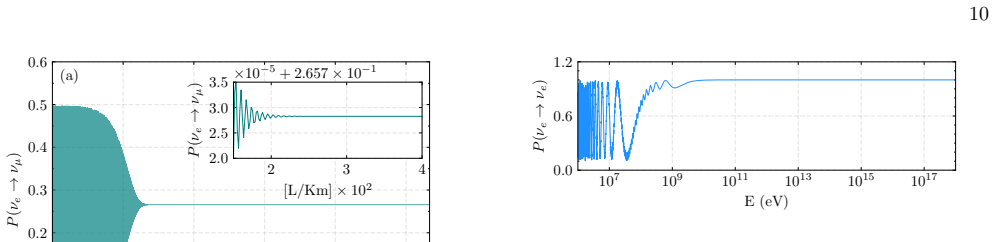
Treating the kappa-Minkowski deformation parameter as Gaussian white noise produces a Lindblad master equation whose decoherence rate scales as the inverse fourth power of energy.
A machine-rendered reading of the paper's core claim, the machinery that carries it, and where it could break.
Core claim
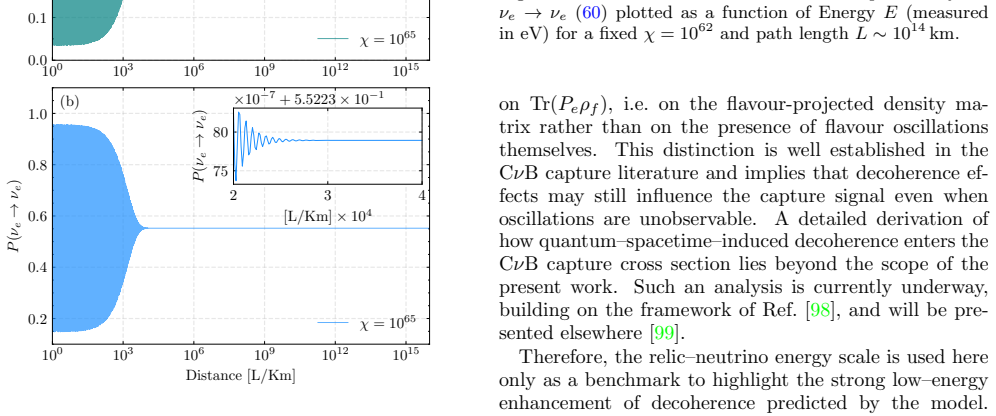
Promoting the deformation parameter of kappa-Minkowski geometry to a Gaussian white-noise process directly determines the Lindblad operators and produces a master equation whose decoherence rate satisfies Gamma proportional to E^{-4}; the resulting damped oscillation probabilities for neutrinos therefore exhibit strongest suppression at the lowest energies.
What carries the argument
The Lindblad master equation obtained by treating the kappa-Minkowski deformation parameter as Gaussian white noise, which supplies both the form of the decoherence operators and the distinctive E^{-4} energy dependence.
If this is right
- The derived master equation applies to any quantum system, not only neutrinos.
- Neutrino survival and transition probabilities acquire explicit exponential damping factors whose magnitude decreases with increasing energy.
- High-energy neutrino data remain essentially unaffected while low-energy regimes become the natural arena for detectable effects.
- The E^{-4} scaling stands in contrast to quantum-gravity models that predict decoherence rates increasing with energy.
Where Pith is reading between the lines
- Precision experiments targeting the cosmic neutrino background could serve as a practical test bed for the framework.
- The same noise-modeling technique might be adapted to other noncommutative geometries or to quantum-information protocols sensitive to Planck-scale fluctuations.
- Low-energy rather than high-energy regimes emerge as the more promising window for Planck-scale signatures under this class of models.
Load-bearing premise
The deformation parameter of kappa-Minkowski geometry can be promoted to a stochastic Gaussian white-noise process whose statistics fix the Lindblad operators.
What would settle it
Measurement of the energy dependence of damping in oscillation probabilities for neutrinos at sub-eV energies, or the absence of such damping, would directly test the predicted inverse-fourth-power scaling.
Figures


read the original abstract
We present a general open-quantum-systems framework to model decoherence induced by stochastic Planck-scale fluctuations of spacetime, focusing on the kappa-Minkowski noncommutative geometry as a representative quantum-gravity scenario. Treating the deformation parameter as Gaussian white noise, we derive a Lindblad-type master equation applicable to arbitrary quantum systems and obtain a distinctive inverse-energy scaling of the decoherence rate, Gamma proportional to E^{-4}. As an illustrative example, we analyze a three-level system motivated by neutrino flavor oscillations and derive closed-form expressions for survival and transition probabilities with spacetime-induced damping. The E^{-4} scaling contrasts sharply with the positive power laws often invoked in quantum-gravity phenomenology and predicts negligible decoherence for high-energy neutrinos consistent with IceCube observations, while implying that the strongest effects arise in the extreme low-energy regime. In this context, the sub-eV-scale energies characteristic of the cosmic neutrino background provide a natural infrared benchmark for illustrating the enhanced sensitivity to quantum-spacetime fluctuations. Our results establish a unified formalism connecting quantum-information methods, open-system dynamics, and quantum-spacetime phenomenology, thereby offering a framework for exploring potential signatures of Planck-scale physics in future low-energy neutrino studies.
Editorial analysis
A structured set of objections, weighed in public.
Referee Report
Summary. The manuscript develops an open-quantum-systems framework for decoherence induced by stochastic Planck-scale fluctuations of spacetime, using kappa-Minkowski noncommutative geometry as an example. Treating the deformation parameter as Gaussian white noise, the authors derive a Lindblad-type master equation for arbitrary quantum systems and obtain a decoherence rate scaling as Gamma proportional to E^{-4}. They apply the framework to a three-level system modeling neutrino flavor oscillations, deriving closed-form survival and transition probabilities that include spacetime-induced damping, and discuss implications for low-energy regimes such as the cosmic neutrino background while noting consistency with high-energy IceCube observations.
Significance. If the derivation holds, the work supplies a unified formalism linking quantum-information methods, open-system dynamics, and quantum-gravity phenomenology. The distinctive E^{-4} scaling contrasts with many other quantum-gravity decoherence models and yields falsifiable predictions: negligible effects at high energies (aligning with existing data) but enhanced sensitivity at sub-eV scales. The closed-form probabilities facilitate direct phenomenological comparison, and the framework offers a concrete route for exploring Planck-scale signatures in future low-energy neutrino experiments.
major comments (1)
- [Abstract and the open-systems framework section] The modeling step that promotes the kappa-Minkowski deformation parameter to a Gaussian white-noise process (abstract and the section deriving the master equation) is introduced without derivation from the underlying commutation relations [x^0, x^i] = i a x^i or from any UV completion. This assumption directly supplies the noise correlator that defines the Lindblad operators and produces the reported E^{-4} scaling; any deviation from white-noise statistics would change both the dissipator and the power law. This assumption is load-bearing for the central claim.
minor comments (1)
- The abstract states that closed-form expressions for survival and transition probabilities are derived, but explicit equation or section references would improve navigation and allow readers to verify the damping terms without searching the full text.
Simulated Author's Rebuttal
We thank the referee for their careful reading of the manuscript and for the positive evaluation of its potential significance. We address the single major comment below.
read point-by-point responses
-
Referee: [Abstract and the open-systems framework section] The modeling step that promotes the kappa-Minkowski deformation parameter to a Gaussian white-noise process (abstract and the section deriving the master equation) is introduced without derivation from the underlying commutation relations [x^0, x^i] = i a x^i or from any UV completion. This assumption directly supplies the noise correlator that defines the Lindblad operators and produces the reported E^{-4} scaling; any deviation from white-noise statistics would change both the dissipator and the power law. This assumption is load-bearing for the central claim.
Authors: We agree that the identification of the deformation parameter with Gaussian white noise is a phenomenological modeling assumption rather than a direct consequence of the kappa-Minkowski commutation relations or any specific UV completion. The commutation relations fix the algebraic structure of noncommutativity but leave the stochastic dynamics of the deformation parameter unspecified; white-noise statistics are adopted to obtain a Markovian Lindblad equation in the standard open-systems manner. This choice produces the reported E^{-4} scaling as a direct consequence. We will revise the manuscript to state this assumption more explicitly in the abstract and framework section, to motivate it via the Markovian approximation appropriate for rapid Planck-scale fluctuations, and to note that other noise correlators would yield different dissipators and scalings. No derivation from first principles is claimed or possible within the present scope. revision: yes
Circularity Check
No significant circularity; derivation follows explicitly from stated modeling assumption.
full rationale
The paper states its central modeling step as treating the kappa-Minkowski deformation parameter as Gaussian white noise, from which the Lindblad master equation and Gamma ~ E^{-4} scaling are derived. This is presented as an explicit assumption in the abstract and framework section, not as a result obtained by fitting parameters to data, self-definition of quantities, or reduction via self-citation chains. No load-bearing step reduces by construction to prior results from the same authors; the scaling is a direct consequence of the white-noise correlator combined with the energy dependence in the Hamiltonian, making the derivation self-contained as an open-systems model without circularity.
Axiom & Free-Parameter Ledger
free parameters (1)
- noise variance of deformation parameter
axioms (2)
- ad hoc to paper The kappa-Minkowski deformation parameter can be treated as Gaussian white noise
- standard math The resulting dynamics admit a Lindblad master equation
Lean theorems connected to this paper
-
IndisputableMonolith/Cost/FunctionalEquationwashburn_uniqueness_aczel unclear?
unclearRelation between the paper passage and the cited Recognition theorem.
Treating the deformation parameter as Gaussian white noise, we derive a Lindblad-type master equation ... and obtain a distinctive inverse-energy scaling of the decoherence rate, Gamma proportional to E^{-4}.
-
IndisputableMonolith/Foundation/AlexanderDualityalexander_duality_circle_linking unclear?
unclearRelation between the paper passage and the cited Recognition theorem.
the algebra of κ-Minkowski spacetime emerges as the flat limit of quantum gravity
What do these tags mean?
- matches
- The paper's claim is directly supported by a theorem in the formal canon.
- supports
- The theorem supports part of the paper's argument, but the paper may add assumptions or extra steps.
- extends
- The paper goes beyond the formal theorem; the theorem is a base layer rather than the whole result.
- uses
- The paper appears to rely on the theorem as machinery.
- contradicts
- The paper's claim conflicts with a theorem or certificate in the canon.
- unclear
- Pith found a possible connection, but the passage is too broad, indirect, or ambiguous to say the theorem truly supports the claim.
Forward citations
Cited by 2 Pith papers
-
Directly computing Wigner functions for open quantum systems
An expression is derived to compute time-dependent Wigner functions directly from initial values in open quantum systems of a non-relativistic particle with a general environment.
-
Spin-Induced Non-Markovian Time-Crystal-Like Dynamics and Fractal Scaling in the Bateman Dual Oscillator
Spin-induced deformation in the Bateman dual oscillator framework yields non-Markovian reduced dynamics with persistent oscillations and fractal scaling that mimic time crystals in a globally unitary quantum system.
Reference graph
Works this paper leans on
-
[1]
and MINOS [32]. Neutrinos, with their unique quan- tum properties and ability to oscillate between different flavors over long distances, offer a promising pathway for probing otherwise inaccessible aspects of spacetime. Due to their weak interaction with matter, neutrinos serve as ideal probes for exploring the fundamental nature of spacetime across vast...
-
[2]
H. D. Zeh, On the interpretation of measurement in quantum theory, Found. Phys.1, 69 (1970)
work page 1970
-
[3]
W. H. Zurek, Decoherence, einselection, and the quan- tum origins of the classical, Rev. Mod. Phys.75, 715 (2003)
work page 2003
-
[4]
Anastopoulos, Frequently asked questions about de- coherence, Int
C. Anastopoulos, Frequently asked questions about de- coherence, Int. J. Theor. Phys.41, 1573 (2002)
work page 2002
-
[5]
Hornberger, Introduction to Decoherence Theory, Lect
K. Hornberger, Introduction to Decoherence Theory, Lect. Notes Phys.768, 221 (2009)
work page 2009
-
[6]
Penrose, On gravity’s role in quantum state reduc- tion, Gen
R. Penrose, On gravity’s role in quantum state reduc- tion, Gen. Relativ. Gravit.28, 581 (1996)
work page 1996
-
[7]
Schlosshauer, Decoherence, the measurement prob- lem, and interpretations of quantum mechanics, Rev
M. Schlosshauer, Decoherence, the measurement prob- lem, and interpretations of quantum mechanics, Rev. Mod. Phys.76, 1267 (2004)
work page 2004
- [8]
-
[9]
T. Guha, B. Bhattacharya, D. Das, S. S. Bhattacharya, A. Mukherjee, A. Roy, K. Mukherjee, N. Ganguly, and A. S. Majumdar, Environmental effects on nonlocal cor- relations, Quanta8, 57 (2019)
work page 2019
-
[10]
R. Chatterjee and A. S. Majumdar, Bell-inequality vi- olation by dynamical Casimir photons in a supercon- ducting microwave circuit, Phys. Rev. A106, 042224 (2022)
work page 2022
-
[11]
I. J. Allali and M. P. Hertzberg, Decoherence from gen- eral relativity, Phys. Rev. D103, 104053 (2021)
work page 2021
-
[12]
P. Nandi and F.G. Scholtz, The hidden Lorentz covari- ance of quantum mechanics, Ann. Phys.464, 169643 (2024)
work page 2024
-
[13]
Quantum Ge- ometric Phases as a New Window on Gravitational Waves,
Partha Nandi and Frederik G. Scholtz, “Quantum Ge- ometric Phases as a New Window on Gravitational Waves,” arXiv:2508.05881 [hep-th], 2025
-
[14]
Leggett, Testing the limits of quantum mechanics: motivation, state of play, prospects, J
A. Leggett, Testing the limits of quantum mechanics: motivation, state of play, prospects, J. Phys.: Condens. Matter14R415 (2002)
work page 2002
-
[15]
I. B. Pittaway and F. G. Scholtz, Quantum interfer- ence on the non-commutative plane and the quantum- to-classical transition, J. Phys. A: Math. Theor.56, 165303 (2023)
work page 2023
-
[16]
D. Trinchero and F. G Scholtz, Pinhole interference in three-dimensional fuzzy space, Ann. Phys.450, 169224 (2023)
work page 2023
- [17]
-
[18]
S. Bhattacharya and N. Joshi, Decoherence and en- tropy generation at one loop in the inflationary de Sitter spacetime for Yukawa interaction, JCAP04, 078 (2024)
work page 2024
-
[19]
L. Petruzziello and F. Illuminati, Quantum gravita- tional decoherence from fluctuating minimal length and deformation parameter at the Planck scale, Nat. Com- mun.12, 4449 (2021)
work page 2021
-
[20]
Michele Arzano and Folkert Kuipers, Stochastic ori- gin of spacetime noncommutativity, Phys. Rev. D111, 025010 (2025)
work page 2025
-
[21]
C. A. Mead, Possible connection between gravitation and fundamental length, Phys. Rev.135, B849 (1964)
work page 1964
-
[22]
Amelino-Camelia, Quantum spacetime phenomenol- ogy, Living Rev
G. Amelino-Camelia, Quantum spacetime phenomenol- ogy, Living Rev. Relativ.16, 5 (2013)
work page 2013
-
[23]
The quantum structure of spacetime at the Planck scale and quantum fields
S. Doplicher, K. Fredenhagen, and J. E. Roberts, The quantum structure of space-time at the Planck scale and quantum fields, Commun. Math. Phys.172, 187 (1995), 13 arXiv:hep-th/0303037
work page internal anchor Pith review Pith/arXiv arXiv 1995
-
[24]
S. W. Hawking, The unpredictability of quantum grav- ity, Commun. Math. Phys.87, 395 (1982)
work page 1982
-
[25]
J. A. Wheeler, Geons, Phys. Rev.97, 511 (1955)
work page 1955
-
[26]
L. Perivolaropoulos, Cosmological horizons, uncertainty principle, and maximum length quantum mechanics, Phys. Rev. D95, 103523 (2017)
work page 2017
-
[27]
F. K. Anagnostopoulos, G. Kofinas, and V. Zarikas, ”IR quantum gravity solves naturally cosmic acceler- ation and its coincidence problem”, Int. J. Mod. Phys. D28, 1944013 (2019)
work page 2019
-
[28]
B. P. Abbottet al.(LIGO Scientific and Virgo Col- laboration), Observation of gravitational waves from a binary black hole merger, Phys. Rev. Lett.116, 061102 (2016)
work page 2016
-
[29]
P. Nandi and B. R. Majhi, Unveiling gravity’s quantum fingerprint through gravitational waves, Phys. Lett. B 857, 138988 (2024)
work page 2024
- [30]
-
[31]
Herceget al., Gravitational probe of quantum space- time, Phys
N. Herceget al., Gravitational probe of quantum space- time, Phys. Lett. B854, 138716 (2024)
work page 2024
-
[32]
T. Adam and N. Agafonovaet al.(The OPERA collabo- ration), Measurement of the neutrino velocity with the OPERA detector in the CNGS beam, J. High Energ. Phys.2012, 93 (2012)
work page 2012
-
[33]
P. Adamsonet al.(MINOS Collaboration), Measure- ment of neutrino velocity with the MINOS detectors and NuMI neutrino beam, Phys. Rev. D76, 072005 (2007)
work page 2007
- [34]
-
[35]
E. Lisi, A. Marrone and D. Montanino, Probing possible decoherence effects in atmospheric neutrino oscillations, Phys. Rev. Lett.85, 1166 (2000)
work page 2000
- [36]
-
[37]
V. D’Esposito and G. Gubitosi, Constraints on quan- tum spacetime-induced decoherence from neutrino os- cillations, Phys. Rev. D110, 026004 (2024)
work page 2024
- [38]
-
[39]
M. D. C. Torri and L. Miramonti, Neutrinos as possible probes for quantum gravity, Class. Quantum Grav.41, 153001 (2024)
work page 2024
-
[40]
A. Domi, T. Eberl, M. J. Fahn, K. Giesel, L. Hennig, U. Katz, R. Kemper, and M. Kobler, “Understanding gravitationally induced decoherence parameters in neu- trino oscillations using a microscopic quantum mechan- ical model,” JCAP11(2024) 006, doi:10.1088/1475- 7516/2024/11/006, arXiv:2403.03106 [gr-qc]
-
[41]
R. Abbasiet al.(The IceCube Collaboration), Detection of astrophysical tau neutrino candidates in IceCube, Eur. Phys. J. C82, 1031 (2022)
work page 2022
-
[42]
R. Abbasiet al.(The IceCube Collaboration), Search for quantum gravity using astrophysical neutrino flavour with IceCube, Nat. Phys.18, 1287 (2022)
work page 2022
-
[43]
R. Abbasiet al.(The IceCube Collaboration), Search- ing for decoherence from quantum gravity at the Ice- Cube south pole neutrino observatory, Nat. Phys.20, 913 (2024)
work page 2024
-
[44]
A. de Gouvˆ ea, V. De Romeri, and C. A. Ternes, Probing neutrino quantum decoherence at reactor experiments, J. High Energ. Phys.2020, 18 (2020)
work page 2020
-
[45]
Stuttard, Neutrino signals of lightcone fluctuations resulting from fluctuating spacetime, Phys
T. Stuttard, Neutrino signals of lightcone fluctuations resulting from fluctuating spacetime, Phys. Rev. D104, 056007 (2021)
work page 2021
-
[46]
Y. Farzan and T. Schwetz, A decoherence explanation of the gallium neutrino anomaly, arXiv:2306.09422
-
[47]
Sch¨ ucher, Forces from Connes Geometry, arXiv:0111236 [hep-th]
T. Sch¨ ucher, Forces from Connes Geometry, arXiv:0111236 [hep-th]
-
[48]
A. H. Chamseddine and A. Connes, Conceptual Ex- planation for the Algebra in the Noncommutative Ap- proach to the Standard Model, Phys. Rev. Lett.99, 191601 (2007)
work page 2007
-
[49]
H.-P. Breuer and F. Petruccione,The Theory of Open Quantum Systems(Oxford University Press, 2002)
work page 2002
- [50]
-
[51]
Lindblad, On the generators of quantum dynamical semigroups, Commun
G. Lindblad, On the generators of quantum dynamical semigroups, Commun. Math. Phys.48, 119 (1976)
work page 1976
-
[52]
S. Majid,Algebraic approach to quantum gravity II: Noncommutative spacetime, inApproaches to quantum gravity: Toward a new understanding of space, time and matter, edited by D. Oriti (Cambridge University Press, Cambridge, 2009)
work page 2009
-
[53]
Wohlgenannt, Non-commutative geometry and physics, Ukr
M. Wohlgenannt, Non-commutative geometry and physics, Ukr. J. Phys.55, 5 (2010)
work page 2010
- [54]
-
[55]
F. Girelli, E. R. Livine, and D. Oriti, Deformed special relativity as an effective flat limit of quantum gravity, Nucl. Phys. B708, 411 (2005)
work page 2005
- [56]
-
[57]
Born, Reciprocity theory of elementary particles, Rev
M. Born, Reciprocity theory of elementary particles, Rev. Mod. Phys.21, 463 (1949)
work page 1949
-
[58]
C. C. Perelman, Born’s reciprocal relativity theory, curved phase space, Finsler geometry and the cosmo- logical constant, Ann. Phys.416, 168143 (2020)
work page 2020
-
[59]
V. Barger, J.G. Learned, S. Pakvasa, and T.J. Weiler, Neutrino decay as an explanation of atmospheric neu- trino observations, Phys. Rev. Lett.82, 2640 (1999)
work page 1999
-
[60]
G. Amelino-Camelia, L. Smolin, and A. Starodubt- sev, Quantum symmetry, the cosmological constant and Planck scale phenomenology, Class. Quantum Grav.21, 3095 (2004)
work page 2004
-
[61]
J. Lukierski, H. Ruegg and W. R¨ uhl, Fromκ-Poincar´ e algebra toκ-Lorentz quasigroup. A deformation of rel- ativistic symmetry, Phys. Lett. B313, 357 (1993)
work page 1993
-
[62]
E R. Livine and D. Oriti, About Lorentz invariance in a discrete quantum setting, J. High Energ. Phys.2004, 050 (2004)
work page 2004
-
[63]
R. H. Sanders and S. S. McGaugh, Modified Newtonian dynamics as an alternative to dark matter, Ann. Rev. Astron. Astrophys.40, 263 (2002)
work page 2002
- [64]
-
[65]
T. R. Govindarajan, K. S. Gupta, E. Harikumar, S. Meljanac, and D. Meljanac, Deformed oscillator alge- bras and QFT inκ-Minkowski Spacetime, Phys. Rev. D 80, 025014 (2009)
work page 2009
-
[66]
E. Harikumar, T. Juri´ c, and S. Meljanac, Electrody- namics onκ-Minkowski space-time, Phys. Rev. D,84, 085020 (2011)
work page 2011
-
[67]
Bosso, On the quasi-position representation in the- ories with a minimal length, Class
P. Bosso, On the quasi-position representation in the- ories with a minimal length, Class. Quant. Grav.38, 075021 (2021)
work page 2021
-
[68]
P. Bosso and G. G. Luciano, Generalized uncertainty principle: from the harmonic oscillator to a QFT toy model, Eur. Phys. J. C,81, 982, (2021)
work page 2021
-
[69]
E. Harikumar, T. Juri´ c, and S. Meljanac, Geodesic equation inκ-Minkowski spacetime, Phys. Rev. D86, 045002 (2012)
work page 2012
-
[70]
F. J. Dyson, Feynman’s proof of the Maxwell equations, Am. J. Phys.58, 209 (1990)
work page 1990
-
[71]
S. Tanimura, Relativistic generalization and extension to the non-Abelian gauge theory of Feynman’s proof of the Maxwell equations, Ann. Phys.220, 229 (1992)
work page 1992
-
[72]
C. Rovelli and L. Smolin, Spin networks and quantum gravity, Phys. Rev. D52, 5743 (1995)
work page 1995
-
[73]
G’t Hooft, Deterministic quantum mechanics, Fundam. Theor. Phys.185, 49 (2006)
work page 2006
-
[74]
E. Al-Nasrallah, S. Das, F. Illuminati, L. Petruzziello, and E. C. Vagenas, Discriminating quantum gravity models by gravitational decoherence, Nucl. Phys. B 992, 116246 (2023)
work page 2023
-
[75]
S. Donadi and M. Fadel, Quantum gravitational deco- herence of a mechanical oscillator from spacetime fluc- tuations, Phys. Rev. D111, 026009 (2025)
work page 2025
-
[76]
F. Benatti and R. Floreanini, Open system approach to neutrino oscillations, J. High Energ. Phys.2000, 032, (2000)
work page 2000
-
[77]
D. Ghosh and B. R. Majhi, Influence of thermal bath on Pancharatnam-Berry phase in an accelerated frame, Phys. Lett. B858, 139015 (2024)
work page 2024
-
[78]
Kayser, On the quantum mechanics of neutrino os- cillation, Phys
B. Kayser, On the quantum mechanics of neutrino os- cillation, Phys. Rev. D24, 110 (1981)
work page 1981
-
[79]
R. N. Mohapatra and P. B. Pal,Massive Neutrinos in Physics and Astrophysics(World Scientific Lecture Notes in Physics: Vol 72, Singapore, 1991)
work page 1991
-
[80]
R. L. Workmanet al. (Particle Data Group), Review of Particle Physics, Prog. Theor. Exp. Phys.2022, 083C01 (2022)
work page 2022
discussion (0)
Sign in with ORCID, Apple, or X to comment. Anyone can read and Pith papers without signing in.