Probing CP-Violating Neutral Triple Gauge Couplings at Electron-Positron Colliders
Pith reviewed 2026-05-22 18:44 UTC · model grok-4.3
The pith
Electron-positron colliders can probe CP-violating neutral triple gauge couplings with new physics scales reaching O(10 TeV).
A machine-rendered reading of the paper's core claim, the machinery that carries it, and where it could break.
Core claim
We study the CP-violating neutral triple gauge couplings realized via dimension-8 operators in SMEFT, present a new formulation of the CPV nTGC form factors compatible with spontaneous electroweak symmetry breaking, match these form factors to the operators in the broken phase, and demonstrate that e+e- colliders with energies up to 5 TeV and polarized beams can reach sensitivities to the new physics scale of O(10 TeV) and to the form factors of O(10^{-6} to 10^{-8}).
What carries the argument
Dimension-8 CP-violating neutral triple gauge coupling operators in SMEFT, matched to a new set of CPV nTGC form factors that remain consistent after electroweak symmetry breaking.
If this is right
- Sensitivities to the new physics scale of nTGCs improve from O(TeV) at 250 GeV to O(10 TeV) at 3-5 TeV colliders.
- Form-factor sensitivities range from O(10^{-4}) at 250 GeV to O(10^{-6}-10^{-8}) at 3-5 TeV.
- Electron and positron beam polarizations measurably enhance the ability to constrain the CPV couplings.
- The formulation ensures the form factors respect the broken-phase gauge symmetry without introducing inconsistencies.
Where Pith is reading between the lines
- If signals appear at the predicted levels, they would point to new CP-violating physics appearing first in gauge-boson self-interactions rather than in fermion couplings.
- The same operator matching technique could be applied to other dimension-8 structures involving multiple gauge bosons to check for similar sensitivity gains at higher energies.
- Non-observation at the highest energies would tighten bounds on the coefficient of the leading CP-odd dimension-8 operator in a manner complementary to Higgs or top-quark searches.
Load-bearing premise
The CP-violating neutral triple gauge couplings arise only from dimension-8 SMEFT operators and allow a consistent matching to form factors once the electroweak symmetry is broken.
What would settle it
A collider measurement finding no CP-violating signal in neutral triple gauge boson production at a level better than 10^{-6} at 3 TeV or worse than 10^{-4} at 250 GeV would contradict the calculated sensitivity reach.
Figures

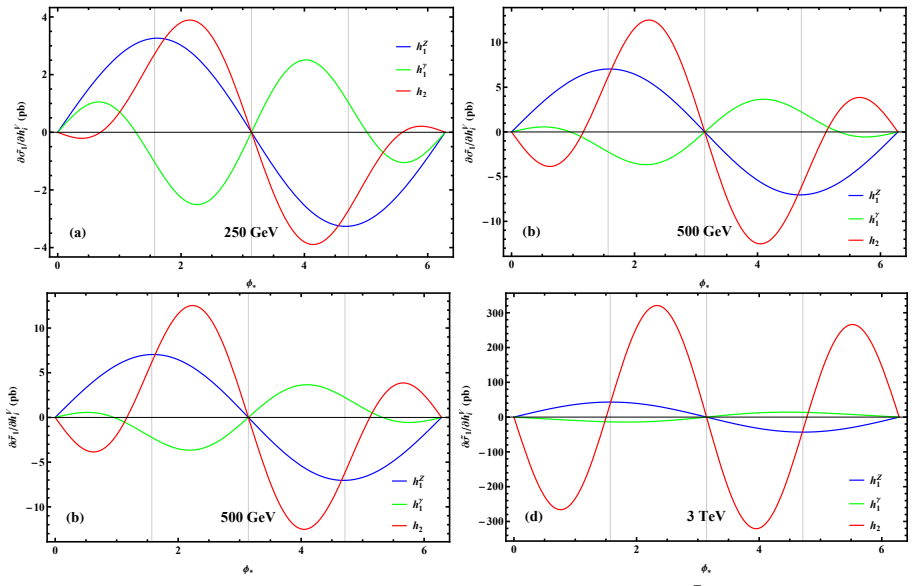


read the original abstract
We study the CP-violating (CPV) neutral triple gauge couplings (nTGCs) that can be realized via dimension-8 operators in the Standard Model Effective Field Theory (SMEFT). We present a new formulation of the CPV nTGC form factors that is compatible with spontaneous breaking of the electroweak gauge symmetry, and show how these CPV form factors can be matched consistently with the corresponding dimension-8 CPV nTGC operators in the broken phase. We then study probes of the CPV nTGCs at future high-energy $e^+e^-$ colliders with centre-of-mass energies $\sqrt{s}=(0.25, 0.5, 1, 3, 5)$TeV respectively, demonstrating that the $e^{\mp}$ beam polarizations can help to improve the sensitivities of probes of the nTGCs. We estimate that the sensitivity reaches for probing the new physics scales of nTGCs can range from ${O}(\rm{TeV})$ at a 250GeV $e^+e^-$ collider to ${O}(10\,\rm{TeV})$ at an $e^+e^-$ collider of energy $(3-5)$TeV, and that the sensitivities to the nTGC form factors vary from ${O}(10^{-4})$ to ${O}(10^{-6}-10^{-8})$ for the $e^+e^-$ collision energy from 250GeV to $(3-5)$TeV.
Editorial analysis
A structured set of objections, weighed in public.
Referee Report
Summary. The manuscript studies CP-violating neutral triple gauge couplings realized via dimension-8 operators in SMEFT. It introduces a formulation of CPV nTGC form factors consistent with spontaneous electroweak symmetry breaking, demonstrates their matching to the operators in the broken phase, and performs sensitivity projections for e+e- colliders at sqrt(s) = 0.25, 0.5, 1, 3, and 5 TeV. The central results are that beam polarization improves reach, new-physics scales can be probed from O(TeV) at 250 GeV to O(10 TeV) at 3-5 TeV, and form-factor sensitivities range from O(10^{-4}) to O(10^{-6}-10^{-8}).
Significance. If the projections are robust, the work supplies concrete benchmarks for future e+e- collider searches for CP-violating nTGCs and illustrates the utility of polarization. The operator-to-form-factor matching provides a technically useful bridge between the SMEFT and phenomenological descriptions.
major comments (1)
- [Abstract and high-energy sensitivity projections] Abstract and the high-energy sensitivity projections (presumably Sec. 4-5 and associated tables): the claimed O(10 TeV) reach and 10^{-8} form-factor bounds at 3-5 TeV assume the dimension-8 EFT remains valid up to the quoted scales. For CP-odd dim-8 operators the amplitude grows ~s^2/Lambda^4; at sqrt(s)=5 TeV and Lambda=10 TeV the dimensionless coefficient is O(0.06), which is large enough to drive the J=0 partial wave |Re a_0| above the unitarity bound 1/2 in the high-energy limit. No unitarity bounds, cutoff-scale checks, or partial-wave analysis are reported for the benchmark points used in the sensitivity tables. This directly affects the defensibility of the highest-energy claims.
minor comments (2)
- [Abstract] The abstract lists the collider energies but does not explicitly name the processes (e.g., e+e- -> ZZ, Z gamma) used for the projections; adding this would improve clarity.
- [Introduction and matching section] Notation for the CPV form factors (introduced after the operator matching) could be cross-referenced more explicitly to the Wilson coefficients to aid readers.
Simulated Author's Rebuttal
We thank the referee for the careful reading of our manuscript and for the constructive comment on the high-energy projections. We address the point below and will revise the manuscript accordingly to strengthen the presentation.
read point-by-point responses
-
Referee: [Abstract and high-energy sensitivity projections] Abstract and the high-energy sensitivity projections (presumably Sec. 4-5 and associated tables): the claimed O(10 TeV) reach and 10^{-8} form-factor bounds at 3-5 TeV assume the dimension-8 EFT remains valid up to the quoted scales. For CP-odd dim-8 operators the amplitude grows ~s^2/Lambda^4; at sqrt(s)=5 TeV and Lambda=10 TeV the dimensionless coefficient is O(0.06), which is large enough to drive the J=0 partial wave |Re a_0| above the unitarity bound 1/2 in the high-energy limit. No unitarity bounds, cutoff-scale checks, or partial-wave analysis are reported for the benchmark points used in the sensitivity tables. This directly affects the defensibility of the highest-energy claims.
Authors: We appreciate the referee's observation on the importance of unitarity constraints for the dimension-8 operators. Our sensitivity projections are computed directly from the cross sections within the SMEFT, with the new-physics scale Λ inferred from the form-factor bounds under the assumption that the EFT provides a valid description up to the collider energies. We agree that an explicit discussion of unitarity is warranted to support the highest-energy claims. In the revised manuscript we will add a partial-wave analysis for the relevant CP-violating processes, verifying that |Re a_0| remains below the unitarity bound for the benchmark points at each collider energy. We will also qualify the quoted reaches in the abstract and results sections by noting the range of validity of the EFT. This addition will not alter the reported form-factor sensitivities, which are obtained model-independently from the collider observables, but will make the interpretation of the derived Λ scales more robust. revision: yes
Circularity Check
No circularity: sensitivity projections derived from standard SMEFT matching and collider kinematics
full rationale
The paper defines CPV nTGC form factors via explicit matching to dimension-8 SMEFT operators after EWSB, then computes projected reaches at future e+e- colliders from cross-section scaling and statistical significance. No equation reduces the quoted O(TeV) to O(10 TeV) sensitivities or 10^{-4} to 10^{-8} form-factor bounds to a fitted parameter or self-citation by construction. The derivation remains self-contained against external benchmarks such as SMEFT power counting and collider luminosity assumptions.
Axiom & Free-Parameter Ledger
free parameters (1)
- Wilson coefficients of dimension-8 CPV nTGC operators
axioms (1)
- domain assumption Spontaneous breaking of SU(2)_L x U(1)_Y electroweak gauge symmetry
Lean theorems connected to this paper
-
IndisputableMonolith/Foundation/RealityFromDistinction.leanreality_from_one_distinction unclear?
unclearRelation between the paper passage and the cited Recognition theorem.
We study the CP-violating (CPV) neutral triple gauge couplings (nTGCs) that can be realized via dimension-8 operators in the Standard Model Effective Field Theory (SMEFT).
What do these tags mean?
- matches
- The paper's claim is directly supported by a theorem in the formal canon.
- supports
- The theorem supports part of the paper's argument, but the paper may add assumptions or extra steps.
- extends
- The paper goes beyond the formal theorem; the theorem is a base layer rather than the whole result.
- uses
- The paper appears to rely on the theorem as machinery.
- contradicts
- The paper's claim conflicts with a theorem or certificate in the canon.
- unclear
- Pith found a possible connection, but the passage is too broad, indirect, or ambiguous to say the theorem truly supports the claim.
Forward citations
Cited by 1 Pith paper
-
Probing Neutral Triple Gauge Couplings via $ZZ$ Production at $e^+e^-$ Colliders with Machine Learning
Formulates nTGC form factors from dim-8 SMEFT operators compatible with electroweak symmetry breaking and applies machine learning to fermion angular distributions to probe new physics scales up to multi-TeV in ZZ pro...
Reference graph
Works this paper leans on
-
[1]
Be- yond Standard Model: From Theory to Experiment
For recent reviews, see John Ellis, arXiv:2105.14942 [hep-ph], in the conference proceedings of “Be- yond Standard Model: From Theory to Experiment” (BSM-2021), Zewail City, Egypt, March29-31, 2021; I. Brivio and M. Trott, Phys. Rept. 793 (2019) 1 [arXiv:1706.08945 [hep-ph]]; and references therein
-
[2]
A basis of dimension-eight operators for anomalous neutral triple gauge boson interactions
C. Degrande, JHEP 02 (2014) 101 [arXiv:1308.6323 [hep-ph]]
work page internal anchor Pith review Pith/arXiv arXiv 2014
-
[3]
J. Ellis, H.-J. He, R.-Q. Xiao, S.-P. Zeng, and J. Zheng, Phys. Rev. D 111 (2025) 015007, no.1 [arXiv:2408.12508]
-
[4]
J. Ellis, H.-J. He, R.-Q. Xiao, and S.-P. Zeng, Phys. Rev. D (2025), arXiv:2506.21433
work page internal anchor Pith review Pith/arXiv arXiv 2025
- [5]
-
[6]
J. Ellis, H.-J. He, and R.-Q. Xiao, Phys. Rev. D108 (2023) L111704, no.11 [arXiv:2308.16887]
-
[7]
J. Ellis, H.-J. He, and R.-Q. Xiao, Phys. Rev. D107 (2023) 035005, no.3 [arXiv:2206.11676]
-
[8]
J. Ellis, H.-J. He, and R.-Q. Xiao, Science China (Phys.Mech.Astron.) 64 (2021) 221062, no.2, [arXiv:2008.04298]
-
[9]
J. Ellis, S.F.Ge, H.-J. He, R.-Q. Xiao, Chin. Phys. C44 (2020) 063106, no.6 [arXiv:1902.06631]
-
[10]
Jahedi, JHEP 12 (2023) 031 [arXiv:2305.11266 [hep-ph]]; S
E.g., S. Jahedi, JHEP 12 (2023) 031 [arXiv:2305.11266 [hep-ph]]; S. Spor, E. Gurkanli and M. Köksal, arXiv:2302.08245 [hep-ph]; S. Jahedi and J. Lahiri, JHEP 04 (2023) 085 [arXiv: 2212.05121 [hep-ph]]; S. Spor, Nucl. Phys. B991 (2023) 116198 [arXiv:2207.11585 [hep-ph]]; A. Senol, S. Spor, E. Gurkanli, V. Cetinkaya, H. Denizli, and M. Köksal, Eur. Phys. J....
-
[11]
G.J.Gounaris, J.Layssac, F.M.Renard, Phys.Rev.D61(2000)073013[arXiv:hep-ph/9910395]
work page internal anchor Pith review Pith/arXiv arXiv 2000
- [12]
-
[13]
F. Englert and R. Brout, Phys. Rev. Lett. 13 (1964) 321; P. W. Higgs, Phys. Rev. Lett. 13 (1964) 508; Phys. Lett. 12 (1964) 132; G. S. Guralnik, C. R. Hagen and T. Kibble, Phys. Rev. Lett. 13 (1964) 585; T. Kibble, Phys. Rev. 155 (1967) 1554
work page 1964
-
[14]
On polarization parameters of spin-$1$ particles and anomalous couplings in $e^+e^-\to ZZ/Z\gamma$
R. Rahaman and R. K. Singh, Eur. Phys. J. C76 (2016) 539 [arXiv:1604.06677 [hep-ph]]
work page internal anchor Pith review Pith/arXiv arXiv 2016
-
[15]
B. Ananthanarayan, J. Lahiri, M. Patra and S. D. Rindani, JHEP 08 (2014) 124 [arXiv:1404.4845 [hep-ph]]
work page internal anchor Pith review Pith/arXiv arXiv 2014
-
[16]
Global Analysis for Probing Electroweak Symmetry Breaking Mechanism at High Energy Colliders
For a comprehensive review, see H. J. He, Y.P.Kuang and C.P.Yuan, arXiv:hep-ph/9704276 and DESY-97-056, in the proceedings of the workshop on “Physics at the TeV Energy Scale”, vol.72, p.119, 1996. See also, H. J. He and W.B. Kilgore, Phys. Rev. D 55 (1997) 1515; H. J. He, Y.P. Kuang and C.P. Yuan, Phys. Rev. D 51 (1995) 6463; Phys. Rev. D 55 (1997) 3038;...
work page internal anchor Pith review Pith/arXiv arXiv 1996
-
[17]
Navaset al.,[Particle Data Group], Phys
S. Navaset al.,[Particle Data Group], Phys. Rev. D110 (2024) 030001
work page 2024
-
[18]
W. Abdallahet al.[CEPC Study Group], Radiat. Detect. Technol. Methods 8 (2024) 1-1105, no.1, [erratum:ibid.9 (2025) 184-192, no.1] [arXiv:2312.14363 [physics.acc-ph]]
-
[19]
K. Fujii, C. Grojean, and M. E. Peskinet al.,arXiv:1801.02840 [hep-ph]
work page internal anchor Pith review Pith/arXiv arXiv
-
[20]
For a review, D. E. Morrissey and M. J. Ramsey-Musolf, New J. Phys. 14 (2012) 125003 [arXiv:1206.2942 [hep-ph]]. 22
work page internal anchor Pith review Pith/arXiv arXiv 2012
discussion (0)
Sign in with ORCID, Apple, or X to comment. Anyone can read and Pith papers without signing in.