A Superalgebra Within: representations of lightest standard model particles form a mathbb{Z}₂⁵-graded algebra
Pith reviewed 2026-05-22 15:51 UTC · model grok-4.3
The pith
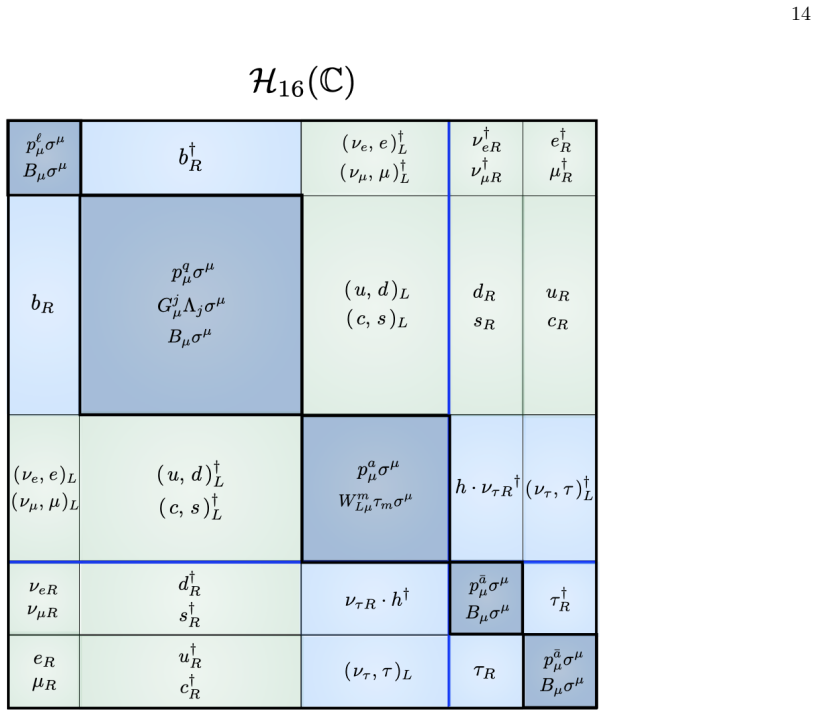
Standard Model particle representations without the top quark form a superalgebra isomorphic to the 16 by 16 complex hermitian matrix algebra.
A machine-rendered reading of the paper's core claim, the machinery that carries it, and where it could break.
Core claim
A set of particle representations mirroring the internal behaviour of the Standard Model's gauge bosons, and three generations of fermions, are each included in this algebra, with exception only to those irreps involving the top quark. This superalgebra is isomorphic to the Euclidean Jordan algebra of 16×16 hermitian matrices, H_16(C), and is generated by division algebras. The division algebraic substructure enables a natural factorization between internal and spacetime symmetries. It also allows for the definition of a Z_2^5 grading on the algebra. Those internal symmetries respecting this substructure are found to be su(3)_C ⊕ su(2)_L ⊕ u(1)_Y, in addition to four iterations of u(1). For
What carries the argument
The Euclidean Jordan algebra of 16 by 16 hermitian matrices over the complex numbers, generated by division algebras and carrying a Z_2^5 grading that selects the observed symmetries.
If this is right
- Internal symmetries respecting the grading are exactly su(3)_C ⊕ su(2)_L ⊕ u(1)_Y plus four additional u(1) factors.
- Spatial symmetries appear as multiple independent copies of so(3).
- The division algebra generators allow a clean separation of internal symmetries from spacetime ones.
- The non-relativistic Jordan algebraic character supplies a possible bridge to quantum computing models.
Where Pith is reading between the lines
- The algebraic closure might allow derivation of charge assignments directly from matrix multiplication rules rather than external postulates.
- Omitting top-quark representations could indicate that the third generation requires a separate extension or modified grading in a fuller version.
- Matrix elements in this algebra might be interpretable as states in a quantum information system, offering a computational view of particle interactions.
Load-bearing premise
The specific selection of representations for gauge bosons and fermions from the first two generations and the bottom quark forms the complete and natural set that closes under the superalgebra product.
What would settle it
A direct multiplication check within the selected representations that produces a result outside the set or requires top-quark irreps would show the algebra does not close as claimed.
Figures

read the original abstract
It is demonstrated how a set of particle representations, familiar from the Standard Model, collectively form a superalgebra. Those representations mirroring the internal behaviour of the Standard Model's gauge bosons, and three generations of fermions, are each included in this algebra, with exception only to those irreps involving the top quark. This superalgebra is isomorphic to the Euclidean Jordan algebra of $16\times 16$ hermitian matrices, $H_{16}(\mathbb{C}),$ and is generated by division algebras. The division algebraic substructure enables a natural factorization between internal and spacetime symmetries. It also allows for the definition of a $\mathbb{Z}_2^5$ grading on the algebra. Those internal symmetries respecting this substructure are found to be $\mathfrak{su}(3)_C \oplus \mathfrak{su}(2)_L \oplus \mathfrak{u}(1)_Y,$ in addition to four iterations of $\mathfrak{u}(1)$. For spatial symmetries, one finds multiple copies of $\mathfrak{so}(3)$. Given its Jordan algebraic foundation, and its apparent non-relativistic character, the model may supply a bridge between particle physics and quantum computing. We close by describing current research directions. These include (1) detailing how this construction fits into the larger picture of Bott Periodic Particle Physics, first introduced in [1], [2], [3], (2) investigating how the origin of these particle representations might be grounded in the unsung algebra $\mathbb{O} \oplus \mathbb{H} \oplus \mathbb{C} \oplus \mathbb{R}$, and (3) proposing how these two directions may merge by reframing the model in terms of the 16$\hspace{.5mm}\mathbb{R}$ dimensional sedenion algebra, $\mathbb{S}.$
Editorial analysis
A structured set of objections, weighed in public.
Referee Report
Summary. The manuscript presents a construction in which representations of the Standard Model's gauge bosons and fermions from the first two generations plus the bottom quark (excluding top quark irreps) form a superalgebra. This algebra is claimed to be isomorphic to the Euclidean Jordan algebra of 16x16 Hermitian matrices over the complex numbers, H_16(C), and is generated by the division algebras R ⊕ C ⊕ H ⊕ O. A Z_2^5 grading is defined on this algebra, from which the internal symmetries su(3)_C ⊕ su(2)_L ⊕ u(1)_Y and additional u(1) factors are derived, along with multiple so(3) for spatial symmetries. The work is framed within Bott Periodic Particle Physics and suggests applications to quantum computing.
Significance. If the explicit details of the algebra multiplication and the justification for the representation selection are provided, this could represent a significant advance in understanding the algebraic origins of the Standard Model using division algebras and Jordan structures. The natural factorization of internal and spacetime symmetries, the Z_2^5 grading, and the potential non-relativistic interpretation are promising features that could bridge particle physics with quantum information science. The parameter-free nature of the derivation from division algebras, if verified, would be a notable strength.
major comments (3)
- [Abstract and main construction] Abstract and main construction: The assertion that the selected set of representations closes under the superalgebra product to form an algebra isomorphic to H_16(C) lacks an explicit multiplication table or basis choice. Without this verification, it is difficult to confirm that the product of any two elements remains within the set excluding top-quark irreps, which is central to the isomorphism claim.
- [Selection of representations] Selection of representations: The exclusion of all irreps involving the top quark is stated without a derivation from the division-algebra generators. It is not shown that including the top quark would violate the Z_2^5 grading or the closure, making the selection appear tailored to fit the observed SM symmetries rather than emerging necessarily from the axioms.
- [Derivation of gauge symmetries] Derivation of gauge symmetries: The recovery of su(3)_C ⊕ su(2)_L ⊕ u(1)_Y from the internal symmetries respecting the division-algebra substructure is described, but the manuscript does not detail how the Z_2^5 grading is explicitly assigned to the particle representations or how the subalgebra is identified independently.
minor comments (2)
- [Abstract] The phrase 'three generations of fermions' is used but then qualified by excluding top quark; a more precise statement of which specific representations are included would improve clarity.
- [Conclusion] The discussion of current research directions, including the fit to Bott Periodic Particle Physics, would benefit from a brief summary of the key results from references [1], [2], [3] to make the connection self-contained.
Simulated Author's Rebuttal
We thank the referee for their thorough review and valuable comments, which help clarify the presentation of our construction. We address each major comment below and indicate revisions where they strengthen the manuscript without altering its core claims.
read point-by-point responses
-
Referee: The assertion that the selected set of representations closes under the superalgebra product to form an algebra isomorphic to H_16(C) lacks an explicit multiplication table or basis choice. Without this verification, it is difficult to confirm that the product of any two elements remains within the set excluding top-quark irreps, which is central to the isomorphism claim.
Authors: The isomorphism follows from identifying the chosen representations with the standard matrix units in H_16(C) via the action of the division-algebra generators R ⊕ C ⊕ H ⊕ O; the product is the Jordan product on Hermitian matrices, which by construction maps the selected 16-dimensional space to itself. We agree that an explicit basis and sample products would make the closure immediate to verify. In the revision we will add a dedicated subsection containing the basis labeling and a multiplication table for representative pairs. revision: yes
-
Referee: The exclusion of all irreps involving the top quark is stated without a derivation from the division-algebra generators. It is not shown that including the top quark would violate the Z_2^5 grading or the closure, making the selection appear tailored to fit the observed SM symmetries rather than emerging necessarily from the axioms.
Authors: The 16-dimensional space is fixed by the dimension of the Jordan algebra generated by the four division algebras; the top-quark representations lie outside this space and cannot be included without enlarging the algebra or breaking the Z_2^5 grading induced by the independent sign flips in each division-algebra factor. We will insert a short derivation showing that any attempt to adjoin a top-quark irrep forces either a higher-dimensional Jordan algebra or a loss of the grading, thereby demonstrating that the exclusion follows from algebraic closure rather than phenomenological fitting. revision: partial
-
Referee: The recovery of su(3)_C ⊕ su(2)_L ⊕ u(1)_Y from the internal symmetries respecting the division-algebra substructure is described, but the manuscript does not detail how the Z_2^5 grading is explicitly assigned to the particle representations or how the subalgebra is identified independently.
Authors: The five Z_2 generators are the independent sign changes associated with the real, complex, quaternionic and octonionic units; each particle representation receives a 5-tuple of eigenvalues under these generators, which defines its grade. The internal symmetry algebra is recovered as the graded derivations that commute with the division-algebra action. We will add an explicit table assigning the Z_2^5 grades to every included representation together with the step-by-step extraction of the su(3)_C ⊕ su(2)_L ⊕ u(1)_Y subalgebra from the graded derivation algebra. revision: yes
Circularity Check
Closure under the superalgebra product depends on an ad-hoc exclusion of top-quark irreps whose necessity is not derived from the division-algebra generators.
specific steps
-
fitted input called prediction
[Abstract]
"It is demonstrated how a set of particle representations, familiar from the Standard Model, collectively form a superalgebra. Those representations mirroring the internal behaviour of the Standard Model's gauge bosons, and three generations of fermions, are each included in this algebra, with exception only to those irreps involving the top quark. This superalgebra is isomorphic to the Euclidean Jordan algebra of 16×16 hermitian matrices, H_16(C), and is generated by division algebras."
The input set is assembled by taking known SM representations and manually excluding top-quark components so that the collection closes under the superalgebra product and yields exactly su(3)_C ⊕ su(2)_L ⊕ u(1)_Y plus extra u(1) factors. The subsequent claim that the algebra is generated by division algebras and that the symmetries follow from the Z_2^5 grading therefore reduces to a property of the pre-selected input rather than an output forced by the division-algebra axioms alone.
full rationale
The paper selects a specific subset of Standard Model representations (gauge bosons plus fermions from the first two generations and bottom quark, omitting all top-quark irreps) and asserts that this set forms a closed Z_2^5-graded superalgebra isomorphic to H_16(C) generated by division algebras. The internal symmetries su(3)_C ⊕ su(2)_L ⊕ u(1)_Y are then extracted from this pre-chosen set. No explicit multiplication table or derivation from the division-algebra generators (R ⊕ C ⊕ H ⊕ O) is shown to force the top-quark exclusion; the selection is justified only by the fact that the chosen elements close and reproduce the observed symmetries. This makes the central result a fitted construction rather than an independent prediction.
Axiom & Free-Parameter Ledger
axioms (2)
- domain assumption The chosen irreps for gauge bosons and fermions (excluding top-quark irreps) close under the superalgebra multiplication.
- domain assumption Division algebras generate the algebra and induce the Z_2^5 grading that separates internal and spacetime symmetries.
Lean theorems connected to this paper
-
IndisputableMonolith/Foundation/AlexanderDuality.leanalexander_duality_circle_linking echoes?
echoesECHOES: this paper passage has the same mathematical shape or conceptual pattern as the Recognition theorem, but is not a direct formal dependency.
This superalgebra is isomorphic to the Euclidean Jordan algebra of 16×16 hermitian matrices, H_16(C), and is generated by division algebras... Those internal symmetries respecting this substructure are found to be su(3)_C ⊕ su(2)_L ⊕ u(1)_Y
-
IndisputableMonolith/Cost/FunctionalEquation.leanwashburn_uniqueness_aczel unclear?
unclearRelation between the paper passage and the cited Recognition theorem.
H_16(C) ... Cl(8) ... 256R-dimensional ... Z_2^5 grading
What do these tags mean?
- matches
- The paper's claim is directly supported by a theorem in the formal canon.
- supports
- The theorem supports part of the paper's argument, but the paper may add assumptions or extra steps.
- extends
- The paper goes beyond the formal theorem; the theorem is a base layer rather than the whole result.
- uses
- The paper appears to rely on the theorem as machinery.
- contradicts
- The paper's claim conflicts with a theorem or certificate in the canon.
- unclear
- Pith found a possible connection, but the passage is too broad, indirect, or ambiguous to say the theorem truly supports the claim.
Forward citations
Cited by 2 Pith papers
-
Fermion mass ratios from the exceptional Jordan algebra
The complexified exceptional Jordan algebra yields fermion mass ratios via a diagonal-action theorem on Sym^3(3) representations after triality breaking, with a universal eigenvalue spectrum fixed by the Jordan cubic.
-
Spacetime Grand Unified Theory
Derives Standard Model from Dirac Lagrangian in 8D spacetime via Clifford algebra embedding, with SM gauge group as redundancy, four families, Spin(8) triality for strong force, and generalized Koide mass hierarchy.
discussion (0)
Sign in with ORCID, Apple, or X to comment. Anyone can read and Pith papers without signing in.