mathcal{PT-}Symmetric Two-Level Open Quantum Systems: Information Theoretic Facets
Pith reviewed 2026-05-22 13:47 UTC · model grok-4.3
The pith
A PT-symmetric two-level Hamiltonian admits a first-principles generalized Lindblad master equation derived from a light-matter interaction model.
A machine-rendered reading of the paper's core claim, the machinery that carries it, and where it could break.
Core claim
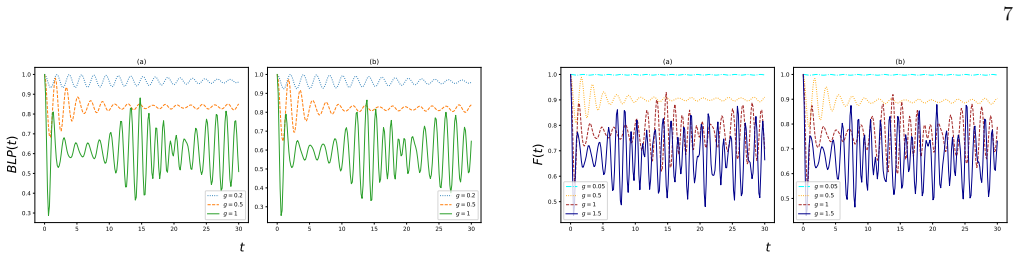
The central claim is that a first-principles derivation of the generalized Gorini-Kossakowski-Sudarshan-Lindblad master equation appropriate for a PT-symmetric Hamiltonian is possible, inspired by a simple light-matter interaction open system model. This enables calculation of information-theoretic quantities such as a non-Markovian witness and fidelity for the PT-symmetric Hamiltonian, with results compared to their Hermitian two-level counterparts, while the nature of entanglement between two PT-symmetric and Hermitian open quantum systems is calculated to observe the contrast.
What carries the argument
The generalized Gorini-Kossakowski-Sudarshan-Lindblad master equation adapted for PT-symmetric Hamiltonians, derived via a light-matter interaction model that incorporates the non-Hermitian dynamics while preserving the open-system evolution structure.
If this is right
- The non-Markovian witness exhibits distinct time-dependent signatures for PT-symmetric evolution compared with Hermitian evolution.
- Fidelity between initial and evolved states follows a modified trajectory under the generalized master equation.
- Entanglement measures between two PT-symmetric open systems differ quantitatively from those between Hermitian counterparts.
- The framework supplies a consistent route to compute information loss and recovery rates in systems with balanced gain and loss.
Where Pith is reading between the lines
- The same light-matter derivation route could be applied to construct master equations for higher-dimensional PT-symmetric systems.
- Observed differences in entanglement suggest possible advantages for information transfer protocols that exploit gain-loss balance.
- Experimental tests in optical lattices or superconducting circuits could directly measure the predicted contrast in non-Markovianity.
Load-bearing premise
The PT-symmetric Hamiltonian can be incorporated into a Lindblad-type master equation via a light-matter interaction model without introducing inconsistencies that invalidate the subsequent information-theoretic calculations.
What would settle it
A numerical simulation or experiment on a controlled PT-symmetric optical or atomic system in which the derived master equation produces negative probabilities or yields a non-Markovianity witness that deviates from the predicted contrast with Hermitian dynamics would falsify the claim.
Figures



read the original abstract
The theory of a two-level $\eta$-Hermitian Hamiltonian with $\mathcal{PT}$ symmetry is reviewed and extended to include open system dynamics. A first-principles derivation of the generalized Gorini-Kossakowski-Sudarshan-Lindblad master equation appropriate for a $\mathcal{PT}-$symmetric Hamiltonian is presented. Inspired by a simple light matter interaction open system model, information theoretic quantities like a non-Markovian witness and fidelity are calculated for the $\mathcal{PT-}$symmetric Hamiltonian, and the results are compared with their corresponding two-level Hermitian counterparts. The nature of entanglement between two $\mathcal{PT-}$symmetric and Hermitian open quantum systems is calculated, and the contrast observed.
Editorial analysis
A structured set of objections, weighed in public.
Referee Report
Summary. The manuscript reviews the theory of two-level η-Hermitian Hamiltonians with PT symmetry and extends it to open-system dynamics. It presents a first-principles derivation of a generalized Gorini-Kossakowski-Sudarshan-Lindblad master equation for a PT-symmetric Hamiltonian, motivated by a light-matter interaction model. Information-theoretic quantities (non-Markovian witness, fidelity) are computed for the PT-symmetric case and compared to Hermitian two-level counterparts; the nature of entanglement between two PT-symmetric and two Hermitian open systems is also examined and contrasted.
Significance. If the derivation is internally consistent and the master equation remains completely positive with respect to the PT inner product, the work would usefully extend information-theoretic tools to non-Hermitian open systems and quantify concrete differences from the Hermitian case. The light-matter-inspired microscopic derivation and the direct comparison of witnesses and entanglement are strengths that could be of interest to the PT-symmetric quantum optics community.
major comments (2)
- [Derivation of generalized GKSL master equation] The central derivation of the generalized GKSL equation (abstract and the section presenting the light-matter model) must explicitly verify that the resulting dissipator preserves complete positivity with respect to the PT-symmetric inner product <ψ|η|φ>. Standard microscopic derivations assume a Hermitian system Hamiltonian and the usual Hilbert-space inner product; it is not shown whether the non-Hermitian PT-symmetric terms require redefinition of the system-bath coupling or additional regularization to maintain this property. Without such verification the subsequent non-Markovian witness, fidelity, and entanglement calculations lose their information-theoretic meaning.
- [Information-theoretic quantities and comparisons] The comparisons of the non-Markovian witness and fidelity (the sections reporting numerical or analytic results) should state whether the observed contrasts survive when the PT metric η is used consistently in the definition of the trace and inner product; if the calculations are performed in the standard inner product, the claimed differences may be artifacts of the metric choice.
minor comments (2)
- [Light-matter interaction model] Clarify the precise form of the light-matter interaction Hamiltonian used to derive the master equation; the abstract refers to a 'simple' model but the explicit operator form and the resulting jump operators should be displayed.
- [Introduction] Add a short paragraph contrasting the present approach with existing literature on PT-symmetric Lindblad equations to make the novelty of the first-principles derivation clearer.
Simulated Author's Rebuttal
We thank the referee for the thorough review and insightful comments on our manuscript. We address each major comment below and outline the revisions we will make to strengthen the presentation and address the concerns raised.
read point-by-point responses
-
Referee: [Derivation of generalized GKSL master equation] The central derivation of the generalized GKSL equation (abstract and the section presenting the light-matter model) must explicitly verify that the resulting dissipator preserves complete positivity with respect to the PT-symmetric inner product <ψ|η|φ>. Standard microscopic derivations assume a Hermitian system Hamiltonian and the usual Hilbert-space inner product; it is not shown whether the non-Hermitian PT-symmetric terms require redefinition of the system-bath coupling or additional regularization to maintain this property. Without such verification the subsequent non-Markovian witness, fidelity, and entanglement calculations lose their information-theoretic meaning.
Authors: We agree that an explicit verification of complete positivity preservation with respect to the PT-symmetric inner product is essential for the validity of the information-theoretic analysis. Our derivation begins from a microscopic light-matter interaction model adapted to the η-Hermitian PT-symmetric Hamiltonian. In the revised manuscript, we will add a dedicated subsection that derives the conditions for the dissipator to be completely positive and trace-preserving under the PT inner product <ψ|η|φ>. This will include checking the analogous Lindblad form and any necessary adjustments to the system-bath coupling operators. We will also discuss whether additional regularization is required beyond the standard assumptions. revision: yes
-
Referee: [Information-theoretic quantities and comparisons] The comparisons of the non-Markovian witness and fidelity (the sections reporting numerical or analytic results) should state whether the observed contrasts survive when the PT metric η is used consistently in the definition of the trace and inner product; if the calculations are performed in the standard inner product, the claimed differences may be artifacts of the metric choice.
Authors: This is a valid concern regarding the consistency of the metric. In the current calculations, the non-Markovian witness and fidelity are evaluated using the standard Hilbert-space inner product to facilitate direct comparison with Hermitian counterparts in the literature. In the revision, we will explicitly recompute these quantities (or provide analytic arguments) using the PT metric η for the trace and inner products where relevant. We will add a paragraph discussing whether the observed contrasts between PT-symmetric and Hermitian cases persist under this consistent metric choice, and clarify any cases where they do or do not, to ensure the differences are not artifacts. revision: partial
Circularity Check
No circularity in first-principles derivation of generalized GKSL for PT-symmetric systems
full rationale
The paper derives a generalized Gorini-Kossakowski-Sudarshan-Lindblad master equation from a light-matter interaction model that incorporates a PT-symmetric Hamiltonian, then computes non-Markovian witnesses, fidelity, and entanglement measures directly from the resulting dynamics. These steps are presented as extensions of standard open-systems techniques rather than reductions to fitted parameters or prior self-citations by construction. The information-theoretic comparisons to Hermitian counterparts follow from the derived equation without self-definitional loops or load-bearing uniqueness theorems imported from the authors' own work. The derivation chain remains self-contained against external benchmarks.
Axiom & Free-Parameter Ledger
axioms (2)
- domain assumption PT-symmetric Hamiltonians can possess real spectra and can be consistently coupled to an environment via a generalized Lindblad equation.
- domain assumption The light-matter interaction model provides a valid first-principles route to the open-system generator for PT-symmetric cases.
Lean theorems connected to this paper
-
IndisputableMonolith/Cost/FunctionalEquation.leanwashburn_uniqueness_aczel unclear?
unclearRelation between the paper passage and the cited Recognition theorem.
A first-principles derivation of the generalized Gorini-Kossakowski-Sudarshan-Lindblad master equation appropriate for a PT-symmetric Hamiltonian is presented... information theoretic quantities like a non-Markovian witness and fidelity are calculated
-
IndisputableMonolith/Foundation/AlphaCoordinateFixation.leanJ_uniquely_calibrated_via_higher_derivative unclear?
unclearRelation between the paper passage and the cited Recognition theorem.
The structure of this generalized PT-symmetric GKSL master equation is similar to the one for a dissipative two-level Hermitian system
What do these tags mean?
- matches
- The paper's claim is directly supported by a theorem in the formal canon.
- supports
- The theorem supports part of the paper's argument, but the paper may add assumptions or extra steps.
- extends
- The paper goes beyond the formal theorem; the theorem is a base layer rather than the whole result.
- uses
- The paper appears to rely on the theorem as machinery.
- contradicts
- The paper's claim conflicts with a theorem or certificate in the canon.
- unclear
- Pith found a possible connection, but the passage is too broad, indirect, or ambiguous to say the theorem truly supports the claim.
Forward citations
Cited by 1 Pith paper
-
Directly computing Wigner functions for open quantum systems
An expression is derived to compute time-dependent Wigner functions directly from initial values in open quantum systems of a non-relativistic particle with a general environment.
Reference graph
Works this paper leans on
-
[1]
C. M. Bender and S. Boettcher, Phys. Rev. Lett.80, 5243 (1998)
work page 1998
-
[2]
C. M. Bender, S. Boettcher, and P. N. Meisinger, Journal of Mathematical Physics40, 2201–2229 (1999)
work page 1999
-
[3]
C. M. Bender, D. C. Brody, and H. F. Jones, Phys. Rev. Lett.89, 270401 (2002)
work page 2002
-
[4]
C. M. Bender, P. N. Meisinger, and Q. Wang, Journal of Physics A: Mathematical and General36, 6791 (2003)
work page 2003
-
[5]
C. M. Bender, Contemporary Physics46, 277–292 (2005)
work page 2005
-
[6]
C. M. Bender, Reports on Progress in Physics70, 947 (2007)
work page 2007
- [7]
- [8]
-
[9]
F. Minganti, A. Miranowicz, R. W. Chhajlany, and F. Nori, Phys. Rev. A100, 062131 (2019)
work page 2019
-
[10]
P. Bhasin and T. Das, Journal of Physics A: Mathemat- ical and Theoretical58, 125303 (2025)
work page 2025
-
[11]
A. Kumari and U. Sen, Journal of Physics A: Mathemat- ical and Theoretical55, 185302 (2022)
work page 2022
-
[12]
Mostafazadeh, Journal of Mathematical Physics43, 2814–2816 (2002)
A. Mostafazadeh, Journal of Mathematical Physics43, 2814–2816 (2002)
work page 2002
-
[13]
Mostafazadeh, Journal of Mathematical Physics43, 205–214 (2002)
A. Mostafazadeh, Journal of Mathematical Physics43, 205–214 (2002)
work page 2002
-
[14]
Mostafazadeh, Journal of Mathematical Physics43, 3944–3951 (2002)
A. Mostafazadeh, Journal of Mathematical Physics43, 3944–3951 (2002)
work page 2002
-
[15]
A. Mostafazadeh and A. Batal, Journal of Physics A: Mathematical and General37, 11645 (2004)
work page 2004
-
[16]
A. MOSTAFAZADEH, International Journal of Geo- metric Methods in Modern Physics07, 1191 (2010), https://doi.org/10.1142/S0219887810004816
-
[17]
C. E. R¨ uter, K. G. Makris, R. El-Ganainy, D. N. Christodoulides, M. Segev, and D. Kip, Nature Physics 6, 192–195 (2010)
work page 2010
-
[18]
J. Schindler, A. Li, M. C. Zheng, F. M. Ellis, and T. Kot- tos, Phys. Rev. A84, 040101 (2011)
work page 2011
-
[19]
S. Bittner, B. Dietz, U. G¨ unther, H. L. Harney, M. Miski- Oglu, A. Richter, and F. Sch¨ afer, Phys. Rev. Lett.108, 024101 (2012)
work page 2012
-
[20]
C. M. Bender, B. K. Berntson, D. Parker, and E. Samuel, American Journal of Physics81, 173–179 (2013)
work page 2013
-
[21]
R. Fleury, D. Sounas, and A. Al` u, Nature Communica- tions6(2015), 10.1038/ncomms6905
-
[22]
H. C. Baker, Physical Review A30, 773–793 (1984)
work page 1984
- [23]
-
[24]
C. Hang, G. Huang, and V. V. Konotop, Phys. Rev. Lett.110, 083604 (2013)
work page 2013
- [25]
-
[26]
G. S. Agarwal and K. Qu, Phys. Rev. A85, 031802 (2012)
work page 2012
-
[27]
Y. Wu, W. Liu, J. Geng, X. Song, X. Ye, C.-K. Duan, X. Rong, and J. Du, Science364, 878 (2019), https://www.science.org/doi/pdf/10.1126/science.aaw8205
-
[28]
Ohlsson, EPL (Europhysics Letters)113, 61001 (2016)
T. Ohlsson, EPL (Europhysics Letters)113, 61001 (2016)
work page 2016
-
[29]
J. Alexandre, C. M. Bender, and P. Milling- ton, Journal of High Energy Physics2015(2015), 10.1007/jhep11(2015)111
-
[30]
J. Alexandre, C. M. Bender, and P. Millington, Journal of Physics: Conference Series873, 012047 (2017)
work page 2017
-
[31]
J. Alexandre, J. Ellis, P. Millington, and D. Seynaeve, Phys. Rev. D98, 045001 (2018)
work page 2018
-
[32]
P. D. Mannheim, Phys. Rev. D99, 045006 (2019)
work page 2019
-
[33]
J. Alexandre, J. Ellis, P. Millington, and D. Seynaeve, Phys. Rev. D99, 075024 (2019)
work page 2019
-
[34]
Weiss,Quantum Dissipative Systems(WORLD SCI- ENTIFIC, 2011)
U. Weiss,Quantum Dissipative Systems(WORLD SCI- ENTIFIC, 2011)
work page 2011
-
[35]
H.-P. Breuer and F. Petruccione,The Theory of Open Quantum Systems(Oxford University PressOxford, 2007)
work page 2007
-
[36]
Banerjee,Open Quantum Systems: Dynamics of Non- classical Evolution(Springer Singapore, 2018)
S. Banerjee,Open Quantum Systems: Dynamics of Non- classical Evolution(Springer Singapore, 2018)
work page 2018
- [37]
-
[38]
B. Vacchini, A. Smirne, E.-M. Laine, J. Piilo, and H.-P. Breuer, New Journal of Physics13, 093004 (2011)
work page 2011
-
[39]
D. Tiwari, K. G. Paulson, and S. Baner- jee, Annalen der Physik535, 2200452 (2023), https://onlinelibrary.wiley.com/doi/pdf/10.1002/andp.202200452
- [40]
- [41]
-
[42]
Lindblad, Communications in Mathematical Physics 48, 119–130 (1976)
G. Lindblad, Communications in Mathematical Physics 48, 119–130 (1976)
work page 1976
-
[43]
M. J. W. Hall, J. D. Cresser, L. Li, and E. Andersson, 13 Phys. Rev. A89, 042120 (2014)
work page 2014
-
[44]
´Angel Rivas, S. F. Huelga, and M. B. Plenio, Reports on Progress in Physics77, 094001 (2014)
work page 2014
-
[45]
H.-P. Breuer, E.-M. Laine, J. Piilo, and B. Vacchini, Rev. Mod. Phys.88, 021002 (2016)
work page 2016
-
[46]
Chru´ sci´ nski, Physics Reports992, 1 (2022), dynami- cal maps beyond Markovian regime
D. Chru´ sci´ nski, Physics Reports992, 1 (2022), dynami- cal maps beyond Markovian regime
work page 2022
-
[47]
N. P. Kumar, S. Banerjee, R. Srikanth, V. Ja- gadish, and F. Petruccione, Open Systems & Information Dynamics25, 1850014 (2018), https://doi.org/10.1142/S1230161218500142
- [48]
- [49]
-
[50]
C. K¨ ading and M. Pitschmann, “Density matrices in quantum field theory: Non-markovianity, path integrals and master equations,” (2025), arXiv:2503.08567 [hep- th]
-
[51]
I. Chakrabarty, S. Banerjee, and N. Siddharth, Quantum Information and Computation11, 541–562 (2011)
work page 2011
- [52]
- [53]
-
[54]
C. M. Chandrashekar, R. Srikanth, and S. Banerjee, Phys. Rev. A76, 022316 (2007)
work page 2007
-
[55]
S. Banerjee, R. Srikanth, C. M. Chandrashekar, and P. Rungta, Phys. Rev. A78, 052316 (2008)
work page 2008
-
[56]
R. Srikanth, S. Banerjee, and C. M. Chandrashekar, Phys. Rev. A81, 062123 (2010)
work page 2010
- [57]
- [58]
-
[59]
H. Badhani, S. Banerjee, and C. M. Chandrashekar, Physica Scripta99, 105112 (2024)
work page 2024
-
[60]
G. Scolarici and L. Solombrino, Czechoslovak Journal of Physics56, 935–941 (2006)
work page 2006
-
[61]
G. Scolarici, Symmetry, Integrability and Ge- ometry: Methods and Applications (2007), 10.3842/sigma.2007.088
- [62]
-
[63]
F. Kleefeld, arXiv e-prints , arXiv:0906.1011 (2009), arXiv:0906.1011 [hep-th]
work page internal anchor Pith review Pith/arXiv arXiv 2009
-
[64]
J. Larson and T. Mavrogordatos,The Jaynes–Cummings Model and Its Descendants, 2053-2563 (IOP Publishing, 2021)
work page 2053
-
[65]
Frith, Journal of Physics A: Mathematical and Theo- retical53, 485303 (2020)
T. Frith, Journal of Physics A: Mathematical and Theo- retical53, 485303 (2020)
work page 2020
-
[66]
H.-P. Breuer, E.-M. Laine, and J. Piilo, Phys. Rev. Lett. 103, 210401 (2009)
work page 2009
-
[67]
M. A. Nielsen and I. L. Chuang,Quantum Computa- tion and Quantum Information: 10th Anniversary Edi- tion(Cambridge University Press, 2010)
work page 2010
-
[68]
Jozsa, Journal of Modern Optics41, 2315–2323 (1994)
R. Jozsa, Journal of Modern Optics41, 2315–2323 (1994)
work page 1994
-
[69]
Uhlmann, Reports on Mathematical Physics9, 273–279 (1976)
A. Uhlmann, Reports on Mathematical Physics9, 273–279 (1976)
work page 1976
-
[70]
W. K. Wootters, Physical Review Letters80, 2245–2248 (1998)
work page 1998
-
[71]
J. Karthik, A. Sharma, and A. Lakshminarayan, Phys. Rev. A75, 022304 (2007)
work page 2007
-
[72]
C. M. Bender, D. C. Brody, and H. F. Jones, Physical Review Letters89(2002), 10.1103/phys- revlett.89.270401
-
[73]
C. M. Bender, J. Brod, A. Refig, and M. E. Reuter, Jour- nal of Physics A: Mathematical and General37, 10139 (2004)
work page 2004
-
[74]
L. Du, Z. Xu, C. Yin, and L. Guo, Chinese Physics Letters35, 050301 (2018)
work page 2018
-
[75]
A. Mostafazadeh, Journal of Mathematical Physics 43, 205 (2002), https://pubs.aip.org/aip/jmp/article- pdf/43/1/205/19019524/205 1 online.pdf
work page 2002
- [76]
-
[77]
C. M. Bender, P. E. Dorey, C. Dunning, A. Fring, D. W. Hook, H. F. Jones, S. Kuzhel, G. L´ evai, and R. Tateo,PT Symmetry: In Quantum and Classical Physics(World Scientific Publishing Europe Limited, 2019)
work page 2019
-
[78]
Lecture notes on the theory of open quan- tum systems,
D. A. Lidar, “Lecture notes on the theory of open quan- tum systems,” (2020), arXiv:1902.00967 [quant-ph]
-
[79]
A. K. Pati, Pramana73, 485 (2009)
work page 2009
-
[80]
G. Scolarici and L. Solombrino, Journal of Physics A: Mathematical and Theoretical42, 055303 (2009)
work page 2009
discussion (0)
Sign in with ORCID, Apple, or X to comment. Anyone can read and Pith papers without signing in.