REVIEW 3 major objections 4 minor 3 cited by
Likelihoods for Stochastic Gravitational Wave Background Data Analysis
T0 review · 3 major / 4 minor · reviewed 2026-08-07 · deepseek-v4-flash
Pith's one-line read This paper shows that replacing the exact Whittle likelihood with Gaussian approximations biases stochastic gravitational-wave background parameter estimates, and that for space-based detectors and pulsar timing arrays the bias can exceed…
desk verdict Solid methods paper with a clean toy-model bias, but the LISA/PTA bias numbers in Table II are an unvalidated extrapolation. read the letter →
The pith
A machine-rendered reading of the paper's core claim, the machinery that carries it, and where it could break.
The reading
What carries the argument
The load-bearing object is the exact Whittle (Wishart) likelihood for the per-segment, per-frequency data matrices $D_{IJ,k}$, whose inverse-covariance quadratic form is the benchmark against which all approximations are measured. The key identity is the fractional bias $B=-1/N_s$ derived for the Gaussian likelihood with the determinant term, eq. (28), which gives the paper its quantitative handle on when Gaussianity fails. Supporting machinery includes the WMAP-inspired construction $\ln L_{\rm WMAP} = \tfrac{1}{3}\ln L_Q + \tfrac{2}{3}\ln L_{\rm LN}$, which reproduces the Whittle log-likelihood to third order in the fractional deviation $\delta=(D-P)/P$, and the reduced Whittle likelihood conditioned on fiducial auto-power estimates rather than inferring them, together with the optimal inverse-noise weighted cross-correlation estimator.
What would settle it
Run a Monte Carlo of the three-detector colored-noise model at space-based parameters with a known injected amplitude, and compare the maximum-likelihood estimates from the full Whittle likelihood and the standard Gaussian cross-correlation likelihood; if the empirical fractional bias of the recovered amplitude is not approximately $-1/N_s$, or is smaller than the quoted Fisher uncertainty, the forecast that the bias exceeds the statistical uncertainty is not supported.
Extended reading notes
Core claim
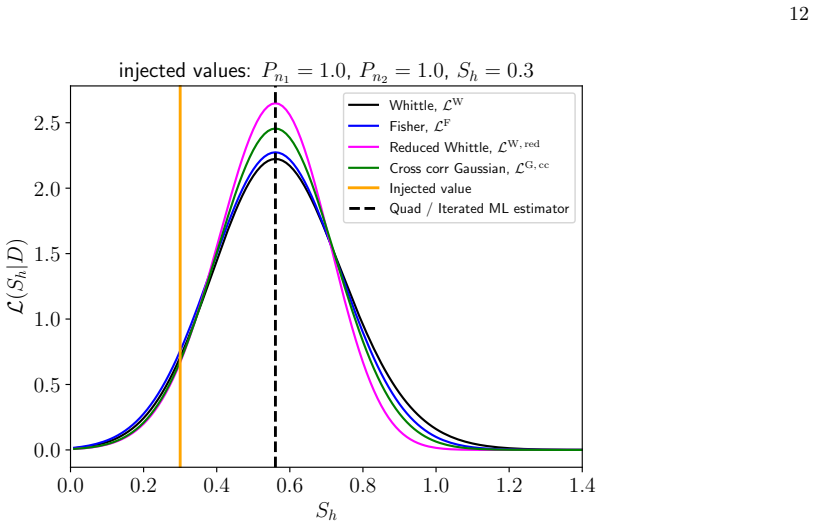
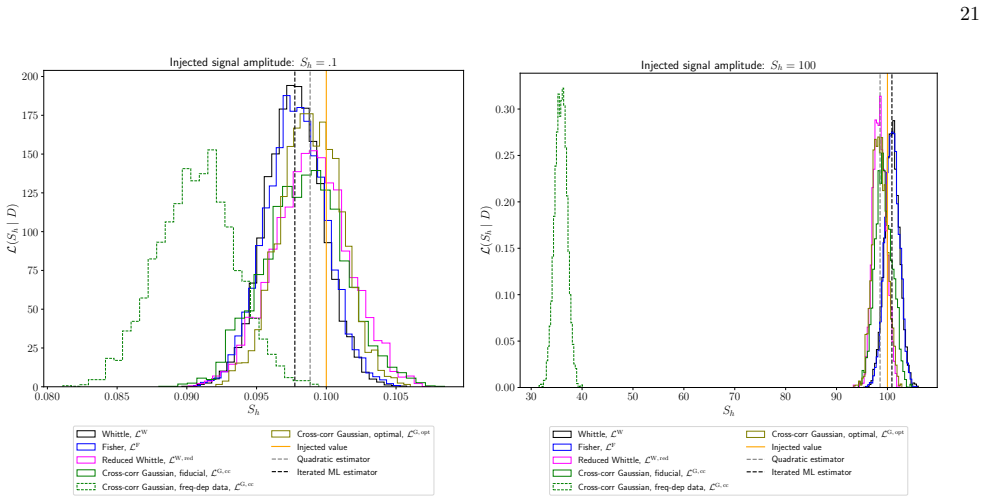
The paper establishes that the commonly used Gaussian cross-correlation likelihood is an approximation with a price. In the simplest analytically solvable setting of one detector and one frequency bin with $N_s$ independent segments, the exact Whittle likelihood is a gamma/chi-squared distribution for the power estimate $D$; replacing it by the Gaussian likelihood with theoretical variance and determinant term shifts the maximum-likelihood estimate from $D$ to $\hat P_D = D\bigl(\sqrt{1+4/N_s}-1\bigr)N_s/2 = D\bigl(1-1/N_s+\mathcal{O}(N_s^{-2})\bigr)$, giving fractional bias $B \simeq -1/N_s$. The same pattern appears in numerical studies of two- and three-detector networks with white and colored signal and noise: Gaussian approximations systematically underestimate the background amplitude when $N_s$ is small, while likelihoods conditioned on fiducial noise estimates are unbiased but undercover. The paper also derives an alternative likelihood formed as one-third quadratic plus two-thirds log-normal that matches the Whittle likelihood through third order in the fractional deviation, and reduced Whittle and optimal-filter likelihoods that avoid the bias. These results imply that segment length, bandwidth, and likelihood choice must be coordinated, and that for space-based and pulsar-timing configurations the bias, not the noise, sets the accuracy floor.
Load-bearing premise
The headline detector forecasts assume that the one-bin, one-detector bias formula $B=-1/N_s$ carries over to the full multi-detector likelihood, without a derivation of how a biased noise estimate propagates to the recovered background amplitude in that combined analysis.
Editorial extensions
If this is right
- For current ground-based searches with very short segments of seconds, the bias $B\sim10^{-6}$ is far below the statistical uncertainty, so the standard Gaussian pipeline remains statistics-limited.
- For third-generation ground-based detectors with segment durations of order ten minutes, the bias can exceed the nominal statistical error, moving the analysis into a bias-limited regime.
- Space-based detectors operating with roughly a hundred segments of about 11.5 days have $B$ between $10^{-3}$ and $10^{-2}$, larger than both the statistical and Fisher-matrix uncertainties, so a Gaussian analysis would systematically underestimate the background amplitude.
- Pulsar timing arrays, which effectively use a single segment, lie deep in the bias-limited regime and need the reduced or optimal-filter likelihoods for unbiased inference.
- Conditioning the likelihood on fiducial noise estimates taken from neighboring segments or smooth fits removes the bias, while using in-segment data-dependent estimates reintroduces it.
Reading between the lines
- The paper's analytic bias formula is derived for one detector and one frequency bin; the detector-by-detector forecasts in Table II apply it to the full multi-detector likelihood as an extrapolation, so a network-level derivation or simulation is the natural next check.
- The WMAP-inspired mixture of quadratic and log-normal likelihoods should transfer to colored spectra and multiple detectors, giving a cheap and unbiased replacement for the Gaussian likelihood that avoids iterating the full Whittle maximum-likelihood equations.
- Using auto-power estimates from neighboring segments rather than the analysis segment is the key practical lever for preventing the bias, and smoothing over frequency or time deserves exploration as a tunable data-compression step.
- In the strong-signal regime the reduced likelihoods trade bias for undercoverage, so a robust strategy may combine the optimal-filter estimator for the amplitude with the full Whittle likelihood for interval estimation.
Editorial analysis
A structured set of objections, weighed in public.
Referee Report
Summary. The paper presents a systematic comparison of likelihood functions used in stochastic gravitational-wave background (SGWB) searches, starting from the exact Whittle/Wishart likelihood and constructing a hierarchy of approximate Gaussian and Gaussian-like likelihoods. The examples progress from a single detector and a single frequency bin, where an analytic result gives a fractional bias B = -1/Ns for the Gaussian determinant likelihood LD, to two- and three-detector networks with white and colored signal and noise models, and finally to realistic detector configurations (LVK, ET/CE, LISA, Taiji, PTAs). The authors derive several reduced and optimal-filter likelihoods, discuss under what conditions they are unbiased, and present P-P plots to diagnose coverage. Their central quantitative claim is that for some segment durations and bandwidths, especially for space-based detectors and PTAs, the systematic bias from Gaussian approximations can exceed the statistical uncertainty, and they make practical recommendations for segment choice and likelihood selection.
Significance. If the quantitative warning is substantiated, the paper would be a valuable contribution to SGWB data analysis, because segmentation choices and likelihood approximations are central to current and future searches with LVK, ET/CE, LISA, and PTAs. The analytic derivation of B = -1/Ns in the single-detector toy model is clean and self-contained, and the hierarchy of examples is pedagogically useful. The paper also re-derives the WMAP-type composite likelihood coefficients rather than assuming them, and the P-P plot diagnostics are a strong practical addition. The main caveat is that the headline detector-level conclusion rests on an extrapolation of the toy-model bias to multi-detector, multi-bin analyses; that extrapolation is not derived and is in tension with the paper's own unbiasedness results for cross-correlation estimators. The paper's careful treatment of which likelihoods have good coverage in the toy models is nevertheless a solid contribution, and the recommended alternative likelihoods deserve attention.
major comments (3)
- [§V.A, Table II; §IV.B-C; eq. (28)] The headline quantitative conclusion that LISA and PTA configurations can have Gaussian-likelihood biases exceeding statistical uncertainty relies on applying the one-detector, one-frequency-bin bias B = -1/Ns from eq. (28) to the multi-detector, multi-bin SGWB analyses in Table II. This is an extrapolation that is not derived. The paper itself states in §IV.B (text after eq. (60)) that both the quadratic cross-correlation estimator Ŝh,cc and the iterated Whittle ML estimator Ŝh are unbiased, and the bias seen in §IV.C and Fig. 5 appears only for the reduced likelihoods when the autopower estimates are frequency-by-frequency data-driven estimates, with footnote 8 explicitly warning against such estimates. The magnitude of any such bias is controlled by the scatter of the estimated autopowers used in the likelihood weights, not by the determinant bias of the single-parameter Gaussian likelihood LD. The authors should either derive how a biased or estimated autopower PSD propagates into Ŝh in the joint likelihood, or clearly reframe Table II as an illustrative upper bound and support the LISA/PTA claim with concrete simulations using smoothed/fiducial versus data-driven autopower estimates.
- [§V.A, Table II] The comparison of B to the statistical uncertainty is not internally consistent. For the ET/CE 10-minute row, Table II shows B = 1.9e-5, while the FIM-based uncertainty in the last column is 4.6(2.5)e-5; the text nonetheless states that 'the bias exceeds the statistical error and becomes a dominant contribution to the total uncertainty.' If the relevant statistical error is S = 1/sqrt(Nf Ns) from eq. (29), the paper needs to justify why the FIM column, which accounts for joint estimation including noise parameters, is not the appropriate benchmark. As written, the qualitative conclusion depends on which statistical uncertainty definition is chosen, and the paper's stated 'statistical error' is ambiguous.
- [§V.A, Table II, and §VI] The PTA rows in Table II report B = '–', yet the conclusions in §VI state that PTAs with Ns ~ 1 are in the bias-limited regime. If B is not defined or computed for Ns = 1, this claim appears to rest on an informal extrapolation of B = -1/Ns, which would formally give a -100% bias at Ns = 1. That would be a much stronger and different statement than what the text argues. The authors should either provide a quantitative derivation of the PTA bias relevant to actual PTA likelihoods (which include many pulsars and frequencies) or soften the conclusion to reflect the absence of a quantitative estimate.
minor comments (4)
- [References, ref. [16]] Reference [16] appears malformed: 'P. artist Moran and P. Whittle' should presumably be 'P. A. P. Moran' and 'P. Whittle'; please correct it.
- [Table II] In the compiled text, several rows of Table II appear to have missing or misaligned entries (e.g., the LVK 10-minute row and the ET/CE 10-minute row do not show all seven columns). Please ensure the table renders with the correct entries for Ns, Nf, S, B, and S from FIM.
- [§IV.C, eqs. (66)-(68)] The definition of the barred quantities \(\bar D_k\) and \(\bar P_k\) is given only by reference to 'similar' expressions; please state explicitly that \(\bar D_k\) is obtained by replacing the diagonal elements of \(D_{IJ,k}\) with \(\bar P_{II,k}\), and likewise for \(\bar P_k\).
- [§VI] The sentence 'We concluded that, since sidereal-day folding reorganizes, but does not reduce, the effective sample count...' should be reworded as 'We conclude...' for consistency with the rest of the conclusions section.
Circularity Check
No significant circularity: the central bias derivation is self-contained, and self-citations are contextual rather than load-bearing.
full rationale
The paper's core derivation chain is self-contained. The exact Whittle likelihood is stated from the Gaussian data model (eq. 11), the Gaussian approximations LS, LQ, and LD are defined explicitly (eqs. 23-25), and the central bias result B = -1/Ns is obtained analytically by maximizing LD and taking the expectation value (eqs. 26-28). The WMAP-inspired likelihood is not assumed from the literature: its coefficients 1/3 and 2/3 are re-derived by expanding the Whittle log-likelihood, LQ, and LLN in powers of delta and matching through O(delta^3) (eqs. 32-37). The multi-detector Whittle, Fisher, reduced Whittle, and cross-correlation Gaussian likelihoods are all constructed from the same stated model and covariance matrices. Self-citations such as [14,15] for data compression, [25] for neighboring-segment noise estimates, and [31] for pulsar catalog modeling are contextual and do not carry the central claim. The Table II comparison, which applies the one-bin toy-model bias B = 1/Ns to realistic detector configurations, is an extrapolation whose quantitative validity for LISA/PTA can be questioned on correctness grounds, but it is not circular: B is neither fitted to the tabled targets nor defined in terms of their outputs. The simulation-based P-P plots and posterior comparisons provide independent tests of the likelihood approximations. No step reduces by construction to its own input.
Assumptions & free parameters
assumptions (5)
- domain assumption Signal and noise are zero-mean Gaussian processes, uncorrelated with each other.
- domain assumption Noise is stationary and uncorrelated across distinct frequency bins.
- domain assumption Data segments are statistically equivalent and independent.
- domain assumption Instrumental noise is uncorrelated between different detectors.
- domain assumption Individual frequency bins are statistically independent.
Cite this review
Pith. "Pith review of Likelihoods for Stochastic Gravitational Wave Background Data Analysis." pith.science (2026). https://pith.science/paper/AAFLY435
@misc{pith2026250524695,
  author       = {Pith},
  title        = {Pith review of: Likelihoods for Stochastic Gravitational Wave Background Data Analysis},
  year         = {2026},
  howpublished = {\url{https://pith.science/paper/AAFLY435}},
  note         = {Machine review of arXiv:2505.24695}
}
read the original abstract
We present a systematic study of likelihood functions used for Stochastic Gravitational Wave Background (SGWB) searches. By dividing the data into many short segments, one customarily takes advantage of the Central Limit Theorem to justify a Gaussian crosscorrelation likelihood. We show, with a hierarchy of ever more realistic examples, beginning with a single frequency bin and one detector, and then moving to two and three detectors with white and colored signal and noise, that approximating the exact Whittle likelihood by various Gaussian alternatives can induce systematic biases in the estimation of the SGWB parameters. We derive several approximations for the full likelihood and identify regimes where Gaussianity breaks down. We also discuss the possibility of conditioning the full likelihood on fiducial noise estimates to produce unbiased SGWB parameter estimation. We show that for some segment durations and bandwidths, particularly in space-based and pulsar-timing arrays, the bias can exceed the statistical uncertainty. Our results provide practical guidance for segment choice, likelihood selection, and data-compression strategies to ensure robust SGWB inference in current and next-generation gravitational wave detectors.
Figures


Figures from the paper (6 more)




Forward citations
Cited by 3 Pith papers
-
Probing Quadratically Coupled Ultralight Dark Matter with the Laser Interferometer Space Antenna
LISA forecasts for quadratically coupled ultralight dark matter show competitive or superior sensitivity to terrestrial and astrophysical probes in selected mass windows, free of screening.
-
Detectability and Parameter Estimation for Einstein Telescope Configurations with GWJulia
A new open-source Julia tool forecasts Einstein Telescope parameter-estimation accuracy, finding the 2L45 design marginally best for single parameters but comparable to other layouts when joint precision is required.
-
Cosmic Variance in Anisotropy Searches at Pulsar Timing Arrays
Cosmic variance does not create false anisotropy detections in pulsar timing array searches when the correct likelihood is used, and the maximum resolvable multipole scales as the number of pulsars rather than its squ...
Reference graph
Works this paper leans on
-
[1]
converts strain powerSh(fk) to energy-density spectrum units (see eq.(9)). In the weak-signal regime, one can further combine these segment-dependent estimators by weighting them by the inverse of the (approximate) variances (σ2)s IJ,k≈ ( 2π2 3H2 0 f3 k ΓIJ (fk) )2 ¯Ps II,k ¯Ps JJ,k. (13) If the number of segments is sufficiently large, this averaging ove...
work page 2025
-
[2]
T. Regimbau, Res. Astron. Astrophys.11, 369 (2011), arXiv:1101.2762 [astro-ph.CO]
arXiv 2011
-
[3]
C. Caprini and D. G. Figueroa, Class. Quant. Grav.35, 163001 (2018), arXiv:1801.04268 [astro-ph.CO]
arXiv 2018
-
[4]
Aasi,et al., Classical and Quantum Gravity32, 074001 (2015), arXiv:1411.4547 [gr-qc]
LIGO Scientific Collaboration, J. Aasi,et al., Classical and Quantum Gravity32, 074001 (2015), arXiv:1411.4547 [gr-qc]
arXiv 2015
-
[5]
Acernese,et al., Classical and Quantum Gravity32, 024001 (2014)
Virgo Collaboration, F. Acernese,et al., Classical and Quantum Gravity32, 024001 (2014)
work page 2014
-
[6]
KAGRA Collaboration, T. Akutsu, et al., Progress of Theoretical and Experimental Physics 2021, 05A101 (2021), arXiv:2005.05574 [physics.ins-det]
arXiv 2021
- [7]
-
[8]
Abacet al., (2025), arXiv:2503.12263 [gr-qc]
A. Abacet al., (2025), arXiv:2503.12263 [gr-qc]
arXiv 2025
Show all 49 references
-
[9]
Reitzeet al., Bull
D. Reitzeet al., Bull. Am. Astron. Soc.51, 035 (2019), arXiv:1907.04833 [astro-ph.IM]
2019 arXiv
- [10]
-
[11]
Allen and J
B. Allen and J. D. Romano, Phys. Rev. D59, 102001 (1999), arXiv:gr-qc/9710117
1999 arXiv
-
[12]
J. D. Romano and N. J. Cornish, Living Rev. Rel.20, 2 (2017), arXiv:1608.06889 [gr-qc]
2017 arXiv
-
[13]
Caporali, G
I. Caporali, G. Capurri, W. Del Pozzo, A. Ricciardone, and L. Valbusa Dall’Armi, (2025), arXiv:2501.09057 [gr-qc]
2025 arXiv
-
[14]
B. P. Abbottet al. (LIGO Scientific, Virgo), Phys. Rev. D100, 061101 (2019), arXiv:1903.02886 [gr-qc]
2019 arXiv
-
[15]
Caprini, D
C. Caprini, D. G. Figueroa, R. Flauger, G. Nardini, M. Peloso, M. Pieroni, A. Ricciardone, and G. Tasinato, JCAP11, 017 (2019), arXiv:1906.09244 [astro-ph.CO]
2019 arXiv
-
[16]
Dictionary
R. Flauger, N. Karnesis, G. Nardini, M. Pieroni, A. Ricciardone, and J. Torrado, JCAP01, 059 (2021), arXiv:2009.11845 [astro-ph.CO]. 22 0.0 0.2 0.4 0.6 0.8 1.0 Normal CDF 0.0 0.2 0.4 0.6 0.8 1.0CDF = -0.5, = 0.5 0.0 0.2 0.4 0.6 0.8 1.0 Normal CDF 0.0 0.2 0.4 0.6 0.8 1.0CDF = -...
2021 arXiv
-
[17]
artist Moran and P
P. artist Moran and P. Whittle (1951)
1951
-
[18]
Wishart, Biometrika20A, 32 (1928)
J. Wishart, Biometrika20A, 32 (1928)
1928
-
[19]
Thrane, N
E. Thrane, N. Christensen, and R. M. S. Schofield, Phys. Rev. D87, 123009 (2013)
2013
-
[20]
M. W. Coughlinet al., Phys. Rev. D97, 102007 (2018)
2018
-
[21]
É. É. Flanagan, Phys. Rev. D48, 2389 (1993)
1993
-
[22]
Christensen, Phys
N. Christensen, Phys. Rev. D55, 448 (1997)
1997
-
[23]
Wick’s Theorem
L. Isserlis, Biometrika12, 134 (1918), often called “Wick’s Theorem" by physicists, although Wick’s work was three decades later. 23 0.00 0.25 0.50 0.75 1.00 Nominal CDF 0.0 0.5 1.0Empirical CDF W( |Ds k) weak signal 0.00 0.25 0.50 0.75 1.00 Nominal CDF 0.0 0.5 1.0Empirical CD...
1918
-
[24]
Hamimeche and A
S. Hamimeche and A. Lewis, Phys. Rev. D77, 103013 (2008)
2008
-
[25]
Verdeet al
L. Verdeet al. (WMAP), Astrophys. J. Suppl.148, 195 (2003), arXiv:astro-ph/0302218
2003 arXiv
-
[26]
Matas and J
A. Matas and J. D. Romano, Phys. Rev. D103, 062003 (2021)
2021
-
[27]
S. M. Kay,Fundamentals of Statistical Signal Processing: Estimation Theory, Vol. 1 (Prentice Hall, Englewood Cliffs, NJ, 1993)
1993
-
[28]
Abbottet al
R. Abbottet al. (KAGRA, Virgo, LIGO Scientific), Phys. Rev. D104, 022004 (2021), arXiv:2101.12130 [gr-qc]
2021
-
[29]
Barsotti, S
L. Barsotti, S. Gras, M. Evans, and P. Fritschel,The updated Advanced LIGO design curve, LIGO (2018), LIGO Document T1800044
2018
- [30]
- [31]
-
[32]
Babak, M
S. Babak, M. Falxa, G. Franciolini, and M. Pieroni, Phys. Rev. D110, 063022 (2024), arXiv:2404.02864 [astro-ph.CO]
2024 arXiv
-
[33]
Abbottet al
R. Abbottet al. (KAGRA, VIRGO, LIGO Scientific), Phys. Rev. X13, 041039 (2023), arXiv:2111.03606 [gr-qc]
2023 arXiv
-
[34]
Evanset al., (2023), arXiv:2306.13745 [astro-ph.IM]
M. Evanset al., (2023), arXiv:2306.13745 [astro-ph.IM]
2023 arXiv
-
[35]
Pieroni, A
M. Pieroni, A. Ricciardone, and E. Barausse, Sci. Rep.12, 17940 (2022), arXiv:2203.12586 [astro-ph.CO]
2022 arXiv
-
[36]
Ruan, Z.-K
W.-H. Ruan, Z.-K. Guo, R.-G. Cai, and Y.-Z. Zhang, Int. J. Mod. Phys. A35, 2050075 (2020), arXiv:1807.09495 [gr-qc]
2020 arXiv
-
[37]
Luoet al
J. Luoet al. (TianQin), Class. Quant. Grav.33, 035010 (2016), arXiv:1512.02076 [astro-ph.IM]
2016 arXiv
-
[38]
Agazieet al
G. Agazieet al. (NANOGrav), Astrophys. J. Lett.951, L8 (2023), arXiv:2306.16213 [astro-ph.HE]
2023 arXiv
-
[39]
Agazieet al
G. Agazieet al. (NANOGrav), Astrophys. J. Lett.951, L9 (2023), arXiv:2306.16217 [astro-ph.HE]
2023 arXiv
-
[40]
Antoniadiset al
J. Antoniadiset al. (EPTA, InPTA:), Astron. Astrophys.678, A50 (2023), arXiv:2306.16214 [astro-ph.HE]
2023 arXiv
-
[41]
D. J. Reardonet al., Astrophys. J. Lett.951, L6 (2023), arXiv:2306.16215 [astro-ph.HE]
2023 arXiv
-
[42]
Xuet al., Res
H. Xuet al., Res. Astron. Astrophys.23, 075024 (2023), arXiv:2306.16216 [astro-ph.HE]
2023 arXiv
-
[43]
Afzalet al
A. Afzalet al. (NANOGrav), Astrophys. J. Lett.951, L11 (2023), [Erratum: Astrophys.J.Lett. 971, L27 (2024), Erratum: Astrophys.J. 971, L27 (2024)], arXiv:2306.16219 [astro-ph.HE]
2023 arXiv
-
[44]
Antoniadiset al
J. Antoniadiset al. (EPTA, InPTA), Astron. Astrophys.685, A94 (2024), arXiv:2306.16227 [astro-ph.CO]
2024 arXiv
-
[45]
D. G. Figueroa, M. Pieroni, A. Ricciardone, and P. Simakachorn, Phys. Rev. Lett.132, 171002 (2024), arXiv:2307.02399 [astro-ph.CO]
2024 arXiv
-
[46]
Ellis, M
J. Ellis, M. Fairbairn, G. Franciolini, G. Hütsi, A. Iovino, M. Lewicki, M. Raidal, J. Urrutia, V. Vaskonen, and H. Veermäe, Phys. Rev. D109, 023522 (2024), arXiv:2308.08546 [astro-ph.CO]
2024 arXiv
-
[47]
A. Ain, P. Dalvi, and S. Mitra, Phys. Rev. D92, 022003 (2015), arXiv:1504.01714 [gr-qc]
2015 arXiv
-
[48]
A. Ain, J. Suresh, and S. Mitra, Phys. Rev. D98, 024001 (2018), arXiv:1803.08285 [gr-qc]
2018 arXiv
-
[49]
Abbottet al
R. Abbottet al. (KAGRA, Virgo, LIGO Scientific), Phys. Rev. D104, 022005 (2021), arXiv:2103.08520 [gr-qc]
2021
Reviewed August 7, 2026 · model on record in the stance chip above.
Discussion (0). Continue with ORCID to comment.