REVIEW 3 major objections 5 minor 1 cited by
Neuralocks: Real-Time Dynamic Neural Hair Simulation
T0 review · 3 major / 5 minor · reviewed 2026-08-06 · deepseek-v4-flash
Pith's one-line read This paper claims the first fully self-supervised neural network can simulate dynamic hair at the strand level, a 1 MB model that runs at 0.189 ms for 3,000 strands with quality comparable to a much larger quasi-static neural baseline.
desk verdict A genuinely novel self-supervised strand-level hair simulator with strong runtime numbers, but the 'dynamic' claim is thinner than the title suggests because the model has no state feedback. read the letter →
The pith
A machine-rendered reading of the paper's core claim, the machinery that carries it, and where it could break.
The reading
What carries the argument
The load-bearing object is the strand-level neural simulator, an MLP that maps body pose history plus local lock information directly to canonical-space displacements, removing any recurrent state. Dynamics enter through an inertia potential $L_{\text{inertia}} = \frac{1}{2\Delta t^2}(\mathbf{x} - \hat{\mathbf{x}})^\top M(\mathbf{x} - \hat{\mathbf{x}})$, where $\hat{\mathbf{x}} = 2\mathbf{x}_{t-1} - \mathbf{x}_{t-2}$ is a ballistic prediction from the two previous frames, whose values are detached from backpropagation; this lets the network learn inertia-like response to motion without modeling a time evolution or hidden state. The other central piece is an improved Cosserat bend-twist energy, an elastic rod strain measure, whose strain measure uses orientations obtained by fast parallel transport from the root segment, giving a wider range of deformation than a constant-director approximation at similar computational cost. Together these allow a deterministic, stable mapping trained purely from self-supervised physics losses.
What would settle it
Freeze a trained model and run a motion where the body stops suddenly after a fast jump; then compare the predicted strands in the following frames against a physics reference. If the hair freezes or returns to rest immediately instead of showing state-dependent settling or continued sway, the deterministic pose-history assumption is falsified. A second test: run the same pose-history sequence starting from two different hair configurations (e.g., hair lifted by a hand versus hair hanging) and check whether the outputs differ at all.
Extended reading notes
Core claim
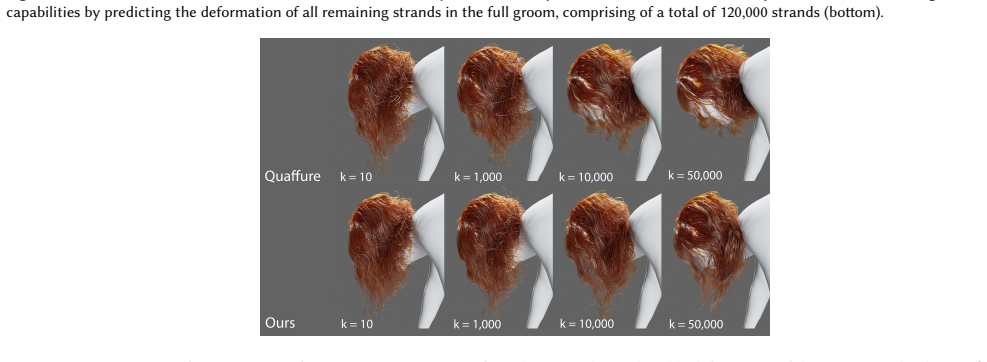
The central claim is that dynamic hair behavior can be learned as a deterministic mapping from boundary-condition history to deformed strand geometry. The simulator, a two-layer MLP with 256 hidden units, takes the strand's root UV coordinate, a compact rest-shape latent code, the average latent code of neighboring strands ('local locks'), the current body pose and shape, and the previous 30 frames of body joint velocities, and outputs displacement vectors in canonical space; these are added to the canonical strand embedding and rigidly transformed to world space. The network is trained without any precomputed simulation data, using a physics-based loss that includes stretch, an improved Cosserat bend-twist term, gravity, body and self collisions, an inertia potential computed from two detached previous predictions, and new hair-style and adhesion terms that preserve groom shape and clumping. The paper reports that this produces dynamic, stable results comparable to a dynamic extension of Quaffure at 1 MB versus 692 MB, runs at 0.189 ms for 3,000 strands, and generalizes to unseen similar grooms.
Load-bearing premise
The network treats hair deformation as a fixed function of the recent body pose alone, never taking the hair's own current state as input, so any motion that depends on that state, such as hair continuing to sway after the body has stopped, is outside what the model can produce.
Editorial extensions
If this is right
- Hair simulation can run at interactive rates on low-end and mobile devices: 0.189 ms for 3,000 strands and 6.872 ms for 120,000 strands, versus 140 ms for a GPU XPBD solver.
- The self-supervised paradigm removes the artist-generated dataset bottleneck, so hair reconstruction methods can be paired with this simulator to produce automatic end-to-end avatar deformation.
- Predicting strands one at a time from root UV and local lock codes scales to arbitrary strand counts and avoids the upsampling step required by texture-space guide-strand methods.
- Because no recurrent architecture or hidden state is used, training can start at any animation frame and inference is deterministic, stable, and simple to deploy.
- The same framework extends to quasi-static mesh-based rigged hair, with a much smaller network running in about 0.3 microseconds with single-threaded CPU execution.
Reading between the lines
- Because the mapping uses only pose history, the model cannot represent hair states that depend on initial conditions or external forces; adding a compressed current-state latent or a short recurrent adapter, while preserving the simplicity of the inertia loss, would be a direct test of how much motion variety is lost.
- The reported more damped motion relative to XPBD suggests the inertia loss acts as an implicit damping term; scaling its weight or adding an explicit velocity-dependent residual could trade stability for livelier responses without changing the architecture.
- The local-lock neighborhood encoding is a generic mechanism: any strand-like deformable object (fur, cables, cloth fibers) with a rest-shape latent and a rooted parameterization could reuse the same self-supervised training recipe.
- Training with fixed material parameters means stiffness and adhesion are baked into one model; conditioning the network on those coefficients, as the paper lists for future work, would let one model span multiple hair types and offer a clear benchmark for the method's generality.
Editorial analysis
A structured set of objections, weighed in public.
Referee Report
Summary. The paper presents Neuralocks, a strand-level MLP-based hair simulator trained entirely with self-supervised physics-energy losses (stretch, bend-twist, gravity, body and self collisions, style preservation, adhesion, and inertia). The network maps a window of body pose/shape history, a per-strand latent code from a frozen autoencoder, and a local-neighborhood 'lock' embedding to canonical-space displacements, which are then rigidly transformed to world space. The authors claim the first fully self-supervised dynamic neural hair simulation, a 1 MB model, and a runtime of 0.189 ms for 3,000 strands versus 140 ms for a GPU XPBD solver, with visual quality described as comparable to a dynamic extension of their own Quaffure baseline. They also propose an improved Cosserat bend-twist energy, a fast parallel-transport approximation, and additional losses for style and clump preservation, and demonstrate strand generalization and a mesh-based rigged-hair application.
Significance. If the claims hold, the method is a meaningful practical contribution: the training objective is a genuine physics energy rather than a fit to precomputed target data, the model size and inference speed are concrete and plausible, and the strand-level formulation avoids the full-groom map size limits of prior neural hair work. The self-supervised setup and the compact runtime footprint are clear strengths for real-time avatar and game applications. However, the central 'dynamic simulation' claim is constrained by the deterministic, state-independent mapping that the authors acknowledge in Section 5, and the quality comparisons to XPBD and Dynamic Quaffure rest on qualitative stills rather than quantitative metrics. With the scope clarified and quantitative dynamics/quality evaluations added, the contribution would be solid; as written, the central claim is broader than the expressive class of the model supports.
major comments (3)
- [Sec. 3.3, Sec. 3.4.5 (Eq. 9), Sec. 5] The network input contains body pose/shape history and strand latent codes but no feature of the current hair state; in Eq. (9), the inertial target x_hat = 2 x_{t-1} - x_{t-2} is detached from the computation graph and is not fed back into the network. Consequently, the output is a deterministic function of the boundary-condition history: identical body trajectories with different initial hair configurations produce identical outputs, and after the body stops the hair cannot continue to sway, oscillate, or settle as a damped system. Section 5 acknowledges determinism, but this is not merely a 'motion variety' issue; it defines the expressive class of the method. The paper should either add explicit hair-state conditioning or a recurrent component so state-dependent dynamics are expressible, or it should explicitly rescope the central claim to 'pose-history-conditioned quasi-static deformation with inertial smoothing' and provide evidence that this scope still justifies the abstract's 'dynamic hair simulation' statement.
- [Sec. 4.1, Fig. 9, Fig. 12, Table 1] The claims that the method 'captures the overall dynamics comparable to those obtained by physics-based simulation' and that the comparison to Dynamic Quaffure shows 'comparable results' are supported only by still images and qualitative wording. No quantitative metric is reported for dynamics (e.g., oscillation frequency, settling time, phase lag, state-dependence) or for quality (e.g., intersection counts with the body, per-vertex distance to an XPBD reference, artifact measurements). Without such metrics, the central trade-off described in Sec. 4.1 — 740x faster at the cost of 'more damped motion' — cannot be evaluated. I recommend adding a quantitative comparison on a small set of motion sequences, such as per-vertex L2 error against a high-quality reference, mean penetration depth, and a sway-after-stop decay test.
- [Sec. 4.5, Table 1 and Dynamic Quaffure comparison] The performance comparison with Dynamic Quaffure is potentially confounded: Quaffure predicts the full groom in one pass and is reported to have a maximum strand count of 4096, while the 0.189 ms figure for Neuralocks is for 3,000 strands. It is not clear whether the reported 3.89 ms for Dynamic Quaffure is for 3,000 or 4,096 strands, nor whether both measurements use the same hardware and precision. The memory comparison (1 MB vs 692 MB) should clarify whether the reported sizes include the strand encoder, UV maps, and any preprocessing weights for both methods. Please report runtime and memory for both methods at matched strand counts and with the same evaluation setup.
minor comments (5)
- [Sec. 3.4.2, Eq. (4)] The text refers to the collision stiffness as 'kbc' immediately after Eq. (4), but the equation uses k_body_collision; please unify the notation.
- [Sec. 3.4.5] The description 'we let the network predict three consecutive frames' is underspecified; please clarify how the three frames are sampled from the pose history, how the detached x_{t-1} and x_{t-2} are used as inputs for the third frame, and how this interacts with the absence of recurrence.
- [Fig. 12 caption] The caption contains a typo ('bur' should be 'but'), and the sentence structure would benefit from punctuation separating the comparison statement from the scalability statement.
- [Sec. 4, Fig. 13] The text states that 'all results contain grooms from the training set' and then presents Fig. 13 as unseen grooms; please clarify which figures use training-set grooms and confirm that no strands from the unseen grooms were used during training.
- [Sec. 5] The limitation that hand interactions are too sparse in the training data is acknowledged; reporting the training-data statistics for collision coverage (e.g., number of frames with hand contact per groom) would make this limitation more concrete.
Circularity Check
No significant derivation circularity: the physics-energy training objective is not fitted to the network's own outputs, and the deterministic pose-history limitation is an admitted expressiveness gap rather than a circular step.
full rationale
The paper's derivation chain is not circular in the sense that any predicted quantity reduces by construction to an input or to a fitted target. The total training loss in Eq. (1) is composed of physics-based potentials (stretch, bend-twist, collision, gravity, style, adhesion, inertia), none of which regress the network against a precomputed ground-truth deformation that was itself derived from the network. The inertia loss in Eq. (9) uses an inertial prediction x_hat = 2 x_{t-1} - x_{t-2} with detached previous frames, so it acts as an implicit smoothing/regularization objective rather than a target that is equivalent to the network's input features. The paper explicitly limits its method in Sec. 5 to deterministic results that depend only on boundary-condition history and not on the hair's own past configuration; this is a real limitation of the dynamic-simulation claim, but it is not a circular relationship between premise and conclusion. The authors do rely on their own prior Quaffure work for the quasi-static baseline and they construct the Dynamic Quaffure comparison themselves, which is a benchmarking and fairness concern; however, this does not make the central method's derivation self-referential, and Quaffure is a published, externally checkable result rather than an imported uniqueness theorem. No equation in the paper reduces to its own input, no fitted parameter is renamed as a prediction, and no load-bearing argument depends on an unverified self-citation. The main risk in this paper is overclaiming 'dynamics' for a deterministic pose-history-conditioned regressor, which is a correctness/scope issue, not circularity.
Assumptions & free parameters
free parameters (11)
- kstretch (stretch stiffness) =
not reported
- kbend_twist (bend-twist stiffness) =
not reported
- kbody_collision =
not reported
- ksc (self-collision stiffness) =
not reported
- khair_style =
not reported
- kadhesion =
not reported
- r_neighbor =
0.25
- s_max =
user-selected
- N (pose history) =
30
- vertex mass m =
not reported
- delta_t (time step) =
not reported
assumptions (6)
- domain assumption The discrete Cosserat rod formulation is a valid and sufficient model for hair strand mechanics for the target application.
- ad hoc to paper Hair deformation can be modeled as a deterministic function of body pose history alone, with no dependence on the current hair state.
- domain assumption Training on a sparse subset of approximately 3,000 strands generalizes to a full groom of 120,000 strands.
- domain assumption The CT2Hair dataset plus artist-made grooms form an adequate training distribution for unseen similar grooms.
- domain assumption The fast parallel transport approximation is adequate for the bend-twist potential.
- standard math The variational formulation of Newton's method provides a valid inertia loss for training.
invented entities (1)
-
Neural lock neighborhood embedding (z_lock)
Cite this review
Pith. "Pith review of Neuralocks: Real-Time Dynamic Neural Hair Simulation." pith.science (2026). https://pith.science/paper/ZKC6QUQ3
@misc{pith2026250705191,
  author       = {Pith},
  title        = {Pith review of: Neuralocks: Real-Time Dynamic Neural Hair Simulation},
  year         = {2026},
  howpublished = {\url{https://pith.science/paper/ZKC6QUQ3}},
  note         = {Machine review of arXiv:2507.05191}
}
read the original abstract
Real-time hair simulation is a vital component in creating believable virtual avatars, as it provides a sense of immersion and authenticity. The dynamic behavior of hair, such as bouncing or swaying in response to character movements like jumping or walking, plays a significant role in enhancing the overall realism and engagement of virtual experiences. Current methods for simulating hair have been constrained by two primary approaches: highly optimized physics-based systems and neural methods. However, state-of-the-art neural techniques have been limited to quasi-static solutions, failing to capture the dynamic behavior of hair. This paper introduces a novel neural method that breaks through these limitations, achieving efficient and stable dynamic hair simulation while outperforming existing approaches. We propose a fully self-supervised method which can be trained without any manual intervention or artist generated training data allowing the method to be integrated with hair reconstruction methods to enable automatic end-to-end methods for avatar reconstruction. Our approach harnesses the power of compact, memory-efficient neural networks to simulate hair at the strand level, allowing for the simulation of diverse hairstyles without excessive computational resources or memory requirements. We validate the effectiveness of our method through a variety of hairstyle examples, showcasing its potential for real-world applications.
Figures


Figures from the paper (11 more)




Forward citations
Cited by 1 Pith paper
-
HairWeaver: Few-Shot Photorealistic Hair Motion Synthesis with Sim-to-Real Guided Video Diffusion
HairWeaver animates a single human photo with physically plausible hair motion by transferring simulated CG hair dynamics into a frozen video diffusion model via two lightweight LoRA adapters.
Reference graph
Works this paper leans on
-
[1993]
InComputer Graphics Forum, Vol
An integrated system for modeling, animating and rendering hair. InComputer Graphics Forum, Vol. 12. Wiley Online Library, 211–221. Gilles Daviet. 2023. Interactive Hair Simulation on the GPU using ADMM. In ACM SIGGRAPH 2023 Conference Proceedings . 1–11. Gilles Daviet, Florence Bertails-Descoubes, and Laurence Boissieux. 2011. A hybrid iterative solver f...
-
[2023]
Towards Realtime: A Hybrid Physics-Based Method for Hair Animation on GPU. Proc. ACM Comput. Graph. Interact. Tech. 6, 3, Article 43 (aug 2023), 18 pages. doi:10.1145/3606937 T. Kugelstadt and E. Schömer. 2016. Position and orientation based Cosserat rods. In Proceedings of the ACM SIGGRAPH/Eurographics Symposium on Computer Animation (Zurich, Switzerland...
doi:10.1145/3606937 2023
-
[2024]
ACM Transactions on Graphics (TOG) 43, 6 (2024), 1–10
Accelerate Neural Subspace-Based Reduced-Order Solver of Deformable Simulation by Lipschitz Optimization. ACM Transactions on Graphics (TOG) 43, 6 (2024), 1–10. Qing Lyu, Menglei Chai, Xiang Chen, and Kun Zhou. 2020. Real-time hair simulation with neural interpolation. IEEE Transactions on Visualization and Computer Graphics 28, 4 (2020), 1894–1905. Shuga...
Reviewed August 6, 2026 · model on record in the stance chip above.
Discussion (0). Continue with ORCID to comment.