Optimisation-Free Recursive QAOA for the Binary Paint Shop Problem
Pith reviewed 2026-05-19 04:20 UTC · model grok-4.3
The pith
Recursive QAOA solves the binary paint shop problem near-optimally using transferred parameters without any variational optimization.
A machine-rendered reading of the paper's core claim, the machinery that carries it, and where it could break.
Core claim
By formulating the binary paint shop problem as an Ising ground-state task equivalent to MAX-CUT and applying recursive QAOA with parameters transferred across problem sizes, the algorithm maintains solution quality comparable to fully optimized QAOA while using substantially smaller circuits and fewer measurements; the method trims outer gates via reverse causal cones and remains robust when parameters deviate from their optimal values.
What carries the argument
Recursive QAOA with parameter transfer, which iteratively reduces problem size by fixing variables and reuses variational parameters from smaller instances to eliminate the classical optimization loop.
If this is right
- RQAOA maintains near-optimal performance even when parameters are transferred rather than optimized for the target instance.
- Quantum resource costs drop markedly compared with standard QAOA because recursion shortens circuits and reduces the number of measurements required.
- The approach bypasses the barren-plateau issue that normally forces expensive classical optimization in variational quantum algorithms.
- The same parameter-transfer strategy applies directly to other MAX-CUT-type problems with symmetric local Hamiltonians.
Where Pith is reading between the lines
- This technique could be tested on other manufacturing or scheduling problems whose Hamiltonians share the same local symmetry.
- Parameter transfer might allow quantum optimization to scale beyond the size where classical optimizers fail due to noise or barren plateaus.
- Hybrid classical-quantum pipelines could combine this method with fast classical heuristics to refine solutions after the quantum step.
Load-bearing premise
The binary paint shop problem's Hamiltonian has enough symmetric local structure that parameters from smaller instances remain effective when applied to larger ones.
What would settle it
Apply the optimization-free recursive QAOA to a binary paint shop instance of size 50 using parameters transferred from a size-10 instance and measure whether the fraction of color changes deviates by more than 5 percent from the value obtained with instance-specific optimization.
Figures





read the original abstract
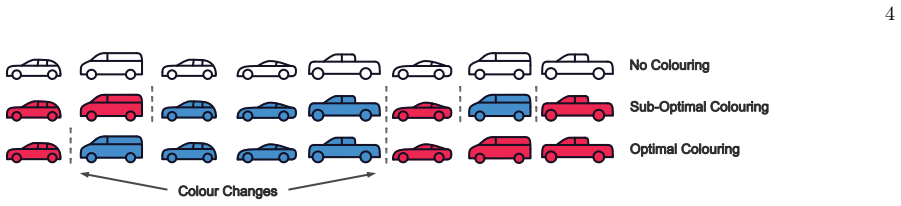
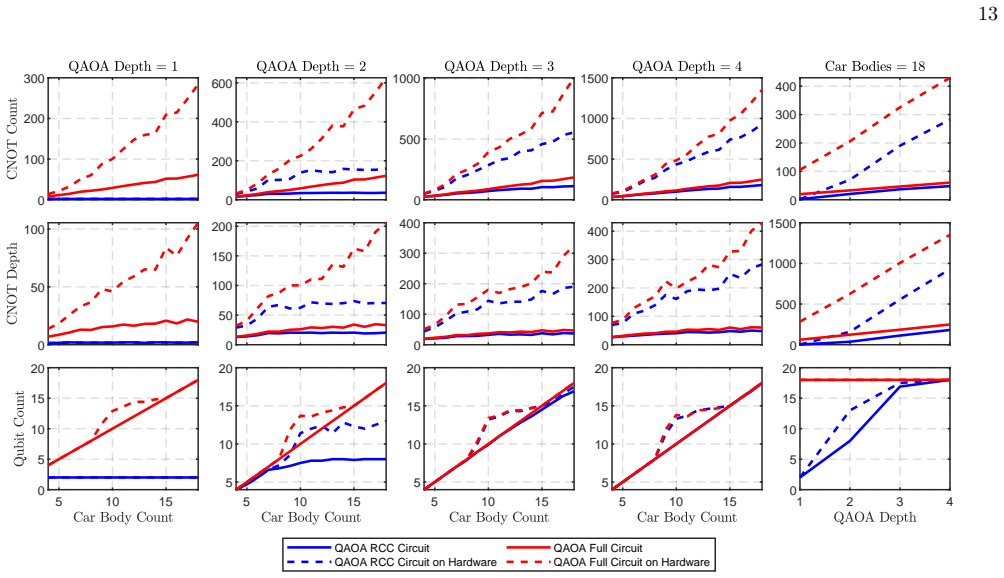
The Quantum Approximate Optimisation Algorithm (QAOA) is a leading candidate for near-term quantum advantage, yet its practical impact is hindered by limited performance on symmetric local Hamiltonians and the costly optimisation of variational parameters. The Recursive-QAOA (RQAOA) introduced by Bravyi et al. Phys. Rev. Lett. (2020), addresses the first limitation while also reducing circuit size, and parameter transfer techniques can be used to effectively bypass the optimisation loop. In this work, we combine these two ideas to develop an optimisation-free RQAOA and evaluate its performance on the Binary Paint Shop Problem (BPSP) -- an optimisation problem found in manufacturing where a sequence of cars must be painted under constraints while minimising the number of colour changes. The BPSP can be formulated as an Ising ground state problem with a symmetric local Hamiltonian in the form of MAX-CUT and properties well-suited for the application of QAOA parameter transfer. We benchmark QAOA and RQAOA with parameter transfer against classical solvers and heuristics, and investigate their resilience to suboptimal parameters. For circuit optimisation, we use reverse causal cones (RCC) and introduce a method of trimming outer two-qubit gates. To estimate the classical resources needed to simulate these quantum algorithms, we compute entanglement entropy and bond dimensions using matrix product state methods. We also compare circuit sizes and measurement counts across implementations. Our results show that RQAOA is inherently robust to parameter deviations, maintaining near-optimal solutions without noticeable degradation under parameter transfer while substantially reducing quantum resource requirements compared to QAOA. This highlights a viable route toward scalable quantum optimisation without the overhead of the classical optimisation loop and its challenges with barren plateaus.
Editorial analysis
A structured set of objections, weighed in public.
Referee Report
Summary. The manuscript proposes combining Recursive QAOA (RQAOA) with parameter-transfer techniques to create an optimisation-free variant, and evaluates it on the Binary Paint Shop Problem (BPSP) formulated as a MAX-CUT-like Ising Hamiltonian. It reports that RQAOA with transferred parameters remains near-optimal across recursion depths, substantially reduces circuit size and measurement overhead relative to standard QAOA, and demonstrates resilience to parameter deviations. Resource estimates are obtained via matrix-product-state calculations of entanglement entropy and bond dimension; circuit optimisation employs reverse causal cones together with a new outer-gate trimming procedure. Benchmarks against classical solvers and heuristics are included.
Significance. If the central empirical claims hold, the work supplies a concrete route to bypass the classical optimisation loop and its barren-plateau issues for at least one industrially relevant problem class, while quantifying the resulting quantum-resource savings. The use of MPS-based entanglement diagnostics and the introduction of outer-gate trimming are concrete technical contributions that could be reused elsewhere.
major comments (2)
- [Results on recursion depths] Results section (around the recursion-depth experiments): the central claim that transferred parameters remain near-optimal at every recursion depth rests on the assumption that the reduced Hamiltonians retain the symmetric local MAX-CUT structure of the original BPSP instance. No explicit verification—e.g., computation of the same symmetry measures or transferability metrics on the reduced instances—is reported. This is load-bearing for the robustness conclusion.
- [Benchmark tables/figures] Benchmark tables and figures: the reported performance advantages of RQAOA with parameter transfer are presented without error bars, without the number of independent instances or random seeds, and without statistical comparison to the classical baselines. This weakens the quantitative claim of “no noticeable degradation” and “substantially reducing quantum resource requirements.”
minor comments (2)
- [Methods] The description of the outer-gate trimming procedure would benefit from an explicit pseudocode or circuit diagram showing which gates are removed at each step.
- [Resource estimation] A short comparison table of circuit depth and CNOT count before and after RCC + trimming would make the resource-saving claim easier to assess at a glance.
Simulated Author's Rebuttal
We thank the referee for their careful reading of the manuscript and for the constructive comments. We address each major comment below and describe the revisions we intend to incorporate.
read point-by-point responses
-
Referee: [Results on recursion depths] Results section (around the recursion-depth experiments): the central claim that transferred parameters remain near-optimal at every recursion depth rests on the assumption that the reduced Hamiltonians retain the symmetric local MAX-CUT structure of the original BPSP instance. No explicit verification—e.g., computation of the same symmetry measures or transferability metrics on the reduced instances—is reported. This is load-bearing for the robustness conclusion.
Authors: We appreciate the referee pointing out this load-bearing assumption. The recursive reduction procedure in RQAOA is constructed to eliminate variables while preserving the local interaction structure of the original BPSP Ising Hamiltonian; however, we agree that an explicit check on the reduced instances would strengthen the robustness argument. In the revised manuscript we will add a short subsection (or supplementary figure) that computes the same symmetry measures and transferability metrics on the reduced Hamiltonians at successive recursion depths, thereby directly verifying that the symmetric local MAX-CUT character is retained. revision: yes
-
Referee: [Benchmark tables/figures] Benchmark tables and figures: the reported performance advantages of RQAOA with parameter transfer are presented without error bars, without the number of independent instances or random seeds, and without statistical comparison to the classical baselines. This weakens the quantitative claim of “no noticeable degradation” and “substantially reducing quantum resource requirements.”
Authors: We acknowledge that the current presentation of the benchmark results omits important statistical information. In the revised version we will (i) report the exact number of independent BPSP instances and random seeds used, (ii) add error bars (standard error of the mean) to all relevant tables and figures, and (iii) include a brief statistical comparison (e.g., paired t-tests or Wilcoxon tests with p-values) against the classical baselines. These additions will provide quantitative support for the statements of “no noticeable degradation” and resource savings. revision: yes
Circularity Check
No significant circularity; empirical benchmarks are self-contained
full rationale
The paper evaluates an optimisation-free RQAOA variant on the Binary Paint Shop Problem by combining the external RQAOA construction from Bravyi et al. (2020) with parameter transfer techniques. All reported performance claims, including robustness to parameter deviations and resource reductions, rest on direct numerical benchmarks against classical solvers, entanglement entropy calculations via matrix product states, and circuit-size comparisons. No derivation step equates a fitted quantity to a prediction by construction, no self-citation is load-bearing for the central empirical result, and the Hamiltonian symmetry is invoked only as motivation for applying known transfer methods rather than as a self-defined property. The work is therefore self-contained against external benchmarks and prior literature.
Axiom & Free-Parameter Ledger
axioms (1)
- domain assumption The Binary Paint Shop Problem admits an Ising formulation as a symmetric local MAX-CUT Hamiltonian well-suited for QAOA parameter transfer.
Lean theorems connected to this paper
-
IndisputableMonolith/Cost/FunctionalEquation.leanwashburn_uniqueness_aczel unclear?
unclearRelation between the paper passage and the cited Recognition theorem.
The BPSP can be formulated as an Ising ground state problem with a symmetric local Hamiltonian in the form of MAX-CUT ... well-suited for QAOA parameter transfer
-
IndisputableMonolith/Foundation/BranchSelection.leanbranch_selection unclear?
unclearRelation between the paper passage and the cited Recognition theorem.
RQAOA is inherently robust to parameter deviations, maintaining near-optimal solutions without noticeable degradation under parameter transfer
What do these tags mean?
- matches
- The paper's claim is directly supported by a theorem in the formal canon.
- supports
- The theorem supports part of the paper's argument, but the paper may add assumptions or extra steps.
- extends
- The paper goes beyond the formal theorem; the theorem is a base layer rather than the whole result.
- uses
- The paper appears to rely on the theorem as machinery.
- contradicts
- The paper's claim conflicts with a theorem or certificate in the canon.
- unclear
- Pith found a possible connection, but the passage is too broad, indirect, or ambiguous to say the theorem truly supports the claim.
Forward citations
Cited by 1 Pith paper
-
No quantum advantage implies improved bounds and classical algorithms for the binary paint shop problem
Absence of quantum advantage for log-depth QAOA on the binary paint shop problem implies a classical mean-field algorithm achieving a paint-swap ratio of approximately 0.2799, outperforming known heuristics and quantu...
Reference graph
Works this paper leans on
-
[1]
Reverse-Causal Cones (RCCs) The RQAOA allows us to avoid needing to prepare the full ansatz state. This is because RQAOA only needs to know the largest correlation magnitude between each ad- jacent pair of qubits to round a correlation to±1 when reducing the graph and the parameterized ansatz state can be optimised at each reduction step by calculating th...
-
[2]
Trimming RCC Outer Two-Qubit Gates In cases when the RCC’s first layer includes qubits that are not included in the second layer, these extra qubits and the gates that connect them can be replaced with noise gates applied to remaining qubits that neighbour the removed ones. To mimic the effects of depolarising noise, a noise gate can be implemented on a q...
-
[3]
Approximation Measure To compare methods fairly, we aim for a measure of approximation quality that is independent of problem in- stance and preferably independent of the objective func- tion’s properties, such as whether higher values are bet- ter or whether the values span positive and negative val- ues. To keep comparisons simple, we construct a measur...
-
[4]
Greedy Heuristic Thefirstcarinthesequenceisassignedred(whichcon- sequently assigns blue to its paired car). Then, iterating through the sequence, each unassigned car is assigned the same colour as the previous car in the sequence. For example, Ω(S) → { , , , , , , , } → { , , , , , , , } → { , , , , , , , } → { , , , , , , , }, resulting in a colour chang...
-
[5]
Recursive Greedy Heuristic Each car body pair is added to the sequence one by one, in the same order they appear in the problem car se- quence. Each pair’s colours are assigned to minimise the number of colour changes directly after they are added. For example, Ω(S) → { , } → { , , , } → { , , , , , } → { , , , , , , , }, resulting in a colour change coun...
-
[6]
NumPy Minimum Eigensolver This algorithm is used to find exact solutions to the BPSP. By first mapping the BPSP instance to an Ising Hamiltonian, using the method shown in Section IIC, the algorithm uses an eigensolver to find the eigenvector with the smallest eigenvalue, which corresponds to the minimum number of colour changes. For diagonal Hamil- tonia...
-
[7]
Obstacles to variational quantum opti- mization from symmetry protection
Sergey Bravyi, Alexander Kliesch, Robert Koenig, and Eugene Tang. Obstacles to variational quantum opti- mization from symmetry protection. Physical Review Letters, 125(26):260505, 2020
work page 2020
-
[8]
Quantum computing in the NISQ era and beyond
John Preskill. Quantum computing in the NISQ era and beyond. Quantum, 2:79, 2018
work page 2018
-
[9]
Sebastian Brandhofer, Daniel Braun, Vanessa Dehn, et al. Benchmarking the performance of portfolio opti- mization with QAOA.Quantum Information Processing, 22(1):25, 2022
work page 2022
-
[10]
Maxine T Khumalo, Hazel A Chieza, Krupa Prag, and Matthew Woolway. An investigation of IBM quantum computing device performance on combinatorial optimi- sation problems. Neural Computing and Applications, pages 1–16, 2022
work page 2022
-
[11]
Michael Streif, Sheir Yarkoni, Andrea Skolik, et al. Beat- ing classical heuristics for the binary paint shop problem with the quantum approximate optimization algorithm. Physical Review A, 104(1):012403, 2021
work page 2021
-
[12]
Improving variational quantum optimiza- tion using CVaR.Quantum, 4:256, 2020
Panagiotis Kl Barkoutsos, Giacomo Nannicini, Anton Robert, et al. Improving variational quantum optimiza- tion using CVaR.Quantum, 4:256, 2020
work page 2020
-
[13]
A Quantum Approximate Optimization Algorithm
Edward Farhi, Jeffrey Goldstone, and Sam Gutmann. A quantum approximate optimization algorithm.arXiv preprint arXiv:1411.4028, 2014
work page internal anchor Pith review Pith/arXiv arXiv 2014
-
[14]
Kostas Blekos, Dean Brand, Andrea Ceschini, Chiao-Hui Chou, Rui-Hao Li, Komal Pandya, and Alessandro Sum- mer. A review on quantum approximate optimization algorithm and its variants.Physics Reports, 1068:1–66, 2024
work page 2024
-
[15]
Challenges and opportuni- ties in quantum optimization
Amira Abbas, Andris Ambainis, Brandon Augustino, Andreas Bärtschi, Harry Buhrman, Carleton Coffrin, Giorgio Cortiana, Vedran Dunjko, Daniel J Egger, Bruce G Elmegreen, et al. Challenges and opportuni- ties in quantum optimization. Nature Reviews Physics, pages 1–18, 2024
work page 2024
-
[16]
Algorithms for quantum computation: discrete logarithms and factoring
Peter W Shor. Algorithms for quantum computation: discrete logarithms and factoring. In Proceedings 35th annual symposium on foundations of computer science, pages 124–134. Ieee, 1994
work page 1994
-
[17]
A fast quantum mechanical algorithm for database search
Lov K Grover. A fast quantum mechanical algorithm for database search. InProceedings of the twenty-eighth annual ACM symposium on Theory of computing, pages 212–219, 1996
work page 1996
-
[18]
David S Johnson, Gregory Gutin, Lyle A McGeoch, An- dersYeo, WeixiongZhang, andAlexeiZverovitch. Exper- imental analysis of heuristics for the ATSP.The travel- ing salesman problem and its variations, pages 445–487, 2007
work page 2007
-
[19]
Chained Lin-Kernighan for large traveling salesman problems
David Applegate, William Cook, and André Rohe. Chained Lin-Kernighan for large traveling salesman problems. Informs journal on computing, 15(1):82–92, 2003
work page 2003
-
[20]
An effective implementation of the Lin– Kernighantravelingsalesmanheuristic
Keld Helsgaun. An effective implementation of the Lin– Kernighantravelingsalesmanheuristic. European journal of operational research, 126(1):106–130, 2000
work page 2000
-
[21]
Polynomial time approximation schemes for Euclidean traveling salesman and other geometric problems
Sanjeev Arora. Polynomial time approximation schemes for Euclidean traveling salesman and other geometric problems. Journal of the ACM (JACM), 45(5):753–782, 1998
work page 1998
-
[22]
The traveling salesman problem: a case study in local optimization
David S Johnson and Lyle A Mcgeoch. The traveling salesman problem: a case study in local optimization. John Wiley and Sons, 1995
work page 1995
-
[23]
Data structures for traveling salesmen
Michael L Fredman, David S Johnson, Lyle A McGeoch, and Gretchen Ostheimer. Data structures for traveling salesmen. Journal of Algorithms, 18(3):432–479, 1995
work page 1995
-
[24]
Connecting ansatz expressibility to gradient magnitudes and barren plateaus
Zoë Holmes, Kunal Sharma, Marco Cerezo, and Patrick J Coles. Connecting ansatz expressibility to gradient magnitudes and barren plateaus. PRX Quantum, 3(1):010313, 2022
work page 2022
-
[25]
Noise-induced barren plateaus in variational quantum al- gorithms
Samson Wang, Enrico Fontana, Marco Cerezo, Kunal Sharma, Akira Sone, Lukasz Cincio, and Patrick J Coles. Noise-induced barren plateaus in variational quantum al- gorithms. Nature communications, 12(1):1–11, 2021
work page 2021
-
[26]
Barren plateaus in quantum neural network training landscapes.Nature communications, 9(1):1–6, 2018
Jarrod R McClean, Sergio Boixo, Vadim N Smelyanskiy, Ryan Babbush, and Hartmut Neven. Barren plateaus in quantum neural network training landscapes.Nature communications, 9(1):1–6, 2018
work page 2018
-
[27]
Rui Zhang. Environment-aware production scheduling for paint shops in automobile manufacturing: A multi- objective optimization approach. International Journal of Environmental Research and Public Health, 15(1):32, 2018
work page 2018
-
[28]
P Bonsma, Th Epping, and Winfried Hochstättler. Complexity results on restricted instances of a paint shop problem for words.Discrete Applied Mathematics, 154(9):1335–1343, 2006
work page 2006
-
[29]
Paintshop, odd cy- cles and necklace splitting.Discrete Applied Mathemat- ics, 157(4):780–793, 2009
Frédéric Meunier and András Sebő. Paintshop, odd cy- cles and necklace splitting.Discrete Applied Mathemat- ics, 157(4):780–793, 2009
work page 2009
-
[30]
Some simplified NP-complete problems
Michael R Garey, David S Johnson, and Larry Stock- meyer. Some simplified NP-complete problems. InPro- ceedings of the sixth annual ACM symposium on Theory of computing, pages 47–63, 1974
work page 1974
-
[31]
The fixed angle conjecture for QAOA on regular MaxCut graphs.arXiv preprint arXiv:2107.00677, 2021
Jonathan Wurtz and Danylo Lykov. The fixed angle conjecture for QAOA on regular MaxCut graphs.arXiv preprint arXiv:2107.00677, 2021
-
[32]
AsierOzaeta, WimvanDam, andPeterLMcMahon. Ex- pectation values from the single-layer quantum approxi- mate optimization algorithm on Ising problems.Quan- tum Science and Technology, 7(4):045036, 2022
work page 2022
-
[33]
Michael Streif, Sheir Yarkoni, Andrea Skolik, Florian Neukart, and Martin Leib. Beating classical heuristics for the binary paint shop problem with the quantum ap- proximate optimization algorithm. Physical Review A, 104(1):012403, 2021
work page 2021
-
[34]
Training the quantum approximate optimization algorithm without access to a quantum processing unit
Michael Streif and Martin Leib. Training the quantum approximate optimization algorithm without access to a quantum processing unit. Quantum Science and Tech- nology, 5(3):034008, 2020
work page 2020
-
[35]
QAOAKit: A toolkit for re- producible study, application, and verification of the QAOA
Ruslan Shaydulin, Kunal Marwaha, Jonathan Wurtz, and Phillip C Lotshaw. QAOAKit: A toolkit for re- producible study, application, and verification of the QAOA. In2021 IEEE/ACM Second International Work- shop on Quantum Computing Software (QCS), pages 64–
-
[36]
Parametertrans- fer for quantum approximate optimization of weighted maxcut
Ruslan Shaydulin, Phillip C Lotshaw, Jeffrey Larson, JamesOstrowski, andTravisSHumble. Parametertrans- fer for quantum approximate optimization of weighted maxcut. ACM Transactions on Quantum Computing, 4(3):1–15, 2023
work page 2023
-
[37]
Alberto Peruzzo, Jarrod McClean, Peter Shadbolt, Man- 17 Hong Yung, Xiao-Qi Zhou, Peter J Love, Alán Aspuru- Guzik, and Jeremy L O’brien. A variational eigenvalue solver on a photonic quantum processor.Nature Com- munications, 5(1):1–7, 2014
work page 2014
-
[38]
Quantum Computation by Adiabatic Evolution
Edward Farhi, Jeffrey Goldstone, Sam Gutmann, and Michael Sipser. Quantum computation by adiabatic evo- lution. arXiv preprint quant-ph/0001106, 2000
work page internal anchor Pith review Pith/arXiv arXiv 2000
-
[39]
Max Born and Vladimir Fock. Beweis des adiabaten- satzes. Zeitschrift für Physik, 51(3):165–180, 1928
work page 1928
-
[40]
On the adiabatic theorem of quantum mechanics
Tosio Kato. On the adiabatic theorem of quantum mechanics. Journal of the Physical Society of Japan, 5(6):435–439, 1950
work page 1950
-
[41]
IBMILOGCplex. V12.1: User’smanualforCPLEX. In- ternational Business Machines Corporation, 46(53):157, 2009
work page 2009
-
[42]
Approximability of the minimum bi- section problem: An algorithmic challenge
Marek Karpinski. Approximability of the minimum bi- section problem: An algorithmic challenge. InInterna- tional Symposium on Mathematical Foundations of Com- puter Science, pages 59–67. Springer, 2002
work page 2002
-
[43]
Complexity results on a paint shop problem
Th Epping, Winfried Hochstättler, and Peter Oertel. Complexity results on a paint shop problem. Discrete Applied Mathematics, 136(2-3):217–226, 2004
work page 2004
-
[44]
Multi- car paint shop optimization with quantum annealing
Sheir Yarkoni, Alex Alekseyenko, Michael Streif, David Von Dollen, Florian Neukart, and Thomas Bäck. Multi- car paint shop optimization with quantum annealing. In 2021 IEEE International Conference on Quantum Com- puting and Engineering (QCE),pages35–41.IEEE, 2021
work page 2021
-
[45]
Paint line color change reduction in automobile assembly through simu- lation
Yong-Hee Han, Chen Zhou, Bert Bras, Leon McGinnis, Carol Carmichael, and PJ Newcomb. Paint line color change reduction in automobile assembly through simu- lation. InWinter Simulation Conference, volume2, pages 1204–1209, 2003
work page 2003
-
[46]
The quantum approximate optimization algorithm needs to see the whole graph: A typical case
EdwardFarhi, DavidGamarnik, andSamGutmann. The quantum approximate optimization algorithm needs to see the whole graph: A typical case. arXiv preprint arXiv:2004.09002, 2020
-
[47]
The quantum approximate optimization algorithm needs to seethewholegraph: Worstcaseexamples
EdwardFarhi, DavidGamarnik, andSamGutmann. The quantum approximate optimization algorithm needs to seethewholegraph: Worstcaseexamples. arXiv preprint arXiv:2005.08747, 2020
-
[48]
Joao Basso, David Gamarnik, Song Mei, and Leo Zhou. Performance and limitations of the QAOA at constant levels on large sparse hypergraphs and spin glass models. In2022 IEEE 63rd Annual Symposium on Foundations of Computer Science (FOCS), pages 335–343. IEEE, 2022
work page 2022
-
[49]
Classical and quantum bounded depth approximation algorithms
Matthew B Hastings. Classical and quantum bounded depth approximation algorithms. arXiv preprint arXiv:1905.07047, 2019
-
[50]
Recursive QAOA outper- forms the original QAOA for the MAX-CUT problem on complete graphs
Eunok Bae and Soojoon Lee. Recursive QAOA outper- forms the original QAOA for the MAX-CUT problem on complete graphs. Quantum Information Processing, 23(3):78, 2024
work page 2024
-
[51]
Reinforcement learning assisted recursive QAOA
Yash J Patel, Sofiene Jerbi, Thomas Bäck, and Ve- dran Dunjko. Reinforcement learning assisted recursive QAOA. EPJ Quantum Technology, 11(1):6, 2024
work page 2024
-
[52]
Quantum-informed recursive optimization algorithms
Jernej Rudi Finžgar, Aron Kerschbaumer, Martin JA Schuetz, Christian B Mendl, and Helmut G Katzgraber. Quantum-informed recursive optimization algorithms. PRX Quantum, 5(2):020327, 2024
work page 2024
-
[53]
Recursivequantumrelaxationforcombinatorial optimization problems
Ruho Kondo, Yuki Sato, Rudy Raymond, and Naoki Ya- mamoto. Recursivequantumrelaxationforcombinatorial optimization problems. Quantum, 9:1594, 2025
work page 2025
-
[54]
Burhan Gulbahar. Majority voting with recursive qaoa and cost-restricted uniform sampling for maximum- likelihooddetectioninmassivemimo. IEEE Transactions on Wireless Communications, 2025
work page 2025
-
[55]
The quantum alternating operator ansatz on maximum k-vertex cover
Jeremy Cook, Stephan Eidenbenz, and Andreas Bärtschi. The quantum alternating operator ansatz on maximum k-vertex cover. In 2020 IEEE International Conference on Quantum Computing and Engineering (QCE), pages 83–92. IEEE, 2020
work page 2020
-
[56]
Accelerating quantum approximate optimiza- tion algorithm using machine learning
Mahabubul Alam, Abdullah Ash-Saki, and Swaroop Ghosh. Accelerating quantum approximate optimiza- tion algorithm using machine learning. In2020 Design, Automation & Test in Europe Conference & Exhibition (DATE), pages 686–689. IEEE, 2020
work page 2020
-
[57]
Reinforcement-learning- assisted quantum optimization
Matteo M Wauters, Emanuele Panizon, Glen B Mbeng, and Giuseppe E Santoro. Reinforcement-learning- assisted quantum optimization. Physical Review Re- search, 2(3):033446, 2020
work page 2020
-
[58]
Iteration-free quantum ap- proximate optimization algorithm using neural networks
Ohad Amosy, Tamuz Danzig, Ohad Lev, Ely Porat, Gal Chechik, and Adi Makmal. Iteration-free quantum ap- proximate optimization algorithm using neural networks. Quantum Machine Intelligence, 6(2):38, 2024
work page 2024
-
[59]
Transferability of optimal QAOA parameters between random graphs
Alexey Galda, Xiaoyuan Liu, Danylo Lykov, Yuri Alex- eev, and Ilya Safro. Transferability of optimal QAOA parameters between random graphs. In2021 IEEE In- ternational Conference on Quantum Computing and En- gineering (QCE), pages 171–180. IEEE, 2021
work page 2021
-
[60]
Empirical perfor- mance bounds for quantum approximate optimization
Phillip C Lotshaw, Travis S Humble, Rebekah Herrman, James Ostrowski, and George Siopsis. Empirical perfor- mance bounds for quantum approximate optimization. Quantum Information Processing, 20(12):1–32, 2021
work page 2021
-
[61]
Leo Zhou, Sheng-Tao Wang, Soonwon Choi, Hannes Pichler, and Mikhail D Lukin. Quantum approximate optimization algorithm: Performance, mechanism, and implementation on near-term devices. Physical Review X, 10(2):021067, 2020
work page 2020
-
[62]
Jonathan Wurtz and Peter Love. MaxCut quantum ap- proximate optimization algorithm performance guaran- tees for p> 1.Physical Review A, 103(4):042612, 2021
work page 2021
-
[63]
Michel X Goemans and David P Williamson. Improved approximation algorithms for maximum cut and satisfia- bility problems using semidefinite programming.Journal of the ACM (JACM), 42(6):1115–1145, 1995
work page 1995
-
[64]
Fernando GSL Brandao, Michael Broughton, Edward Farhi, Sam Gutmann, and Hartmut Neven. For fixed control parameters the quantum approximate optimiza- tion algorithm’s objective function value concentrates for typicalinstances. arXiv preprint arXiv:1812.04170, 2018
work page internal anchor Pith review Pith/arXiv arXiv 2018
-
[65]
Quantum approximate optimization algorithm for MaxCut: A fermionic view
Zhihui Wang, Stuart Hadfield, Zhang Jiang, and Eleanor G Rieffel. Quantum approximate optimization algorithm for MaxCut: A fermionic view. Physical Re- view A, 97(2):022304, 2018
work page 2018
-
[66]
Stuart Andrew Hadfield.Quantum algorithms for scien- tific computing and approximate optimization. Columbia University, 2018
work page 2018
-
[67]
Edward Farhi, Jeffrey Goldstone, Sam Gutmann, and Leo Zhou. The quantum approximate optimization algo- rithm and the Sherrington-Kirkpatrick model at infinite size. Quantum, 6:759, 2022
work page 2022
-
[68]
Learning to opti- mize variational quantum circuits to solve combinatorial problems
Sami Khairy, Ruslan Shaydulin, Lukasz Cincio, Yuri Alexeev, and Prasanna Balaprakash. Learning to opti- mize variational quantum circuits to solve combinatorial problems. In Proceedings of the AAAI conference on ar- tificial intelligence, volume 34, pages 2367–2375, 2020
work page 2020
-
[69]
Isak Lyngfelt and Laura García-Álvarez. Symmetry- informed transferability of optimal parameters in the 18 quantum approximate optimization algorithm.Physical Review A, 111(2):022418, 2025
work page 2025
-
[70]
Hybrid quantum optimization in the con- text of minimizing traffic congestion
Jedwin Villanueva, Gary J Mooney, Bhaskar Roy Bard- han, Joydip Ghosh, Charles D Hill, and Lloyd CL Hollenberg. Hybrid quantum optimization in the con- text of minimizing traffic congestion. arXiv preprint arXiv:2504.08275, 2025
discussion (0)
Sign in with ORCID, Apple, or X to comment. Anyone can read and Pith papers without signing in.