Probing the Type 3 interacting dark-energy model using matter pairwise velocity
Pith reviewed 2026-05-19 00:57 UTC · model grok-4.3
The pith
Effects of momentum coupling and scalar potential slope are degenerate in matter pairwise velocities.
A machine-rendered reading of the paper's core claim, the machinery that carries it, and where it could break.
Core claim
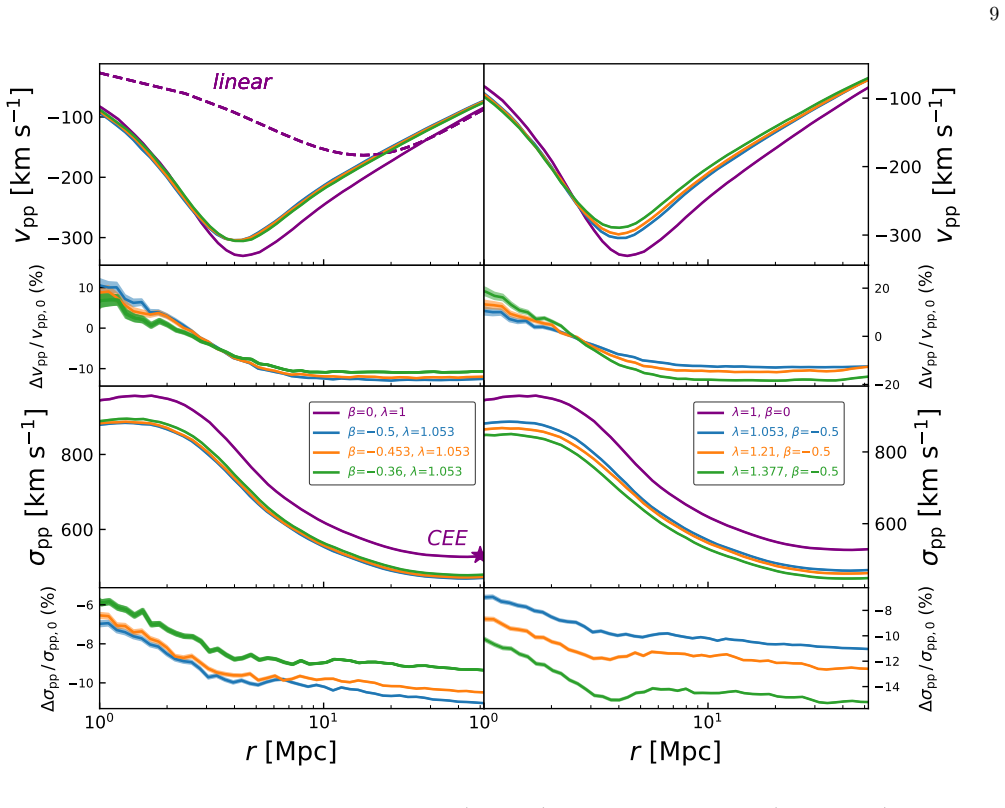
In the Type 3 model dark matter and dark energy exchange momentum only; N-body simulations show that the momentum-exchange coupling beta (less than zero) and the scalar-field potential slope lambda imprint degenerate changes on the mean matter peculiar pairwise velocity and on the velocity dispersion.
What carries the argument
Matter pairwise velocity statistics (mean peculiar pairwise velocity and velocity dispersion) that carry the imprint of the Type 3 model parameters beta and lambda.
If this is right
- Pairwise velocity statistics become a usable probe of dark-sector momentum exchange.
- Analyses that employ velocity data must account for the degeneracy between beta and lambda.
- The slope of the scalar-field potential leaves a detectable signature in large-scale velocity fields.
- N-body simulations confirm that the interaction parameters alter both mean velocity and dispersion at observable levels.
Where Pith is reading between the lines
- Combining pairwise velocity data with galaxy clustering or weak-lensing measurements could lift the reported degeneracy.
- Surveys that map peculiar velocities at multiple redshifts may reveal scale-dependent signatures that help separate beta from lambda.
- If the degeneracy persists across redshifts, current bounds on interacting dark energy derived without velocity statistics could be incomplete.
Load-bearing premise
The Type 3 model is built so that dark matter and dark energy exchange momentum only, thereby keeping the background expansion history nearly identical to LambdaCDM.
What would settle it
An observational data set in which independent variations of beta and lambda produce clearly distinguishable changes in measured pairwise velocity dispersion would falsify the degeneracy.
Figures



read the original abstract
Dark sector interactions can be explored via the so-called Type 3 model where dark matter and dark energy exchange momentum only, so as to minimize deviations from the $\Lambda$CDM background expansion history. Using N-body simulations, we analyze the imprint of Type 3 model parameters, the momentum exchange coupling constant $\beta$ and the slope of scalar field potential $\lambda$, on large-scale structure observables, particularly the matter pairwise velocity statistics. We find that the effects of $\beta$ ($<0$) and $\lambda$ on the mean matter peculiar pairwise velocity and velocity dispersion are degenerate. Our results highlight the potential of velocity statistics as a probe of dark sector interactions and underscore the importance of disentangling $\beta$ and $\lambda$ in cosmological analyses.
Editorial analysis
A structured set of objections, weighed in public.
Referee Report
Summary. The manuscript investigates the Type 3 interacting dark-energy model in which dark matter and dark energy exchange momentum only, thereby minimizing deviations from the ΛCDM background expansion history. Using N-body simulations, the authors examine the effects of the momentum-exchange coupling β (<0) and the scalar-field potential slope λ on large-scale structure, focusing on the mean matter peculiar pairwise velocity and the velocity dispersion. The central result is that the effects of β and λ on these velocity statistics are degenerate.
Significance. If the reported degeneracy is shown to arise purely from the interaction term under strictly controlled background expansion, the result would be significant for cosmological analyses of dark-sector interactions. It would demonstrate that pairwise velocity statistics can serve as a probe of such models while flagging a degeneracy that must be broken in parameter constraints. The choice to target velocity observables rather than density statistics alone is a reasonable extension of existing LSS tests.
major comments (1)
- [Abstract] Abstract: The claim that β (<0) and λ produce degenerate effects on the mean peculiar pairwise velocity and velocity dispersion assumes that the background expansion history remains indistinguishable from ΛCDM for the simulated parameter pairs. The abstract states that momentum exchange is introduced “so as to minimize deviations,” yet provides no explicit verification (e.g., comparison of H(z), w_DE(z), or the linear growth factor) when λ is varied at fixed β. This verification is load-bearing for the degeneracy interpretation; any residual differences in Hubble drag or growth would contribute to the velocity statistics independently of the interaction term.
minor comments (2)
- The abstract omits basic simulation specifications (box size, particle resolution, number of realizations, and error estimation procedure for the pairwise velocity and dispersion measurements). These details are needed to judge the robustness of the reported degeneracy.
- The range of numerical values explored for β and λ should be stated explicitly so that readers can assess the domain over which the degeneracy holds.
Simulated Author's Rebuttal
We thank the referee for their constructive feedback and positive evaluation of the work's significance. We address the major comment below and will incorporate the suggested verification into the revised manuscript.
read point-by-point responses
-
Referee: [Abstract] Abstract: The claim that β (<0) and λ produce degenerate effects on the mean peculiar pairwise velocity and velocity dispersion assumes that the background expansion history remains indistinguishable from ΛCDM for the simulated parameter pairs. The abstract states that momentum exchange is introduced “so as to minimize deviations,” yet provides no explicit verification (e.g., comparison of H(z), w_DE(z), or the linear growth factor) when λ is varied at fixed β. This verification is load-bearing for the degeneracy interpretation; any residual differences in Hubble drag or growth would contribute to the velocity statistics independently of the interaction term.
Authors: We agree that explicit verification strengthens the degeneracy claim. The Type 3 model is constructed so that the momentum-exchange interaction leaves the background expansion history identical to ΛCDM for any combination of β and λ; the scalar-field slope λ enters only the perturbation equations. Nevertheless, to make this explicit and address the referee's concern, we will add a short subsection (or appendix figure) in the revised manuscript comparing H(z), w_DE(z), and the linear growth factor D(a) across the simulated (β, λ) pairs, confirming that residual deviations are negligible compared to the velocity-signal differences. revision: yes
Circularity Check
No significant circularity in simulation-based parameter study
full rationale
The paper reports results from N-body simulations in which the Type 3 model parameters β and λ are varied independently while the background expansion is constructed to stay close to ΛCDM; the mean pairwise velocity and dispersion are then measured as direct simulation outputs. The reported degeneracy is an observed numerical outcome rather than a quantity defined in terms of itself or recovered by fitting a parameter to a related statistic. No equations or steps are shown that reduce the central claim to a self-definition, a fitted input renamed as a prediction, or a load-bearing self-citation chain. The analysis therefore remains self-contained against external simulation benchmarks.
Axiom & Free-Parameter Ledger
free parameters (2)
- β
- λ
axioms (1)
- domain assumption Dark matter and dark energy exchange momentum only in the Type 3 model, minimizing deviations from ΛCDM background expansion.
Lean theorems connected to this paper
-
IndisputableMonolith/Cost/FunctionalEquation.leanwashburn_uniqueness_aczel unclear?
unclearRelation between the paper passage and the cited Recognition theorem.
Dark sector interactions... exchange momentum only, so as to minimize deviations from the ΛCDM background expansion history... effects of β(<0) and λ on the mean matter peculiar pairwise velocity and velocity dispersion are degenerate.
-
IndisputableMonolith/Foundation/RealityFromDistinction.leanreality_from_one_distinction unclear?
unclearRelation between the paper passage and the cited Recognition theorem.
The defining characteristic of the Type 3 model... Jμ vanishes at the background level... no energy exchange... uncoupled background expansion history.
What do these tags mean?
- matches
- The paper's claim is directly supported by a theorem in the formal canon.
- supports
- The theorem supports part of the paper's argument, but the paper may add assumptions or extra steps.
- extends
- The paper goes beyond the formal theorem; the theorem is a base layer rather than the whole result.
- uses
- The paper appears to rely on the theorem as machinery.
- contradicts
- The paper's claim conflicts with a theorem or certificate in the canon.
- unclear
- Pith found a possible connection, but the passage is too broad, indirect, or ambiguous to say the theorem truly supports the claim.
Forward citations
Cited by 1 Pith paper
-
Measuring neutrino mass and asymmetry through galaxy pairwise peculiar velocity
Galaxy pairwise peculiar velocities from Cosmicflows-4 yield M_ν = 0.24^{+0.34}_{-0.18} eV and η² = 2.14^{+0.30}_{-0.32} (7σ non-zero asymmetry) in the CMB framework, consistent with prior Planck results.
Reference graph
Works this paper leans on
- [1]
-
[2]
A. G. Riess et al., Astrophys. J.699, 539 (2009)
work page 2009
-
[3]
D. J. Eisensteinet al., Astrophys. J.633, 560 (2005)
work page 2005
-
[5]
A. Vikhlinin et al. , Astrophys. J. 692, 1060 (2009), ac- cessed: 2020-12-01
work page 2009
-
[6]
E. J. Copeland, M. Sami, and S. Tsujikawa, Int. J. Mod. Phys. 15, 1753 (2006)
work page 2006
-
[7]
T. Clifton, P. G. Ferreira, A. Padilla, and C. Skordis, Phys. Rept. 513, 1 (2012)
work page 2012
-
[8]
C. L. Bennett et al. (WMAP), Astrophys. J. Suppl.208, 20 (2013)
work page 2013
- [9]
- [10]
- [11]
- [12]
-
[13]
Baumann, Cosmology (Cambridge University Press,
D. Baumann, Cosmology (Cambridge University Press,
-
[14]
A. G. Adame et al., JCAP2025 (04), 012
-
[15]
A. G. Adame et al., JCAP2025 (02), 021
-
[16]
A. G. Adame et al., JCAP2025 (01), 124
- [17]
- [18]
-
[19]
A. Spurio Mancini et al., Mon. Not. Roy. Astron. Soc.490, 2155 (2019)
work page 2019
-
[20]
A. Shahab Joudaki et al., Mon. Not. Roy. Astron. Soc. 471, 1259 (2017)
work page 2017
- [21]
-
[22]
Di Valentino et al., Astropart
E. Di Valentino et al., Astropart. Phys. 131, 102604 (2021)
work page 2021
- [23]
- [24]
-
[25]
A. Pourtsidou, C. Skordis, and E. Copeland, Phys. Rev. D 88, 083505 (2013)
work page 2013
- [26]
- [27]
- [28]
-
[29]
M. C. D. Marsh, Phys. Rev. Lett.118, 011302 (2017)
work page 2017
-
[30]
A. Gómez-Valent, V. Pettorino, and L. Amendola, Phys. Rev. D101, 123513 (2020)
work page 2020
-
[31]
R. Bean, É. Flanagan, I. Laszlo, and M. Trodden, Phys. Rev. D78, 123514 (2008)
work page 2008
- [32]
- [33]
-
[34]
A. V. Macciò, C. Quercellini, R. Mainini, L. Amendola, and S. A. Bonometto, Phys. Rev. D69, 123516 (2004)
work page 2004
- [35]
- [36]
- [37]
-
[38]
Y. Liu, S. Liao, X. Liu, J. Zhang, R. An, and Z. Fan, Mon. Not. Roy. Astron. Soc.511, 3076 (2022)
work page 2022
-
[39]
M. Baldi, in Nuclear Phys. B - Proc. Suppl. , Vol. 194 (2009) pp. 178–184
work page 2009
- [40]
-
[41]
Y. Zhao, Y. Liu, S. Liao, J. Zhang, X. Liu, and W. Du, Mon. Not. Roy. Astron. Soc.523, 5962 (2023)
work page 2023
-
[42]
C. Skordis, A. Pourtsidou, and E. Copeland, Phys. Rev. D 91, 083537 (2015)
work page 2015
- [43]
- [44]
- [45]
- [46]
-
[47]
F. Chamings, A. Avgoustidis, E. Copeland, A. Green, and A. Pourtsidou, Phys. Rev. D101, 043531 (2020)
work page 2020
- [48]
-
[49]
B. Bose, M. Baldi, and A. Pourtsidou, JCAP2018 (04), 032
-
[50]
F. Ferlito, S. Vagnozzi, D. F. Mota, and M. Baldi, Mon. Not. Roy. Astron. Soc.512, 1885 (2022)
work page 2022
- [51]
- [52]
- [53]
-
[54]
D. Palma and G. N. Candlish, Mon. Not. Roy. Astron. Soc. 526, 1904 (2023)
work page 1904
- [55]
- [56]
- [57]
- [58]
-
[59]
W. Zhang, M.-c. Chu, S. Liao, S. Yeung, and H.-J. Hu, As- trophys. J. Lett.978, L6 (2025), arXiv:2412.04660 [astro- ph.CO]
-
[60]
R. Juszkiewicz, P. G. Ferreira, H. A. Feldman, A. H. Jaffe, and M. Davis, Science287, 109 (2000)
work page 2000
- [61]
-
[62]
Y.-Z. Ma, M. Li, and P. He, Astron. Astrophys.583, A52 (2015)
work page 2015
-
[63]
J. L. Tinker, P. Norberg, D. H. Weinberg, and M. S. War- ren, Astrophys. J.659, 877 (2007)
work page 2007
-
[64]
F. C. van den Bosch et al., Mon. Not. Roy. Astron. Soc. 376, 841 (2007)
work page 2007
- [65]
- [66]
-
[67]
Y. P. Jing, G. Borner, and Y. Suto, Astrophys. J.564, 15 (2002)
work page 2002
- [68]
- [69]
-
[70]
W. Zhang, M.-c. Chu, R. Hu, S. Liao, and Y. Shek, Mon. Not. Roy. Astron. Soc.529, 360 (2024)
work page 2024
- [71]
- [72]
-
[73]
X. Liu, S. Tsujikawa, and K. Ichiki, Phys. Rev. D109, 043533 (2024)
work page 2024
- [74]
-
[75]
T. Brinckmann and J. Lesgourgues, Physics of the Dark Universe 24, 100260 (2019)
work page 2019
- [76]
-
[77]
P. A. R. Ade et al. (Planck), Astro. Astrophys.571, A20 (2014)
work page 2014
-
[78]
P. A. R. Ade et al. (Planck), Astro. Astrophys.594, A24 (2015)
work page 2015
- [79]
- [80]
- [81]
discussion (0)
Sign in with ORCID, Apple, or X to comment. Anyone can read and Pith papers without signing in.