REVIEW 4 major objections 4 minor 1 cited by
SearchInstruct generates supervised fine-tuning datasets by expanding a handful of seed questions with an LLM and grounding each answer in retrieved documents, claiming measurable gains in specialized domains and a lightweight method for up
Reviewed by Pith at T0; open to challenge. T0 means a machine referee read the full paper against a public rubric. the ladder, T0–T4 →
2026-08-04 17:35 UTC pith:DYBJEQEE
load-bearing objection A practical retrieval-grounded SFT data pipeline whose central comparison is confounded by data quantity and targeted generation; the method is plausible and well-described but needs a controlled ablation. the 4 major comments →
SearchInstruct: Enhancing Domain Adaptation via Retrieval-Based Instruction Dataset Creation
The pith
A machine-rendered reading of the paper's core claim, the machinery that carries it, and where it could break.
Core claim
SearchInstruct's central claim is that query diversity matters more than answer diversity: expanding a modest seed set of human questions into many realistic variants, then grounding each answer in retrieved documents, produces SFT data that fixes coverage gaps ordinary synthetic pipelines miss. The method moves retrieval from inference time to data-construction time, so the fine-tuned model internalizes external knowledge rather than depending on it per query. Evidence is a blind human evaluation where models trained with SearchInstruct data win 62–68% of pairwise comparisons against prior models, and a model-editing experiment where a 27B model is updated with recent facts (political chang
What carries the argument
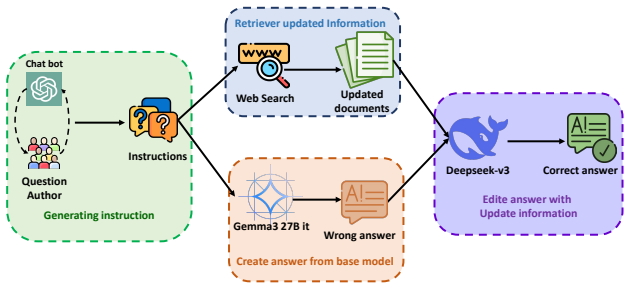
The four-stage pipeline: (1) seed generation from human or human-LLM collaborative writing; (2) LLM-based query expansion, paraphrasing and recombining seeds into a larger instruction pool; (3) document retrieval using web search, RAG, or domain APIs, with an LLM rewrite step to produce search-oriented queries; and (4) response construction, where the instruction is paired with filtered retrieved contexts and an LLM generates an answer grounded in that evidence. For model editing, the pipeline is adapted to retrieve updated documents, generate minimal edits to the base model's old answer, and use the revised answer as the 'chosen' response in preference optimization. The load-bearing idea is
Load-bearing premise
The win rates in the human evaluation are attributed to the SearchInstruct method, but the compared models differ in training data quantity, training recency, and the fact that the added data was iteratively refined to fix exactly the weaknesses probed by the 100-question benchmark, so the reported improvements may not isolate the effect of retrieval-based construction.
What would settle it
Train two models on equal-sized SFT sets generated from the same expanded question pool, one with answers grounded in retrieved documents and one with ungrounded LLM answers; if the grounded model does not win significantly on a held-out benchmark that was not used for iterative refinement, the claimed advantage of retrieval-grounded construction is not supported. Alternatively, if a model trained on non-retrieved expansions of the same seeds matches the win rates, the effect is just extra data.
If this is right
- If correct, domain adaptation for low-resource languages and niches can be done with a small seed set and a retrieval source, removing the need for large human-annotated corpora.
- Models fine-tuned on retrieval-grounded data should rely less on retrieval at inference time, making deployment simpler and cheaper.
- The iterative refinement loop (generate data targeting identified weaknesses) provides a practical recipe for continuously improving models after release.
- The model-editing experiment suggests a lightweight way to refresh factual knowledge in existing models with minimal general-knowledge degradation, though integration depth is limited.
- The method's effectiveness depends on retrieval quality; in noisy or sparse document collections, gains will shrink.
Where Pith is reading between the lines
- A matched control experiment separating 'extra data' from 'retrieval grounding' would sharpen the causal claim; the paper's current comparison confounds quantity, recency, and targeted refinement.
- The approach could translate to other knowledge-scarce domains (legal, medical, regional culture) where seed questions are cheap but documents are scattered; a testable prediction is that benefits scale with document availability and query-document vocabulary mismatch.
- The shallow-editing limitation hints that retrieval-grounded SFT injects facts but not the relational structure around them; combining the pipeline with knowledge-graph or entity-link supervision might deepen integration.
- The query-expansion stage might serve as a data-augmentation tool for evaluation benchmarks too, since it generates realistic user phrasings that document-grounded pipelines tend to miss.
Editorial analysis
A structured set of objections, weighed in public.
Referee Report
Summary. The paper proposes SearchInstruct, a four-stage pipeline for constructing supervised fine-tuning (SFT) datasets: seed generation, LLM-based query expansion, document retrieval, and retrieval-grounded answer synthesis. The authors apply the pipeline to two specialized Persian-language domains (traditional cuisine and domestic tourism), fine-tuning MATINA models with the generated data and comparing them to prior MATINA checkpoints via a blind human evaluation. They also apply the framework to model editing: they retrieve up-to-date documents, minimally revise outdated Gemma-3-27B answers with a secondary LLM, and train with ORPO on the resulting preference pairs. The central claim is that retrieval-based dataset construction yields measurable improvements in domain LLM performance and enables lightweight knowledge updates. The paper releases the code, prompts, and generated instruction–response pairs.
Significance. If the central claim were fully supported, SearchInstruct would be a practical contribution to low-resource domain adaptation: it offers a concrete way to generate diverse, realistic, and evidence-grounded instruction data without large-scale human annotation, and it is accompanied by a public repository containing code, prompts, and generated data, which is a genuine strength for reproducibility. The model-editing application is also interesting, and the authors honestly disclose its limitation to surface-level fact replacement. However, the current evaluation does not establish that the observed gains come from the distinctive retrieval-based component. The head-to-head comparison in Figure 2 conflates the method with additional data quantity and iterative targeting, and the MMLU claim in Table 2 is statistically unsupported. The contribution is defensible but needs stronger, controlled evidence.
major comments (4)
- [§4.1.1, Figure 2, Table 1] The main human-evaluation comparison does not isolate the effect of retrieval-grounded answer construction. The 'with' condition is trained on the original MATINA data plus 7,560–8,932 additional SFT pairs (Table 1), while the 'without' condition receives no additional data. The new data were generated in three feedback-driven stages (§3.2) that target the exact query types later probed by the 100-question benchmark. Any additional SFT data—especially data aimed at underrepresented question types—could plausibly produce the same win rates. A control condition that adds an equal-sized dataset produced by the same seed set and expansion/feedback loop but without retrieval (e.g., self-instruct-style or Evol-Instruct-style answers) is required to attribute the win rates to SearchInstruct's retrieval mechanism. As reported, the 62–68% win rates also lack error bars, inter-annotator agreement,
- [§4.1.1, Figure 3, Appendix C] The independence of the 100-question human benchmark from the training-data distribution is not established. Five annotators each wrote 20 test questions after the iterative refinement loop had already identified weak areas and generated targeted seeds to address them (§3.2, Figure 3). If the test-question authors used guidelines similar to the seed-generation guidelines in Appendix C, the test set is effectively drawn from the same distribution as the training data. This makes the evaluation circular in practice, even if the annotators were not the same people who wrote the seeds. A held-out evaluation set designed before the augmentation, or an external benchmark, would be needed to support the general claim that SearchInstruct improves domain adaptation beyond the targeted distribution.
- [§4.2.1, Table 2] The statement that 'results in Table 2 show no significant drop in accuracy' is not supported. The table shows declines in every MMLU category, from -1.43 to -3.18 points, with an average decline of -1.99. No standard errors, confidence intervals, or significance tests are reported, so 'no significant drop' is a statistical claim without statistical evidence. The STEM decline of -3.18 is especially concerning. Additionally, the targeted evaluation is described only qualitatively ('human evaluation confirmed'); please report the number of test items, win rates, and agreement statistics, or soften the claim accordingly.
- [Abstract, §4.1.1, Table 1] The abstract and introduction claim that SearchInstruct 'notably enhances both the diversity and quality of SFT datasets,' but diversity and quality are not directly measured. Table 1 reports only sample counts; no diversity metric (e.g., embedding dispersion, n-gram coverage, or category entropy) and no quality metric (e.g., factual accuracy or human-rated answer quality) is provided. The human evaluation measures preference over model outputs, which is an indirect and confounded proxy. The paper should either report direct diversity/quality measurements or restrict the claim to the observed preference outcomes.
minor comments (4)
- [Figure 2] Please report the raw number of pairwise comparisons per condition and explicitly state how ties are handled. The 'lose' shares (2–4%) are nearly invisible in the stacked bars; a table alongside the figure would improve clarity.
- [§3.2, Appendix C] The seed-generation process is described in detail, but the paper does not report the number of seeds per domain, the number of annotators, or any inter-annotator agreement. These details would help readers assess the reproducibility of the seed set.
- [Appendix E, Table 5] The DeepSpeed column uses undefined abbreviations (Z0, Z3) and the meaning of 'Pref.β' is not explicitly defined (presumably the ORPO beta). Please add a footnote or expand the table caption.
- [Appendix D, Table 4] There is a typo in the English header: 'Tow' should be 'Two'. Also, the English translation of the second row contains an unbalanced parenthesis; please proofread the appendix tables.
Circularity Check
No significant circularity: SearchInstruct's dataset-generation pipeline is empirical and self-contained; the main weak spots are evaluation confounds and an internal MATINA baseline, not derivation circularity.
full rationale
SearchInstruct is an empirical pipeline rather than a formal derivation: it defines an instruction dataset D = {(i, Ai)} with Ai = LLManswer(i, Cfiltered_i) and then fine-tunes M(i) -> Ai. No equation or fitted parameter is reused as a prediction. The central evidence is the blind human evaluation in Section 4.1.1/Figure 2, where models trained with SearchInstruct data win 62-68% of comparisons against 'one trained prior to SearchInstruct augmentation'. This is a real evaluation weakness: the 'with' condition receives 7,560-8,932 additional SFT pairs (Table 1) produced in feedback-driven stages (Section 3.2: 'Additional seeds are then generated ... to target these weaknesses'), so the head-to-head does not isolate the retrieval-grounded answer construction. That is a missing control / confounding factor, not a circular reduction: the 100 benchmark questions were independently human-written and not generated by the SearchInstruct pipeline. The MATINA baseline (Hosseinbeigi et al., 2025) includes two current co-authors, so the comparison is partly internal, but this self-citation is not load-bearing for the method's construction. The model-editing section also self-reports its own limitation (Section 6: 'editing responses through surface-level substitution does not lead to deep conceptual integration') and Table 2 shows a 1.99-point MMLU drop without a significance test, weakening that claim but not making it circular. Overall, no step in the paper reduces its announced result to its inputs by construction or via a load-bearing self-citation chain.
Axiom & Free-Parameter Ledger
free parameters (5)
- number of generated questions per expansion (k)
- number of expansion iterations (m)
- retrieval top-k
- seed set size and composition
- training hyperparameters (LoRA rank, alpha, learning rate, epochs, ORPO beta) =
LoRA rank 128/256, LR 1e-4/3e-5, beta 0.05
axioms (5)
- domain assumption SFT on diverse instruction-response pairs improves instruction following and domain performance
- domain assumption A powerful LLM given retrieved relevant context can generate accurate, contextually appropriate answers
- domain assumption Retrieved web content is accurate and up-to-date
- ad hoc to paper The 100-question human benchmark is representative and independent of the training data
- domain assumption LLM-based query expansion produces diverse and realistic queries without introducing distribution shift
Cite this review
Pith. "Pith review of SearchInstruct: Enhancing Domain Adaptation via Retrieval-Based Instruction Dataset Creation." pith.science (2026). https://pith.science/paper/DYBJEQEE
@misc{pith2026250910708,
  author       = {Pith},
  title        = {Pith review of: SearchInstruct: Enhancing Domain Adaptation via Retrieval-Based Instruction Dataset Creation},
  year         = {2026},
  howpublished = {\url{https://pith.science/paper/DYBJEQEE}},
  note         = {Machine review of arXiv:2509.10708}
}
read the original abstract
Supervised Fine-Tuning (SFT) is essential for training large language models (LLMs), significantly enhancing critical capabilities such as instruction following and in-context learning. Nevertheless, creating suitable training datasets tailored for specific domains remains challenging due to unique domain constraints and data scarcity. In this paper, we propose SearchInstruct, an innovative method explicitly designed to construct high quality instruction datasets for SFT. Our approach begins with a limited set of domain specific, human generated questions, which are systematically expanded using a large language model. Subsequently, domain relevant resources are dynamically retrieved to generate accurate and contextually appropriate answers for each augmented question. Experimental evaluation demonstrates that SearchInstruct enhances both the diversity and quality of SFT datasets, leading to measurable improvements in LLM performance within specialized domains. Additionally, we show that beyond dataset generation, the proposed method can also effectively facilitate tasks such as model editing, enabling efficient updates to existing models. To facilitate reproducibility and community adoption, we provide full implementation details, the complete set of generated instruction response pairs, and the source code in a publicly accessible Git repository: [https://github.com/mostafaamiri/SearchInstruct](https://github.com/mostafaamiri/SearchInstruct)
Figures





Forward citations
Cited by 1 Pith paper
-
DataArc-SynData-Toolkit: A Unified Closed-Loop Framework for Multi-Path, Multimodal, and Multilingual Data Synthesis
DataArc-SynData-Toolkit is an open-source, configuration-driven framework that unifies synthetic data generation for multimodal, multilingual, and multi-task LLM training with improved usability and quality control.
Reference graph
Works this paper leans on
-
[1]
You will be provided with sample questions
Ask the LLM to suggest a list of subtopics within the domain; 11 Query Expansion System Prompt You are an expert in question generation. You will be provided with sample questions. Your task is to create exactly **{args.number_created_questions}** new questions inspired by the sample questions. Each question should retain the structure and intent of the o...
-
[2]
Showcase creativity while maintaining a challenging nature
-
[3]
questions
Avoid being overly simple, nonsensical, or repetitive. Provide the output in JSON format with the following structure: {{ "questions": [ "Generated question 1", "Generated question 2", ... ] }} Do not include any additional explanations, comments, or extra content. Only return the JSON output as specified. Figure 5: System prompt design for query expansion
-
[4]
Be realistic, logical, and coherent
-
[5]
this year
Do **not** rewrite, paraphrase, or restructure unless absolutely necessary for grammatical correctness after an edit. ### Temporal Reference When interpreting date expressions (e.g., "this year"), assume the current year is **2025 CE / 1404 SH**. ## Output Return a **single plain-text string** with the fully updated answer. Do **not** include any metadata...
2025
-
[7]
For each subtopic, prompt the LLM to gener- ate instruction-style questions based on prede- fined types
-
[8]
My Fesenjan stew turned out too sour. How can I fix the taste?
Select, edit, or rewrite the outputs into final seeds that match our quality criteria. This collaborative setup enabled faster idea gen- eration, controlled diversity, and linguistic varia- tion, while maintaining human oversight to ensure instructional clarity and domain relevance. In the following sections, we describe the seed construction process for ...
-
[9]
**Preserve the wording, tone, and sentence structure** of CURRENT_ANSWER unless NEW_CONTEXT explicitly requires a change
-
[10]
If only names, dates, numbers, or similar facts change, **replace those elements only**—leave the rest untouched
-
[11]
If NEW_CONTEXT introduces new, non-conflicting information, **append** it naturally using the same writing style
-
[12]
Always favor information from NEW_CONTEXT
If a statement in CURRENT_ANSWER is contradicted, **overwrite only the smallest necessary part** to reflect the updated fact. Always favor information from NEW_CONTEXT
-
[2021]
InProceedings of the International Con- ference on Learning Representations (ICLR 2021)
Measuring massive multitask language under- standing. InProceedings of the International Con- ference on Learning Representations (ICLR 2021). Also available as arXiv:2009.03300. Jiwoo Hong, Noah Lee, and James Thorne. 2024. Orpo: Monolithic preference optimization without refer- ence model. InProceedings of the 2024 Conference on Empirical Methods in Nat...
Pith/arXiv arXiv 2021
-
[2023]
https://github.com/tatsu-lab/ stanford_alpaca
Stanford alpaca: An instruction -following llama model. https://github.com/tatsu-lab/ stanford_alpaca. Boxin Wang, Wei Ping, Lawrence McAfee, Peng Xu, Bo Li, Mohammad Shoeybi, and Bryan Catan- zaro. 2024. Instructretro: Instruction tuning post retrieval-augmented pretraining. InProceedings of the 41st International Conference on Machine Learn- ing (ICML 2...
Pith/arXiv arXiv 2024
This paper was first reviewed by deepseek-v4-flash on August 4, 2026.
discussion (0)
Sign in with ORCID, Apple, or X to comment. Anyone can read and Pith papers without signing in.