REVIEW 4 major objections 5 minor 32 references
Experimental Investigation of Time Series Classification using a Self-Pulsing Microring Resonator Network
T0 review · 4 major / 5 minor · reviewed 2026-08-04 · deepseek-v4-flash
Pith's one-line read By stacking output ports of a self-pulsing microring-resonator network, a linear readout reaches 96.49% on MNIST; reading a single time sample, using the network's optical memory, reaches 68.57%.
desk verdict The core effect is real, but the headline numbers are test-selected maxima and need a validation-based rerun before they can be quoted at face value. read the letter →
The pith
A machine-rendered reading of the paper's core claim, the machinery that carries it, and where it could break.
The reading
What carries the argument
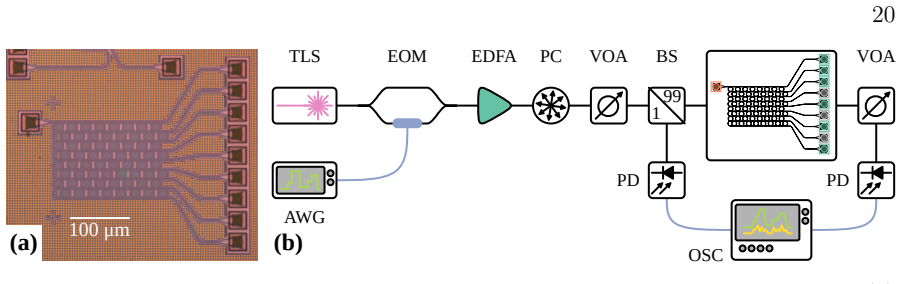
The central object is an 8-by-8 matrix of 64 coupled silicon microring resonators on a CMOS-compatible chip. Each ring acts as a wavelength-selective filter whose resonance shifts when two-photon absorption generates free carriers and heat; the two effects have different lifetimes (roughly 1–45 ns for carriers, 60–280 ns for thermal), giving the network volatile memory on two timescales and a self-pulsing regime in which a constant or slowly varying optical input is translated into periodic or irregular pulses. This nonlinear, memory-bearing optical transformation expands the dimensionality of the input, and the only trained component is a linear readout over the network's output ports, opti
What would settle it
Record the network's response to a fixed probe image after pauses of varying length (for instance 1, 5, 10, 15, and 20 microseconds) and check whether the output after the pause is identical; if shuffling image order changes the reported multi-port or single-pixel accuracies by more than the stated variability, the independence assumption fails and some of the reported per-image performance reflects sequence information.
Extended reading notes
Core claim
The paper reports experimental evidence that a purely silicon 8x8 microring-resonator network, driven by milliwatt-level input light into a self-pulsing nonlinear regime, generates multiple diverse, memory-carrying representations of a time-encoded image. Combining representations from five output ports yields 96.49% test accuracy on MNIST with inverse encoding and a 20 ns pixel duration, against a 92.03% linear-classifier baseline and a 92.12% out-of-resonance control. In a single-pixel setting, where the linear readout uses only one time sample from all wavelengths and ports, the network reaches 68.57% on MNIST and 53.13% on Fashion-MNIST, against baselines near 24–27%. The authors attribu
Load-bearing premise
The load-bearing premise is that the pause between consecutive images (about 10–15 microseconds) fully returns the microring network to its resting state, so the response to each image is independent and does not leak information from the previous image; the paper asserts this but does not measure the reset.
Editorial extensions
If this is right
- With roughly 60,000 trainable parameters, the microring reservoir plus linear readout reaches 96.49% on MNIST, outperforming a digital one-hidden-layer network with 77 neurons (96.07%) at the same parameter count; matching the optical accuracy digitally requires 120 hidden neurons and 130 nonlinear software operations, versus 10 for the optical readout.
- Single-pixel inference, using only one time sample and no digital memory of the input sequence, reaches 68.57% on MNIST and 53.13% on Fashion-MNIST, showing that the chip's optical memory can substitute for a digital buffer in streaming or edge tasks.
- The improvement over the out-of-resonance control (92.12% versus 96.49% best) indicates that the gain comes from the MRR network's nonlinear dynamics, not from the linear optical path alone.
- Combining three to five output ports consistently improves accuracy, while using too many ports causes overfitting, suggesting that the multi-port strategy is useful but has a finite optimal size.
- Inverse and box encodings, where background light keeps the rings in a nonlinear regime, outperform normal encoding, showing that sustained nonlinear dynamics, not just the stroke pulses, are what drive the computational benefit.
Reading between the lines
- If the reset pause between images is incomplete, some of the reported accuracy could include sequence-order information; a direct test would be to randomize the order of images and check whether accuracies change by more than the reported variance.
- The single-pixel result suggests that the reservoir's memory can be traded against readout parallelism: a slower, cheaper photodetector that averages the output (as the authors' downsampling mimics) would still benefit from optical memory, pointing toward low-bandwidth, low-cost edge sensing.
- The multi-wavelength, multi-port scheme hints at wavelength-division multiplexing as a scaling path, but the observed overfitting with many ports suggests a limit set by signal-to-noise and variance rather than by the number of available physical features.
- The comparison with digital networks counts only software nonlinear operations; a full energy or latency comparison would need to include the laser, modulator, amplifier, and photodetection overhead, which the paper does not quantify.
Signed reviews
Editorial analysis
A structured set of objections, weighed in public.
Referee Report
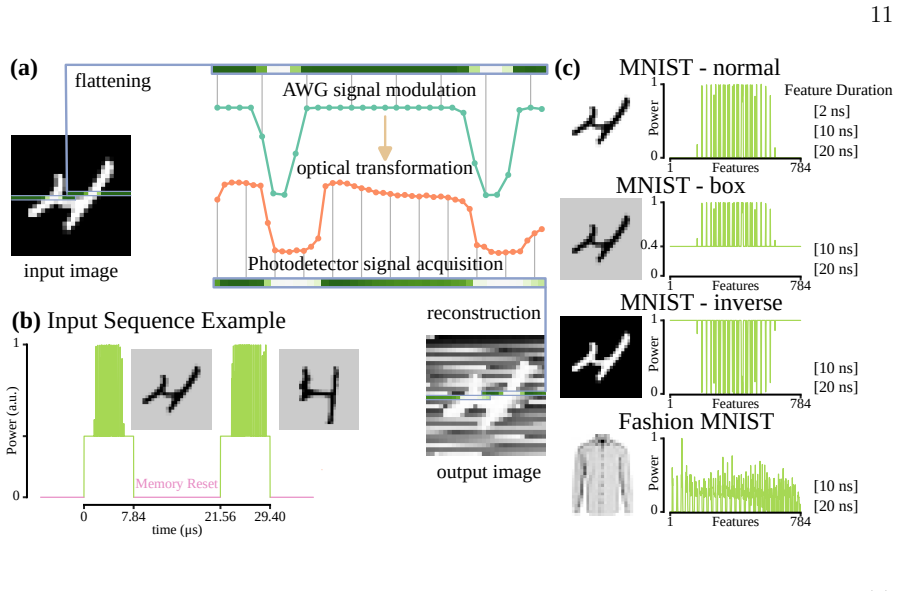
Summary. The paper experimentally demonstrates reservoir computing on an 8x8 silicon microring-resonator (MRR) network for image classification. MNIST and Fashion-MNIST images are flattened, encoded as optical time sequences with three encodings and several timesteps, and injected into the chip. Outputs from up to six physical ports, ten laser frequencies, and five input powers are fed to a linear readout. The authors report a best MNIST accuracy of 96.49% with five ports (baselines: 92.03% software linear classifier, 92.12% out-of-resonance optical transform), and a single-pixel accuracy of 68.57% on MNIST using optical memory compared with 23.67% out-of-resonance. They also compare with digital ANNs, arguing that the photonic system reaches comparable accuracy with fewer trainable parameters and fewer software nonlinear operations.
Significance. If the results hold, this is a valuable experimental demonstration that nonlinear self-pulsing dynamics and volatile optical memory in a CMOS-compatible silicon MRR network provide a computationally useful reservoir for temporal classification, including a single-pixel regime that removes the need for digital memory at inference. The paper has real strengths: it is an experimental study on a fabricated device, it includes out-of-resonance and software baselines, it systematically explores port/frequency/power diversity, and it openly provides code and data via Zenodo. The qualitative conclusion that the MRR dynamics improve classification over a purely linear optical transform is supported by the out-of-resonance control and by consistent multi-port boxplot trends. However, the headline quantitative claims are weakened by test-set selection of operating points and by an apples-to-oranges single-pixel baseline; these issues need to be fixed before the exact numbers can be accepted.
major comments (4)
- [§3.1, Fig. 5b, Table 1; Methods §5.4.1] The headline accuracies are maxima over a large grid of operating conditions selected on the test set. Figure 5b reports, for each frequency/power pair, the highest accuracy across port combinations, and Table 1 lists the resulting 'best test accuracy' per encoding/duration. Methods §5.4.1 describes validation only for the dropout rate, not for laser frequency (10 values), input power (5 values), or port combination (up to ~6). Selecting the maximum of ~300 test-set evaluations inflates the expected reported number and removes any error bar. This does not by itself erase the 4.46-point gap versus the 92.03% software linear classifier, but it makes the exact numbers untrustworthy and makes the comparison with the 96.07±0.10% ANN (Table 3) statistically meaningless. Please select operating points on a validation set only, then report test accuracy once, or report the distribution of accura
- [§2.5, Table 5, Fig. 2b] The claim that the pause between consecutive images fully resets the network is asserted but not measured. Table 5 gives pauses of 2.744 µs, 13.72 µs, and 15.68 µs, while Fig. 2b shows self-pulsing periods up to tens of microseconds and the text gives thermal lifetimes of 60–280 ns. Some detected periods exceed the pause duration. The sentence 'This pause ensures that the system’s response to each input remains independent and is not influenced by residual dynamics from previous samples' therefore needs experimental support: e.g., a measurement of the output returning to baseline after a stimulus, or a comparison of first-pixel vs later-pixel accuracy. Without this, the reported per-image accuracies could partly reflect inter-image leakage or sequence-order information.
- [§3.2, Table 4, Fig. 6] The single-pixel comparison is not apples-to-apples. The photonic accuracy uses up to 60 representations (10 frequencies × 6 ports at a fixed power) as features, while the out-of-resonance baseline uses a single linear representation, and the digital baseline uses one raw pixel value. The dramatic gap (68.57% vs 23.67%) is therefore partly a feature-count effect. A fair baseline should concatenate the same number of out-of-resonance channels, or the same number of raw-image pixels, before applying the linear classifier. The memory-based interpretation (Fig. 6c) is suggestive, but the magnitude of the claimed improvement needs to be re-evaluated against an equal-dimensionality linear baseline.
- [§3.1.3, Table 3] The ANN comparison reports 96.07(10)% and 96.53(7)% with standard deviations over 10 runs, but the photonic accuracies are single best test-set maxima with no uncertainty. Moreover, the 'nonlinear operations' column counts only software nonlinearities (10 vs 130); the optical nonlinear operations in the MRR network are not counted but have an energy and hardware cost. The claim 'same accuracy with fewer nonlinear operations' is thus only about the software readout, not about the total system. Please report an uncertainty or repeated-measurement spread for the photonic system, and clarify that the nonlinear-operation comparison excludes the photonic reservoir's own nonlinear processing.
minor comments (5)
- [Abstract] Typo: 'provides an in-depth study of of MRR networks' should read 'study of MRR networks'.
- [Table 5] The 20 ns row lists the AWG sampling time as '12.8µs'; presumably this is 12.8 ns. Please correct.
- [Conclusion] The conclusion describes the 96.49%/85.81% results as starting from 'baselines (accuracy without photonic network) of 92.12% and 83.83%'. The 92.12% and 83.83% are out-of-resonance optical baselines, not purely software baselines (which are 92.03% and 85.17%). Please phrase this more precisely.
- [Fig. 4 caption] Minor formatting: 'Photodetector signal acquisitioninput image' is missing a space/separator, making the caption hard to parse.
- [§3.2] The text says 'we exclude the first 80 time samples from the investigation' and then reports best pixel accuracy. Please specify in the main text, not only in Methods, that the pixel index is selected on a validation split; this is good practice and should be highlighted.
Circularity Check
No circularity: the experimental MRR classification results are self-contained measurements compared against external software and out-of-resonance baselines.
full rationale
I walked the paper's derivation chain from image encoding, through the MRR network response, to the trained linear readout. The reported accuracies are measured test-set performances on physical outputs, not quantities derived from fitted parameters that are then relabeled as predictions. The baselines are a software linear classifier (92.03%) and an out-of-resonance control (up to 92.12%), providing independent points of comparison. The self-citations ([16], [17], [21]) are used as background to motivate that silicon MRRs can exhibit self-pulsing and memory, but the present work independently characterizes the device response (Fig. 2b) and demonstrates the classification improvements empirically against controls. No equation in the paper reduces a claimed prediction to its input by construction, and no fitted parameter is renamed as a prediction. The main statistical concern, that the headline accuracies are maxima over a grid of operating conditions and port combinations selected on the test set, is a model-selection/validation issue rather than a circularity: it can inflate reported numbers but does not make the derivation equivalent to its inputs. The reset-pause assertion is an experimental assumption about independence between images, not a circular definition. Therefore no circular step is present.
Assumptions & free parameters
free parameters (5)
- Best operating point for MNIST multiport result (laser frequency, input power, timestep, encoding, number of ports) =
192.74 THz, 1.1 mW, 20 ns, inverse, 5 ports
- Single-pixel index for best single-pixel MNIST result =
264 (inverse encoding, 10 ns timestep)
- Dropout rate in photonic linear readout =
not specified in text
- Downsampling factor for single-pixel outputs =
3
- Excluded initial time samples in single-pixel analysis =
80
assumptions (3)
- domain assumption A fixed nonlinear dynamical system with memory can serve as a reservoir, allowing a linear readout to classify input signals.
- domain assumption The self-pulsing and memory behavior of the MRR network is governed by free-carrier and thermo-optic nonlinearities as characterized in prior publications [21,16,17].
- domain assumption The pause between consecutive images is long enough to reset the MRR network to its resting state, so responses to different images are independent.
Cite this review
Pith. "Pith review of Experimental Investigation of Time Series Classification using a Self-Pulsing Microring Resonator Network." pith.science (2026). https://pith.science/paper/AJAJNQ3X
@misc{pith2026250911721,
  author       = {Pith},
  title        = {Pith review of: Experimental Investigation of Time Series Classification using a Self-Pulsing Microring Resonator Network},
  year         = {2026},
  howpublished = {\url{https://pith.science/paper/AJAJNQ3X}},
  note         = {Machine review of arXiv:2509.11721}
}
read the original abstract
Photonic neuromorphic computing offers compelling advantages in power efficiency and parallel processing, but often falls short in realizing scalable nonlinearity and long-term memory. These limitations can be overcome by silicon microring resonator (MRR) networks. These integrated photonic circuits enable compact, high-throughput neuromorphic computing by simultaneously exploiting spatial, temporal, and wavelength dimensions. This work provides an in-depth study of of MRR networks for photonics-based machine learning (ML). We investigate the system's effectiveness on two widely used image classification benchmarks, MNIST and Fashion-MNIST, by encoding images directly into time sequences. In particular, we enhance the computational performance of a linear readout classifier within the reservoir computing paradigm through the strategic use of multiple physical output ports, diverse laser wavelengths, and varied input power levels. Moreover, we explore a single-pixel classification setting, where inference does not require digital memory, thanks to the inherent memory and parallelism of our MRR network.
Figures


Figures from the paper (4 more)


Reference graph
Works this paper leans on
-
[1]
Photonics for Neuromorphic Computing: Fundamentals, Devices, and Opportunities.Advanced Materials, 37(2):2312825, 2025
Renjie Li, Yuanhao Gong, Hai Huang, Yuze Zhou, Sixuan Mao, Zhijian Wei, and Zhaoyu Zhang. Photonics for Neuromorphic Computing: Fundamentals, Devices, and Opportunities.Advanced Materials, 37(2):2312825, 2025
2025
-
[2]
Shastri, Mohammed A
Daniel Brunner, Bhavin J. Shastri, Mohammed A. Al Qadasi, H. Ballani, Sylvain Barbay, Stefano Biasi, Peter Bienstman, Simon Bilodeau, Wim Bogaerts, Fabian B¨ ohm, G. Brennan, Sonia Buckley, Xinlun Cai, Marcello Calvanese Strinati, B. Canakci, Benoit Charbonnier, Mario Chemnitz, Yitong Chen, Stanley Cheung, Jeff Chiles, Suyeon Choi, Demetrios N. Christodou...
2025
-
[3]
Integrated photonic neuromorphic computing: Opportunities and challenges.Nature Reviews Electrical Engineering, 1(6):358– 373, June 2024
Nikolaos Farmakidis, Bowei Dong, and Harish Bhaskaran. Integrated photonic neuromorphic computing: Opportunities and challenges.Nature Reviews Electrical Engineering, 1(6):358– 373, June 2024
2024
-
[4]
Experimental Demonstration of 4-Port Photonic Reservoir Computing for Equalization of 4 and 16 QAM Signals.Journal of Lightwave Technology, 42(24):8555–8563, December 2024
Sarah Masaad, Stijn Sackesyn, Stylianos Sygletos, and Peter Bienstman. Experimental Demonstration of 4-Port Photonic Reservoir Computing for Equalization of 4 and 16 QAM Signals.Journal of Lightwave Technology, 42(24):8555–8563, December 2024
2024
-
[5]
Photonic neuromorphic technologies in optical communications.Nanophoton- ics, 11(5):897–916, February 2022
Apostolos Argyris. Photonic neuromorphic technologies in optical communications.Nanophoton- ics, 11(5):897–916, February 2022
2022
-
[6]
Metasurface Micro/Nano-Optical Sensors: Principles and Applications.ACS nano, 16(8):11598–11618, August 2022
Jin Qin, Shibin Jiang, Zhanshan Wang, Xinbin Cheng, Baojun Li, Yuzhi Shi, Din Ping Tsai, Ai Qun Liu, Wei Huang, and Weiming Zhu. Metasurface Micro/Nano-Optical Sensors: Principles and Applications.ACS nano, 16(8):11598–11618, August 2022
2022
-
[7]
Abhishek Venketeswaran, Nageswara Lalam, Jeffrey Wuenschell, P. R. Ohodnicki Jr., Mudabbir Badar, Kevin P. Chen, Ping Lu, Yuhua Duan, Benjamin Chorpening, and Michael Buric. Recent Advances in Machine Learning for Fiber Optic Sensor Applications.Advanced Intelligent Systems, 4(1):2100067, 2022
2022
-
[8]
U. M. N. Jayawickrema, H. M. C. M. Herath, N. K. Hettiarachchi, H. P. Sooriyaarachchi, and J. A. Epaarachchi. Fibre-optic sensor and deep learning-based structural health monitoring systems for civil structures: A review.Measurement, 199:111543, August 2022
2022
Show all 32 references
-
[9]
Shastri, Alexander N
Bhavin J. Shastri, Alexander N. Tait, T. Ferreira de Lima, Wolfram H. P. Pernice, Harish Bhaskaran, C. D. Wright, and Paul R. Prucnal. Photonics for artificial intelligence and neuromorphic computing.Nature Photonics, 15(2):102–114, February 2021
2021
-
[10]
Physical reservoir computing for Edge AI applications.The Innovation Materials, 3(2):100127, 2025
Jianquan Liu, Guangdi Feng, Wei Li, Shenglan Hao, Suting Han, Qiuxiang Zhu, Bobo Tian, Chungang Duan, and Junhao Chu. Physical reservoir computing for Edge AI applications.The Innovation Materials, 3(2):100127, 2025
2025
-
[11]
Experimental demonstration of reservoir computing on a silicon photonics chip.Nature Communications, 5(1):3541, March 2014
Kristof Vandoorne, Pauline Mechet, Thomas Van Vaerenbergh, Martin Fiers, Geert Morthier, David Verstraeten, Benjamin Schrauwen, Joni Dambre, and Peter Bienstman. Experimental demonstration of reservoir computing on a silicon photonics chip.Nature Communications, 5(1):3541, March 2014
2014
-
[12]
Fabrication and integration of photonic devices for phase-change memory and neuromorphic computing
Wen Zhou, Xueyang Shen, Xiaolong Yang, Jiangjing Wang, and Wei Zhang. Fabrication and integration of photonic devices for phase-change memory and neuromorphic computing. International Journal of Extreme Manufacturing, 6(2):022001, January 2024
2024
-
[13]
Wolfram H. P. Pernice and Harish Bhaskaran. Photonic non-volatile memories using phase change materials.Applied Physics Letters, 101(17):171101, October 2012
2012
-
[14]
David Wright, Harish Bhaskaran, and Wolfram H
Carlos R ´ ıos, Matthias Stegmaier, Peiman Hosseini, Di Wang, Torsten Scherer, C. David Wright, Harish Bhaskaran, and Wolfram H. P. Pernice. Integrated all-photonic non-volatile multi-level memory.Nature Photonics, 9(11):725–732, November 2015. 26
2015
-
[15]
Feldmann, N
J. Feldmann, N. Youngblood, C. D. Wright, H. Bhaskaran, and W. H. P. Pernice. All-optical spiking neurosynaptic networks with self-learning capabilities.Nature, 569(7755):208–214, May 2019
2019
-
[16]
Exploring the potential of self-pulsing optical microresonators for spiking neural networks and sensing.Communications Physics, 7(1):380, November 2024
Stefano Biasi, Alessio Lugnan, Davide Micheli, and Lorenzo Pavesi. Exploring the potential of self-pulsing optical microresonators for spiking neural networks and sensing.Communications Physics, 7(1):380, November 2024
2024
-
[17]
Reservoir Computing with All-Optical Non-Fading Memory in a Self-Pulsing Microresonator Network.Advanced Optical Materials, 13(11):2403133, 2025
Alessio Lugnan, Stefano Biasi, Alessandro Foradori, Peter Bienstman, and Lorenzo Pavesi. Reservoir Computing with All-Optical Non-Fading Memory in a Self-Pulsing Microresonator Network.Advanced Optical Materials, 13(11):2403133, 2025
2025
-
[18]
David Wright, Wolfram H
Alessio Lugnan, Samarth Aggarwal, Frank Br¨ uckerhoff-Pl¨ uckelmann, C. David Wright, Wolfram H. P. Pernice, Harish Bhaskaran, and Peter Bienstman. Emergent Self-Adaptation in an Integrated Photonic Neural Network for Backpropagation-Free Learning.Advanced Science, 12(2):2404920, 2025
2025
-
[19]
Harnessing Nonlinearity: Predicting Chaotic Systems and Saving Energy in Wireless Communication.Science, 304(5667):78–80, April 2004
Herbert Jaeger and Harald Haas. Harnessing Nonlinearity: Predicting Chaotic Systems and Saving Energy in Wireless Communication.Science, 304(5667):78–80, April 2004
2004
-
[20]
Recent advances in physical reservoir computing: A review.Neural Networks, 115:100–123, July 2019
Gouhei Tanaka, Toshiyuki Yamane, Jean Benoit H´ eroux, Ryosho Nakane, Naoki Kanazawa, Seiji Takeda, Hidetoshi Numata, Daiju Nakano, and Akira Hirose. Recent advances in physical reservoir computing: A review.Neural Networks, 115:100–123, July 2019
2019
-
[21]
Photonic Neural Networks Based on Integrated Silicon Microresonators.Intelligent Computing, 3:0067, January 2024
Stefano Biasi, Giovanni Donati, Alessio Lugnan, Mattia Mancinelli, Emiliano Staffoli, and Lorenzo Pavesi. Photonic Neural Networks Based on Integrated Silicon Microresonators.Intelligent Computing, 3:0067, January 2024
2024
-
[22]
Tait, Allie X
Alexander N. Tait, Allie X. Wu, Thomas Ferreira de Lima, Ellen Zhou, Bhavin J. Shastri, Mitchell A. Nahmias, and Paul R. Prucnal. Microring Weight Banks.IEEE Journal of Selected Topics in Quantum Electronics, 22(6):312–325, November 2016
2016
-
[23]
A Microring as a Reservoir Computing Node: Memory/Nonlinear Tasks and Effect of Input Non-Ideality.Journal of Lightwave Technology, 40(17):5917–5926, September 2022
Davide Bazzanella, Stefano Biasi, Mattia Mancinelli, and Lorenzo Pavesi. A Microring as a Reservoir Computing Node: Memory/Nonlinear Tasks and Effect of Input Non-Ideality.Journal of Lightwave Technology, 40(17):5917–5926, September 2022
2022
-
[24]
Micro ring resonators as building blocks for an all-optical high-speed reservoir-computing bit-pattern-recognition system.JOSA B, 30(11):3048–3055, November 2013
Charis Mesaritakis, Vassilis Papataxiarhis, and Dimitris Syvridis. Micro ring resonators as building blocks for an all-optical high-speed reservoir-computing bit-pattern-recognition system.JOSA B, 30(11):3048–3055, November 2013
2013
-
[25]
Cascadable excitability in microrings.Optics Express, 20(18):20292–20308, August 2012
Thomas Van Vaerenbergh, Martin Fiers, Pauline Mechet, Thijs Spuesens, Rajesh Kumar, Geert Morthier, Benjamin Schrauwen, Joni Dambre, and Peter Bienstman. Cascadable excitability in microrings.Optics Express, 20(18):20292–20308, August 2012
2012
-
[26]
Mancinelli, M
M. Mancinelli, M. Borghi, F. Ramiro-Manzano, J. M. Fedeli, and L. Pavesi. Chaotic dynamics in coupled resonator sequences.Optics Express, 22(12):14505–14516, June 2014
2014
-
[27]
David Wright, and Peter Bienstman
Alessio Lugnan, Santiago Garc ´ ıa-Cuevas Carrillo, C. David Wright, and Peter Bienstman. Rigorous dynamic model of a silicon ring resonator with phase change material for a neuromorphic node.Optics Express, 30(14):25177–25194, July 2022
2022
-
[28]
All-optical silicon microring spiking neuron.Photonics Research, 10(4):939–946, April 2022
Jinlong Xiang, Yujia Zhang, Yaotian Zhao, Xuhan Guo, and Yikai Su. All-optical silicon microring spiking neuron.Photonics Research, 10(4):939–946, April 2022
2022
-
[29]
All-optical passive spiking processing and reservoir computing with a silicon microring and wavelength-time division multiplexing.Photonics Research, June 2025
Giovanni Donati, Stefano Biasi, Lorenzo Pavesi, and Antonio Hurtado. All-optical passive spiking processing and reservoir computing with a silicon microring and wavelength-time division multiplexing.Photonics Research, June 2025
2025
-
[30]
MNIST handwritten digit database.ATT Labs [Online]
Yann LeCun, Corinna Cortes, and CJ Burges. MNIST handwritten digit database.ATT Labs [Online]. Available: http://yann.lecun.com/exdb/mnist, 2, 2010
2010
-
[31]
Fashion-MNIST: A novel image dataset for benchmarking machine learning algorithms.CoRR, abs/1708.07747, 2017
Han Xiao, Kashif Rasul, and Roland Vollgraf. Fashion-MNIST: A novel image dataset for benchmarking machine learning algorithms.CoRR, abs/1708.07747, 2017
2017 arXiv
-
[32]
MIT press, 2020
Ethem Alpaydin.Introduction to machine learning. MIT press, 2020. 27 Contributions A.F. and A.L. conceived the experiments, prepared the setup and performed the experimental measurements. A.L. designed the integrated photonic circuit. A.F. performed the data analysis for secti...
2020
Reviewed August 4, 2026 · model on record in the stance chip above.
Discussion (0). Continue with ORCID to comment.