REVIEW 1 major objections 2 minor 1 cited by
Memory-SAM retrieves similar past tongue images to generate point prompts that guide SAM2 without any human clicks or fine-tuning.
Reviewed by Pith at T0; open to challenge. T0 means a machine referee read the full paper against a public rubric. the ladder, T0–T4 →
T0 review · grok-4.3
2026-05-18 06:00 UTC pith:TLW74ZPN
load-bearing objection Memory-SAM gets strong mIoU on tongue images by turning DINOv3 retrieval into SAM2 point prompts without training or clicks, but the in-the-wild reliability rests on unexamined retrieval quality. the 1 major comments →
Memory-SAM: Human-Prompt-Free Tongue Segmentation via Retrieval-to-Prompt
The pith
A machine-rendered reading of the paper's core claim, the machinery that carries it, and where it could break.
Core claim
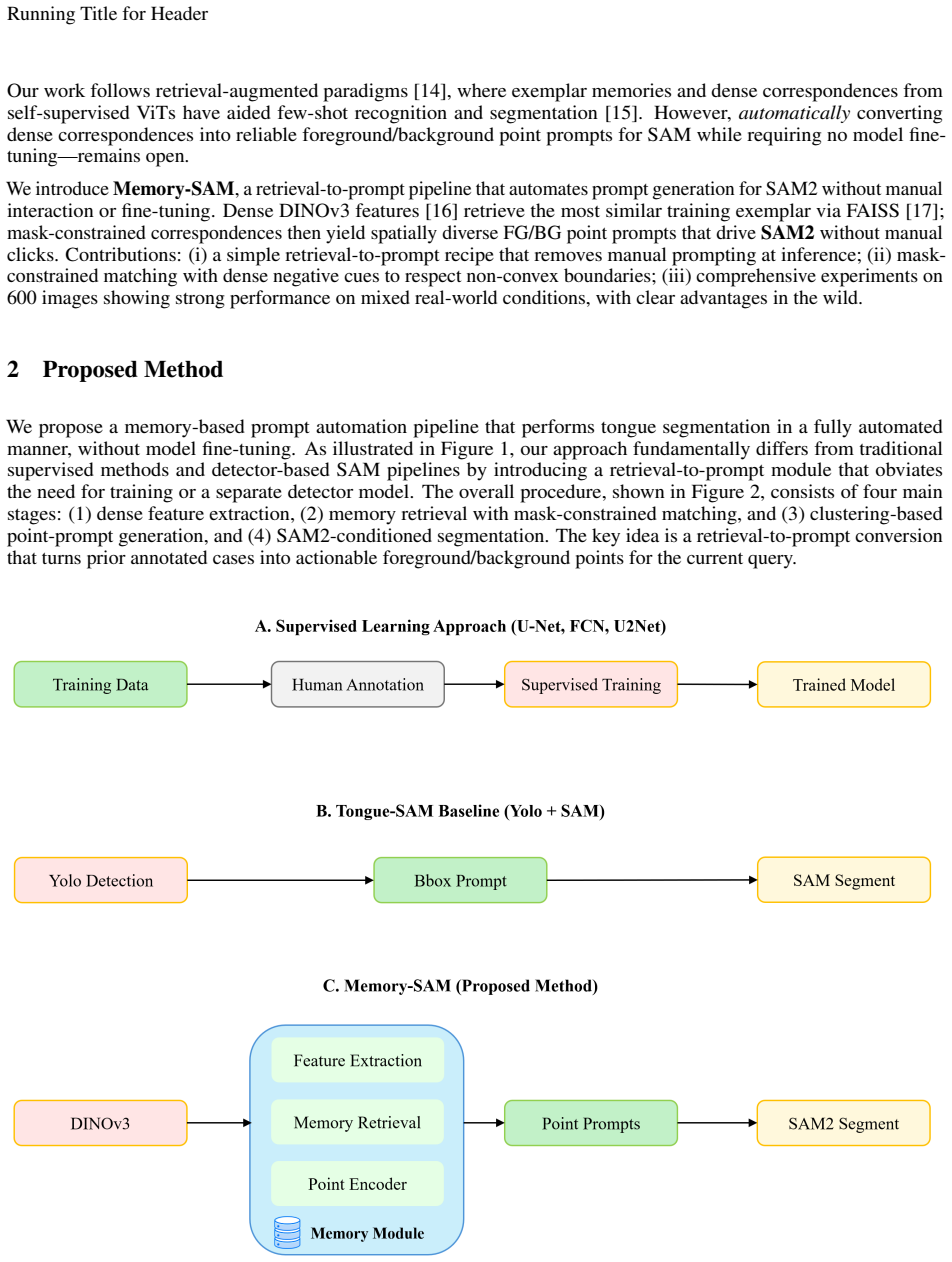
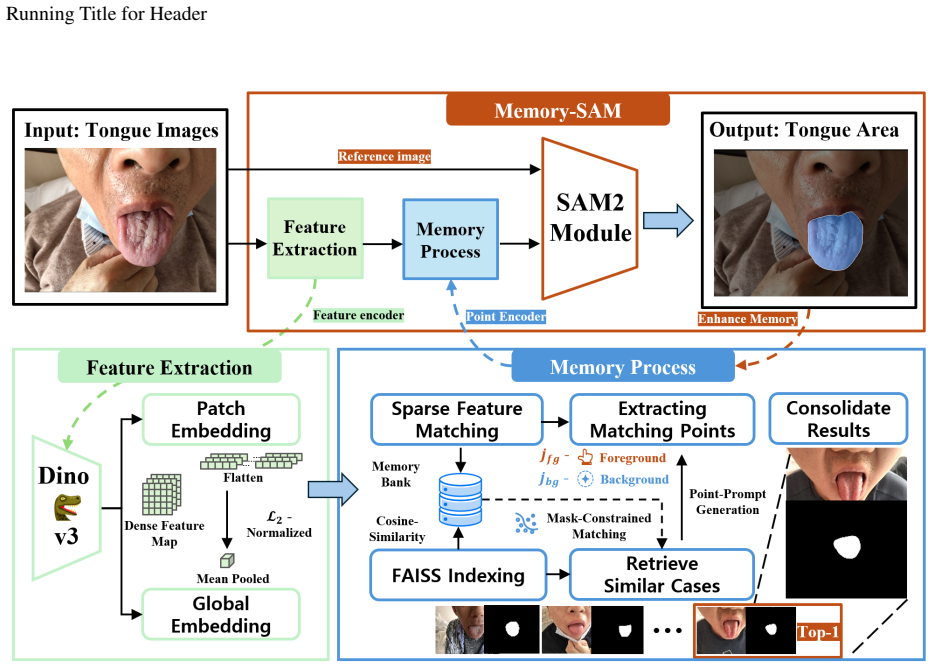
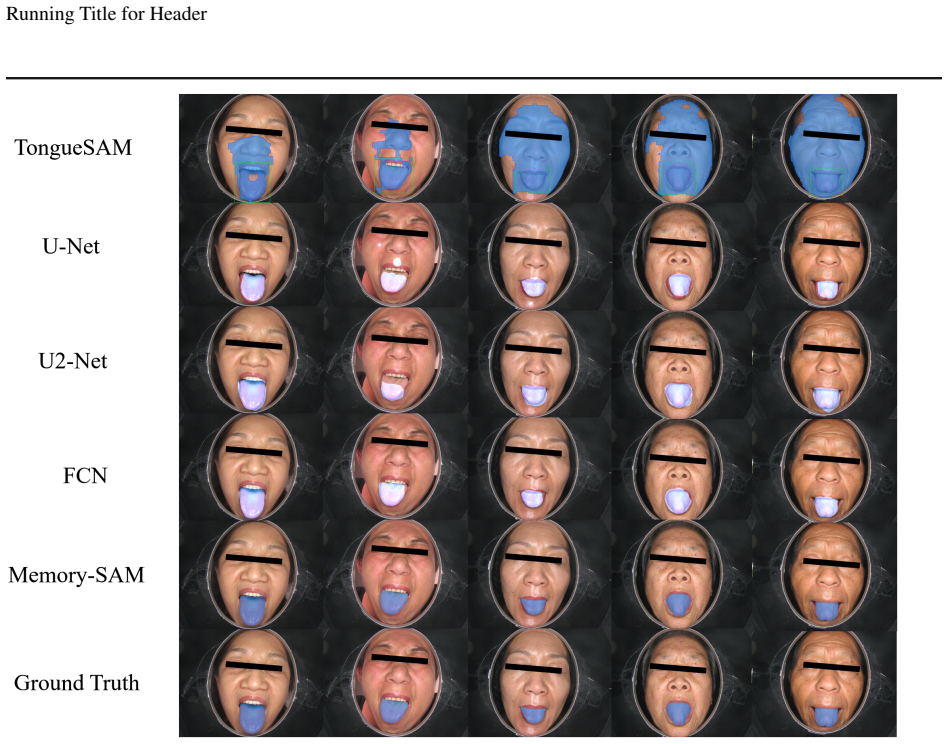
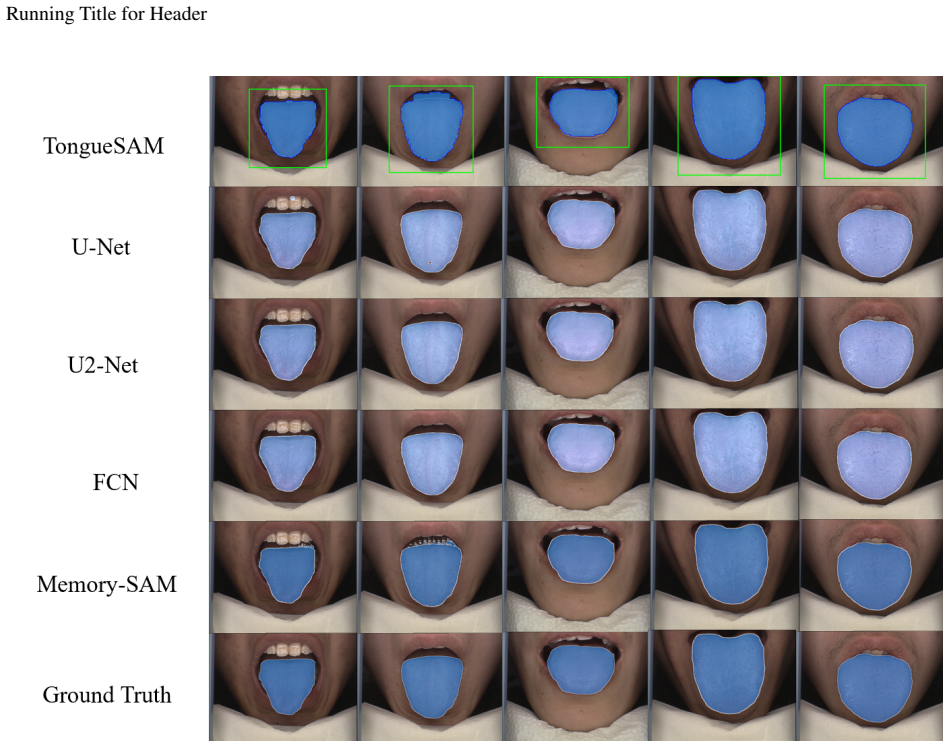
Memory-SAM is a training-free, human-prompt-free pipeline that automatically generates effective prompts from a small memory of prior cases via dense DINOv3 features and FAISS retrieval. Given a query image, mask-constrained correspondences to the retrieved exemplar are distilled into foreground/background point prompts that guide SAM2 without manual clicks or model fine-tuning. On the mixed test split of 600 expert-annotated images, Memory-SAM achieves mIoU 0.9863, surpassing FCN at 0.8188 and a detector-to-box SAM baseline at 0.1839, with particular advantages under real-world conditions where boundaries are irregular.
What carries the argument
The retrieval-to-prompt mechanism that locates an exemplar via dense DINOv3 features and FAISS, then converts mask-constrained feature correspondences into foreground and background point prompts for SAM2.
Load-bearing premise
That dense DINOv3 features will consistently retrieve an exemplar whose existing mask yields accurate foreground and background point prompts for any new tongue image.
What would settle it
A controlled test on query images whose closest memory matches have tongue shapes or lighting that differ markedly from the query, followed by measurement of whether the distilled point prompts still produce high-accuracy SAM2 segmentations.
If this is right
- Segmentation of irregular tongue boundaries becomes feasible with only a small collection of prior annotated cases rather than thousands of new labels.
- The same retrieval-to-prompt process works on both controlled lab images and in-the-wild captures without any model retraining.
- Point prompts derived from correspondences allow SAM2 to focus on foreground and background regions automatically.
- The overall pipeline stays fully automatic at inference time, removing the need for human clicks or updates to the underlying model.
Where Pith is reading between the lines
- If retrieval occasionally returns a poor match for rare tongue presentations, accuracy would drop, implying that expanding the memory bank with more diverse cases could further stabilize results.
- The same retrieval-plus-prompt strategy might transfer to other medical imaging domains where SAM-family models are already deployed but manual prompting remains a bottleneck.
- Allowing the memory bank to grow incrementally with newly segmented cases could create a self-improving system without requiring periodic full retraining.
- In clinical settings with limited annotation staff, this approach lowers the barrier to deploying reliable tongue analysis tools.
Editorial analysis
A structured set of objections, weighed in public.
Referee Report
Summary. The manuscript presents Memory-SAM, a training-free and human-prompt-free pipeline for tongue segmentation. Given a query image, it retrieves a similar exemplar from a small memory bank using dense DINOv3 features and FAISS, then distills mask-constrained correspondences into foreground/background point prompts that guide SAM2. Evaluated on 600 expert-annotated images (300 controlled, 300 in-the-wild), Memory-SAM reports mIoU 0.9863 on the mixed test split, outperforming FCN (0.8188) and a detector-to-box SAM baseline (0.1839), with noted gains under real-world conditions. The code is publicly released.
Significance. If the results hold, the work demonstrates a data-efficient way to adapt SAM2 for medical segmentation tasks with irregular boundaries and limited annotations, such as TCM tongue imaging. By avoiding fine-tuning and manual prompts, it addresses practical barriers in deploying foundation models. Public code availability is a clear strength that supports reproducibility and extension to other domains.
major comments (1)
- [Evaluation] The central performance claim (mIoU 0.9863 on the mixed split, especially the 300 in-the-wild images) rests on the retrieval step consistently surfacing suitable exemplars whose masks yield reliable fg/bg point prompts after domain shift. However, the manuscript provides no per-image retrieval diagnostics, similarity-score histograms, retrieval success rates, or failure-case analysis to verify this assumption.
minor comments (2)
- [Abstract] The abstract notes ceiling effects above 0.98 on controlled data due to annotation variability but does not report the per-split mIoU values, standard deviations, or inter-annotator agreement to contextualize the results.
- [Evaluation] No error bars or multiple-run statistics accompany the reported mIoU figures, which would strengthen the quantitative comparison to the FCN and detector-to-box baselines.
Simulated Author's Rebuttal
We thank the referee for the constructive feedback and the recommendation for minor revision. We address the major comment on evaluation below and will strengthen the manuscript accordingly.
read point-by-point responses
-
Referee: [Evaluation] The central performance claim (mIoU 0.9863 on the mixed split, especially the 300 in-the-wild images) rests on the retrieval step consistently surfacing suitable exemplars whose masks yield reliable fg/bg point prompts after domain shift. However, the manuscript provides no per-image retrieval diagnostics, similarity-score histograms, retrieval success rates, or failure-case analysis to verify this assumption.
Authors: We agree that additional diagnostics on the retrieval step would improve transparency and allow readers to better assess robustness under domain shift. While the reported mIoU of 0.9863 on the mixed split (with clear gains on the 300 in-the-wild images) provides indirect evidence that retrieved exemplars yield effective prompts, we acknowledge the value of direct verification. In the revised manuscript we will add a new subsection containing: (i) a histogram of FAISS similarity scores across the test set, (ii) retrieval success rates (defined as the fraction of queries where the retrieved exemplar produces point prompts leading to mIoU > 0.90), and (iii) a qualitative failure-case analysis with example images where retrieval is suboptimal. These elements will be computed from the existing public code and data. revision: yes
Circularity Check
No significant circularity detected
full rationale
The paper describes an empirical, training-free pipeline that retrieves exemplars from a small memory bank using dense DINOv3 features and FAISS, then distills mask-constrained correspondences into point prompts for the external SAM2 model. The reported mIoU of 0.9863 is obtained via direct evaluation on a held-out test split of 600 expert-annotated images (300 controlled, 300 in-the-wild), rather than any closed-form derivation or fitted parameter that reduces to the method's own inputs by construction. No equations, self-definitional loops, or load-bearing self-citations appear in the provided description; the central performance claim rests on the independent behavior of pre-trained external models and retrieval evaluated against ground-truth annotations.
Axiom & Free-Parameter Ledger
axioms (1)
- domain assumption Dense DINOv3 features enable reliable mask-constrained correspondences between query and retrieved tongue images.
read the original abstract
Accurate tongue segmentation is crucial for reliable TCM analysis. Supervised models require large annotated datasets, while SAM-family models remain prompt-driven. We present Memory-SAM, a training-free, human-prompt-free pipeline that automatically generates effective prompts from a small memory of prior cases via dense DINOv3 features and FAISS retrieval. Given a query image, mask-constrained correspondences to the retrieved exemplar are distilled into foreground/background point prompts that guide SAM2 without manual clicks or model fine-tuning. We evaluate on 600 expert-annotated images (300 controlled, 300 in-the-wild). On the mixed test split, Memory-SAM achieves mIoU 0.9863, surpassing FCN (0.8188) and a detector-to-box SAM baseline (0.1839). On controlled data, ceiling effects above 0.98 make small differences less meaningful given annotation variability, while our method shows clear gains under real-world conditions. Results indicate that retrieval-to-prompt enables data-efficient, robust segmentation of irregular boundaries in tongue imaging. The code is publicly available at https://github.com/jw-chae/memory-sam.
Figures
Lean theorems connected to this paper
-
IndisputableMonolith/Foundation/RealityFromDistinction.leanreality_from_one_distinction unclear?
unclearRelation between the paper passage and the cited Recognition theorem.
Given a query image, mask-constrained correspondences to the retrieved exemplar are distilled into foreground/background point prompts that guide SAM2 without manual clicks or model fine-tuning.
What do these tags mean?
- matches
- The paper's claim is directly supported by a theorem in the formal canon.
- supports
- The theorem supports part of the paper's argument, but the paper may add assumptions or extra steps.
- extends
- The paper goes beyond the formal theorem; the theorem is a base layer rather than the whole result.
- uses
- The paper appears to rely on the theorem as machinery.
- contradicts
- The paper's claim conflicts with a theorem or certificate in the canon.
- unclear
- Pith found a possible connection, but the passage is too broad, indirect, or ambiguous to say the theorem truly supports the claim.
Forward citations
Cited by 1 Pith paper
-
MMIR-TCM: Memory-Integrated Multimodal Inference and Retrieval for TCM Clinical Decision Support
MMIR-TCM is a multimodal framework using MLLM, memory-SAM, and RAG that claims to outperform GPT-4o and Gemini on TCM tongue diagnosis tasks via a new dataset and custom metric.
discussion (0)
Sign in with ORCID, Apple, or X to comment. Anyone can read and Pith papers without signing in.