REVIEW 4 major objections 4 minor 1 cited by
The paper argues that oscillating real-scalar boson stars act as strictly periodic gravitational lenses: a radial caustic whose size vibrates with the star's oscillation makes any nearby source cross it every half period, producing phase-lo
Reviewed by Pith at T0; open to challenge. T0 means a machine referee read the full paper against a public rubric. the ladder, T0–T4 →
T0 review · deepseek-v4-flash
2026-08-03 20:29 UTC pith:E5QIKEQF
load-bearing objection Genuinely new and physically clean idea — oscillatons produce a pulsating radial caustic and periodic lensing spikes — but the quantitative predictions rest on unvalidated fits and an unreproducible event-number estimate. the 4 major comments →
Periodic Gravitational Lensing with Oscillating Boson Stars
The pith
A machine-rendered reading of the paper's core claim, the machinery that carries it, and where it could break.
Core claim
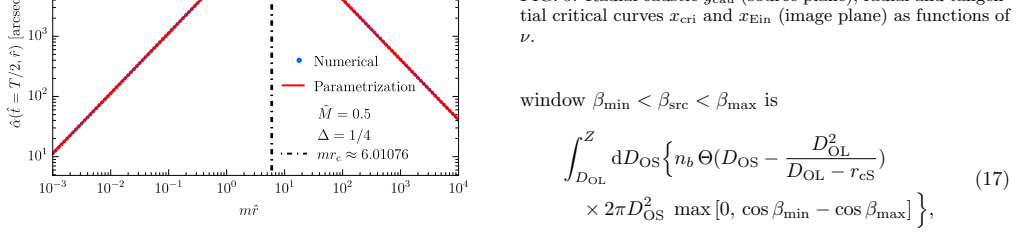
On the paper's own terms, the discovery is that an oscillating (real-scalar) boson star generically hosts an oscillating radial caustic. The metric oscillates at frequency 2ω, making the deflection angle and characteristic radius r_c(t) periodic with period T=π/ω. In dimensionless form, the caustic exists whenever ν(t)=r_c(t)/R drops below 1, and its radius decreases monotonically with ν, so the caustic pulsates in and out. A source near it crosses every half period, creating or annihilating a bright image pair at the critical curve and producing phase-locked photometric spikes with astrometric motion. The deflection is fitted by a broken power law and the time dependence by ν(t)=ν̄[1−ε cos(
What carries the argument
The load-bearing object is the oscillating radial caustic—a source-plane curve at which image pairs are created or destroyed—whose radius pulses with the stellar oscillation. The oscillaton's metric, expanded in cos(2jωt) and truncated at j_max=1, makes the characteristic radius r_c(t) in the deflection angle oscillate with period T=π/ω; the deflection is fitted by a broken power law with Δ≈1/4. The dimensionless lens equation y=x−ν^{-2}x[1+(x/ν)^4]^{-1/2}, with ν(t)=r_c(t)/R, produces a radial caustic only when ν<1, and the caustic size decreases monotonically with ν. All the periodic phenomena—pair creation/annihilation, magnification spikes, astrometric wobble—follow from this ν(t) oscill
Load-bearing premise
The strictly periodic, every-half-period phenomenology rests on the first-harmonic truncation (j_max=1) of the oscillaton's Fourier series and on the broken-power-law fit (Δ≈1/4) to its deflection angle; if either approximation is inaccurate, the caustic still oscillates but the exact periodicity of the spike train is modified.
What would settle it
Compute the full deflection angle from an oscillaton solution retaining j_max≥2 (e.g., the same M=0.5 star) and integrate null geodesics to obtain α̂(t̂,r̂); if the caustic-size variation acquires additional harmonic content or the broken-power-law fit fails, the predicted strictly periodic spike train is falsified. Observationally, a high-cadence, multi-filter survey of a region where type-I events are predicted would find the achromatic periodic spikes in the T∼10^2–10^5 s window—or, if absent, bound the boson-star number density.
If this is right
- A detected train of strictly periodic, achromatic spikes synchronized with astrometric motion would be direct evidence for an intrinsically time-dependent compact dark-sector object—an oscillating real-scalar boson star.
- A null search for such periodic lensing can place abundance constraints on oscillatons and axion stars over wide mass ranges.
- With fiducial parameters (fuzzy dark matter, f_BS=10^-3, m=10^-18 eV, M=10^4 M_sun, Z=1 Gpc), the expected number of detectable events is O(10^3); axion-star scenarios with f_BS≈0.4 give O(10^6), within reach of current astrometric and high-cadence surveys.
- Because the signal is achromatic and phase-locked to a period T=π/ω, the oscillation frequency of the lens is imprinted in the spike train, linking the observables to the scalar mass.
- The same mechanism extends to self-interacting real scalars, including axion-like particles, and to ultralight vector bosons, making the periodic-caustic signature a generic feature of such condensates.
Where Pith is reading between the lines
- If the j_max=1 truncation is not converged, higher harmonics would add sub-harmonic structure to the caustic oscillation, turning 'strictly periodic every half period' into quasiperiodic; searches should therefore allow a small period drift, not only exact periodicity.
- The spike period, T=π/ω, is roughly π/m for weakly bound oscillatons, so a measured period would directly give the boson mass, and the fractional amplitude ε of the ν modulation could be compared with the metric-oscillation amplitude as a consistency check.
- The event-number estimate treats sources as uniform-brightness spheres; real source-size distributions will sharpen or suppress the predicted rates, and follow-up targeted searches toward caustic-crossing regions may be more efficient than blind all-sky surveys.
- If the broken-power-law form with Δ≈1/4 is generic for nonsingular compact lenses, the same pulsating-caustic phenomenology could apply to other dark-sector objects, but the amplitude ε and caustic excursion would need to be computed case by case.
Editorial analysis
A structured set of objections, weighed in public.
Referee Report
Summary. The paper claims that oscillating real-scalar boson stars (oscillatons) generically possess an oscillating radial caustic. Because the star's density profile and metric oscillate coherently, the caustic radius r_c(t) pulsates, so a background source near the caustic crosses it once every half period. Each crossing produces phase-locked observables: creation/annihilation of a bright image pair, achromatic photometric spikes, and astrometric motion. The authors introduce a broken power-law deflection angle (Eq. 3, Δ≈1/4), cast the lens equation in dimensionless form (Eq. 5), classify type I and type II caustic-crossing geometries, derive an event-number integral (Eq. 8), and estimate that current astrometric and high-cadence photometric surveys could detect O(10^3) events for fuzzy-dark-matter parameters, or O(10^6) for axion-like-particle parameters. The framework is argued to extend to self-interacting real scalars and ultralight vector bosons.
Significance. If the central mechanism is robust, this is a genuinely novel and falsifiable time-domain signature of intrinsically time-dependent compact dark-matter objects. The qualitative argument—that an extended, oscillating lens produces a pulsating radial caustic whose crossings generate periodic observable spikes—is physically plausible and well aligned with standard lensing theory. The paper also provides concrete, if preliminary, event-rate estimates and explains how null searches would constrain boson-star abundance. The main value is in proposing a distinctive observational target; the main weakness is that the quantitative predictions depend on several numerical modeling choices that are asserted but not validated. The paper is not yet at the level of reliability needed for the event-rate forecasts to be used by observers.
major comments (4)
- [End Matter, Eq. (10)] The jmax=1 truncation is justified only by the statement that 'the Fourier expansion converges rapidly.' No convergence test is shown. The central claim of strict periodicity and 'crossing once every half period' is tied to the time dependence of the metric, and higher harmonics would generically introduce a non-single-cosine ν(t), potentially changing the number of caustic crossings per period and the spike timing. Please quantify the amplitude of the j=2 (and higher) modes for the representative M~=0.5 solution, and show the induced error in r_c(t) and y_cau(ν).
- [Eq. (3) and Fig. 8] The broken power-law deflection angle with Δ≈1/4 is the load-bearing input for the entire quantitative analysis: the dimensionless lens equation (5), the caustic radius y_cau, the critical curves, and the event rates all follow from exactly this exponent. The paper states that the parametrization 'reproduces the numerical results to high accuracy' but gives no fit residuals, no dependence of Δ on the central amplitude, and no error bars. Since the exact value of Δ controls the shape of y_cau(ν) and the caustic crossing conditions, the quantitative predictions are not reproducible without reporting the fit quality. Please provide residual plots and a scan over the stable mass range.
- [After Eq. (5)] The time dependence of the caustic scale is modeled as ν(t)=νbar[1−ε cos(2πt/T)], with ε and νbar left unspecified. The half-period crossing condition, the synthetic light curves in Fig. 3, and the event-rate estimates depend directly on this ansatz. Without explicit calibration of ε(M~) and νbar(M~,D~) from the numerical oscillaton solutions, the predicted spike train and event yields cannot be reproduced or compared with observations. Please supply these functions, or at least representative values with a justification of their ranges.
- [Eqs. (11) and (19)] The minimum mass bound M_min and the event-rate scaling use the small-amplitude scale invariance (11), which is stated to hold for ϕ~1(0)≪1. However, the representative solution used for the lensing and deflection calculations has M~=0.5 and is not in the small-amplitude regime. The paper does not test whether the scaling r_c ∝ M^{-1} m^{-2} remains valid at M~=0.5 or near the stability limit. This directly affects the allowed parameter region in Figs. 5–6. Please justify the extrapolation or provide numerical checks of the scaling for the masses used in the event-rate estimates.
minor comments (4)
- [Abstract and Introduction] Typo: 'anoscillating' should be 'an oscillating'. Also in the Introduction, the list of boundary conditions has a semicolon/colon inconsistency: 'which are: (i) ... ; (ii) ...' should be formatted consistently.
- [Eq. (5) and following text] The sentence 'ε depends only on M~ and νbar depends on M~ and D~' is ambiguous: D~ is not explicitly defined at that point (it is later used in the event-number section). Please define D~=mD and give the functional form or a table of values.
- [Reference [17]] Reference [17] (Svrcek and Witten) is missing the year of publication and volume/page numbers. Please complete the bibliographic information.
- [Fig. 3 and detection threshold] The magnification values quoted in the text (O(10^4), O(10^3)) and the apparent-magnitude threshold m_app=30 should specify whether these assume point-source or extended-source magnification, and which source size is used. This is material for interpreting the event-rate yields.
Circularity Check
No significant circularity; the central derivation is a modeling calculation, and the unvalidated numerical inputs are robustness concerns rather than input-output equivalence.
full rationale
The paper's derivation chain is: (i) solve the EKG equations for an oscillaton, truncating at jmax=1; (ii) numerically compute and then fit the deflection angle with the broken power law of Eq. (3); (iii) insert this into the dimensionless lens equation (5); (iv) model the caustic scale as nu(t)=nubar[1-eps cos(2 pi t/T)]; and (v) derive caustic-crossing observables and event numbers. No target observable (periodic spikes, crossing times, event rates) is used to fit any parameter in the model, and none of the derived quantities equals an input by construction. The broken power law and the cosine time dependence are explicit modeling assumptions, not predictions dressed as fits. The statement 'Because the Fourier expansion converges rapidly, we retain only the leading oscillatory terms and set jmax=1' is an unsupported assertion, and the paper does not report the fit accuracy of Eq. (3) or the values of eps and nubar; these are correctness/robustness gaps, not circularity. The only self-citation (Ref. [23]) concerns future gravitational-wave lensing and is not load-bearing. The existence of a radial caustic for extended nonsingular lenses and the periodicity induced by the oscillating metric are standard and do not reduce to the fitted inputs. Thus the paper's central claim is not forced by definition, by fitted observables, or by a self-citation chain; the honest score is 0.
Axiom & Free-Parameter Ledger
free parameters (4)
- Delta (deflection exponent) =
~1/4 (with slight M-tilde dependence)
- eps (caustic oscillation amplitude) =
not given
- nubar (mean caustic scale) =
not given
- Event-rate fiducials =
M_abs=0, n_b=1 kpc^-3, f_BS=1e-3, m_app=30
axioms (7)
- domain assumption Oscillon/oscillaton solutions to the EKG system exist and are long-lived and stable up to M-tilde_max ~ 0.6.
- ad hoc to paper The Fourier expansion (10) converges rapidly, so jmax=1 truncation is sufficient.
- ad hoc to paper The broken power-law deflection angle (3) with Delta ~ 1/4 accurately represents the true deflection.
- ad hoc to paper nu(t) follows a single-cosine time dependence.
- domain assumption Geometric optics applies and sources have uniform surface brightness with finite radius.
- domain assumption Lens and source number densities are constant in the survey volume.
- standard math The small-amplitude scale invariance (11) extends to configurations relevant for the event bounds.
read the original abstract
We show that oscillating (real-scalar) boson stars generically host an \emph{oscillating radial caustic}. Sources near this caustic cross it every half period, thereby producing periodic caustic-crossing lensing. The resulting observables are phase locked to the lens oscillation: image-pair creation or annihilation, changing image morphology, achromatic photometric spikes, and astrometric motion. This signal provides a distinctive target for time-domain astronomy, and its detection would reveal an intrinsically time-dependent compact dark-sector object. Event-number estimates indicate a measurable discovery space with current astrometric and high-cadence photometric surveys, while null searches would constrain the abundance of such objects as dark matter. The predictions rely only on the dynamics of real-scalar condensates and extend naturally to self-interacting real scalars, including axionlike particles, and to ultralight vector bosons.
Figures


Forward citations
Cited by 1 Pith paper
-
Tidal Love numbers of multi-state Boson stars
Quadrupolar electric tidal Love numbers of multi-state boson stars flip from positive to negative when mu~1 > 0.891 or omega~0 > 0.777, while magnetic Love numbers stay negative.
Reference graph
Works this paper leans on
-
[1]
D. J. Kaup, Klein-Gordon Geon, Phys. Rev.172, 1331 (1968)
1968
-
[2]
Jetzer, Boson stars, Phys
P. Jetzer, Boson stars, Phys. Rept.220, 163 (1992)
1992
-
[3]
F. E. Schunck and E. W. Mielke, General relativis- tic boson stars, Class. Quant. Grav.20, R301 (2003), arXiv:0801.0307 [astro-ph]
Pith/arXiv arXiv 2003
-
[4]
S. L. Liebling and C. Palenzuela, Dynamical boson stars, Living Rev. Rel.26, 1 (2023), arXiv:1202.5809 [gr-qc]
Pith/arXiv arXiv 2023
-
[5]
Visinelli, Boson stars and oscillatons: A review, Int
L. Visinelli, Boson stars and oscillatons: A review, Int. J. Mod. Phys. D30, 2130006 (2021), arXiv:2109.05481 [gr-qc]
Pith/arXiv arXiv 2021
-
[6]
Seidel and W
E. Seidel and W. M. Suen, Oscillating soliton stars, Phys. Rev. Lett.66, 1659 (1991)
1991
-
[7]
L. A. Urena-Lopez, Oscillatons revisited, Class. Quant. Grav.19, 2617 (2002), arXiv:gr-qc/0104093
Pith/arXiv arXiv 2002
-
[8]
L. A. Urena-Lopez, T. Matos, and R. Becerril, Inside oscillatons, Class. Quant. Grav.19, 6259 (2002)
2002
-
[9]
M. Alcubierre, R. Becerril, S. F. Guzman, T. Matos, D. Nunez, and L. A. Urena-Lopez, Numerical studies of Phi**2 oscillatons, Class. Quant. Grav.20, 2883 (2003), arXiv:gr-qc/0301105
Pith/arXiv arXiv 2003
-
[10]
Schneider, J
P. Schneider, J. Ehlers, and E. E. Falco,Gravitational Lenses(1992)
1992
-
[11]
M. P. Dabrowski and F. E. Schunck, Boson stars as gravitational lenses, Astrophys. J.535, 316 (2000), arXiv:astro-ph/9807039
Pith/arXiv arXiv 2000
-
[12]
Mollerach and E
S. Mollerach and E. Roulet,Gravitational Lensing and Microlensing(2002)
2002
-
[13]
P. L. Kellyet al., Extreme magnification of an individ- ual star at redshift 1.5 by a galaxy-cluster lens, Nature Astron.2, 334 (2018), arXiv:1706.10279 [astro-ph.GA]
Pith/arXiv arXiv 2018
-
[14]
E. G. M. Ferreira, Ultra-light dark matter, Astron. Astro- phys. Rev.29, 7 (2021), arXiv:2005.03254 [astro-ph.CO]
Pith/arXiv arXiv 2021
-
[15]
P. Madau and M. Dickinson, Cosmic Star Formation History, Ann. Rev. Astron. Astrophys.52, 415 (2014), arXiv:1403.0007 [astro-ph.CO]
Pith/arXiv arXiv 2014
-
[16]
L. A. Urena-Lopez, S. Valdez-Alvarado, and R. Becerril, Evolution and stability phi**4 oscillatons, Class. Quant. Grav.29, 065021 (2012)
2012
-
[17]
P. Svrcek and E. Witten, Axions In String Theory, JHEP 06, 051, arXiv:hep-th/0605206
-
[18]
A. Arvanitaki, S. Dimopoulos, S. Dubovsky, N. Kaloper, and J. March-Russell, String Axiverse, Phys. Rev. D81, 123530 (2010), arXiv:0905.4720 [hep-th]
Pith/arXiv arXiv 2010
-
[19]
J. H. Chang, P. J. Fox, and H. Xiao, Axion stars: mass functions and constraints, JCAP08, 023, arXiv:2406.09499 [hep-ph]. 6
-
[20]
Braaten and H
E. Braaten and H. Zhang, Colloquium : The physics of axion stars, Rev. Mod. Phys.91, 041002 (2019)
2019
-
[21]
M. Jain and M. A. Amin, Polarized solitons in higher- spin wave dark matter, Phys. Rev. D105, 056019 (2022), arXiv:2109.04892 [hep-th]
Pith/arXiv arXiv 2022
-
[22]
H.-Y. Zhang, M. Jain, and M. A. Amin, Polarized vector oscillons, Phys. Rev. D105, 096037 (2022), arXiv:2111.08700 [astro-ph.CO]
Pith/arXiv arXiv 2022
-
[23]
X.-Y. Yang, T. Chen, and R.-G. Cai, Modulations of gravitational waves due to non-static gravitational lenses, JCAP04, 069, arXiv:2410.16378 [astro-ph.CO]
-
[24]
J. M. Ezquiaga, R. K. L. Lo, and L. Vujeva, Diffraction around caustics in gravitational wave lensing, Phys. Rev. D112, 043544 (2025), arXiv:2503.22648 [gr-qc]. 7 End Matter Oscillating boson-star solution.A minimally cou- pled massive real scalar fieldϕevolving in a curved back- ground is governed by the Einstein-Klein-Gordon (EKG) equationsG ab =κT ab a...
Pith/arXiv arXiv 2025
discussion (0)
Sign in with ORCID, Apple, or X to comment. Anyone can read and Pith papers without signing in.