REVIEW 1 major objections 4 minor 2 cited by
The minimal low-scale quark-lepton unification theory predicts scalar leptoquarks decaying predominantly to third-generation fermions, with b-tau, t-tau and b-neutrino final states, and current LHC measurements already exclude masses below
Reviewed by Pith at T0; open to challenge. T0 means a machine referee read the full paper against a public rubric. the ladder, T0–T4 →
T0 review · deepseek-v4-flash
2026-08-03 19:30 UTC pith:Z5ZWJ2H4
load-bearing objection The y2=0 Contur limits are solid; the y2≠0 heavy-neutrino benchmarks are inconsistent with the model's inverse seesaw and overstate the dilution conclusion. the 1 major comments →
Quark-Lepton Unification Signatures
The pith
A machine-rendered reading of the paper's core claim, the machinery that carries it, and where it could break.
Core claim
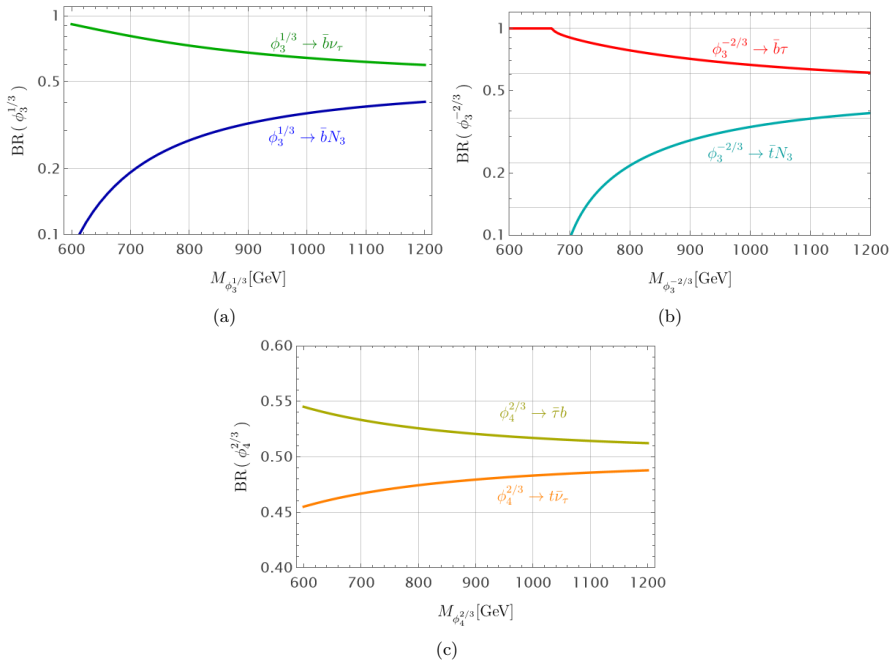
The paper's central claim is that the minimal low-scale quark-lepton unification theory—gauge group SU(4)_C × SU(2)_L × U(1)_R, with each generation of quarks and leptons placed in common multiplets—predicts that its two scalar leptoquarks (particles coupling a quark to a lepton) decay predominantly to third-generation fermions. The decisive relation is Y4 = sqrt(3)(M_D − M_E)/(v sinβ), which fixes the scalar-leptoquark couplings to the difference between the down-quark and charged-lepton mass matrices. In the approximation of small mixings, this gives y4 = sqrt(3)(m_b − m_τ)/(v sinβ), so the main decay channels are φ^{2/3}_4 → τ̄ b, φ^{−2/3}_3 → b̄τ, φ^{5/3}_4 → τ̄ t, and φ^{1/3}_3 → b̄ν. T
What carries the argument
The carrying mechanism is the Y4 Yukawa identity, Y4 = sqrt(3)(M_D − M_E)/(v sinβ), which follows from the SU(4) unification of quarks and leptons in the same multiplets: the scalar leptoquark Φ couples to the difference between the down-quark and charged-lepton mass matrices. In the small-mixing approximation this forces the dominant coupling to the third generation, y4 = sqrt(3)(m_b − m_τ)/(v sinβ), making b-τ and t-τ decays dominant. A second ingredient is the inverse seesaw: three singlet fermions S are added, producing a neutrino mass matrix whose light eigenvalue is m_ν ≈ μ(M_D^ν)^2/(M_D^χ)^2; this keeps neutrinos naturally light while allowing the unification scale v_χ to sit near the
Load-bearing premise
The load-bearing premise is that the benchmarks with a non-zero Y2 coupling—a heavy right-handed neutrino with mass between 10 and 1000 GeV and mixing to Standard Model neutrinos around 10^{-4}—can actually be realized together in the full inverse-seesaw Lagrangian; the paper treats these as independent scan parameters rather than exhibiting a consistent point.
What would settle it
Look for pair-produced scalar leptoquarks decaying to bottom-plus-tau, top-plus-tau, or bottom-plus-missing-energy. In the y2 = 0 case, this theory predicts essentially 100% branching into these third-generation final states; if a dedicated search with the expected sensitivity finds no such resonance for masses up to about 1.5 TeV, that scenario is excluded. Alternatively, if a scalar leptoquark is found, measure the branching-ratio ratios in Eq. (51): a deviation from the predicted mass-ratio pattern would falsify the Y4 origin of the couplings.
If this is right
- If the theory is correct, the cleanest LHC signatures are pair-produced scalar leptoquarks decaying to tau-plus-bottom, tau-plus-top, or bottom-plus-missing-energy final states; these carry most of the sensitivity in current measurements.
- Current measurements already push the Φ3 doublet below about 1 TeV and the Φ4 doublet below about 1.15 TeV out of reach when the unknown Y2 coupling is zero.
- When decays through a heavy right-handed neutrino are open (y2 ≠ 0), the missing-transverse-momentum and tau signatures are diluted, and the excluded mass for Φ3 drops to around 550 GeV for a 10 GeV neutrino; sensitivity returns only when the neutrino is nearly as heavy as the leptoquark.
- Dedicated third-generation leptoquark searches assuming single decay modes set stronger individual mass bounds than generic inclusive measurements, but those benchmarks cannot directly cover the multi-channel and heavy-neutrino decay scenarios of this theory.
- At the high-luminosity LHC, a large fraction of the remaining parameter space could be probed, so discovery of this unification theory in the near future is possible.
Where Pith is reading between the lines
- If a scalar leptoquark is discovered near 1–2 TeV, the predicted width ratios—for example Γ(φ^{2/3}_4 → τ̄ b)/Γ(φ^{5/3}_4 → τ̄ t) ≈ M_{φ^{2/3}_4}/M_{φ^{5/3}_3}—would be a direct test of whether the couplings truly come from the Y4 mass-difference identity rather than from arbitrary Yukawa matrices.
- The paper scans the heavy-neutrino mass and mixing as independent inputs; a more complete analysis would need to exhibit a single point of the full Lagrangian realizing M_N in the 10–1000 GeV range together with V_νN ≈ 10^{-4} and the TeV-scale unification sector. Until that is shown, the weakened bounds at y2 ≠ 0 may overstate the viable parameter space.
- Because the vector leptoquark's tree-level contribution to K_L → e±μ∓ is the main reason its mass naively exceeds 10^3 TeV, future rare-kaon and muon flavor-violation measurements could sharpen the expectation for the vector-leptoquark scale and indirectly test the same unification framework.
- The third-generation dominance implies that b-τ and t-τ final states are essentially direct probes of the unification-scale Yukawa couplings, suggesting that a global fit combining tau, top, and missing-pT differential measurements could extend the paper's reach to higher leptoquark masses.
Editorial analysis
A structured set of objections, weighed in public.
Referee Report
Summary. The paper studies the LHC phenomenology of the minimal SU(4)_C ⊗ SU(2)_L ⊗ U(1)_R quark-lepton unification model with inverse seesaw neutrino masses. The central theoretical result is that the dominant couplings of the two scalar leptoquarks are fixed by third-generation fermion masses, y4 = (√3/v sinβ)(m_b − m_τ), so that the main decay modes are φ_4^{2/3} → τ̄ b, φ_3^{-2/3} → b̄τ, φ_4^{5/3} → τ̄ t, and φ_3^{1/3} → b̄ν_i (Eqs. (49)–(50)). The authors implement the model in FeynRules/UFO and use Contur/Rivet to compare simulated signals with existing ATLAS and CMS measurements. For y2 = 0 they derive exclusions M_Φ3 ≲ 1 TeV and M_Φ4 ≲ 1.15 TeV. For y2 ≠ 0 they introduce heavy right-handed neutrinos with mass M_N = 10–1000 GeV and mixing V_{νN} ≈ 10^−4 and argue that the LHC sensitivity is drastically reduced because leptoquark decays proceed through the heavy neutrino. The paper also discusses production channels, decay chains of the heavy neutrino, and rough HL-LHC projections.
Significance. If the y4 relation is correct, the paper makes a sharp, falsifiable prediction: scalar leptoquark signals in this theory are dominated by third-generation final states. This is a useful and non-trivial result that connects a high-scale unification structure to concrete LHC observables. The use of public tools (FeynRules, MadGraph, Herwig, Rivet, Contur) and existing LHC measurements is a strength; the y2 = 0 limits and the sum-rule-like branching-ratio relations in Eqs. (51)–(52) are valuable and, as far as the presented simulations show, internally consistent. However, the claim that 'for some reasonable choices of model parameters this sensitivity is drastically reduced' rests on heavy-neutrino benchmarks that are not connected to the inverse-seesaw Lagrangian of Sec. 2. The stress-test concern about M_N and V_{νN} being treated as independent inputs is real and load-bearing. The central y4 prediction and the y2 = 0 exclusions stand, but the y2 ≠ 0 interpretation needs a concrete consistent parameter point or a careful rescoping.
major comments (1)
- [Secs. 4B1, 4C1 and Figs. 2, 3, 6; Eq. (32)] The benchmarks used to claim drastically reduced LHC sensitivity for y2 ≠ 0 are not realized by the inverse-seesaw Lagrangian of Sec. 2. In the scans, M_N = 10–1000 GeV and V_{νN} = 10^−4 are treated as independent inputs (e.g. M_N = 500 GeV, V_{νN} = 10^−4 in Figs. 2 and 6). In the mass matrix (32), the heavy eigenstate mass is M_N ≈ M_Dχ and the active-heavy mixing is V_{νN} ≈ M_Dν/M_Dχ. For M_N = 500 GeV and V_{νN} = 10^−4, one needs M_Dν ≈ 0.05 GeV. But Eq. (30), with the assumed y2 = 1 and an electroweak-size v2, gives a 33 entry of order (3/(4√3)) y2 v2 ≈ O(100 GeV), so M_Dν = 0.05 GeV requires a Y1 cancellation at the 10^−3 level. The paper's own illustrative parameters (Sec. 2) have M_Dν ≈ 100 GeV, M_Dχ ≈ 10^6 GeV, μ ≈ 10^−2 GeV, which places the heavy neutrinos at 10^6 GeV, not in the scanned range. No point of the full Sec. 2 Lagrangian is exhibited that realizes the scanned M_
minor comments (4)
- [Eq. (51)] The first ratio in Eq. (51) has M_{φ_5/3_3} in the denominator; the state is φ_5/3_4, so the mass should be M_{φ_5/3_4}. The same typo appears in the adjacent line.
- [Fig. 8 caption] The caption of Fig. 8 says 'y2 = 0 GeV'; y2 is dimensionless, so this should read 'y2 = 0'.
- [Sec. 4B1, Eq. (59)] The relation V_{νN} ≈ √(m_ν/μ) is correct in the inverse seesaw, but it is used together with μ ∼ 10^−2 GeV to motivate V_{νN} ∼ 10^−4 without noting that the same relation, combined with Eq. (33), forces M_Dν = V_{νN} M_Dχ. Clarifying this connection would help the reader see why the scanned benchmark points are non-trivial.
- [Sec. 4C4] In the individual-LQ discussion, the statement that for y2 ≠ 0 and small y4 'there is very little sensitivity due to the dilution of the p_T^miss signal in N decays' inherits the benchmark-consistency issue of the main scans. Even if the benchmarks are repaired, a sentence indicating which M_N and V_{νN} values are actually realized in the model would be useful.
Circularity Check
No significant circularity: the leptoquark couplings follow from measured fermion masses and the LHC limits are anchored to public data via simulation.
full rationale
The central derived quantity, y4 = sqrt(3)/(v sin beta)(m_b - m_tau), follows algebraically from the model's mass matrices in Eqs. (24)-(26) together with measured SM fermion masses; it is not fitted to leptoquark data. The dominant-decay statements in Eqs. (49)-(50) are explicitly conditional on neglecting the unknown flavor-mixing matrices, and the paper states this assumption rather than smuggling it in. The LHC constraints in Figs. 4-8 are obtained by implementing the model in FeynRules/UFO and comparing Monte Carlo events with public ATLAS measurements via Contur, so the exclusion content is externally anchored. Citations to Refs. [7] and [9-18] are partly self-citations, but the load-bearing Yukawa relation is re-derived in this paper, and the framework itself is a published, externally testable model; no uniqueness theorem is imported to force the benchmark choices. A model-consistency caveat is present: the M_N = 10-1000 GeV, V_nuN ~ 10^-4 benchmarks used in Secs. 4B1 and 4C1 are not shown to follow from the inverse-seesaw parameters of Sec. 2 (whose worked example has M_Dnu ~ 100 GeV and M_Dchi ~ 10^6 GeV, placing heavy neutrinos near 10^6 GeV). That is a correctness/support gap, not a circular reduction of a prediction to an input.
Axiom & Free-Parameter Ledger
free parameters (5)
- y2 (third-generation ν_R–LQ Yukawa entry) =
0 or 1 (benchmarks)
- y4 (or equivalently tanβ) =
scanned 0.01–1
- M_N (heavy right-handed neutrino mass) =
10–1000 GeV (scan); 500 GeV in examples
- VνN (SM–heavy neutrino mixing) =
10^-4 in Fig. 3
- MΦ3, MΦ4 (scalar LQ masses) =
scanned ~500–3000 GeV
axioms (5)
- domain assumption The SU(4)_C×SU(2)_L×U(1)_R gauge structure with fields FqL, FuR, FdR, H1, Φ, χ of Ref. [7] is the minimal low-scale quark-lepton unification model.
- domain assumption Inverse seesaw with three S_L singlets generates neutrino masses, with heavy ν_R mass coming from the χ VEV.
- ad hoc to paper Unknown quark–lepton mixing matrices can be neglected (V_i ≈ 1) when computing dominant LQ decays.
- domain assumption The vector LQ is too heavy to contribute at the LHC (M_X > ~10^3 TeV from K_L→e±μ∓).
- ad hoc to paper Benchmark N states with M_N=10–1000 GeV and VνN≈10^-4 are part of the model's parameter space.
invented entities (1)
-
N3: a third-generation right-handed neutrino with mass around 10–1000 GeV and SM mixing VνN≈10^-4
no independent evidence
read the original abstract
We investigate the collider signatures of the minimal framework for quark-lepton unification at a scale not far from the electroweak symmetry breaking scale. This theory predicts a rich spectrum of new fields, including one vector leptoquark, two scalar leptoquarks, a color-octet scalar, and an additional Higgs doublet. Neutrino masses are generated via the inverse seesaw mechanism, facilitating viable matter unification at the low scale. We find that this theory predicts that in many cases the dominant leptoquark decays are to the third generation Standard Model quarks and leptons. We identify key experimental signatures at the Large Hadron Collider, evaluate and discuss the limits from current measurements, and outline potential strategies for probing this theory in the near future.
Figures



Forward citations
Cited by 2 Pith papers
-
Matter Unification and Lepton Flavour Violation
Muon-to-electron conversion at Mu2e can probe quark–lepton unification scales up to ~10^4 TeV in the minimal SU(4)_C×SU(2)_L×U(1)_R model, even where rare kaon decays are suppressed by unknown mixing angles.
-
Universal Seesaw Pati-Salam Model with P for Strong CP
A parity-symmetric Pati-Salam model with universal seesaw masses gives an axionless strong-CP solution and radiatively induced neutrino masses.
Reference graph
Works this paper leans on
-
[1]
INTRODUCTION The idea of quark-lepton unification [1, 2] is one of the most appealing ideas for physics beyond the Standard Model (SM). In this context, the SM quarks and leptons are unified in the same fermionic multiplets, and neutrinos are predicted to be massive. This theory was in fact the firsttheorytobeproposedforphysicsbeyondtheSM,alsopredictingfo...
Pith/arXiv arXiv 2025
-
[2]
LOW SCALE QUARK-LEPTON UNIFICA TION This minimal theory for matter unification is based on the gauge symmetry [7] SU(4)C ⊗SU(2) L ⊗U(1) R, while the SM matter fields are unified as follows FqL = ur ug ub ν dr dg db e L ∼(4,2,0),(1) FuR = ur ug ub ν R ∼(4,1,1/2),(2) FdR = dr dg db e R ∼(4,1,−1/2).(3) Hereu i andd i (withi=r, g, b) are the quarks with diffe...
-
[3]
Notice that without the scalar fieldΦ, there would be only two independent Yukawa couplings, so the charged fermion masses could not be generated to be consistent with measurement. In our convention the charged fermion masses are diagonalized in the following way: U † LMU UR =M diag U ,(27) D† LMDDR =M diag D ,(28) E† LMEER =M diag E .(29) •Neutrino Masse...
-
[4]
Here we discuss the main interactions relevant for the study of the signatures at the LHC
LEPTOQUARKS The theory predicts three types of LQ: one vector and two scalars. Here we discuss the main interactions relevant for the study of the signatures at the LHC. As mentioned above, the vector LQ mediates the rare processK0 L →e ±µ∓ at tree-level, and naively its mass should be above the103 TeV scale. Therefore, one cannot expect to observe the ve...
-
[5]
LHC PHENOMENOLOGY A. Production Channels Over much of the parameter range of the theory, the dominant production process is pair production via the strong coupling of the LQs, pp→LQ LQ ∗,(53) pp→lepton+LQ,(54) where the incoming partons can beggorq¯q. The pair production cross section for smaller LQ masses and large values of the Yukawa coupling, single p...
-
[6]
Heavy Neutrino Decays The right-handed neutrinos can decay via the mixing with the SM neutrinos and can have 3-body decays mediated by the scalar LQsϕ1/3 3 andϕ −2/3 3 . Within the framework of the inverse seesaw mechanism, the mixing between SM neutrinos and the right handed neutrinos can be written as VνN ≃ r mν µ .(59) Whenµ∼10 −2 GeV, the mixing betwe...
-
[7]
We begin by considering the casey2 = 0
Limits and sensitivity toΦ 3 We first study theΦ3 doublet, which contains theϕ−1/3 3 andϕ −2/3 3 LQs, assuming theΦ4 is decoupled. We begin by considering the casey2 = 0. In this case, the relevant free parameters are y4 which we allow to vary in the range0.01≤y 4 ≤1, and the LQ massM Φ3 which we scan in the range 500 GeV to 1.5 TeV. The heavy neutrino ma...
2000
-
[8]
As can be seen from Eqs
Limits and sensitivity toΦ 4 Similar scans are performed forMΦ4, under the assumption that theΦ3 is decoupled. As can be seen from Eqs. (57) and (58), in this case the heavy neutrino plays no role. Fig. 7a shows a scan of the sensitivity as a function ofy4 andM Φ4 fory 2 = 0. Masses below about 1150 GeV are excluded, with the sensitivity increasing slowly...
-
[9]
8 shows the sensitivity in the plane ofM Φ3 vsM Φ4, forM N = 500GeV and and y2 = 0, y4 = 1, Fig
Limits and sensitivity when bothΦ 3 andΦ 4 are accessible Fig. 8 shows the sensitivity in the plane ofM Φ3 vsM Φ4, forM N = 500GeV and and y2 = 0, y4 = 1, Fig. 8a, andy2 =y 4 = 1, Fig. 8b. While the phenomenology is more complex in this case, we still see that the same signatures –τ, top andpmiss T – play the major role. The increased cross sections mean ...
2000
-
[10]
For ϕ−1/3 3 alone, and considering the casey2 = 0, masses below about 700 GeV are excluded at the 95% c.l., mainly due to missing transverse momentum signatures
Individual LQ limits For completeness, and for comparison with existing searches, scenarios were studied in which the mass hierarchy within a LQ doublet is strong, such that only one LQ is active at a time. For ϕ−1/3 3 alone, and considering the casey2 = 0, masses below about 700 GeV are excluded at the 95% c.l., mainly due to missing transverse momentum ...
-
[11]
TheQCDPairproductionsearches, whicharemostlymodelindependent, providethemoststringent constraints on the LQ mass
Existing exclusion limits The ATLAS and CMS collaborations have performed dedicated searches for LQ signatures. TheQCDPairproductionsearches, whicharemostlymodelindependent, providethemoststringent constraints on the LQ mass. For the 3rd generation up-type scalar LQ (LQu 3), decaying tobτwith 100%branching ratio, the ATLAS collaboration excludes masses up...
-
[12]
decaying exclusively intobνandtτfinal states, respectively. These bounds on the LQ masses are stronger than the bounds found on individual LQs in this study, which is to be expected since those dedicated searches focus on specific final-state signatures, and apply multivariate or machine-learning techniques to enhance signal sensitivity, whereas the bound...
-
[13]
SUMMAR Y The minimal theory that unifies quarks and leptons at the low energy scale has been investi- gated. This theory makes testable predictions at the LHC and future colliders, introducing several new fields beyond those of the Standard Model: one vector leptoquark, two scalar leptoquarks, a color-octet scalar, and an additional Higgs doublet. Neutrin...
-
[14]
Lepton Number as the Fourth Color,
Jogesh C. Pati and Abdus Salam, “Lepton Number as the Fourth Color,” Phys. Rev. D10, 275–289 (1974), [Erratum: Phys.Rev.D 11, 703–703 (1975)]
1974
-
[15]
Is Baryon Number Conserved?
Jogesh C. Pati and Abdus Salam, “Is Baryon Number Conserved?” Phys. Rev. Lett.31, 661–664 (1973)
1973
-
[16]
µ→eγat a Rate of One Out of10 9 Muon Decays?
Peter Minkowski, “µ→eγat a Rate of One Out of10 9 Muon Decays?” Phys. Lett. B67, 421–428 (1977)
1977
-
[17]
Complex Spinors and Unified Theories,
Murray Gell-Mann, Pierre Ramond, and Richard Slansky, “Complex Spinors and Unified Theories,” Conf. Proc. C790927, 315–321 (1979), arXiv:1306.4669 [hep-th]
Pith/arXiv arXiv 1979
-
[18]
Neutrino Mass and Spontaneous Parity Nonconserva- tion,
Rabindra N. Mohapatra and Goran Senjanovic, “Neutrino Mass and Spontaneous Parity Nonconserva- tion,” Phys. Rev. Lett.44, 912 (1980)
1980
-
[19]
Horizontal gauge symmetry and masses of neutrinos,
Tsutomu Yanagida, “Horizontal gauge symmetry and masses of neutrinos,” Conf. Proc. C7902131, 95–99 (1979)
1979
-
[20]
Low Scale Quark-Lepton Unification,
Pavel Fileviez Perez and Mark B. Wise, “Low Scale Quark-Lepton Unification,” Phys. Rev. D88, 057703 (2013), arXiv:1307.6213 [hep-ph]
Pith/arXiv arXiv 2013
-
[21]
The Minimal quark - lepton symmetry model and the limit on Z-prime mass,
A. D. Smirnov, “The Minimal quark - lepton symmetry model and the limit on Z-prime mass,” Phys. Lett. B346, 297–302 (1995), arXiv:hep-ph/9503239
Pith/arXiv arXiv 1995
-
[22]
Two-Higgs-doublet model and quark- lepton unification,
Pavel Fileviez Perez, Elliot Golias, and Alexis D. Plascencia, “Two-Higgs-doublet model and quark- lepton unification,” JHEP08, 293 (2022), arXiv:2205.02235 [hep-ph]
Pith/arXiv arXiv 2022
-
[23]
Flavor anomalies and quark-lepton unification,
Pavel Fileviez Perez and Clara Murgui, “Flavor anomalies and quark-lepton unification,” Phys. Rev. D 106, 035033 (2022), arXiv:2203.07381 [hep-ph]
Pith/arXiv arXiv 2022
-
[24]
Probing quark-lepton unification with leptoquark and Higgs boson decays,
Pavel Fileviez Perez, Elliot Golias, and Alexis D. Plascencia, “Probing quark-lepton unification with leptoquark and Higgs boson decays,” Phys. Rev. D105, 075011 (2022), arXiv:2107.06895 [hep-ph]
Pith/arXiv arXiv 2022
-
[25]
Leptoquarks and matter unification: Flavor anomalies and the muon g-2,
Pavel Fileviez Perez, Clara Murgui, and Alexis D. Plascencia, “Leptoquarks and matter unification: Flavor anomalies and the muon g-2,” Phys. Rev. D104, 035041 (2021), arXiv:2104.11229 [hep-ph]
Pith/arXiv arXiv 2021
-
[26]
Hunting and identifying coloured resonances in four top events with machine learning,
Thomas Flacke, Jeong Han Kim, Manuel Kunkel, Jun Seung Pi, and Werner Porod, “Hunting and identifying coloured resonances in four top events with machine learning,” (2025), arXiv:2506.04318 [hep-ph]
Pith/arXiv arXiv 2025
-
[27]
Finite naturalness and quark-lepton unification,
Pavel Fileviez Pérez, Clara Murgui, Samuel Patrone, Adriano Testa, and Mark B. Wise, “Finite naturalness and quark-lepton unification,” Phys. Rev. D109, 015011 (2024), arXiv:2308.07367 [hep- ph]
Pith/arXiv arXiv 2024
-
[28]
All possible first signals of gauge leptoquark in quark-lepton unification and beyond,
Hedvika Gedeonová and Matěj Hudec, “All possible first signals of gauge leptoquark in quark-lepton unification and beyond,” Phys. Rev. D107, 095029 (2023), arXiv:2210.00347 [hep-ph]
Pith/arXiv arXiv 2023
-
[29]
Scalar leptoquarks, baryon number violation, and Pati-Salam sym- metry,
Clara Murgui and Mark B. Wise, “Scalar leptoquarks, baryon number violation, and Pati-Salam sym- metry,” Phys. Rev. D104, 035017 (2021), arXiv:2105.14029 [hep-ph]
Pith/arXiv arXiv 2021
-
[30]
LHC bounds on colored scalars,
Víctor Miralles and Antonio Pich, “LHC bounds on colored scalars,” Phys. Rev. D100, 115042 (2019), arXiv:1910.07947 [hep-ph]
Pith/arXiv arXiv 2019
-
[31]
A unified leptoquark model confronted with lepton non-universality inB-meson decays,
T. Faber, M. Hudec, Michal Malinský, P. Meinzinger, Werner Porod, and Florian Staub, “A unified leptoquark model confronted with lepton non-universality inB-meson decays,” Phys. Lett. B787, 159–166 (2018), arXiv:1808.05511 [hep-ph]
Pith/arXiv arXiv 2018
-
[32]
Physics of leptoquarks in precision 18 experiments and at particle colliders,
I. Doršner, S. Fajfer, A. Greljo, J. F. Kamenik, and N. Košnik, “Physics of leptoquarks in precision 18 experiments and at particle colliders,” Phys. Rept.641, 1–68 (2016), arXiv:1603.04993 [hep-ph]
Pith/arXiv arXiv 2016
-
[33]
Quark - lepton unification and rare meson decays,
G. Valencia and S. Willenbrock, “Quark - lepton unification and rare meson decays,” Phys. Rev. D50, 6843–6848 (1994), arXiv:hep-ph/9409201
Pith/arXiv arXiv 1994
-
[34]
Neutrino Mass and Baryon Number Nonconservation in Super- string Models,
R. N. Mohapatra and J. W. F. Valle, “Neutrino Mass and Baryon Number Nonconservation in Super- string Models,” Phys. Rev. D34, 1642 (1986)
1986
-
[35]
FeynRules 2.0 - A complete toolbox for tree-level phenomenology,
Adam Alloul, Neil D. Christensen, Céline Degrande, Claude Duhr, and Benjamin Fuks, “FeynRules 2.0 - A complete toolbox for tree-level phenomenology,” Comput. Phys. Commun.185, 2250–2300 (2014), arXiv:1310.1921 [hep-ph]
Pith/arXiv arXiv 2014
-
[36]
UFO - The Universal FeynRules Output,
Celine Degrande, Claude Duhr, Benjamin Fuks, David Grellscheid, Olivier Mattelaer, and Thomas Reiter, “UFO - The Universal FeynRules Output,” Comput. Phys. Commun.183, 1201–1214 (2012), arXiv:1108.2040 [hep-ph]
Pith/arXiv arXiv 2012
-
[37]
J. Alwall, R. Frederix, S. Frixione, V. Hirschi, F. Maltoni, O. Mattelaer, H.-S. Shao, T. Stelzer, P. Tor- rielli, and M. Zaro, “The automated computation of tree-level and next-to-leading order differential cross sections, and their matching to parton shower simulations,” Journal of High Energy Physics2014 (2014), 10.1007/jhep07(2014)079
-
[38]
Herwig 7.0/Herwig++ 3.0 release note,
Johannes Bellmet al., “Herwig 7.0/Herwig++ 3.0 release note,” Eur. Phys. J. C76, 196 (2016), arXiv:1512.01178 [hep-ph]
Pith/arXiv arXiv 2016
-
[39]
Constraining new physics with collider measurements of Standard Model signatures,
Jonathan M. Butterworth, David Grellscheid, Michael Krämer, Björn Sarrazin, and David Yallup, “Constraining new physics with collider measurements of Standard Model signatures,” JHEP03, 078 (2017), arXiv:1606.05296 [hep-ph]
Pith/arXiv arXiv 2017
-
[40]
Testing new physics models with global comparisons to collider measurements: the Contur toolkit,
A. Buckleyet al., “Testing new physics models with global comparisons to collider measurements: the Contur toolkit,” SciPost Phys. Core4, 013 (2021), arXiv:2102.04377 [hep-ph]
Pith/arXiv arXiv 2021
-
[41]
Andy Buckley, Jonathan Butterworth, David Grellscheid, Hendrik Hoeth, Leif Lonnblad, James Monk, Holger Schulz, and Frank Siegert, “Rivet user manual,” Comput. Phys. Commun.184, 2803–2819 (2013), arXiv:1003.0694 [hep-ph]
Pith/arXiv arXiv 2013
-
[42]
Robust independent validation of experiment and theory: Rivet version 4 release note,
Christian Bierlich, Andy Buckley, Jonathan Mark Butterworth, Christian Gutschow, Leif Lonnblad, Tomasz Procter, Peter Richardson, and Yoran Yeh, “Robust independent validation of experiment and theory: Rivet version 4 release note,” SciPost Phys. Codeb.36, 1 (2024), arXiv:2404.15984 [hep-ph]
Pith/arXiv arXiv 2024
-
[43]
Constraints On New Theories Using Rivet : CONTUR version 3 release note,
Andy Buckley, Jon Butterworth, Joseph Egan, Christian Gutschow, Sihyun Jeon, Martin Habedank, Tomasz Procter, Peng Wang, Yoran Yeh, and Luzhan Yue (CONTUR), “Constraints On New Theories Using Rivet : CONTUR version 3 release note,” (2025), arXiv:2505.09272 [hep-ph]
Pith/arXiv arXiv 2025
-
[44]
Presentation of search results: TheCL s technique,
Alexander L. Read, “Presentation of search results: TheCL s technique,” J. Phys. G28, 2693–2704 (2002)
2002
-
[45]
Georges Aadet al.(ATLAS), “A measurement of the high-massτ¯τproduction cross-section at√s= 13TeV with the ATLAS detector and constraints on new particles and couplings,” (2025), arXiv:2503.19836 [hep-ex]
arXiv 2025
-
[46]
Georges Aadet al.(ATLAS), “Differential cross-sections for events with missing transverse momentum and jets measured with the ATLAS detector in 13 TeV proton-proton collisions,” JHEP08, 223 (2024), arXiv:2403.02793 [hep-ex]
Pith/arXiv arXiv 2024
-
[47]
Event Generation with Sherpa 2.2,
Enrico Bothmannet al.(Sherpa), “Event Generation with Sherpa 2.2,” SciPost Phys.7, 034 (2019), arXiv:1905.09127 [hep-ph]
Pith/arXiv arXiv 2019
-
[48]
Simone Alioli, Paolo Nason, Carlo Oleari, and Emanuele Re, “A general framework for implementing NLO calculations in shower Monte Carlo programs: the POWHEG BOX,” JHEP06, 043 (2010), arXiv:1002.2581 [hep-ph]
Pith/arXiv arXiv 2010
-
[49]
A Brief Introduction to PYTHIA 8.1,
Torbjorn Sjostrand, Stephen Mrenna, and Peter Z. Skands, “A Brief Introduction to PYTHIA 8.1,” Comput. Phys. Commun.178, 852–867 (2008), arXiv:0710.3820 [hep-ph]
Pith/arXiv arXiv 2008
-
[50]
Georges Aadet al.(ATLAS), “Measurement oft tproduction in association with additional b-jets in the eµfinal state in proton–proton collisions at√s= 13 TeV with the ATLAS detector,” JHEP01, 068 (2025), arXiv:2407.13473 [hep-ex]
Pith/arXiv arXiv 2025
-
[51]
Armen Tumasyanet al.(CMS), “Measurement of differentialt ¯tproduction cross sections in the full kinematic range using lepton+jets events from proton-proton collisions at√s= 13 TeV,” Phys. Rev. D104, 092013 (2021), arXiv:2108.02803 [hep-ex]
Pith/arXiv arXiv 2021
-
[52]
Georges Aadet al.(ATLAS), “Measurements of differential cross-sections in top-quark pair events 19 with a high transverse momentum top quark and limits on beyond the Standard Model contributions to top-quark pair production with the ATLAS detector at √s= 13 TeV,” JHEP06, 063 (2022), arXiv:2202.12134 [hep-ex]
Pith/arXiv arXiv 2022
-
[53]
Georges Aadet al.(ATLAS), “Measurements of differential cross-sections in four-lepton events in 13 TeV proton-proton collisions with the ATLAS detector,” JHEP07, 005 (2021), arXiv:2103.01918 [hep- ex]
Pith/arXiv arXiv 2021
-
[54]
Georges Aadet al.(ATLAS), “Search for pair production of third-generation leptoquarks decaying into a bottom quark and aτ-lepton with the ATLAS detector,” Eur. Phys. J. C83, 1075 (2023), arXiv:2303.01294 [hep-ex]
Pith/arXiv arXiv 2023
-
[55]
Georges Aadet al.(ATLAS), “Search for new phenomena in final states withb-jets and missing trans- verse momentum in √s= 13TeVppcollisions with the ATLAS detector,” JHEP05, 093 (2021), arXiv:2101.12527 [hep-ex]
Pith/arXiv arXiv 2021
-
[56]
GeorgesAadet al.(ATLAS),“Searchforpairproductionofthird-generationscalarleptoquarksdecaying into a top quark and aτ-lepton inppcollisions at √s= 13 TeV with the ATLAS detector,” JHEP06, 179 (2021), arXiv:2101.11582 [hep-ex]. 20
Pith/arXiv arXiv 2021
discussion (0)
Sign in with ORCID, Apple, or X to comment. Anyone can read and Pith papers without signing in.