The effects of alloy disorder on strongly-driven flopping mode qubits in Si/SiGe
Pith reviewed 2026-05-21 16:42 UTC · model grok-4.3
The pith
Alloy disorder randomizes valley parameters in Si/SiGe but pulse fine-tuning still enables high-fidelity strongly driven flopping mode qubits across wide ranges when charge noise is weak, or with large splittings and small phase differences
A machine-rendered reading of the paper's core claim, the machinery that carries it, and where it could break.
Core claim
In the presence of alloy disorder that randomizes valley energy splitting and phase difference between dots, strongly driven flopping mode qubits can achieve high fidelity by fine-tuning the electronic pulse for a given valley configuration when charge noise is weak, and by operating with large valley splittings and small phase differences when charge noise is strong; strongly driven pulses are less sensitive to inter-dot detuning fluctuations but more sensitive to valley parameter shifts, which can dominate infidelities, while device tuning schemes help avoid poor configurations.
What carries the argument
Optimization of the driving pulse under randomized valley splitting and inter-dot phase difference, which controls leakage via valley excitations during tunneling.
If this is right
- High fidelity remains possible across a wide range of valley parameters with weak charge noise via pulse fine-tuning.
- With strong charge noise, high fidelity requires large valley splittings in each dot and small valley phase difference.
- Strongly driven pulses show reduced sensitivity to fluctuations in inter-dot detuning.
- Small shifts in valley parameters can dominate infidelities in some regimes.
- Tuning schemes can steer devices away from poor-performing valley configurations to improve scalability.
Where Pith is reading between the lines
- Real devices may require on-the-fly pulse calibration based on measured valley splittings to maintain the predicted fidelities.
- The approach could extend to arrays of coupled flopping-mode qubits where similar disorder effects accumulate across multiple dots.
- Varying germanium concentration during growth offers a fabrication knob to test and reduce the modeled disorder statistics.
- The reduced detuning sensitivity under strong driving may relax requirements on charge-noise filtering in cryogenic control electronics.
Load-bearing premise
The conclusions depend on a specific statistical model in which alloy disorder primarily randomizes valley splitting and inter-dot phase difference to open valley excitation leakage channels.
What would settle it
Measure gate fidelity in fabricated Si/SiGe devices while independently varying charge noise strength and valley parameter distributions to test whether the predicted high-fidelity regimes appear only under the modeled conditions.
Figures





read the original abstract
In Si quantum dot systems, large magnetic field gradients are needed to implement spin rotations via electric dipole spin resonance (EDSR). By increasing the effective electron dipole, flopping mode qubits can provide faster gates with smaller field gradients. Moreover, operating in the strong-driving limit can reduce their sensitivity to charge noise. However, alloy disorder in Si/SiGe heterostructures randomizes the valley energy splitting and the valley phase difference between dots, enhancing the probably of valley excitations while tunneling between the dots, and opening a leakage channel. In this work, we analyze the performance of flopping mode spin qubits in the presence of charge noise and alloy disorder, and we optimize these qubits for a variety of valley configurations, in both weak and strong charge-noise regimes. When the charge noise is weak, high fidelity qubits can be implemented across a wide range of valley parameters, provided the electronic pulse is fine-tuned for a given valley configuration. When the charge noise is strong, high-fidelity pulses can still be engineered, provided the valley splittings in each dot are relatively large and the valley phase difference is relatively small. We analyze how charge noise-induced fluctuations of the inter-dot detuning, as well as small shifts in other qubit parameters, impact qubit fidelities. We find that strongly driven pulses are less sensitive to detuning fluctuations but more sensitive to small shifts in the valley parameters, which can actually dominate the qubit infidelities in some regimes. Finally, we discuss schemes to tune devices away from poor-performing configurations, enhancing the scalability of flopping-mode-based qubit architectures.
Editorial analysis
A structured set of objections, weighed in public.
Referee Report
Summary. The manuscript examines strongly-driven flopping-mode spin qubits in Si/SiGe quantum dots, focusing on how alloy disorder randomizes valley splittings and inter-dot phase differences, thereby opening valley-excitation leakage channels during tunneling. Using numerical pulse optimization, the authors show that high-fidelity gates remain achievable across a broad range of valley parameters when charge noise is weak (with device-specific pulse tuning), and that high fidelities can still be engineered in the strong-noise regime provided valley splittings are large and the phase difference is small. They further quantify how detuning fluctuations and small valley-parameter shifts affect infidelity, finding that strong driving reduces detuning sensitivity but increases sensitivity to valley shifts, and outline device-tuning strategies to avoid poor configurations.
Significance. If the numerical results hold under the stated modeling assumptions, the work supplies concrete operating regimes and pulse-design guidelines that could improve the robustness of EDSR-based flopping-mode qubits against realistic Si/SiGe disorder. The explicit comparison of weak- versus strong-noise regimes and the identification of valley-parameter windows that remain high-fidelity even under strong charge noise constitute actionable information for experimental groups seeking scalable spin-qubit architectures.
major comments (2)
- [§3] §3 (Disorder model and Hamiltonian): The central claim that high-fidelity pulses exist for large valley splittings and small phase differences in the strong-noise regime rests on the assumption that alloy disorder independently randomizes on-site valley splittings and the inter-dot phase difference, with leakage occurring primarily via valley excitations during tunneling. The manuscript should include a sensitivity analysis showing how the optimized fidelities change when the variance or spatial correlation length of the disorder distribution is varied by a factor of two; without this, the identified optimal regimes remain tied to the specific statistics chosen.
- [§4.3] §4.3 (Sensitivity to parameter shifts): The statement that valley-parameter shifts can dominate infidelity under strong driving is load-bearing for the recommendation to fine-tune pulses to specific valley configurations. The quantitative contribution of a 10 % shift in valley splitting or phase to the total infidelity should be reported explicitly (e.g., as a separate curve or table entry) rather than only as a qualitative observation, so that readers can judge whether the effect exceeds the charge-noise contribution across the claimed parameter space.
minor comments (3)
- [Abstract] Abstract, line 3: 'enhancing the probably of valley excitations' contains a typographical error and should read 'probability'.
- [Figures] Figure captions and axis labels: Ensure that all fidelity color scales are identical across panels that are meant to be compared directly, and that the range of valley-splitting and phase-difference values is stated explicitly in every relevant figure caption.
- [Throughout] Notation: The symbols used for the valley phase difference (e.g., φ_v) and the inter-dot detuning fluctuation should be defined once in the main text and used consistently thereafter; occasional redefinition in later sections reduces readability.
Simulated Author's Rebuttal
We thank the referee for the careful reading of our manuscript and the constructive comments. We address each major point below and have incorporated additional analyses to strengthen the presentation of our results.
read point-by-point responses
-
Referee: [§3] §3 (Disorder model and Hamiltonian): The central claim that high-fidelity pulses exist for large valley splittings and small phase differences in the strong-noise regime rests on the assumption that alloy disorder independently randomizes on-site valley splittings and the inter-dot phase difference, with leakage occurring primarily via valley excitations during tunneling. The manuscript should include a sensitivity analysis showing how the optimized fidelities change when the variance or spatial correlation length of the disorder distribution is varied by a factor of two; without this, the identified optimal regimes remain tied to the specific statistics chosen.
Authors: We agree that a sensitivity analysis would make the robustness of the reported regimes clearer. Our disorder model follows standard literature treatments for Si/SiGe that assume independent randomization of on-site valley splittings and inter-dot phase (effectively zero correlation length). We have performed additional optimizations in which the variance of the disorder distribution is scaled by a factor of two. The high-fidelity windows for large valley splittings and small phase differences remain qualitatively intact, with only modest quantitative shifts in the achieved fidelities. We will add these results as a supplementary figure and brief discussion in the revised manuscript. Explicit variation of a finite correlation length would require a modified disorder model; we note this limitation and its implications in the text. revision: yes
-
Referee: [§4.3] §4.3 (Sensitivity to parameter shifts): The statement that valley-parameter shifts can dominate infidelity under strong driving is load-bearing for the recommendation to fine-tune pulses to specific valley configurations. The quantitative contribution of a 10 % shift in valley splitting or phase to the total infidelity should be reported explicitly (e.g., as a separate curve or table entry) rather than only as a qualitative observation, so that readers can judge whether the effect exceeds the charge-noise contribution across the claimed parameter space.
Authors: We accept this suggestion. In the revised manuscript we will include an explicit table (and supporting curves) that isolates the infidelity contribution arising from a 10 % shift in valley splitting and from a 10 % shift in phase difference, for representative points in both the weak- and strong-noise regimes. These values will be compared directly with the infidelity due to charge-noise-induced detuning fluctuations alone, allowing readers to assess the relative magnitudes across the parameter space we consider. revision: yes
Circularity Check
No circularity; derivation self-contained via forward numerical modeling
full rationale
The paper performs numerical simulations of flopping-mode qubit dynamics under explicit models of alloy disorder (randomizing valley splittings and phases) and charge noise, followed by pulse optimization and fidelity evaluation across parameter regimes. No load-bearing step reduces a claimed prediction or result to a fitted input by construction, nor invokes self-citations or ansatzes that close the derivation on itself. The reported optimal regimes for weak and strong noise follow directly from the simulated leakage channels and sensitivity analysis, rendering the chain independent of its own outputs.
Axiom & Free-Parameter Ledger
free parameters (2)
- valley splitting and phase difference
- charge noise amplitude
axioms (1)
- domain assumption Alloy disorder randomizes valley energy splitting and valley phase difference between dots, enhancing valley excitation probability during tunneling
Lean theorems connected to this paper
-
IndisputableMonolith/Foundation/RealityFromDistinction.leanreality_from_one_distinction unclear?
unclearRelation between the paper passage and the cited Recognition theorem.
We start with an 8-level Hamiltonian spanned by the charge, spin, and valley degrees of freedom... optimize pulses... Monte Carlo simulation procedure... estimate the average infidelity caused by the Δ fluctuations
-
IndisputableMonolith/Cost/FunctionalEquation.leanwashburn_uniqueness_aczel unclear?
unclearRelation between the paper passage and the cited Recognition theorem.
Alloy disorder... randomizes the valley energy splitting and the valley phase difference... leakage channel
What do these tags mean?
- matches
- The paper's claim is directly supported by a theorem in the formal canon.
- supports
- The theorem supports part of the paper's argument, but the paper may add assumptions or extra steps.
- extends
- The paper goes beyond the formal theorem; the theorem is a base layer rather than the whole result.
- uses
- The paper appears to rely on the theorem as machinery.
- contradicts
- The paper's claim conflicts with a theorem or certificate in the canon.
- unclear
- Pith found a possible connection, but the passage is too broad, indirect, or ambiguous to say the theorem truly supports the claim.
Forward citations
Cited by 3 Pith papers
-
Microscopic modeling of flopping-mode quantum dot spin qubits
A semi-analytical framework models flopping-mode spin qubits from device geometry, simulates EDSR control with Rabi purity analysis, and derives exchange coupling for capacitively coupled pairs via restricted configur...
-
Microscopic modeling of flopping-mode quantum dot spin qubits
A new microscopic model maps quantum dot device geometry directly to flopping-mode qubit parameters, reveals a tradeoff between fast electric driving and clean Rabi oscillations, and derives exchange coupling for capa...
-
Valley-Aware Optimal Control of Spin Shuttling Using Cryogenic Integrated Electronics
A valley-aware co-simulation and noise-aware optimization of discrete cryogenic circuit settings achieves 99.99% average shuttling fidelity over 10 μm at 20 m/s with tens of μW power.
Reference graph
Works this paper leans on
-
[1]
The work was performed using the compute re- sources and assistance of the UW-Madison Center For High Throughput Computing (CHTC) in the Depart- ment of Computer Sciences [51]. The CHTC is sup- ported by UW-Madison, the Advanced Computing Ini- tiative, the Wisconsin Alumni Research Foundation, the 15 Wisconsin Institutes for Discovery, and the National Sc...
-
[2]
ComputingL charge As described in Sec. III in the main text, to develop high-fidelity pulses, we want to estimate the pulse sensi- tivity to charge noise. To do so, we utilize a formalism based on a general 2-level Hamiltonian [44, 52] H=H c +δH,(B1) whereH c is the desired (time-dependent) control Hamil- tonian, and the leakage term δH=χx(t)σx +χz(t)σz,(...
-
[3]
ComputingL leak While we restrict ourselves to the 2-level spin subspace to approximate the gate sensitivity to charge noise, we need to consider leakage out of this subspace while per- forming gate operations. To do so, at each step, we simu- late the evolution of the full 8-level system fromt= 0to t=T :=nT res under the Schrodinger equation, including a...
-
[4]
11, we plot the components of the total cost Cin Eq
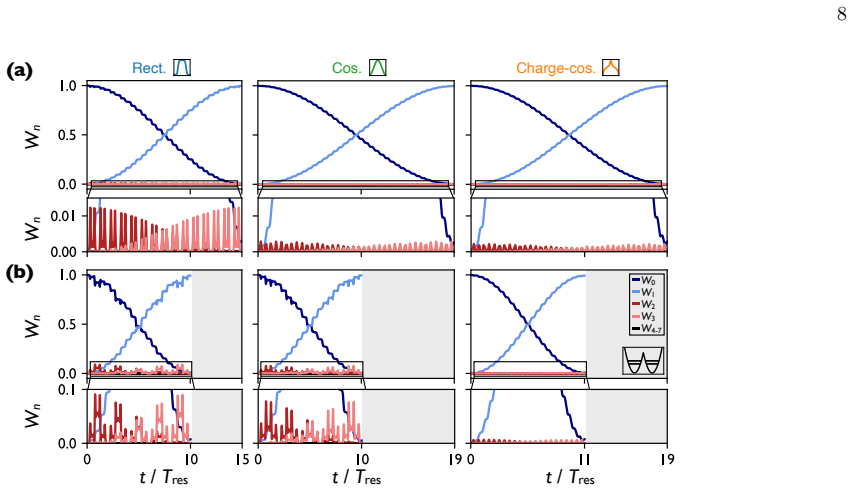
Comparison of cost components In Fig. 11, we plot the components of the total cost Cin Eq. (13) for a variety of valley configurations. Here, we show results for the cosine pulse family, as- suming an optimisticσε= 1µeV. In Fig. 11(a), we assumeE vL =E vR = 100µeV, and in (b) we assume EvL =E vR = 20µeV. Each column represents a dif- ferent valley phase d...
-
[5]
Randomization and re-optimization As described in the main text, in the second stage of our optimization procedure, we fine-tune the pulse parameters for each of the five best-performing pulse lengths through randomization and re-optimization. We represent the pulse parameters as a vectorp, which is op- timized with the Nelder-Mead method [53]. In order t...
-
[6]
Additional details To perform our pulse optimization and simulation, we use the Julia programming language [54]. We select ini- tial conditions such that the optimized pulse performs a single rotation fromθ= 0toπ, and not multiple rota- tions. Data analysis, plotting, and other computations are performed in the Python programming language, in- cluding the...
-
[7]
(7), we need to compute the envelope functionψenv
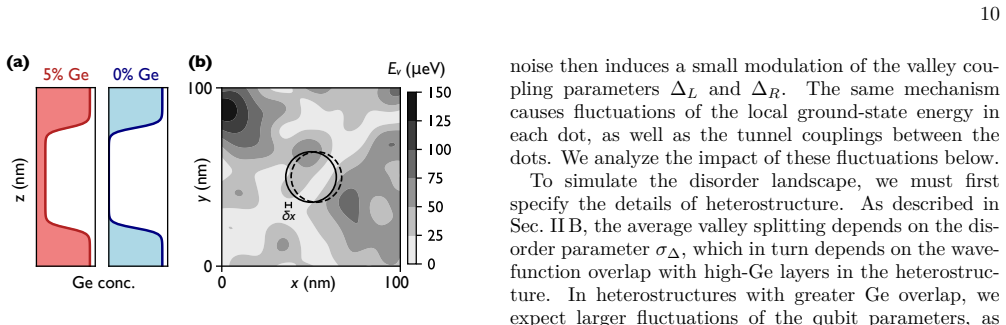
1D simulations To obtainσ∆ for a given heterostructure according to Eq. (7), we need to compute the envelope functionψenv. To do so, a 1D effective mass model suffices. We solve the 1D effective mass Hamiltonian H1D EM =T 1D +Uϕ+U qw,(E1) whereT 1D is a discretized 1D kinetic energy operator, Uϕ=eE zzis the potential due to a vertical electric field Ez, a...
-
[8]
3D simulations We also employ 3D effective mass simulations to de- scribe the local chemical potential and tunnel coupling fluctuations due to alloy disorder. We note that these simulations contain no valley physics, since their pur- pose is only to describe the orbital energies of the sys- tem. Following the methods of Ref. [38], we use a coarse- grained...
-
[9]
Alloy disorder As described above, alloy disorder can induce small shifts in the ground-state energy in the presence of fluc- tuating lateral electric fields. From effective mass theory, the first-order correction to the ground-state energy due to alloy disorder is given by Edis gs = ∫ dr|ψ0(r)|2Udis qw (r),(F1) whereψ0 is the zeroth order envelope functi...
-
[10]
Interface steps Now, we consider the effect of an interface step on the effective detuning fluctuations in a flopping mode qubit. 22 First, we determine the effects of an interface step on the ground-state energy of a single quantum dot. We obtain the ground state energyEgs by diagonalizing the effective mass Hamiltonian Eq. (E5), varying the dot centerx0...
-
[11]
Alloy disorder First, we evaluate the role of alloy disorder on the tun- nel coupling in a double dot. To do so, we consider two models of the lateral confinement potential: biquadratic and quartic, following Ref. [59], given by the following Ubi = 1 2mtω2 { Min [( x−x0−d 2 )2 , ( x−x0 + d 2 )2] + (y−y0)2 } Uqu = 1 2mtω2 [ 1 d2 ( (x−x0)2−d2 4 )2 + (y−y0)2...
-
[12]
As above, we use 3D effective mass simulations to determinetc for different step configura- tions
Interface steps Next, weinvestigatetheroleofinterfacestepsintunnel coupling fluctuations. As above, we use 3D effective mass simulations to determinetc for different step configura- tions. In this case, we exclude alloy disorder by using the virtual crytal approximation. Again, we use the quartic potential model and an inter-dot separationd= 60 nm in Eq. ...
-
[13]
direct” modulation oftc, as opposed to the disorder- induced “indirect
Fluctuations in the inter-dot distance Lastly, we investigate the role of fluctuations in the inter-dot distance due to charge noise. In the case where charge defects live near the qubit, each dot could experience electric field fluctuations in opposite direc- tions. These could have the effect of moving the two dots slightly closer or slightly farther ap...
-
[14]
We expect the effects of charge noise to be more apparent for large noise amplitudes
Impact ofδtc on gate fidelity To estimate the expected infidelity due to tunnel cou- pling fluctuations, we examine the cosine pulse family, in the pessimisticσε= 15µeVcharge noise regime. We expect the effects of charge noise to be more apparent for large noise amplitudes. Starting with a pulse optimized foreitherE vL =E vR = 20µeVorE vL =E vR = 100µeV, ...
-
[15]
to generate these landscapes, assuming the real and imaginary components of∆are uncorrelated, and the spatial covariance of∆is given by Eq. (19). Appendix I: Linear quantum dot array In Section VII of the main text, we considered sparse grids of quantum dots, showing that they enable a much higher probability of finding a high-fidelity qubit. Here, weperf...
-
[16]
D. Loss and D. P. DiVincenzo, Quantum computation with quantum dots, Phys. Rev. A57, 120 (1998)
work page 1998
-
[17]
F. A. Zwanenburg, A. S. Dzurak, A. Morello, M. Y. Sim- mons, L. C. L. Hollenberg, G. Klimeck, S. Rogge, S. N. Coppersmith, and M. A. Eriksson, Silicon quantum elec- tronics, Rev. Mod. Phys.85, 961 (2013)
work page 2013
-
[18]
G. Burkard, T. D. Ladd, A. Pan, J. M. Nichol, and J. R. Petta, Semiconductor spin qubits, Rev. Mod. Phys.95, 025003 (2023)
work page 2023
-
[19]
J. Yoneda, K. Takeda, T. Otsuka, T. Nakajima, M. R. Delbecq, G. Allison, T. Honda, T. Kodera, S. Oda, Y. Hoshi, N. Usami, K. M. Itoh, and S. Tarucha, A quantum-dot spin qubit with coherence limited by charge noise and fidelity higher than 99.9%, Nature Nanotech- nol.13, 102 (2018)
work page 2018
-
[20]
X. Xue, M. Russ, N. Samkharadze, B. Undseth, A. Sam- mak, G. Scappucci, and L. M. K. Vandersypen, Quantum logic with spin qubits crossing the surface code threshold, Nature601, 343 (2022)
work page 2022
-
[21]
A.Noiri, K.Takeda, T.Nakajima, T.Kobayashi, A.Sam- mak, G. Scappucci, and S. Tarucha, Fast universal quan- tum gate above the fault-tolerance threshold in silicon, Nature601, 338 (2022)
work page 2022
-
[22]
A. R. Mills, C. R. Guinn, M. J. Gullans, A. J. Sigillito, M. M. Feldman, E. Nielsen, and J. R. Petta, Two-qubit silicon quantum processor with operation fidelity exceed- ing 99%, Science Advances8, eabn5130 (2022)
work page 2022
-
[23]
P. Dutta and P. M. Horn, Low-frequency fluctuations in solids: 1 f noise, Rev. Mod. Phys.53, 497 (1981)
work page 1981
- [24]
-
[25]
A. Bermeister, D. Keith, and D. Culcer, Charge noise, spin-orbit coupling, and dephasing of single-spin qubits, Applied Physics Letters105, 192102 (2014)
work page 2014
-
[26]
M. M. E. K. Shehata, G. Simion, R. Li, F. A. Mo- hiyaddin, D. Wan, M. Mongillo, B. Govoreanu, I. Radu, K. De Greve, and P. Van Dorpe, Modeling semiconductor spin qubits and their charge noise environment for quan- tum gate fidelity estimation, Phys. Rev. B108, 045305 (2023)
work page 2023
-
[27]
A. Saraiva, W. H. Lim, C. H. Yang, C. C. Escott, A. Laucht, and A. S. Dzurak, Materials for silicon quan- tum dots and their impact on electron spin qubits, Ad- vanced Functional Materials32, 2105488 (2022)
work page 2022
- [28]
-
[29]
E. J. Connors, J. Nelson, L. F. Edge, and J. M. Nichol, Charge-noise spectroscopy of Si/SiGe quantum dots via dynamically-decoupled exchange oscillations, Nature Communications13, 940 (2022)
work page 2022
- [30]
- [31]
- [32]
-
[33]
J. D. Teske, F. Butt, P. Cerfontaine, G. Burkard, and H. Bluhm, Flopping-mode electron dipole spin resonance in the strong-driving regime, Phys. Rev. B107, 035302 (2023)
work page 2023
- [34]
-
[35]
M. G. Borselli, R. S. Ross, A. A. Kiselev, E. T. Croke, K. S. Holabird, P. W. Deelman, L. D. Warren, I. Alvarado-Rodriguez, I. Milosavljevic, F. C. Ku, W. S. Wong, A. E. Schmitz, M. Sokolich, M. F. Gyure, and A. T. Hunter, Measurement of valley splitting in high- symmetry Si/SiGe quantum dots, Applied Physics Let- ters98, 123118 (2011)
work page 2011
-
[36]
Z. Shi, C. B. Simmons, J. Prance, J. K. Gamble, M. Friesen, D. E. Savage, M. G. Lagally, S. N. Copper- smith, and M. A. Eriksson, Tunable singlet-triplet split- ting in a few-electron Si/SiGe quantum dot, Appl. Phys. Lett.99, 233108 (2011)
work page 2011
-
[37]
D. M. Zajac, T. M. Hazard, X. Mi, K. Wang, and J. R. Petta, A reconfigurable gate architecture for Si/SiGe quantum dots, Appl. Phys. Lett.106, 223507 (2015)
work page 2015
-
[38]
P. Scarlino, E. Kawakami, T. Jullien, D. R. Ward, D. E. Savage, M. G. Lagally, M. Friesen, S. N. Coppersmith, M. A. Eriksson, and L. M. K. Vandersypen, Dressed photon-orbital states in a quantum dot: Intervalley spin resonance, Physical Review B95, 165429 (2017)
work page 2017
-
[39]
X. Mi, C. G. Péterfalvi, G. Burkard, and J. R. Petta, High-resolution valley spectroscopy of Si quantum dots, Phys. Rev. Lett.119, 176803 (2017)
work page 2017
-
[40]
X. Mi, S. Kohler, and J. R. Petta, Landau-Zener interfer- ometry of valley-orbit states in Si/SiGe double quantum dots, Phys. Rev. B98, 161404(R) (2018)
work page 2018
-
[41]
R. Ferdous, E. Kawakami, P. Scarlino, M. Nowak, D. R. Ward, D. E. Savage, M. G. Lagally, S. N. Coppersmith, M. Friesen, M. A. Eriksson, L. M. K. Vandersypen, and 27 R. Rahman, Valley dependent anisotropic spin splitting in silicon quantum dots, npj Quantum Information4, 26 (2018)
work page 2018
-
[42]
S.F.Neyens, R.H.Foote, B.Thorgrimsson, T. J.Knapp, T. McJunkin, L. M. K. Vandersypen, P. Amin, N. K. Thomas, J. S. Clarke, D. E. Savage, M. G. Lagally, M. Friesen, S. N. Coppersmith, and M. A. Eriksson, The critical role of substrate disorder in valley splitting in Si quantum wells, Appl. Phys. Lett.112, 243107 (2018)
work page 2018
-
[43]
F. Borjans, D. Zajac, T. Hazard, and J. Petta, Single- spin relaxation in a synthetic spin-orbit field, Phys. Rev. Applied11, 044063 (2019)
work page 2019
-
[44]
A. Hollmann, T. Struck, V. Langrock, A. Schmidbauer, F. Schauer, T. Leonhardt, K. Sawano, H. Riemann, N. V. Abrosimov, D. Bougeard, and L. R. Schreiber, Large, tunable valley splitting and single-spin relaxation mecha- nisms in aSi/SixGe1−xquantum dot, Phys. Rev. Applied 13, 034068 (2020)
work page 2020
-
[45]
S. W. Oh, A. O. Denisov, P. Chen, and J. R. Petta, Cryogen-free scanning gate microscope for the character- ization of Si/Si0.7Ge0.3 quantum devices at milli-Kelvin temperatures,AIP Advances, AIP Advances11, 125122 (2021)
work page 2021
-
[46]
E. H. Chen, K. Raach, A. Pan, A. A. Kiselev, E. Acuna, J. Z. Blumoff, T. Brecht, M. D. Choi, W. Ha, D. R. Hul- bert, M. P. Jura, T. E. Keating, R. Noah, B. Sun, B. J. Thomas, M. G. Borselli, C. Jackson, M. T. Rakher, and R. S. Ross, Detuning axis pulsed spectroscopy of valley- orbital states inSi/Si-Gequantum dots, Phys. Rev. Ap- plied15, 044033 (2021)
work page 2021
-
[47]
D. Degli Esposti, L. E. A. Stehouwer, Ö. Gül, N. Samkharadze, C. Déprez, M. Meyer, I. N. Meijer, L. Tryputen, S. Karwal, M. Botifoll, J. Arbiol, S. V. Amitonov, L. M. K. Vandersypen, A. Sammak, M. Veld- horst, and G. Scappucci, Low disorder and high val- ley splitting in silicon, npj Quantum Information10, 32 (2024)
work page 2024
-
[48]
M. Volmer, T. Struck, A. Sala, B. Chen, M. Ober- länder, T. Offermann, R. Xue, L. Visser, J.-S. Tu, S. Trellenkamp, Ł. Cywiński, H. Bluhm, and L. R. Schreiber, Mapping of valley splitting by conveyor-mode spin-coherent electron shuttling, npj Quantum Informa- tion10, 61 (2024)
work page 2024
-
[49]
J. P. Dodson, H. E. Ercan, J. Corrigan, M. P. Losert, N. Holman, T. McJunkin, L. F. Edge, M. Friesen, S. N. Coppersmith, and M. A. Eriksson, How valley-orbit states in silicon quantum dots probe quantum well inter- faces, Phys. Rev. Lett.128, 146802 (2022)
work page 2022
- [50]
-
[51]
B. Paquelet Wuetz, M. P. Losert, S. Koelling, L. E. A. Stehouwer, A.-M. J. Zwerver, S. G. J. Philips, M. T. Mądzik, X. Xue, G. Zheng, M. Lodari, S. V. Amitonov, N. Samkharadze, A. Sammak, L. M. K. Vandersypen, R. Rahman, S. N. Coppersmith, O. Moutanabbir, M. Friesen, and G. Scappucci, Atomic fluctuations lifting the energy degeneracy in Si/SiGe quantum do...
work page 2022
-
[52]
T. McJunkin, B. Harpt, Y. Feng, M. Losert, R. Rah- man, J. P. Dodson, M. A. Wolfe, D. E. Savage, M. G. Lagally, S. N. Coppersmith, M. Friesen, R. Joynt, and M. A. Eriksson, SiGe quantum wells with oscillating Ge concentrations for quantum dot qubits, Nature Commun. 13, 7777 (2022)
work page 2022
-
[53]
M. P. Losert, M. A. Eriksson, R. Joynt, R. Rahman, G. Scappucci, S. N. Coppersmith, and M. Friesen, Practi- cal strategies for enhancing the valley splitting in Si/SiGe quantum wells, Phys. Rev. B108, 125405 (2023)
work page 2023
-
[54]
J. R. F. Lima and G. Burkard, Interface and electromag- netic effects in the valley splitting of Si quantum dots, Mater. Quantum. Technol.3, 025004 (2023)
work page 2023
-
[55]
J. R. F. Lima and G. Burkard, Valley splitting depending on the size and location of a silicon quantum dot, Phys. Rev. Mater.8, 036202 (2024)
work page 2024
- [56]
-
[57]
M. Friesen, S. Chutia, C. Tahan, and S. N. Coppersmith, Valley splitting theory of SiGe/Si/SiGe quantum wells, Phys. Rev. B75, 115318 (2007)
work page 2007
-
[58]
B. D. Woods, H. Soomro, E. S. Joseph, C. C. D. Frink, R. Joynt, M. A. Eriksson, and M. Friesen, Coupling conduction-band valleys in SiGe heterostructures via shear strain and Ge concentration oscillations, npj Quan- tum Information10, 54 (2024)
work page 2024
-
[59]
U. Güngördü and J. P. Kestner, Robust quantum gates using smooth pulses and physics-informed neural net- works, Phys. Rev. Res.4, 023155 (2022)
work page 2022
-
[60]
E. J. Connors, J. Nelson, H. Qiao, L. F. Edge, and J. M. Nichol, Low-frequency charge noise in Si/SiGe quantum dots, Phys. Rev. B100, 165305 (2019)
work page 2019
- [61]
-
[62]
H. E. Ercan, M. Friesen, and S. N. Coppersmith, Charge- noise resilience of two-electron quantum dots inSi/SiGe heterostructures, Phys. Rev. Lett.128, 247701 (2022)
work page 2022
-
[63]
J. A. Krzywda and L. Cywiński, Interplay of charge noise and coupling to phonons in adiabatic electron transfer between quantum dots, Phys. Rev. B104, 075439 (2021)
work page 2021
-
[64]
M. P. Losert, M. Oberländer, J. D. Teske, M. Volmer, L. R. Schreiber, H. Bluhm, S. Coppersmith, and M. Friesen, Strategies for enhancing spin-shuttling fideli- ties inSi/SiGequantum wells with random-alloy disor- der, PRX Quantum5, 040322 (2024)
work page 2024
-
[65]
The effects of alloy disorder on strongly- driven flopping mode qubits in Si/SiGe
M. P. Losert, U. Güngördü, S. N. Coppersmith, M. Friesen, and C. Tahan, Source data and code for the publication “The effects of alloy disorder on strongly- driven flopping mode qubits in Si/SiGe”
-
[66]
Center for High Throughput Computing, Center for high throughput computing (2006)
work page 2006
-
[67]
D. Buterakos, S. Das Sarma, and E. Barnes, Geometrical formalism for dynamically corrected gates in multiqubit systems, PRX Quantum2, 010341 (2021)
work page 2021
-
[68]
J. A. Nelder and R. Mead, A simplex method for function minimization, Computer Journal7, 308
-
[69]
J. Bezanson, A. Edelman, S. Karpinski, and V. B. Shah, Julia: A fresh approach to numerical computing, SIAM review59, 65 (2017)
work page 2017
-
[70]
C. R. Harris, K. J. Millman, S. J. van der Walt, R. Gom- mers, P. Virtanen, D. Cournapeau, E. Wieser, J. Tay- lor, S. Berg, N. J. Smith, R. Kern, M. Picus, S. Hoyer, M. H. van Kerkwijk, M. Brett, A. Haldane, J. F. del Río, M. Wiebe, P. Peterson, P. Gérard-Marchant, K. Shep- 28 pard, T. Reddy, W. Weckesser, H. Abbasi, C. Gohlke, and T. E. Oliphant, Array p...
work page 2020
-
[71]
P. Virtanen, R. Gommers, T. E. Oliphant, M. Haber- land, T. Reddy, D. Cournapeau, E. Burovski, P. Pe- terson, W. Weckesser, J. Bright, S. J. van der Walt, M. Brett, J. Wilson, K. J. Millman, N. Mayorov, A. R. J. Nelson, E. Jones, R. Kern, E. Larson, C. J. Carey, İ. Po- lat, Y. Feng, E. W. Moore, J. VanderPlas, D. Laxalde, J. Perktold, R. Cimrman, I. Henri...
work page 2020
-
[72]
J. D. Hunter, Matplotlib: A 2d graphics environment, Computing in Science & Engineering9, 90 (2007)
work page 2007
-
[73]
Schäffler, High-mobility Si and Ge structures, Semi- cond
F. Schäffler, High-mobility Si and Ge structures, Semi- cond. Sci. Tech.12, 1515 (1997)
work page 1997
-
[74]
Q. Li, L. Cywiński, D. Culcer, X. Hu, and S. Das Sarma, Exchange coupling in silicon quantum dots: Theoretical considerations for quantum computation, Phys. Rev. B 81, 085313 (2010)
work page 2010
-
[75]
S. Müller and L. Schüler, GeoStat-Framework/GSTools: v1.5.0 ‘Nifty Neon’ (2023)
work page 2023
discussion (0)
Sign in with ORCID, Apple, or X to comment. Anyone can read and Pith papers without signing in.