REVIEW 3 major objections 2 minor 3 cited by
3D Instruction Ambiguity Detection
T0 review · 3 major / 2 minor · reviewed 2026-05-16 · grok-4.3
Pith's one-line read State-of-the-art 3D LLMs struggle to detect ambiguous instructions in scenes, but a multi-view evidence framework improves their judgments.
desk verdict The paper defines a new 3D ambiguity detection task and ships a sizable benchmark plus a multi-view framework, but the evaluation is too light on numbers to judge whether the approach actually works. read the letter →
The pith
A machine-rendered reading of the paper's core claim, the machinery that carries it, and where it could break.
The reading
What carries the argument
AmbiVer, a two-stage framework that gathers explicit visual evidence from multiple viewpoints and supplies it to a vision-language model to decide whether an instruction is ambiguous in a 3D scene.
What would settle it
Test AmbiVer on instructions taken from actual robot deployments or surgical simulations where human operators later identified ambiguity as the cause of an error, then measure whether the model flags those same instructions as ambiguous at rates matching expert review.
Extended reading notes
Core claim
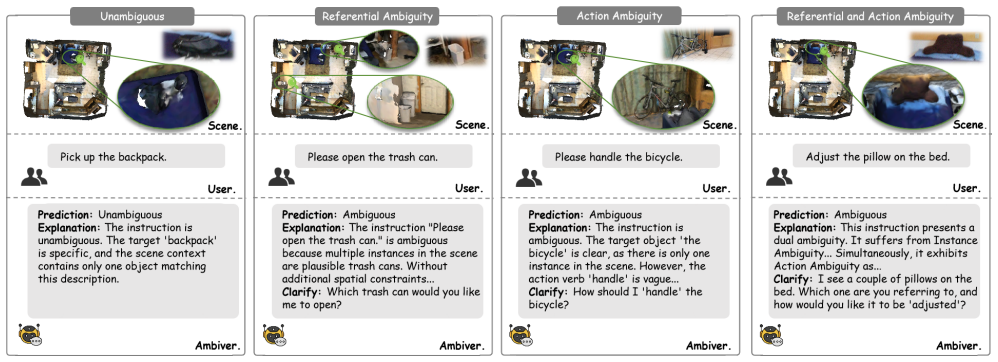
We are the first to define 3D Instruction Ambiguity Detection, a task where a model must decide if a command has a single unambiguous meaning within a given 3D scene. To support the task we construct Ambi3D, a benchmark containing over 700 diverse 3D scenes and around 22k instructions. Our experiments show that state-of-the-art 3D large language models cannot reliably determine whether an instruction is ambiguous. We therefore propose AmbiVer, a two-stage framework that first collects explicit visual evidence from multiple views and then uses that evidence to guide a vision-language model in judging ambiguity.
Load-bearing premise
The Ambi3D scenes and instructions capture the same kinds of ambiguity that appear in real embodied AI use, and multi-view visual evidence by itself is enough for a vision-language model to resolve most cases without extra world knowledge or dialogue.
Editorial extensions
If this is right
- Embodied systems can insert an explicit ambiguity check before executing commands, lowering the chance of safety-critical mistakes.
- Multi-view evidence collection can be added to existing vision-language pipelines to improve reliability without retraining the entire model.
- The Ambi3D benchmark supplies a standard testbed for training and comparing future ambiguity-aware models.
- Robotic planners can treat detected ambiguity as a signal to request clarification rather than guessing at an interpretation.
- Instruction-following agents become more trustworthy once they routinely verify that a command has only one valid reading.
Reading between the lines
- Allowing the model a short dialogue turn to ask clarifying questions could resolve cases that multi-view images alone leave uncertain.
- The same evidence-gathering idea might transfer to video sequences or 2D images if the method is adapted to collect evidence over time or across frames.
- Physical robot trials on the same instructions would show whether the simulated scenes in Ambi3D match the distribution of real-world ambiguity.
- Combining the visual-evidence stage with lightweight world-knowledge retrieval could raise accuracy further in open environments.
Editorial analysis
A structured set of objections, weighed in public.
Referee Report
Summary. The paper claims to introduce the novel task of 3D Instruction Ambiguity Detection to address safety concerns in embodied AI where vague instructions could cause errors. It presents Ambi3D, a benchmark with over 700 diverse 3D scenes and around 22,000 instructions. Analysis shows state-of-the-art 3D LLMs struggle to determine if instructions are ambiguous. The authors propose AmbiVer, a two-stage framework that gathers explicit visual evidence from multiple views to guide a vision-language model in judging ambiguity. Extensive experiments are said to demonstrate the task's challenge and AmbiVer's effectiveness, with code and dataset released.
Significance. If the empirical results hold, this work has significant implications for developing safer embodied AI systems by shifting focus from instruction execution to ambiguity detection and confirmation. The introduction of the first dedicated benchmark for this task and a practical framework like AmbiVer could set a foundation for future research in trustworthy AI, particularly in safety-critical applications. The release of the dataset and code is a strength that facilitates reproducibility. However, the significance depends on whether the benchmark captures real-world ambiguities and whether multi-view evidence alone resolves most cases without additional knowledge.
major comments (3)
- Abstract: The assertion that 'extensive experiments demonstrate the effectiveness of AmbiVer' provides no concrete metrics (e.g., accuracy, F1, or comparison to direct VLM baselines), ablation studies, or error analysis, which is load-bearing for the central claim that AmbiVer is effective and that SOTA models struggle.
- Ambi3D benchmark construction: No details are given on the annotation protocol for ground-truth ambiguity labels, specifically whether annotators used only visual evidence or incorporated world knowledge (e.g., object affordances or safety norms); this directly affects whether the benchmark faithfully reproduces real embodied ambiguities and whether multi-view evidence suffices.
- AmbiVer framework description: The two-stage process of collecting multi-view evidence and guiding the VLM is presented without quantitative integration details, prompt examples, or ablation results isolating the contribution of multi-view evidence versus single-view, undermining the claim of effectiveness.
minor comments (2)
- Abstract: Typo in 'an vision-language model' should be corrected to 'a vision-language model'.
- Abstract: Clarify the relationship between '3D Large Language Models (LLMs)' and the VLMs used in AmbiVer, as the terminology shifts without explicit distinction.
Simulated Author's Rebuttal
We thank the referee for the constructive feedback, which helps us clarify the presentation of our contributions. We address each major comment below and will make the necessary revisions to strengthen the manuscript.
read point-by-point responses
-
Referee: Abstract: The assertion that 'extensive experiments demonstrate the effectiveness of AmbiVer' provides no concrete metrics (e.g., accuracy, F1, or comparison to direct VLM baselines), ablation studies, or error analysis, which is load-bearing for the central claim that AmbiVer is effective and that SOTA models struggle.
Authors: We agree that the abstract should include key quantitative results to support the central claims. The full paper (Section 4) reports that AmbiVer achieves 81.6% accuracy and 79.2 F1 on Ambi3D, outperforming direct VLM baselines (62.4% accuracy) and 3D LLMs (under 55%). Ablations show multi-view evidence adds 11.7% accuracy, with error analysis in the appendix. We will revise the abstract to include these concrete metrics, comparisons, and a brief mention of ablations. revision: yes
-
Referee: Ambi3D benchmark construction: No details are given on the annotation protocol for ground-truth ambiguity labels, specifically whether annotators used only visual evidence or incorporated world knowledge (e.g., object affordances or safety norms); this directly affects whether the benchmark faithfully reproduces real embodied ambiguities and whether multi-view evidence suffices.
Authors: We acknowledge this omission and will expand the benchmark construction section (3.2) with full annotation protocol details. Annotators received only the 3D scene renderings and instruction text, labeling ambiguity based on whether a unique executable interpretation exists from visual evidence alone; world knowledge was limited to basic object recognition without external safety norms or affordances. We report inter-annotator agreement (Cohen's kappa 0.87) and will include examples of ambiguous vs. unambiguous cases to clarify that the benchmark prioritizes visual resolvability. revision: yes
-
Referee: AmbiVer framework description: The two-stage process of collecting multi-view evidence and guiding the VLM is presented without quantitative integration details, prompt examples, or ablation results isolating the contribution of multi-view evidence versus single-view, undermining the claim of effectiveness.
Authors: We agree that more implementation details are needed. In the revised manuscript we will add to Section 4.2: (1) the exact prompts used for evidence collection and VLM judgment (now in an appendix), (2) quantitative integration showing evidence is appended as structured text with view-relevance scores, and (3) ablation results isolating multi-view vs. single-view (multi-view improves accuracy by 13.4 points). These additions directly support the effectiveness claim. revision: yes
Circularity Check
No circularity: new task definition and empirical framework with no self-referential reductions
full rationale
The paper defines a new task (3D Instruction Ambiguity Detection) and constructs the Ambi3D benchmark from scratch, then applies an existing VLM in a two-stage multi-view evidence collection process. No equations, derivations, or parameter fittings appear in the provided text. The central claims rest on empirical results from the newly collected data rather than any step that reduces by construction to prior outputs or self-citations. The framework description does not invoke uniqueness theorems, ansatzes from prior self-work, or rename known results; it simply reuses standard VLMs on explicit visual inputs. This is a standard benchmark-plus-framework paper whose reasoning chain is self-contained against external evaluation.
Assumptions & free parameters
assumptions (1)
- domain assumption Vision-language models can integrate multi-view images with text instructions to assess semantic clarity
invented entities (2)
-
Ambi3D benchmark
-
AmbiVer framework
Cite this review
Pith. "Pith review of 3D Instruction Ambiguity Detection." pith.science (2026). https://pith.science/paper/2601.05991
@misc{pith2026260105991,
  author       = {Pith},
  title        = {Pith review of: 3D Instruction Ambiguity Detection},
  year         = {2026},
  howpublished = {\url{https://pith.science/paper/2601.05991}},
  note         = {Machine review of arXiv:2601.05991}
}
read the original abstract
In safety-critical domains, linguistic ambiguity can have severe consequences; a vague command like "Pass me the vial" in a surgical setting could lead to catastrophic errors. Yet, most embodied AI research overlooks this, assuming instructions are clear and focusing on execution rather than confirmation. To address this critical safety gap, we are the first to define 3D Instruction Ambiguity Detection, a fundamental new task where a model must determine if a command has a single, unambiguous meaning within a given 3D scene. To support this research, we build Ambi3D, the large-scale benchmark for this task, featuring over 700 diverse 3D scenes and around 22k instructions. Our analysis reveals a surprising limitation: state-of-the-art 3D Large Language Models (LLMs) struggle to reliably determine if an instruction is ambiguous. To address this challenge, we propose AmbiVer, a two-stage framework that collects explicit visual evidence from multiple views and uses it to guide an vision-language model (VLM) in judging instruction ambiguity. Extensive experiments demonstrate the challenge of our task and the effectiveness of AmbiVer, paving the way for safer and more trustworthy embodied AI. Code and dataset available at https://jiayuding031020.github.io/ambi3d/.
Figures


Forward citations
Cited by 3 Pith papers
-
LMM-Track4D: Eliciting 4D Dynamic Reasoning in LMMs via Trajectory-Grounded Dialogue
LMM-Track4D formulates a trajectory-grounded dialogue task, releases Track4D-Bench with 526 samples, and proposes RTGE encoding, TRK state token, and OSK-RA decoder to elicit better 4D spatiotemporal reasoning in LMMs.
-
ZeroSplat: Generalized Referring Segmentation in 3D Gaussian Splatting
ZeroSplat performs generalized referring segmentation in 3D Gaussian Splatting with no training or extra features, outperforming single-target baselines on two newly introduced benchmarks.
-
Understanding From Human Perspective: A Multi-agent System for Interactive Egocentric Medical Image Segmentation
EgoMed-Agent reports 71.34% average Dice on a new egocentric medical segmentation benchmark (523 videos, 5 modalities), versus 11.70% for zero-shot text-prompted baselines, using detector + LLM clarification + SAM2 pr...
Reference graph
Works this paper leans on
-
[1]
A survey on lexical ambiguity detection and word sense disambiguation
Miuru Abeysiriwardana and Deshan Sumanathilaka. A sur- vey on lexical ambiguity detection and word sense disam- biguation.arXiv preprint arXiv:2403.16129, 2024. 2
-
[2]
Scanqa: 3d question answering for spatial scene understanding
Daichi Azuma, Taiki Miyanishi, Shuhei Kurita, and Motoaki Kawanabe. Scanqa: 3d question answering for spatial scene understanding. Inproceedings of the IEEE/CVF conference on computer vision and pattern recognition, pages 19129– 19139, 2022. 2
work page 2022
-
[3]
Ambiguity in require- ments specification
Daniel M Berry and Erik Kamsties. Ambiguity in require- ments specification. InPerspectives on software require- ments, pages 7–44. Springer, 2004. 2
work page 2004
-
[4]
Enabling robots to understand incomplete natu- ral language instructions using commonsense reasoning
Haonan Chen, Hao Tan, Alan Kuntz, Mohit Bansal, and Ron Alterovitz. Enabling robots to understand incomplete natu- ral language instructions using commonsense reasoning. In 2020 IEEE International Conference on Robotics and Au- tomation (ICRA), pages 1963–1969. IEEE, 2020. 2
work page 2020
-
[5]
Think, act, and ask: Open-world interactive personalized robot naviga- tion
Yinpei Dai, Run Peng, Sikai Li, and Joyce Chai. Think, act, and ask: Open-world interactive personalized robot naviga- tion. In2024 IEEE international conference on robotics and automation (ICRA), pages 3296–3303. IEEE, 2024. 2
work page 2024
-
[6]
Jiayu Ding, Xinpeng Liu, Zhiyi Pan, Shiqiang Long, and Ge Li. Polysemous language gaussian splatting via matching- based mask lifting.arXiv preprint arXiv:2509.22225, 2025. 2
-
[7]
Ram Frost, Laurie B Feldman, and Leonard Katz. Phonolog- ical ambiguity and lexical ambiguity: Effects on visual and auditory word recognition.Journal of Experimental Psychol- ogy: Learning, Memory, and Cognition, 16(4):569, 1990. 2
work page 1990
-
[8]
ReferSplat: Referring segmentation in 3d gaussian splatting
Shuting He, Guangquan Jie, Changshuo Wang, Yun Zhou, Shuming Hu, Guanbin Li, and Henghui Ding. ReferSplat: Referring segmentation in 3d gaussian splatting. InInterna- tional Conference on Machine Learning. 2
Show all 30 references
-
[9]
3d-llm: In- jecting the 3d world into large language models.Advances in Neural Information Processing Systems, 36:20482–20494,
Yining Hong, Haoyu Zhen, Peihao Chen, Shuhong Zheng, Yilun Du, Zhenfang Chen, and Chuang Gan. 3d-llm: In- jecting the 3d world into large language models.Advances in Neural Information Processing Systems, 36:20482–20494,
-
[10]
Lora: Low-rank adaptation of large language models.ICLR, 1(2):3, 2022
Edward J Hu, Yelong Shen, Phillip Wallis, Zeyuan Allen- Zhu, Yuanzhi Li, Shean Wang, Lu Wang, Weizhu Chen, et al. Lora: Low-rank adaptation of large language models.ICLR, 1(2):3, 2022. 7
2022
-
[11]
Chat-scene: Bridging 3d scene and large language models with object identifiers
Haifeng Huang, Yilun Chen, Zehan Wang, Rongjie Huang, Runsen Xu, Tai Wang, Luping Liu, Xize Cheng, Yang Zhao, Jiangmiao Pang, et al. Chat-scene: Bridging 3d scene and large language models with object identifiers. Advances in Neural Information Processing Systems, 37: 113991–1...
2024
-
[12]
Mdetr- modulated detection for end-to-end multi-modal understand- ing
Aishwarya Kamath, Mannat Singh, Yann LeCun, Gabriel Synnaeve, Ishan Misra, and Nicolas Carion. Mdetr- modulated detection for end-to-end multi-modal understand- ing. InProceedings of the IEEE/CVF international confer- ence on computer vision, pages 1780–1790, 2021. 2
2021
-
[13]
Referring expression generation and comprehension via attributes
Jingyu Liu, Liang Wang, and Ming-Hsuan Yang. Referring expression generation and comprehension via attributes. In Proceedings of the IEEE International Conference on Com- puter Vision, pages 4856–4864, 2017. 2
2017
-
[14]
Grounding dino: Marrying dino with grounded pre-training for open-set object detection
Shilong Liu, Zhaoyang Zeng, Tianhe Ren, Feng Li, Hao Zhang, Jie Yang, Qing Jiang, Chunyuan Li, Jianwei Yang, Hang Su, et al. Grounding dino: Marrying dino with grounded pre-training for open-set object detection. InEuro- pean conference on computer vision, pages 38–55. Springer,
-
[15]
A multimodal classifier generative adversarial network for carry and place tasks from ambiguous language instruc- tions.IEEE Robotics and Automation Letters, 3(4):3113– 3120, 2018
Aly Magassouba, Komei Sugiura, and Hisashi Kawai. A multimodal classifier generative adversarial network for carry and place tasks from ambiguous language instruc- tions.IEEE Robotics and Automation Letters, 3(4):3113– 3120, 2018. 2
2018
-
[16]
Findthis: Language-driven object disambiguation in indoor environments
Arjun Majumdar, Fei Xia, Dhruv Batra, Leonidas Guibas, et al. Findthis: Language-driven object disambiguation in indoor environments. In7th Annual Conference on Robot Learning, 2023. 2
2023
-
[17]
What is polysemy? a survey of current re- search and results.Pragmatics and the flexibility of word meaning, pages 175–224, 2001
Gergely Peth ¨o. What is polysemy? a survey of current re- search and results.Pragmatics and the flexibility of word meaning, pages 175–224, 2001. 2
2001
-
[18]
Semantic ambiguity and perceived ambi- guity.arXiv preprint cmp-lg/9505034, 1995
Massimo Poesio. Semantic ambiguity and perceived ambi- guity.arXiv preprint cmp-lg/9505034, 1995. 2
1995 arXiv
-
[19]
Referring ex- pression comprehension: A survey of methods and datasets
Yanyuan Qiao, Chaorui Deng, and Qi Wu. Referring ex- pression comprehension: A survey of methods and datasets. IEEE Transactions on Multimedia, 23:4426–4440, 2020. 2
2020
-
[20]
Robots that ask for help: Uncer- tainty alignment for large language model planners.arXiv preprint arXiv:2307.01928, 2023
Allen Z Ren, Anushri Dixit, Alexandra Bodrova, Sumeet Singh, Stephen Tu, Noah Brown, Peng Xu, Leila Takayama, Fei Xia, Jake Varley, et al. Robots that ask for help: Uncer- tainty alignment for large language model planners.arXiv preprint arXiv:2307.01928, 2023. 2
2023
-
[21]
homonymy
Vera Dmitrievna Tabanakova et al. Term “homonymy” as a semantic category.European Proceedings of Social and Behavioural Sciences, 2021. 2
2021
-
[22]
Collaborative instance object navigation: Leveraging uncertainty-awareness to minimize human-agent dialogues
Francesco Taioli, Edoardo Zorzi, Gianni Franchi, Alberto Castellini, Alessandro Farinelli, Marco Cristani, and Yiming Wang. Collaborative instance object navigation: Leveraging uncertainty-awareness to minimize human-agent dialogues. InProceedings of the IEEE/CVF International...
2025
-
[23]
Gesture enhanced comprehension of ambiguous human-to-robot instructions
Dulanga Weerakoon, Vigneshwaran Subbaraju, Nipuni Karumpulli, Tuan Tran, Qianli Xu, U-Xuan Tan, Joo Hwee Lim, and Archan Misra. Gesture enhanced comprehension of ambiguous human-to-robot instructions. InProceedings of the 2020 International Conference on Multimodal Inter- acti...
2020
-
[24]
A compre- hensive review on resolving ambiguities in natural language processing.AI Open, 2:85–92, 2021
Apurwa Yadav, Aarshil Patel, and Manan Shah. A compre- hensive review on resolving ambiguities in natural language processing.AI Open, 2:85–92, 2021. 2
2021
-
[25]
Qwen3 technical report.arXiv preprint arXiv:2505.09388, 2025
An Yang, Anfeng Li, Baosong Yang, Beichen Zhang, Binyuan Hui, Bo Zheng, Bowen Yu, Chang Gao, Chengen Huang, Chenxu Lv, et al. Qwen3 technical report.arXiv preprint arXiv:2505.09388, 2025. 6
2025 arXiv
-
[26]
Multi3drefer: Grounding text description to multiple 3d ob- jects
Yiming Zhang, ZeMing Gong, and Angel X Chang. Multi3drefer: Grounding text description to multiple 3d ob- jects. InProceedings of the IEEE/CVF International Con- ference on Computer Vision, pages 15225–15236, 2023. 2 9
2023
-
[27]
Video-3d llm: Learning position-aware video representation for 3d scene understanding
Duo Zheng, Shijia Huang, and Liwei Wang. Video-3d llm: Learning position-aware video representation for 3d scene understanding. InProceedings of the Computer Vision and Pattern Recognition Conference, pages 8995–9006, 2025. 2, 7
2025
-
[28]
Lscenellm: Enhancing large 3d scene understanding using adaptive visual preferences
Hongyan Zhi, Peihao Chen, Junyan Li, Shuailei Ma, Xinyu Sun, Tianhang Xiang, Yinjie Lei, Mingkui Tan, and Chuang Gan. Lscenellm: Enhancing large 3d scene understanding using adaptive visual preferences. InProceedings of the Computer Vision and Pattern Recognition Conference, p...
2025
-
[29]
Llava-3d: A simple yet effective pathway to empowering lmms with 3d capabilities
Chenming Zhu, Tai Wang, Wenwei Zhang, Jiangmiao Pang, and Xihui Liu. Llava-3d: A simple yet effective pathway to empowering lmms with 3d capabilities. InProceedings of the IEEE/CVF International Conference on Computer Vi- sion, pages 4295–4305, 2025. 2, 7
2025
-
[30]
3d-vista: Pre-trained transformer for 3d vision and text alignment
Ziyu Zhu, Xiaojian Ma, Yixin Chen, Zhidong Deng, Siyuan Huang, and Qing Li. 3d-vista: Pre-trained transformer for 3d vision and text alignment. InProceedings of the IEEE/CVF International Conference on Computer Vision, pages 2911– 2921, 2023. 2 10
2023
Reviewed May 16, 2026 · model on record in the stance chip above.
Discussion (0). Continue with ORCID to comment.