REVIEW 2 major objections 5 minor 2 cited by
Task-relevant information in vision transformers is spread across layers, and an attentive probe that fuses all layers beats the standard last-layer linear probe.
Reviewed by Pith at T0; open to challenge. T0 means a machine referee read the full paper against a public rubric. the ladder, T0–T4 →
2026-08-03 10:37 UTC pith:XI4EPGVR
load-bearing objection Solid large-scale probing study, but the missing Head2Toe/VQT comparisons leave the attention mechanism's marginal value untested. the 2 major comments →
Attentive multilayer fusion for vision transformers
The pith
A machine-rendered reading of the paper's core claim, the machinery that carries it, and where it could break.
Core claim
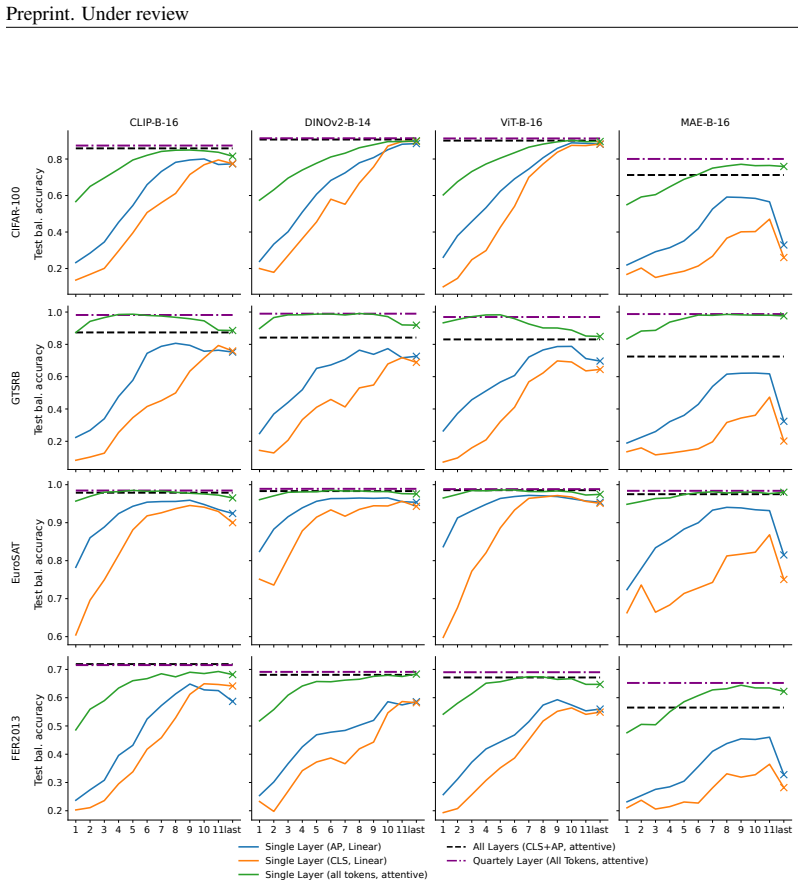
The central claim is that for ViTs pretrained with a CLS token, the last layer's CLS summary does not contain all information needed for transfer, and that the information that is missing lives in intermediate layers in a form accessible through the CLS and average-pooled tokens. The paper's attentive layer fusion mechanism learns, per task, which layers to emphasize, and the resulting probe outperforms last-layer linear probes on all 20 datasets, with an average gain of 5.54 percentage points, and outperforms last-layer full-token attention in median and variance terms. Attention heatmaps show that specialized and structured domains shift weight to intermediate average-pooled tokens, while
What carries the argument
The central mechanism is attentive layer fusion: multi-head cross-attention with a shared learnable query token attending over the stacked CLS and average-pooled (AP) tokens extracted from every ViT layer. It produces a single fused representation fed to a linear classifier. Because it uses only two summary tokens per layer rather than all patch tokens, the attention complexity scales with the square of the number of layers rather than the square of the number of patches, and the parameter count is independent of layer count. The learnable query acts as a task-relevance prototype, so layer weighting adapts per task.
Load-bearing premise
At every layer, the CLS token plus the mean-pooled patch token preserves the task-relevant information that intermediate layers contain — if mean pooling discards the very signal the hierarchy stores, the approach collapses to a less-capable version of existing last-layer token attention.
What would settle it
On a localization-heavy dataset where the decisive cue is confined to a small image region (e.g., histopathology tiles), compare per-layer linear probes on full patch tokens against mean-pooled tokens. If some intermediate layer shows high full-token accuracy but near-chance mean-pooled accuracy, and the all-layer CLS+AP attentive probe cannot recover that signal, the assumption that summary tokens retain the distributed information is falsified.
If this is right
- Using the last-layer CLS token as the default probe leaves measurable accuracy on the table; all-layer attentive fusion improves results on every dataset examined.
- The method's gains concentrate on out-of-distribution and specialized domains (satellite, medical, traffic-sign, texture, synthetic), where intermediate structural features matter most.
- Benefits hold across model scales (small/base/large) and across supervised, self-supervised, and image-text pretraining, so it is not a quirk of one backbone family.
- Hierarchical fusion and spatial fusion are complementary: combining them (attending to tokens from several layers) outperforms either alone, which points toward a design space of orthogonal fusion axes.
- Even for backbones without CLS supervision (masked autoencoders), layer fusion over summary tokens recovers most of the gap to full-token attention.
Where Pith is reading between the lines
- If intermediate layers consistently matter for out-of-distribution tasks, benchmark suites that report only last-layer probing may systematically underestimate the transfer quality of frozen backbones; adopting an all-layer probe as a reference could change model rankings.
- The learned attention weights double as a diagnostic: they give a cheap per-task measurement of how much a backbone has specialized its hierarchy to the pretraining domain, which could be used to predict when fine-tuning will help.
- A natural extension is dense prediction: applying the same layer-weighting idea to per-pixel or per-patch features, rather than image-level summaries, might yield analogous gains for segmentation and detection, where the paper's own GTSRB and DMLab results suggest mean pooling loses spatial signal.
- The overfitting cases (PCAM and PASCAL VOC 2007) hint that replacing average pooling with a learned or attention-based pooling could extend the method to localization-heavy tasks while keeping the hierarchical fusion benefit.
Editorial analysis
A structured set of objections, weighed in public.
Referee Report
Summary. The paper proposes Attentive Layer Fusion (ALF), a probing method for frozen Vision Transformers that applies multi-head cross-attention over CLS and average-pooled token summaries extracted from every transformer layer. A learned query token acts as a task-relevance prototype, and the fused representation is classified by a single linear layer. The central empirical claim, stated in the abstract and Sec. 1, is that ALF achieves consistent, substantial gains over the standard last-layer CLS linear probe, quantified as an average accuracy improvement of 5.54 percentage points across 20 datasets and 9 ViTs, with positive gains on every dataset in Table 1. The paper also reports ablations over layer subsets, token types, linear vs. attentive fusion, and multiple attention-probe architectures, plus experiments with MAEs, fine-tuning comparisons, and attention-heatmap analyses showing task-dependent use of intermediate layers.
Significance. If the central claim holds, the paper makes a useful empirical contribution: it provides large-scale evidence that task-relevant information is distributed across ViT layers and that a lightweight attentive probe over layer summaries can extract it more reliably than final-layer probes. Strengths of the paper include the breadth of the evaluation (20 datasets x 9 models from three model families), the explicit ablations isolating the contribution of intermediate layers and of attention weighting, statistical tests on the aggregate comparisons, the additional MAE experiments, and the release of code for reproducibility. The interpretability analysis is suggestive, though partly self-referential. The main weakness is that the method is not compared against the strongest published multi-layer transfer baselines that the authors themselves cite, leaving the marginal value of the attention mechanism untested. A second weakness is that the headline results are based on single runs for most model-dataset combinations.
major comments (2)
- [Sec. 4.1 / Table 1] The central claim is that attentive layer fusion yields substantial gains over standard linear probes, but the evaluation omits the strongest published multi-layer transfer baselines cited in Sec. 2.2: Head2Toe (Evci et al., 2022) and Visual Query Tuning (Tu et al., 2023). Head2Toe in particular uses all layers with feature selection and whitening and has already demonstrated large transfer gains from intermediate representations. Without a head-to-head comparison on the same 20-dataset/9-model suite, the observed improvement cannot be attributed to the attention mechanism rather than to multi-layer features in general. Fig. 2 shows that the linear all-layer baseline also improves substantially, so the marginal value of attention needs direct evidence. Please add at least Head2Toe and VQT comparisons (or a representative subset with identical protocol) and discuss the results.
- [Sec. 4.1 / Appx. A.15] The main results in Table 1 and Figs. 2-3 are based on a single run per model-dataset configuration, with hyperparameters selected per dataset on a validation split. The seed-stability analysis in Appx. A.15 covers only one model (DINOv2-B-14) and uses a reduced hyperparameter search (no attention dropout), so it does not establish variance for the other eight models or for the aggregate 5.54 pp claim. Given that per-dataset rankings and the mean rank in Table 1 drive the paper's conclusions, please report multi-seed means with confidence intervals for at least a representative subset of models/datasets, or provide a more comprehensive variance analysis, so the reader can assess whether the reported gains are within run-to-run noise.
minor comments (5)
- [Abstract / Appx. A.3] The paper consistently claims 20 datasets, but Appendix Table 2 lists only 19 and Appx. A.3 explicitly says '19 datasets'. ImageNet-1k appears in Table 1 but is missing from Table 2. Please reconcile the count and add the missing dataset row.
- [Sec. 4.5 / Fig. 4] The attention-heatmap analysis reads layer relevance from the same fitted probe that produced the accuracy gains, making the interpretability evidence partly self-referential. The paper does provide independent per-layer probe results in Appx. A.7-A.8; please connect the heatmap discussion to those analyses in the main text, or include an ablation that validates the learned weights (e.g., comparing against random layer subsets).
- [Sec. 5] Typo: 'The field has long hold the belief' should be 'has long held'. Also, the first paragraph would benefit from citations for the claimed 'suggestive evidence' (Tu et al., 2023; Chen et al., 2024; Oquab et al., 2024) already appear in Related Work, but the main text should reference them at the claim.
- [Fig. 2 / Sec. 3.2] The label 'All blocks + last layer' is ambiguous: L_all includes all layers including the last, so 'All layers' or 'All blocks' would be clearer. Similarly, 'All layers (CLS+AP, linear)' in Eq. (6) uses 'AVG' in one place and 'AP' elsewhere; unify the notation for average pooling.
- [Appx. A.12 / Appx. A.15] Model naming is inconsistent: 'DinoV2-B-16' in A.12 vs. 'DINOv2-B-14' elsewhere. DINOv2 base uses patch size 14; please standardize. Also, the seed-stability section title says 20 datasets but the figure omits one dataset; please align.
Circularity Check
No substantive circularity: the accuracy claims are measured on held-out test sets and the method is not derived from its own outputs.
full rationale
This is an empirical probing paper, not a formal derivation. The central claim—consistent gains of 5.54pp over the last-layer CLS linear probe—is evaluated on held-out test accuracy via Eq. (7), and no fitted parameter is renamed as a prediction. The probe components (CLS+AP summaries, cross-attention fusion) are defined independently of the benchmark in Eqs. (1)-(5), and the only trained parameters are the probe head and classifier. The attention heatmap analysis reads weights from the same fitted probe, so it is descriptive rather than an independent confirmation, but it does not support the accuracy claim itself. The only author self-citation (Ciernik et al., 2025, Appx. A.1) concerns experimental code, not a load-bearing premise. The omission of Head2Toe/VQT comparisons is a completeness/external-validity concern, not circularity.
Axiom & Free-Parameter Ledger
free parameters (4)
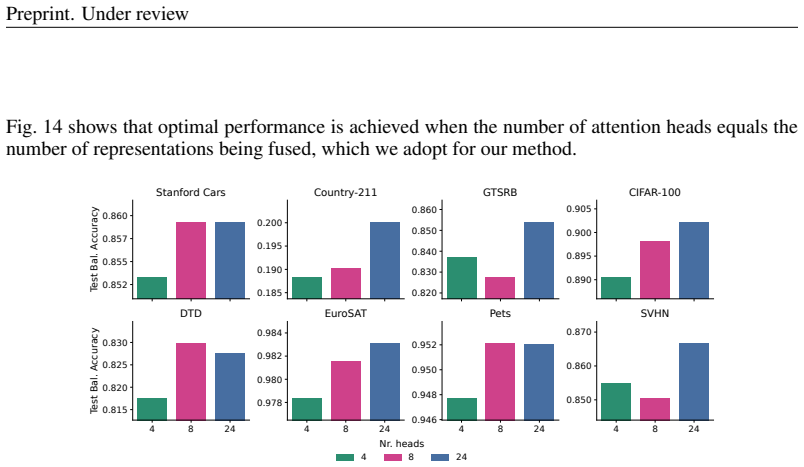
- Attention head count M =
M = number of fused representations; e.g. 24 for all layers of ViT-B-16
- Per-dataset hyperparameters (LR, attention dropout, weight decay) =
LR in {0.1,0.01,0.001}; dropout in {0.0,0.1,0.3}; weight decay in {1e-6,...,1.0}
- Representation jitter =
Gaussian noise N(0,0.05) added to features with p=0.5
- Layer subset =
All layers L_all={1,...,L}
axioms (4)
- domain assumption ViT layers form a feature hierarchy in which task-relevant information for downstream classification is distributed across depth and accessible to linear/attention probes.
- domain assumption CLS + average-pooled patch tokens at each layer preserve enough information to capture the complementary signal; full spatial token detail is not required for the claimed gains.
- domain assumption Public benchmark labels and pretrained backbones (OpenCLIP, DINOv2, ImageNet ViTs) are used as given, and extracted features via thingsvision are correctly standardized (L2-normalized, zero-padded).
- domain assumption The cross-attention module with a shared query token can learn task-adaptive layer weights better than a linear classifier over concatenated features.
Cite this review
Pith. "Pith review of Attentive multilayer fusion for vision transformers." pith.science (2026). https://pith.science/paper/XI4EPGVR
@misc{pith2026260109322,
  author       = {Pith},
  title        = {Pith review of: Attentive multilayer fusion for vision transformers},
  year         = {2026},
  howpublished = {\url{https://pith.science/paper/XI4EPGVR}},
  note         = {Machine review of arXiv:2601.09322}
}
read the original abstract
With the rise of large-scale foundation models, efficiently adapting them to downstream tasks remains a central challenge. Linear probing, which freezes the backbone and trains a lightweight head, is computationally efficient but often restricted to last-layer representations. We show that task-relevant information is distributed across the network hierarchy rather than encoded solely in the last layers. To leverage this distribution of information, we apply an attentive probing mechanism that dynamically fuses representations from all layers of a Vision Transformer. This attentive layer fusion (ALF) learns to identify the most relevant layers for a target task and combines low-level structural cues with high-level semantic abstractions. Across 20 diverse datasets and multiple pretrained foundation models, ALF achieves consistent, substantial gains over standard linear probes. Attention heatmaps further reveal that tasks different from the pre-training domain benefit most from intermediate representations. Overall, our findings underscore the value of intermediate layers and demonstrate a principled, task-aware approach for unlocking their potential for probing-based adaptation.
Figures






Forward citations
Cited by 2 Pith papers
-
Distill What RGB Can Recover: Privileged 3D Evidence for RGB-Only Vision-Language Models
Privileged 3D evidence distilled at training time lets an RGB-only student outperform an RGB-only baseline across four 3D vision-language benchmarks.
-
S-squared-VLA: Decoupling Semantic and Spatial Streams in Vision-Language-Action Models for Autonomous Driving
S2-VLA decouples semantic and spatial streams in a vision-language-action driving model, reaching PDMS 87.1 and NC 98.4 on NAVSIM under supervised fine-tuning.
Reference graph
Works this paper leans on
-
[1]
write newline
" write newline "" before.all 'output.state := FUNCTION n.dashify 't := "" t empty not t #1 #1 substring "-" = t #1 #2 substring "--" = not "--" * t #2 global.max substring 't := t #1 #1 substring "-" = "-" * t #2 global.max substring 't := while if t #1 #1 substring * t #2 global.max substring 't := if while FUNCTION format.date year duplicate empty "emp...
-
[2]
@esa (Ref
\@ifxundefined[1] #1\@undefined \@firstoftwo \@secondoftwo \@ifnum[1] #1 \@firstoftwo \@secondoftwo \@ifx[1] #1 \@firstoftwo \@secondoftwo [2] @ #1 \@temptokena #2 #1 @ \@temptokena \@ifclassloaded agu2001 natbib The agu2001 class already includes natbib coding, so you should not add it explicitly Type <Return> for now, but then later remove the command n...
-
[3]
\@lbibitem[] @bibitem@first@sw\@secondoftwo \@lbibitem[#1]#2 \@extra@b@citeb \@ifundefined br@#2\@extra@b@citeb \@namedef br@#2 \@nameuse br@#2\@extra@b@citeb \@ifundefined b@#2\@extra@b@citeb @num @parse #2 @tmp #1 NAT@b@open@#2 NAT@b@shut@#2 \@ifnum @merge>\@ne @bibitem@first@sw \@firstoftwo \@ifundefined NAT@b*@#2 \@firstoftwo @num @NAT@ctr \@secondoft...
-
[4]
@open @close @open @close and [1] URL: #1 \@ifundefined chapter * \@mkboth \@ifxundefined @sectionbib * \@mkboth * \@mkboth\@gobbletwo \@ifclassloaded amsart * \@ifclassloaded amsbook * \@ifxundefined @heading @heading NAT@ctr thebibliography [1] @ \@biblabel @NAT@ctr \@bibsetup #1 @NAT@ctr @ @openbib .11em \@plus.33em \@minus.07em 4000 4000 `\.\@m @bibit...
arXiv 2007
This paper was first reviewed by deepseek-v4-flash on August 3, 2026.
discussion (0)
Sign in with ORCID, Apple, or X to comment. Anyone can read and Pith papers without signing in.