Recognition: 2 theorem links
· Lean TheoremTransmon Architecture for Emission and Detection of Single Microwave Photons
Pith reviewed 2026-05-16 13:10 UTC · model grok-4.3
The pith
A compact transmon circuit emits single microwave photons and detects them at 60 percent efficiency over a meter-long cable.
A machine-rendered reading of the paper's core claim, the machinery that carries it, and where it could break.
Core claim
The TED uses the double transmon coupler to create a tunable, transition-selective link between a data transmon and a waveguide, allowing the same module to be switched between emission and detection modes. In the demonstrated protocol, a source TED prepares and releases a single-photon Fock state that propagates to a measurement TED, which absorbs and registers the photon, achieving 60 percent overall detection and an inferred 95 percent efficiency at the TED input.
What carries the argument
The transmon emitter/detector (TED), a circuit built around the double transmon coupler that selectively couples a data transmon to a waveguide for either photon emission or absorption.
If this is right
- Enables unconditional fast reset of transmon qubits on timescales of a few microseconds.
- Provides a calibrated tool for microwave single-photon metrology.
- Supplies a compact interface for distributing entanglement between quantum processing units inside the same cryostat.
- Offers a drop-in link for connecting superconducting processors to microwave-to-optical transducers.
Where Pith is reading between the lines
- Because the source and detector TEDs use identical parameters, the design could be replicated across many nodes without per-device retuning.
- The 4-microsecond cycle time sets a practical limit on how many photon-mediated operations can occur within typical transmon coherence windows.
- Integration of multiple TEDs on the same chip could allow on-chip routing of microwave photons between distant qubits.
Load-bearing premise
Calibration of detection efficiency on coherent states accurately predicts performance for true single-photon Fock states and the two TED modules truly share identical parameters under the chosen timing.
What would settle it
A direct count of absorbed photons when the emitter is prepared in a Fock state |1> with no coherent-state extrapolation, or an observed mismatch in performance between the two TED modules when both are run in detection mode.
Figures







read the original abstract
We develop a compact transmon emitter/detector (TED) superconducting circuit and demonstrate its dual functionality as a single-photon source and detector. In our setup, photons emitted by a source TED are transmitted via a meter-long coaxial cable, routed through a circulator, and captured by a measurement TED. Both TED modules operate with nominally identical parameters, highlighting the flexibility of this novel architecture. Furthermore, we introduce an efficient microwave photon detection scheme tailored to the TED. Using this setup, we detect 60% of the emitted Fock state photons and infer a 95% detection efficiency at the input of the measurement TED, which we calibrate against coherent state measurements. The reset and photon emission/detection processes each require approximately $2\,\mu s$, yielding a minimum protocol duration of $4\,\mu s$ as constrained by our chosen TED parameters. Ultimately, the TED demonstrates a new use case for the recently developed double transmon coupler (DTC): a compact, drop-in, tunable, and transition-selective link between a coherent data transmon and a waveguide. Circuits like the TED will play a vital role in quantum information processing by facilitating unconditional fast reset, enabling microwave photon metrology, and serving as nascent quantum communication interfaces (QCIs). QCIs mediate entanglement distribution between quantum processing units (QPUs) within a cryostat or interface with microwave-to-optical transducers for long-range quantum networking.
Editorial analysis
A structured set of objections, weighed in public.
Referee Report
Summary. The manuscript introduces a compact transmon emitter/detector (TED) architecture based on the double transmon coupler (DTC) that serves dual roles as a single-photon source and detector. Photons emitted by a source TED are routed through a meter-long coaxial cable and circulator to a nominally identical measurement TED. The authors report detecting 60% of emitted Fock-state photons and infer a 95% detection efficiency at the TED input, calibrated via coherent-state measurements. Reset, emission, and detection each take ~2 μs, for a minimum 4 μs protocol cycle. The work positions the TED as a building block for fast reset, microwave photon metrology, and quantum communication interfaces.
Significance. If the efficiency calibration and detection claims are substantiated, the TED offers a tunable, drop-in module that combines emission and detection in a single device type, simplifying superconducting quantum networks and enabling faster unconditional reset compared with existing methods. The DTC-based selective coupling is a concrete technical advance that could support scalable photon-mediated entanglement distribution within cryostats.
major comments (2)
- [Abstract] Abstract: the 95% detection efficiency for Fock-state |1⟩ photons is inferred solely from coherent-state calibration. Because coherent states obey Poisson statistics, the observed click probability averages over n=0,1,2,… components; any nonlinearity, saturation, or threshold behavior in the TED absorber response at low photon number would cause the extracted efficiency to differ from the true |1⟩ efficiency. No independent verification (e.g., direct comparison with a known Fock-state source or state tomography) is described.
- [Abstract] Abstract and experimental description: the reported 60% detected fraction and 2 μs timing figures are presented without error bars, full data sets, or explicit exclusion criteria for the calibration measurements. This omission makes it impossible to assess statistical significance or reproducibility of the efficiency inference.
minor comments (1)
- [Abstract] Abstract: the phrase 'nominally identical parameters' for the two TED modules is used without quantifying any observed deviations or the matching procedure.
Simulated Author's Rebuttal
We thank the referee for their careful reading and constructive comments on our manuscript. We address each major comment below and will revise the manuscript to improve clarity on the calibration and data presentation.
read point-by-point responses
-
Referee: [Abstract] Abstract: the 95% detection efficiency for Fock-state |1⟩ photons is inferred solely from coherent-state calibration. Because coherent states obey Poisson statistics, the observed click probability averages over n=0,1,2,… components; any nonlinearity, saturation, or threshold behavior in the TED absorber response at low photon number would cause the extracted efficiency to differ from the true |1⟩ efficiency. No independent verification (e.g., direct comparison with a known Fock-state source or state tomography) is described.
Authors: We agree that the 95% figure is inferred from coherent-state calibration rather than a direct Fock-state measurement. In the revised manuscript we will explicitly state the mean photon numbers used for calibration, quantify the contribution of n≥2 components under Poisson statistics, and add a discussion of the linearity of the TED response in the low-photon regime based on the DTC design. While we do not have an independent Fock-state source or tomography for direct verification, the consistency between the emitted Fock photons and the calibrated detection supports the inference; we will clarify this limitation and the supporting evidence. revision: yes
-
Referee: [Abstract] Abstract and experimental description: the reported 60% detected fraction and 2 μs timing figures are presented without error bars, full data sets, or explicit exclusion criteria for the calibration measurements. This omission makes it impossible to assess statistical significance or reproducibility of the efficiency inference.
Authors: We thank the referee for noting the lack of explicit statistics in the abstract. The 60% detected fraction and 2 μs timings are derived from the full data sets and repeated measurements presented in the results and methods sections of the manuscript, where statistical uncertainties are shown in the figures. We will revise the abstract to include error bars or direct references to the detailed statistics, and add a brief statement on data selection criteria (e.g., stable cooldown periods) in the experimental description to facilitate assessment of reproducibility. revision: yes
Circularity Check
No circularity: experimental calibration and measurements are self-contained
full rationale
The paper reports direct experimental results from a transmon emitter/detector circuit, including measured detection of 60% of emitted Fock-state photons and an inferred 95% detection efficiency obtained via calibration against coherent-state measurements. These quantities are obtained from laboratory data and protocol timing constraints rather than any mathematical derivation chain. No load-bearing step reduces by construction to a fitted parameter, self-definition, or self-citation; the DTC reference is background context only and does not underpin the efficiency numbers. The derivation is therefore self-contained against external benchmarks.
Axiom & Free-Parameter Ledger
Lean theorems connected to this paper
-
IndisputableMonolith/Cost/FunctionalEquation.leanwashburn_uniqueness_aczel unclear?
unclearRelation between the paper passage and the cited Recognition theorem.
We use these transmon-DTC devices as transmon emitter/detectors (TEDs) for microwave photons... detect 60% of the emitted Fock state photons and infer a 95% detection efficiency... calibrated against coherent state measurements.
What do these tags mean?
- matches
- The paper's claim is directly supported by a theorem in the formal canon.
- supports
- The theorem supports part of the paper's argument, but the paper may add assumptions or extra steps.
- extends
- The paper goes beyond the formal theorem; the theorem is a base layer rather than the whole result.
- uses
- The paper appears to rely on the theorem as machinery.
- contradicts
- The paper's claim conflicts with a theorem or certificate in the canon.
- unclear
- Pith found a possible connection, but the passage is too broad, indirect, or ambiguous to say the theorem truly supports the claim.
Forward citations
Cited by 2 Pith papers
-
Emission and Absorption of Microwave Photons in Orthogonal Temporal Modes across a 30-Meter Two-Node Network
Superconducting circuits generate and transfer microwave photons in three mutually orthogonal temporal modes over 30 m, enabling selective absorption at the receiver with 40:1 contrast.
-
High-fidelity iSWAP gate with Double Transmon Coupler
A double transmon coupler enables a parametric iSWAP gate with 99.827% fidelity in 40 ns between transmon qubits.
Reference graph
Works this paper leans on
-
[1]
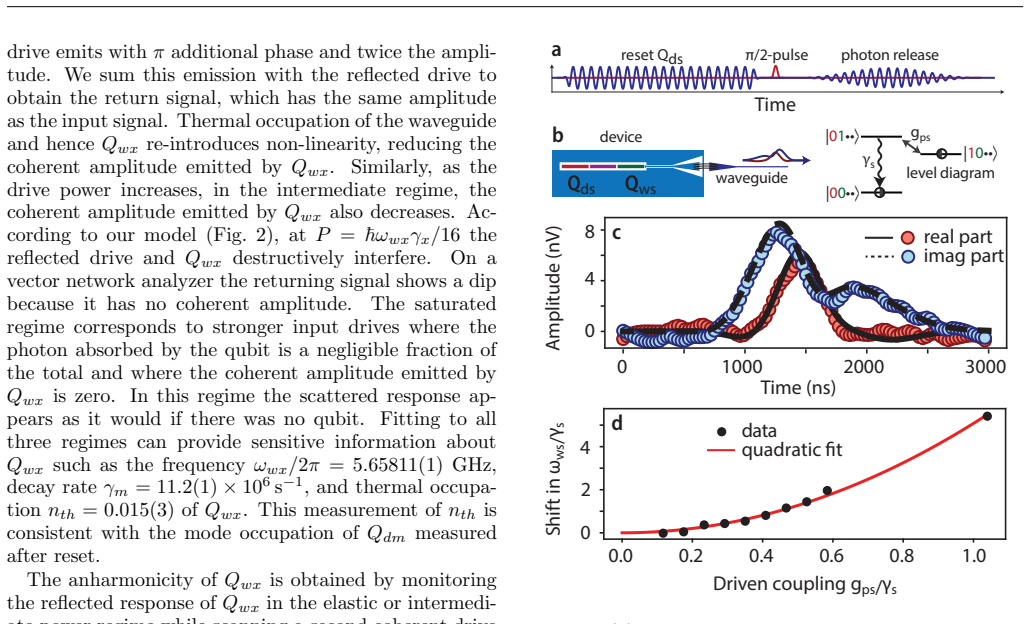
Sub- sequently, we drive the|10· ·⟩ ↔ |01· ·⟩transition by modulatingg ps. This hybridizesQ ds withQ ws, where Qws rapidly releases the excitation into the waveguide at 4 frequencyω ws. This drive is also applied at the beginning of the sequence to resetQ ds into its ground state. Without a reset pulse, we measuredQ ds to have a 12 %|10· ·⟩occupation. To ...
work page 2026
-
[2]
Harmonic oscillator basis We convert to the harmonic oscillator basis to isolate terms of interest from Eq. B1. Using indexq∈ {d, c, w} we may make a substitution for the charge and flux op- erators ˆQq = s ℏ 2Zq (aq +a † q) (B6) ˆϕq = −i φ0 r ℏZq 2 (aq −a † q) (B7) [φ0 ˆϕq, ˆQq] =iℏ(B8) where a poor choice ofZ q can still yield accurate nu- merical resul...
-
[3]
Adiabatic elimination ofQ c The coupling qubitQ c mediates a virtual interaction betweenQ d andQ w. This effective interaction may be computed using the Schrieffer-Wolff transformation H ′ =e SHe −S (C5) S= gC ωd −ω c (d†c−c †d) + −A(t)/2i ωw −(ω c +ω p)(w†c+c †w) (C6) The Schrieffer-Wolff procedure is to divide a Hamiltonian into on-site and coupling ter...
-
[4]
J. I. Cirac, A. K. Ekert, S. F. Huelga, and C. Macchi- avello, Phys. Rev. A59, 4249 (1999)
work page 1999
-
[5]
H. J. Kimble, Nature453, 1023 (2008)
work page 2008
- [6]
- [7]
-
[8]
B. K. Malia, Y. Wu, J. Mart´ ınez-Rinc´ on, and M. A. Ka- sevich, Nature612, 661 (2022)
work page 2022
-
[9]
A. A. Houck, D. I. Schuster, J. M. Gambetta, J. A. Schreier, B. R. Johnson, J. M. Chow, L. Frunzio, J. Ma- jer, M. H. Devoret, S. M. Girvin, and R. J. Schoelkopf, Nature449, 328 (2007)
work page 2007
- [10]
-
[11]
T. Miyamura, Y. Sunada, Z. Wang, J. Ilves, K. Matsuura, and Y. Nakamura, PRX Quantum6, 020347 (2025)
work page 2025
-
[12]
J. O’Sullivan, K. Reuer, A. Grigorev, X. Dai, A. Hern´ andez-Ant´ on, M. H. Mu˜ noz-Arias, C. Hellings, A. Flasby, D. Colao Zanuz, J.-C. Besse, A. Blais, D. Malz, C. Eichler, and A. Wallraff, Nature Communications16, 5505 (2025)
work page 2025
- [13]
-
[14]
B. Kannan, A. Almanakly, Y. Sung, A. Di Paolo, D. A. Rower, J. Braum¨ uller, A. Melville, B. M. Niedziel- ski, A. Karamlou, K. Serniak, A. Veps¨ al¨ ainen, M. E. Schwartz, J. L. Yoder, R. Winik, J. I.-J. Wang, T. P. Orlando, S. Gustavsson, J. A. Grover, and W. D. Oliver, Nature Physics19, 394 (2023)
work page 2023
-
[15]
P. Kurpiers, P. Magnard, T. Walter, B. Royer, M. Pechal, J. Heinsoo, Y. Salath´ e, A. Akin, S. Storz, J.-C. Besse, S. Gasparinetti, A. Blais, and A. Wallraff, Nature558, 264 (2018)
work page 2018
- [16]
-
[17]
P. Campagne-Ibarcq, E. Zalys-Geller, A. Narla, S. Shankar, P. Reinhold, L. Burkhart, C. Axline, W. Pfaff, L. Frunzio, R. J. Schoelkopf, and M. H. De- voret, Phys. Rev. Lett.120, 200501 (2018)
work page 2018
-
[18]
C. J. Axline, L. D. Burkhart, W. Pfaff, M. Zhang, K. Chou, P. Campagne-Ibarcq, P. Reinhold, L. Frun- zio, S. M. Girvin, L. Jiang, M. H. Devoret, and R. J. Schoelkopf, Nature Physics14, 705 (2018)
work page 2018
-
[19]
A. Almanakly, B. Yankelevich, M. Hays, B. Kannan, R. Assouly, A. Greene, M. Gingras, B. M. Niedzielski, H. Stickler, M. E. Schwartz, K. Serniak, J. ˆI.-J. Wang, T. P. Orlando, S. Gustavsson, J. A. Grover, and W. D. Oliver, Nature Physics21, 825 (2025)
work page 2025
- [20]
-
[21]
Y.-F. Chen, D. Hover, S. Sendelbach, L. Maurer, S. T. Merkel, E. J. Pritchett, F. K. Wilhelm, and R. McDer- mott, Phys. Rev. Lett.107, 217401 (2011)
work page 2011
-
[22]
K. Koshino, K. Inomata, T. Yamamoto, and Y. Naka- mura, Phys. Rev. Lett.111, 153601 (2013)
work page 2013
-
[23]
K. Inomata, Z. Lin, K. Koshino, W. D. Oliver, J.-S. Tsai, T. Yamamoto, and Y. Nakamura, Nature Communica- tions7, 12303 (2016)
work page 2016
-
[24]
S. Kono, K. Koshino, Y. Tabuchi, A. Noguchi, and Y. Nakamura, Nature Physics14, 546 (2018)
work page 2018
- [25]
-
[26]
R. Lescanne, S. Del´ eglise, E. Albertinale, U. R´ eglade, T. Capelle, E. Ivanov, T. Jacqmin, Z. Leghtas, and E. Flurin, Phys. Rev. X10, 021038 (2020)
work page 2020
-
[27]
L. Balembois, J. Travesedo, L. Pallegoix, A. May, E. Bil- laud, M. Villiers, D. Est` eve, D. Vion, P. Bertet, and E. Flurin, Phys. Rev. Appl.21, 014043 (2024)
work page 2024
-
[28]
K. Petrovnin, J. Wang, M. Perelshtein, P. Hakonen, and G. S. Paraoanu, PRX Quantum5, 020342 (2024)
work page 2024
-
[29]
A. Opremcak, I. V. Pechenezhskiy, C. Howington, B. G. Christensen, M. A. Beck, E. Leonard, J. Suttle, C. Wilen, K. N. Nesterov, G. J. Ribeill, T. Thorbeck, F. Schlenker, M. G. Vavilov, B. L. T. Plourde, and R. McDermott, Science361, 1239 (2018)
work page 2018
-
[30]
A. L. Pankratov, A. V. Gordeeva, A. V. Chiginev, L. S. Revin, A. V. Blagodatkin, N. Crescini, and L. S. Kuzmin, Nature Communications16, 3457 (2025)
work page 2025
-
[31]
D. L. Campbell, A. Kamal, L. Ranzani, M. Senatore, and M. D. LaHaye, Phys. Rev. Appl.19, 064043 (2023)
work page 2023
- [32]
-
[33]
R. Li, K. Kubo, Y. Ho, Z. Yan, Y. Nakamura, and H. Goto, Phys. Rev. X14, 041050 (2024)
work page 2024
-
[34]
K. Kubo, Y. Ho, and H. Goto, Phys. Rev. Appl.22, 024057 (2024)
work page 2024
-
[35]
W. F. Kindel, M. D. Schroer, and K. W. Lehnert, Phys. Rev. A93, 033817 (2016)
work page 2016
-
[36]
P. Forn-D´ ıaz, C. W. Warren, C. W. S. Chang, A. M. Vadiraj, and C. M. Wilson, Phys. Rev. Appl.8, 054015 (2017)
work page 2017
- [37]
-
[38]
A. Yen, Y. Ye, K. Peng, J. Wang, G. Cunningham, M. Gingras, B. M. Niedzielski, H. Stickler, K. Serniak, M. E. Schwartz, and K. P. O’Brien, Phys. Rev. Appl. 23, 024068 (2025)
work page 2025
- [39]
-
[40]
A. A. Houck, J. A. Schreier, B. R. Johnson, J. M. Chow, J. Koch, J. M. Gambetta, D. I. Schuster, L. Frunzio, M. H. Devoret, S. M. Girvin, and R. J. Schoelkopf, Phys. Rev. Lett.101, 080502 (2008)
work page 2008
-
[41]
A. A. Abdumalikov, O. Astafiev, A. M. Zagoskin, Y. A. Pashkin, Y. Nakamura, and J. S. Tsai, Phys. Rev. Lett. 104, 193601 (2010)
work page 2010
- [42]
-
[43]
C. Eichler, D. Bozyigit, C. Lang, L. Steffen, J. Fink, and A. Wallraff, Phys. Rev. Lett.106, 220503 (2011)
work page 2011
- [44]
-
[45]
S. Gasparinetti, M. Pechal, J.-C. Besse, M. Mondal, C. Eichler, and A. Wallraff, Phys. Rev. Lett.119, 140504 (2017)
work page 2017
-
[46]
L.-M. Duan, M. D. Lukin, J. I. Cirac, and P. Zoller, Na- ture414, 413 (2001)
work page 2001
-
[47]
S. D. Barrett and P. Kok, Phys. Rev. A71, 060310 (2005)
work page 2005
-
[48]
J. Gough and M. R. James, IEEE Transactions on Au- tomatic Control54, 2530 (2009)
work page 2009
-
[49]
J. Gough and M. R. James, Communications in Mathe- matical Physics287, 1109–1132 (2008)
work page 2008
- [50]
-
[51]
L. Luo, D. Hayes, T. Manning, D. Matsukevich, P. Maunz, S. Olmschenk, J. Sterk, and C. Monroe, Fortschritte der Physik57, 1133 (2009)
work page 2009
-
[52]
N. Lambert, E. Gigu‘ere, P. Menczel, B. Li, P. Hopf, G. Su’arez, M. Gali, J. Lishman, R. Gadhvi, R. Agarwal, A. Galicia, N. Shammah, P. Nation, J. R. Johansson, S. Ahmed, S. Cross, A. Pitchford, and F. Nori, Physics Reports1153, 1 (2026)
work page 2026
- [53]
-
[54]
X. You, J. A. Sauls, and J. Koch, Phys. Rev. B99, 174512 (2019)
work page 2019
-
[55]
U. Vool and M. Devoret, International Journal of Circuit Theory and Applications45, 897–934 (2017)
work page 2017
-
[56]
K. Lalumi` ere, B. C. Sanders, A. F. van Loo, A. Fe- dorov, A. Wallraff, and A. Blais, Phys. Rev. A88, 043806 (2013)
work page 2013
- [57]
discussion (0)
Sign in with ORCID, Apple, or X to comment. Anyone can read and Pith papers without signing in.