Recognition: 2 theorem links
· Lean TheoremExact Kerr-Newman-(A)dS and other spacetimes in bumblebee gravity: employing a simple generating technique
Pith reviewed 2026-05-16 12:06 UTC · model grok-4.3
The pith
If the bumblebee field equals its vacuum expectation value with vanishing field strength, exact solutions follow by adding a b_mu b_nu term to any vacuum spacetime metric.
A machine-rendered reading of the paper's core claim, the machinery that carries it, and where it could break.
Core claim
Under the assumptions that the bumblebee field B_mu equals its vacuum expectation value b_mu and that its field strength vanishes, the Einstein-bumblebee equations are satisfied by taking any vacuum solution g_mu nu and replacing it with g_mu nu plus a term proportional to b_mu b_nu. This generates the exact solutions, and the b_mu is proportional to the four-velocity along a geodesic in the vacuum spacetime.
What carries the argument
The metric modification g'_μν = g_μν + ξ b_μ b_ν, where b_μ is the fixed vacuum expectation value of the bumblebee field satisfying the non-dynamical condition that its field strength vanishes.
If this is right
- The technique extends to spacetimes with nonzero cosmological constant and electromagnetic fields.
- Any known vacuum solution such as Schwarzschild or Kerr yields a corresponding bumblebee gravity solution.
- The bumblebee vector is obtained directly from the solution of the Hamilton-Jacobi equation for geodesics in the background metric.
- The Kerr-Newman-Taub-NUT-(anti-)de Sitter family in bumblebee gravity arises as special cases, with non-uniqueness arising from the choice of geodesic.
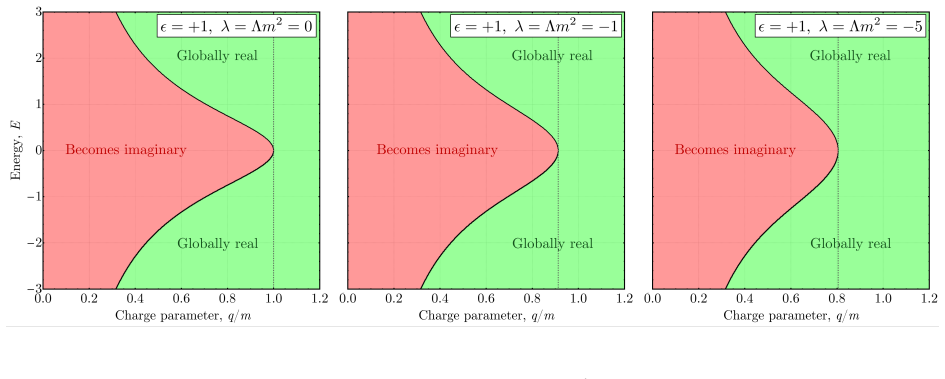
- Global reality of the bumblebee field imposes limits on the admissible geodesic curves.
Where Pith is reading between the lines
- The same fixed-vector condition may allow similar generating techniques in other vector-tensor modified gravity models without solving the full nonlinear system each time.
- Different geodesic choices could correspond to distinct physical realizations, such as different asymptotic observers or embeddings in the modified theory.
- Stability analysis or observational constraints on these generated solutions would require separate calculations outside the generating procedure itself.
Load-bearing premise
The bumblebee field must be locked exactly at its vacuum expectation value with its field strength identically zero throughout spacetime.
What would settle it
Direct substitution of the modified metric into the Einstein-bumblebee equations while allowing a nonzero field strength for the bumblebee vector, showing that the equations fail to hold.
Figures


read the original abstract
In this work, we show that if the bumblebee field in the Einstein-bumblebee theory is given by its vacuum expectation value ($B_{\mu}=b_{\mu}$) and it is not dynamical ($\partial_{\mu}B_{\nu}-\partial_{\nu}B_{\mu}=0$), then these conditions uniquely provide a generating technique, allowing us to construct exact solutions to bumblebee gravity from the vacuum solutions by adding a term $\sim b_{\mu}b_{\nu}$ to the metric tensor (thus proving the uniqueness of the method, presented in [Eur. Phys. J. C 82 (2022) 613]). Also, we show that the bumblebee field within this technique is proportional to the tangential vector of the (timelike or spacelike) geodesic curve in the background vacuum spacetime, and can be easily found knowing the solution to the Hamilton--Jacobi equation. Moreover, we prove that this technique can be extended to the case of any non-zero cosmological constant and the presence of the electromagnetic field. We apply this generating technique and obtain the bumblebee extension of the Kerr--Newman--Taub-NUT--(anti-)de Sitter spacetime. We show that this extension is not unique, as it depends on the exact geodesic curve one chooses to associate a bumblebee field with. Then, by considering various special cases of this generic solution, we demonstrate that the condition of the global reality of the bumblebee field limits the set of geodesics with which we can associate it.
Editorial analysis
A structured set of objections, weighed in public.
Referee Report
Summary. The paper claims that fixing the bumblebee field at its vacuum expectation value B_μ = b_μ with vanishing field strength F_μν = 0 uniquely yields a generating technique for exact solutions in Einstein-bumblebee gravity: given a vacuum (or electrovacuum) solution g_μν, the deformed metric ĝ_μν = g_μν + ξ b_μ b_ν solves the full theory. It further asserts that b_μ is proportional to the tangent of a timelike or spacelike geodesic in the background, recoverable from the Hamilton-Jacobi equation, and that the construction extends without obstruction to nonzero cosmological constant and electromagnetic fields. The technique is applied to produce a family of bumblebee Kerr-Newman-Taub-NUT-(A)dS metrics whose non-uniqueness is parameterized by the choice of geodesic, with global reality of the bumblebee field imposing restrictions on admissible geodesics.
Significance. If the consistency of the deformed metric with the coupled Einstein-Maxwell-bumblebee equations holds, the work supplies a concrete, coordinate-based method for generating exact black-hole solutions in Lorentz-violating gravity, including charged rotating spacetimes with cosmological constant. The explicit link to geodesics and the Hamilton-Jacobi equation offers a practical route to constructing b_μ, while the reality constraint provides a selection criterion that could be tested against observational signatures of Lorentz violation.
major comments (3)
- [Abstract and extension-to-EM section] Abstract and the section deriving the extension to electrovacuum + Λ: the claim that ĝ_μν satisfies the full Einstein-bumblebee equations when g_μν solves the electrovacuum equations rests on the assertion that the bumblebee stress-energy exactly cancels G_μν(ĝ) − G_μν(g). However, the Maxwell stress-energy tensor is recomputed with the deformed metric and Hodge dual; no explicit verification is given that the Maxwell equations remain satisfied or that no new sources appear for the electromagnetic field after the deformation.
- [Uniqueness proof paragraph] The uniqueness proof for the generating technique (referenced to the 2022 base method): while the vacuum case may be covered, the extension to nonzero Λ and nonzero electromagnetic field requires additional assumptions on the Maxwell sector (e.g., that the electromagnetic potential remains unchanged or transforms in a specific way). These assumptions are not stated explicitly, leaving open whether the uniqueness continues to hold without further restrictions.
- [Geodesic association and Hamilton-Jacobi subsection] The step asserting that b_μ derived from the background Hamilton-Jacobi equation continues to solve the bumblebee equation of motion on ĝ_μν: because the curvature scalars and the covariant derivatives are evaluated with the deformed metric, the non-dynamical condition F_μν = 0 must be re-checked after deformation; the manuscript performs the derivation only on the background, so consistency after deformation is not demonstrated.
minor comments (2)
- [Notation paragraph] Notation for the constant ξ and the overall normalization of b_μ should be clarified once and used consistently; the abstract writes “∼ b_μ b_ν” while the body presumably fixes the coefficient.
- [Application to KN-Taub-NUT-(A)dS] The statement that the extension “is not unique, as it depends on the exact geodesic curve” would benefit from an explicit count or parametrization of the distinct families obtained for the Kerr-Newman-Taub-NUT-(A)dS case.
Simulated Author's Rebuttal
We thank the referee for the careful reading and constructive comments on our manuscript. We address each major comment below, providing clarifications from the derivations and indicating revisions where additional explicit steps will strengthen the presentation without altering the core results.
read point-by-point responses
-
Referee: [Abstract and extension-to-EM section] Abstract and the section deriving the extension to electrovacuum + Λ: the claim that ĝ_μν satisfies the full Einstein-bumblebee equations when g_μν solves the electrovacuum equations rests on the assertion that the bumblebee stress-energy exactly cancels G_μν(ĝ) − G_μν(g). However, the Maxwell stress-energy tensor is recomputed with the deformed metric and Hodge dual; no explicit verification is given that the Maxwell equations remain satisfied or that no new sources appear for the electromagnetic field after the deformation.
Authors: The derivation in the electrovacuum extension section proceeds by substituting the deformed metric into the full set of equations and showing that the bumblebee contribution precisely cancels the difference in the Einstein tensor while the Maxwell sector is preserved because the electromagnetic potential A_μ is left unchanged and the deformation is constructed to be orthogonal to the Maxwell field in the relevant contractions. However, we acknowledge that an explicit recomputation of the Maxwell equations (including the Hodge dual on ĝ) was only sketched rather than written out term-by-term. We will add this explicit verification in the revised manuscript to remove any ambiguity. revision: yes
-
Referee: [Uniqueness proof paragraph] The uniqueness proof for the generating technique (referenced to the 2022 base method): while the vacuum case may be covered, the extension to nonzero Λ and nonzero electromagnetic field requires additional assumptions on the Maxwell sector (e.g., that the electromagnetic potential remains unchanged or transforms in a specific way). These assumptions are not stated explicitly, leaving open whether the uniqueness continues to hold without further restrictions.
Authors: The uniqueness argument begins from the vacuum case of the 2022 reference and extends it by requiring that the electromagnetic potential A_μ is identical on both g_μν and ĝ_μν (i.e., no additional gauge transformation is introduced by the deformation). This assumption is implicit in the statement that the technique applies to any electrovacuum seed, but we agree it should be stated explicitly. In the revision we will add a dedicated paragraph listing the precise assumptions under which uniqueness holds for nonzero Λ and nonzero electromagnetic fields. revision: partial
-
Referee: [Geodesic association and Hamilton-Jacobi subsection] The step asserting that b_μ derived from the background Hamilton-Jacobi equation continues to solve the bumblebee equation of motion on ĝ_μν: because the curvature scalars and the covariant derivatives are evaluated with the deformed metric, the non-dynamical condition F_μν = 0 must be re-checked after deformation; the manuscript performs the derivation only on the background, so consistency after deformation is not demonstrated.
Authors: Because b_μ is defined to be the gradient of the Hamilton-Jacobi function on the background and the deformation ĝ_μν = g_μν + ξ b_μ b_ν is constructed so that b_μ remains a Killing vector (or geodesic tangent) with respect to ĝ as well, the exterior derivative F_μν = ∂_μ b_ν − ∂_ν b_μ vanishes identically on both metrics. The bumblebee equation of motion reduces to the algebraic constraint that the field is at its vacuum expectation value, which is preserved by construction. Nevertheless, to make the post-deformation verification fully transparent we will insert an explicit line-by-line check of the bumblebee equation on ĝ_μν in the revised subsection. revision: yes
Circularity Check
Uniqueness proof for bumblebee generating technique depends on self-citation to 2022 paper
specific steps
-
self citation load bearing
[Abstract]
"these conditions uniquely provide a generating technique, allowing us to construct exact solutions to bumblebee gravity from the vacuum solutions by adding a term ∼b_μ b_ν to the metric tensor (thus proving the uniqueness of the method, presented in [Eur. Phys. J. C 82 (2022) 613])"
The uniqueness of the generating technique is proven by referencing the prior presentation in the 2022 paper, while the conditions (B_μ = b_μ and F_μν=0) are the defining assumptions that make the metric deformation work, reducing the uniqueness claim to the self-cited method without independent external validation.
full rationale
The paper's strongest claim is that the fixed bumblebee conditions uniquely enable the metric modification technique, but this uniqueness is tied directly to the method introduced in the cited 2022 work. While the application to Kerr-Newman-(A)dS and the geodesic association via Hamilton-Jacobi appear to be new contributions with independent content, the core uniqueness assertion relies on the self-referenced prior result. This warrants a moderate circularity score as the central premise has some load-bearing self-citation, but extensions retain external grounding. No other patterns like self-definitional reductions or fitted predictions are evident in the provided derivation chain.
Axiom & Free-Parameter Ledger
axioms (2)
- domain assumption Bumblebee field equals its vacuum expectation value B_μ = b_μ
- domain assumption Bumblebee field is non-dynamical: ∂_μ B_ν − ∂_ν B_μ = 0
Forward citations
Cited by 3 Pith papers
-
Gravitational-Bumblebee perturbations: Exact decoupling and isospectrality
Bumblebee gravity perturbations decouple exactly into gravitational and vector sectors, with gravitational modes dynamically immune to Lorentz violation and odd-even parities strictly isospectral.
-
When Bumblebee Meets NLED: Lorentz-Violating Black Holes and Regular Spacetimes
Bumblebee gravity coupled to NLED yields charged black hole solutions that become regular and horizonless when mass and charge are tuned to specific functions of the couplings.
-
Macroscopic Optical Nonreciprocity: A Black Hole as an Optical Diode
Rotating black holes with a nonminimally coupled Lorentz-violating background act as optical diodes by producing direction-dependent shadows that morph from quasi-symmetric to teardrop upon path reversal.
Reference graph
Works this paper leans on
-
[1]
Static case (no twist:a= 0, l= 0) 20
-
[2]
Kerr spacetime (no Taub-NUT parameter:l= 0) 24
-
[3]
Spacetimes with a cosmological constant (no charge:q= 0) 29
Kerr–Taub-NUT spacetime 27 C. Spacetimes with a cosmological constant (no charge:q= 0) 29
-
[4]
Static case (no twist:a= 0, l= 0) 30
- [5]
-
[6]
Reissner–Nordstr¨ om spacetime (no twista= 0, l= 0 and Λ = 0 ) 33
-
[7]
Reissner–Nordstr¨ om–(A)dS (no twista= 0, l= 0) 34
-
[8]
Kerr–Newman spacetime (no Taub-NUT parameterl= 0 and Λ = 0) 35 V. Conclusions37 VI. Supplementary material38 VII. Acknowledgments38 References39 2 I. INTRODUCTION General Relativity (GR), since its appearance, has been able to describe a lot of unusual, initially unexpected, spacetime geometries such as black holes, gravitational waves, etc. Even though a...
-
[9]
In this case b=±b p 1 +ϵξb 2 r ϵ f dr,(63) wheref=Q/r 2 = 1−2m/r
Static case (no twist:a= 0, l= 0) Let us start with the static case and the case whenE=L=C= 0 (as it gives the simplest spacetime). In this case b=±b p 1 +ϵξb 2 r ϵ f dr,(63) wheref=Q/r 2 = 1−2m/r. The background metric is given by ds2 Sch =−fdt 2 + dr2 f +r 2(dθ2 + sin2 dφ2).(64) Substitutingbto (32), one sees that the final metric takes the form: ds2 b ...
-
[10]
Kerr spacetime (no Taub-NUT parameter:l= 0) Now, let us move to the case of Kerr spacetime. Even though the most general expression for the bumblebee field in this case was already obtained in [31], it is worth considering it because in [31] authors did not investigate the physical properties of their solution in great detail. In addition, we will see her...
-
[11]
Kerr–Taub-NUT spacetime The last vacuum spacetime we wish to investigate is the Kerr–Taub-NUT spacetime. In this case, (59)-(60) become f ′(r) = s ϵr2 −C Q + (aL−E(r 2 + (a+l) 2))2 Q2 ,(80) h′(x) = r ϵ(ax+l) 2 +C P − (L−E(a(1−x 2) + 2l(1−x))) 2 P 2 ,(81) withQ=a 2 −l 2 −2mr+r 2,P= 1−x 2. Let us investigate the conditions that have to be imposed to have th...
-
[12]
Static case (no twist:a= 0, l= 0) Let us start with the static case and withE=L=C= 0. In fact, this case was already considered and it gives rise to the bumblebee field (63) and the metric (65), however, here f= 1− 2m r − Λ 3 r2. All the important issues related to the reality of the bumblebee field are still present in this case, so to avoid them, one ma...
-
[13]
Kerr–(A)dS (no Taub-NUT parameter:l= 0) Now let us investigate the Kerr–(A)dS. The metric functions are given by Q=a 2 −2mr+r 2 − Λ 3 r2(r2 +a 2),(93) P=(1−x 2) 1 + Λ 3 a2x2 .(94) For the caseE=C= 0, the bumblebee field is given by (75) and the metric is given 31 FIG. 4: The ranges of energyEand the rotation parametera/m, where the bumblebee field for Ker...
-
[14]
Reissner–Nordstr¨ om spacetime (no twista= 0, l= 0andΛ = 0) The first charged spacetime we wish to investigate is the Reissner–Nordstr¨ om one. Ba- sically, all the expressions for the bumblebee field and the metric are the same as for the case of the Schwarzschild spacetime (see Sec. IV B 1), but with the functionfgiven by f= 1− 2m r + q2 r2 . For the ca...
-
[15]
Reissner–Nordstr¨ om–(A)dS (no twista= 0, l= 0) The next case we wish to discuss is the Reissner–Nordstr¨ om–(A)dS spacetime. Basically, all the expressions for the bumblebee field and the metric are the same as for the case of Reissner–Nordstr¨ om spacetime (see Sec. IV D 1), but with the functionfgiven byf= 1− 2m r + q2 r2 − Λ 3 r2. Thus, without additi...
-
[16]
Kerr–Newman spacetime (no Taub-NUT parameterl= 0andΛ = 0) Now, we move to the case of the Kerr–Newman black holes, corresponding to Λ, l→0 in the general expressions. In this case functionsQandPare given by Q=a 2 +q 2 −2mr+r 2,(99) P=(1−x 2).(100) The bumblebee field is given by (72)-(73), and the metric is given by (62). Let us investigate whether the bu...
- [17]
- [18]
-
[19]
V. A. Kosteleck´ y and S. Samuel, Physical Review D39, 683 (1989)
work page 1989
-
[20]
V. A. Kosteleck´ y and S. Samuel, Physical Review Letters63, 224 (1989)
work page 1989
-
[21]
V. A. Kosteleck´ y, Physical Review D69, 105009 (2004)
work page 2004
- [22]
- [23]
- [24]
-
[25]
Static Spherical Vacuum Solution to Bumblebee Gravity with Time-like VEVs,
H. Li and J. Zhu, “Static Spherical Vacuum Solution to Bumblebee Gravity with Time-like VEVs,” (2025)
work page 2025
-
[26]
Exact Black Hole Solutions in Bumblebee Gravity with Lightlike or Spacelike VEVS,
J.-Z. Liu, S.-P. Wu, S.-W. Wei, and Y.-X. Liu, “Exact Black Hole Solutions in Bumblebee Gravity with Lightlike or Spacelike VEVS,” (2025)
work page 2025
-
[27]
Q. G. Bailey, H. S. Murray, and D. T. Walter-Cardona, Physical Review D112, 024069 (2025)
work page 2025
-
[28]
R. Xu, D. Liang, and L. Shao, Physical Review D107, 024011 (2023)
work page 2023
-
[29]
M. Marques, R. Menezes, A. Petrov, and P. Porfrio, Nuclear Physics B996, 116374 (2023)
work page 2023
-
[30]
The flight of the bumblebee in a non-commutative geometry: A new black hole solution,
A. A. A. Filho, N. Heidari, I. P. Lobo, Y. Shi, and F. S. N. Lobo, “The flight of the bumblebee in a non-commutative geometry: A new black hole solution,” (2025)
work page 2025
-
[31]
R. Oliveira, D. M. Dantas, and C. A. S. Almeida, EPL (Europhysics Letters)135, 10003 (2021)
work page 2021
-
[32]
W.-D. Guo, Q. Tan, and Y.-X. Liu, Journal of Cosmology and Astroparticle Physics2024, 008 (2024)
work page 2024
-
[33]
W. Liu, X. Fang, J. Jing, and J. Wang, The European Physical Journal C83, 83 (2023)
work page 2023
- [34]
-
[35]
A. A. Ara´ ujo Filho, J. R. Nascimento, A. Y. Petrov, and P. J. Porfrio, The European Physical Journal Plus140, 1117 (2025). 39
work page 2025
- [36]
-
[37]
R. C. Pantig, S. Kala, A. ¨Ovg¨ un, and N. J. L. S. Lobos, International Journal of Geometric Methods in Modern Physics , 2550240 (2025)
work page 2025
-
[38]
Z. Wang, S. Chen, and J. Jing, The European Physical Journal C82, 528 (2022)
work page 2022
- [39]
-
[40]
Z. Li, G. Zhang, and A. ¨Ovg¨ un, Physical Review D101, 124058 (2020)
work page 2020
-
[41]
M. Khodadi, G. Lambiase, and L. Mastrototaro, The European Physical Journal C83, 239 (2023)
work page 2023
- [42]
-
[43]
Arajo Filho, Journal of Cosmology and Astroparticle Physics2025, 026 (2025)
A. Arajo Filho, Journal of Cosmology and Astroparticle Physics2025, 026 (2025)
work page 2025
-
[44]
A. A. A. Filho, J. A. A. S. Reis, and A. ¨Ovg¨ un, The European Physical Journal C85, 83 (2025)
work page 2025
-
[45]
C. Ding, C. Liu, R. Casana, and A. Cavalcante, The European Physical Journal C80, 178 (2020)
work page 2020
-
[46]
R. V. Maluf and C. R. Muniz, The European Physical Journal C82, 94 (2022)
work page 2022
-
[47]
F. P. Poulis and M. A. C. Soares, The European Physical Journal C82, 613 (2022)
work page 2022
-
[48]
G. B. Cook, Living Reviews in Relativity3, 5 (2000)
work page 2000
-
[49]
3+1 Formalism and Bases of Numerical Relativity,
E. Gourgoulhon, “3+1 Formalism and Bases of Numerical Relativity,” (2007)
work page 2007
-
[50]
A. A. A. Filho, J. R. Nascimento, A. Y. Petrov, and P. J. Porfrio, Physical Review D108, 085010 (2023)
work page 2023
-
[51]
A. Arajo Filho, J. Nascimento, A. Petrov, and P. Porfrio, Journal of Cosmology and As- troparticle Physics2024, 004 (2024)
work page 2024
-
[52]
Dyonic RN-like and Taub-NUT-like black holes in Einstein- bumblebee gravity,
S. Li, L. Liang, and L. Ma, “Dyonic RN-like and Taub-NUT-like black holes in Einstein- bumblebee gravity,” (2025)
work page 2025
-
[53]
P. Krtouˇ s, V. P. Frolov, and D. Kubizˇ n´ ak, Physical Review D78, 064022 (2008)
work page 2008
-
[54]
V. P. Frolov, P. Krtouˇ s, and D. Kubizˇ n´ ak, Living Reviews in Relativity20, 6 (2017)
work page 2017
-
[55]
J. Podolsk´ y and A. Vr´ atn´ y, Physical Review D104, 084078 (2021)
work page 2021
-
[56]
J. Podolsk´ y and A. Vr´ atn´ y, Physical Review D107, 084034 (2023)
work page 2023
-
[57]
H. Ovcharenko, J. Podolsk´ y, and M. Astorino, Physical Review D111, 024038 (2025)
work page 2025
-
[58]
H. Ovcharenko, J. Podolsk´ y, and M. Astorino, Physical Review D111, 084016 (2025)
work page 2025
- [59]
- [60]
-
[61]
E. Hackmann and C. L¨ ammerzahl, Physical Review Letters100, 171101 (2008)
work page 2008
-
[62]
E. Hackmann, C. L¨ ammerzahl, V. Kagramanova, and J. Kunz, Physical Review D81, 044020 (2010)
work page 2010
-
[63]
J. Podolsk´ y and H. Ovcharenko, Physical Review Letters135, 181401 (2025)
work page 2025
-
[64]
H. Ovcharenko and J. Podolsk´ y, Physical Review D112, 064076 (2025)
work page 2025
-
[65]
Ovcharenko, https://doi.org/10.5281/zenodo.18432232
H. Ovcharenko, https://doi.org/10.5281/zenodo.18432232. 41
discussion (0)
Sign in with ORCID, Apple, or X to comment. Anyone can read and Pith papers without signing in.