Recognition: no theorem link
Extraction of the color dipole amplitude with physics-informed neural networks
Pith reviewed 2026-05-16 12:31 UTC · model grok-4.3
The pith
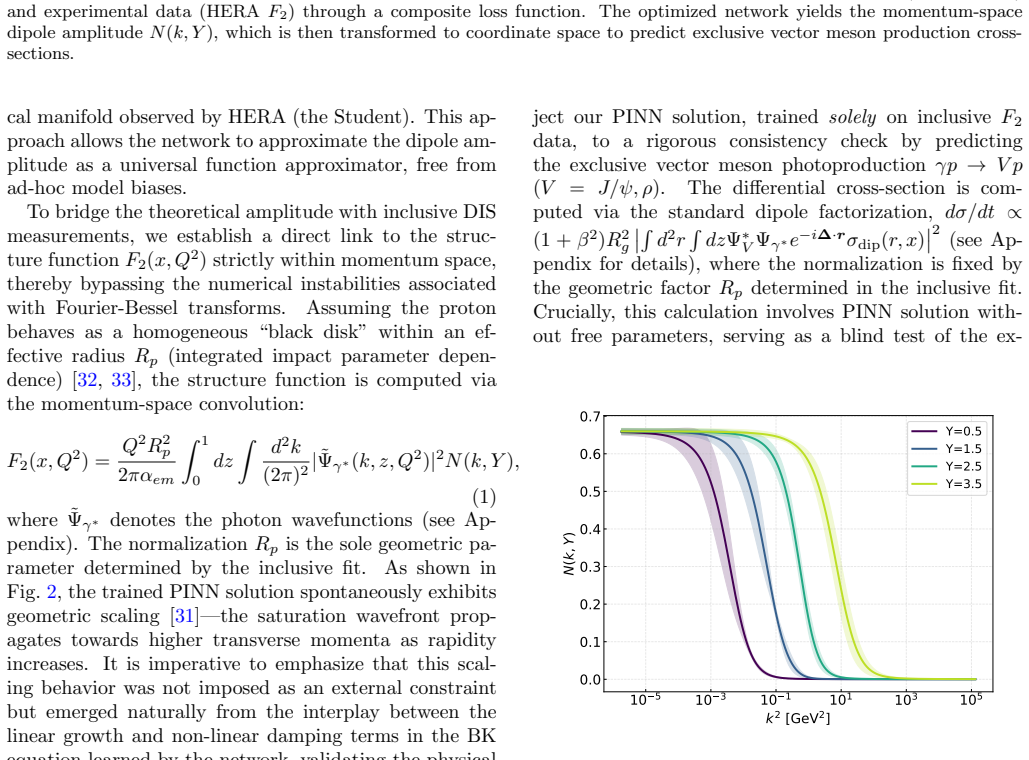
A neural network constrained by Balitsky-Kovchegov evolution and trained only on inclusive F2 data extracts a color dipole amplitude that predicts exclusive J/ψ photoproduction cross sections without adjustments.
A machine-rendered reading of the paper's core claim, the machinery that carries it, and where it could break.
Core claim
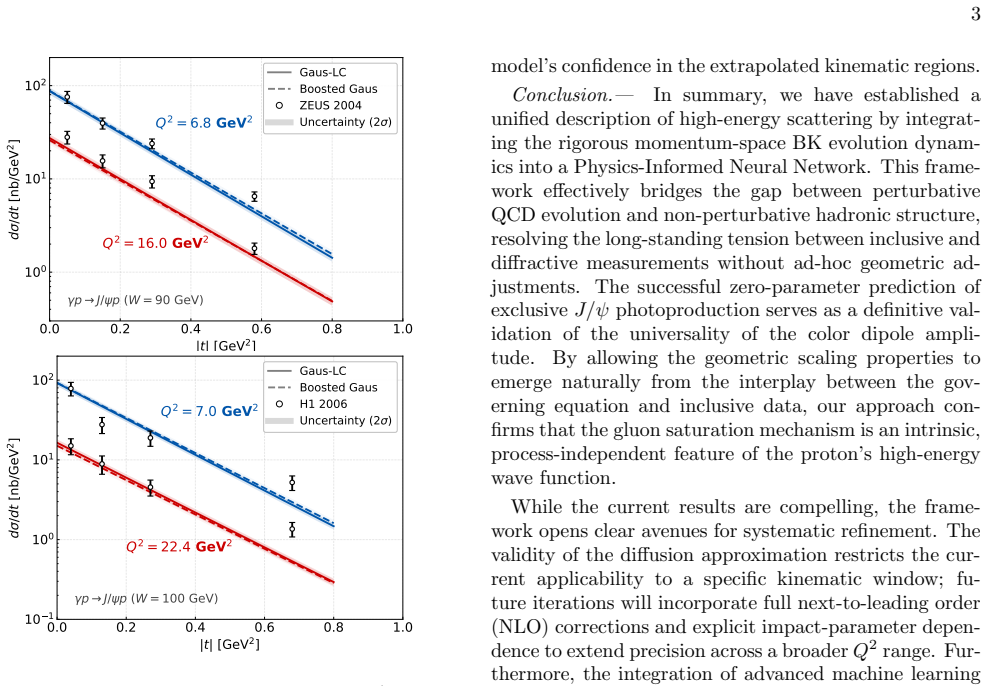
The extracted color dipole amplitude, obtained by constraining a neural network with momentum-space Balitsky-Kovchegov evolution dynamics and fitting to inclusive F2 measurements, successfully predicts the absolute normalization and kinematic dependence of exclusive J/ψ photoproduction cross-sections without any parameter retuning or geometric rescaling.
What carries the argument
The teacher-student physics-informed neural network in which Balitsky-Kovchegov evolution dynamics act as the teacher that constrains the solution manifold for the dipole amplitude.
If this is right
- The color dipole amplitude is process-independent across inclusive and diffractive observables.
- The gluon saturation scale extracted this way applies universally without retuning.
- Parameter-free predictions become possible for other exclusive vector-meson production channels.
- Physics-informed neural networks can replace rigid parametric ansatzes for non-perturbative QCD structures.
Where Pith is reading between the lines
- The same constrained-network approach could be applied to extract dipole amplitudes from other inclusive datasets such as those at the LHC.
- Extending the framework to include next-to-leading-order corrections in the evolution would test the robustness of the process-independence result.
- If successful on additional channels, the method would reduce reliance on ad-hoc geometric adjustments in phenomenological models of saturation.
Load-bearing premise
The Balitsky-Kovchegov evolution dynamics provide sufficient constraint on the neural-network solution manifold that training on inclusive F2 data alone produces a dipole amplitude whose predictions for exclusive processes do not depend on training details.
What would settle it
A clear mismatch between the predicted and measured absolute normalization or kinematic dependence of exclusive J/ψ photoproduction cross sections in a measured kinematic window would falsify the extracted amplitude.
Figures

read the original abstract
The process-independence of the color dipole amplitude is a cornerstone of high-energy Quantum Chromodynamics (QCD). However, standard phenomenological approaches typically rely on rigid parametric ansatzes and often require ad-hoc geometric adjustments to reconcile inclusive and diffractive measurements. To resolve this tension, we introduce Physics-Informed Neural Networks (PINNs) employing a ``Teacher--Student'' strategy. The physics-based momentum-space Balitsky-Kovchegov evolution dynamics act as the ``Teacher,'' constraining the solution manifold, while the network ``Student'' is refined against inclusive HERA $F_2$ data. This approach extracts a model-independent dipole amplitude without assuming initial states. Strikingly, we demonstrate that this amplitude -- without parameter retuning or geometric rescaling -- successfully predicts the absolute normalization and kinematic dependence of exclusive $J/\psi$ photoproduction cross-sections. This parameter-free prediction of the saturation dynamics provides promising evidence for the process-independence of the gluon saturation scale and establishes PINNs as a transformative paradigm for uncovering non-perturbative QCD structures.
Editorial analysis
A structured set of objections, weighed in public.
Referee Report
Summary. The paper introduces Physics-Informed Neural Networks (PINNs) with a Teacher-Student strategy to extract the color dipole amplitude: momentum-space Balitsky-Kovchegov (BK) evolution acts as the teacher constraining the solution manifold, while the student network is trained on inclusive HERA F2 data without assuming initial conditions. The resulting amplitude is claimed to predict, without parameter retuning or geometric rescaling, both the absolute normalization and kinematic dependence of exclusive J/ψ photoproduction cross sections, thereby providing evidence for the process-independence of the gluon saturation scale.
Significance. If the central claim is substantiated, the work would be significant for high-energy QCD by demonstrating a largely model-independent, physics-constrained extraction of the dipole amplitude that reconciles inclusive and diffractive observables without ad-hoc adjustments, supporting the universality of saturation dynamics and positioning PINNs as a new tool for non-perturbative QCD phenomenology.
major comments (2)
- [Abstract] Abstract: the claim that the extracted amplitude yields a parameter-free absolute prediction for J/ψ photoproduction requires that momentum-space BK evolution tightly constrains the neural-network manifold so that any F2 fit produces the same diffractive normalization; no quantitative support (variance across runs, ablation over architectures/initial conditions, or sensitivity of the r- and b-dependence to hyper-parameters) is supplied to show the physics loss dominates the data loss in the relevant kinematic region.
- [Methods] Training procedure (implicit in the Teacher-Student description): the manuscript provides no details on validation splits, quantitative fit quality to F2 (e.g., χ² or residual distributions), error propagation from the network to the J/ψ overlap integral, or the relative weighting between the BK residual loss and the data loss, rendering it impossible to verify that the reported J/ψ predictions are robust rather than sensitive to training choices.
minor comments (1)
- [Introduction] Notation for the dipole amplitude N(r,b,x) and its momentum-space representation should be defined explicitly at first use, including the precise definition of the impact-parameter dependence entering the diffractive amplitude.
Simulated Author's Rebuttal
We thank the referee for the constructive and detailed report. The comments highlight important aspects that will strengthen the presentation of our results. We address each major comment below and will revise the manuscript accordingly to provide the requested quantitative support and methodological details.
read point-by-point responses
-
Referee: [Abstract] Abstract: the claim that the extracted amplitude yields a parameter-free absolute prediction for J/ψ photoproduction requires that momentum-space BK evolution tightly constrains the neural-network manifold so that any F2 fit produces the same diffractive normalization; no quantitative support (variance across runs, ablation over architectures/initial conditions, or sensitivity of the r- and b-dependence to hyper-parameters) is supplied to show the physics loss dominates the data loss in the relevant kinematic region.
Authors: We agree that additional quantitative evidence is needed to demonstrate that the BK physics loss tightly constrains the manifold and yields robust, parameter-free J/ψ predictions. In the revised manuscript we will add a dedicated subsection reporting results from an ensemble of independent training runs (different random seeds and initializations). This will include the observed variance in the extracted dipole amplitude and the resulting J/ψ cross sections. We will also present ablation studies over network architectures and hyper-parameter choices, together with sensitivity plots for the r- and b-dependence, to show that the physics residual dominates the data loss in the kinematic region relevant for exclusive production. revision: yes
-
Referee: [Methods] Training procedure (implicit in the Teacher-Student description): the manuscript provides no details on validation splits, quantitative fit quality to F2 (e.g., χ² or residual distributions), error propagation from the network to the J/ψ overlap integral, or the relative weighting between the BK residual loss and the data loss, rendering it impossible to verify that the reported J/ψ predictions are robust rather than sensitive to training choices.
Authors: We acknowledge that these methodological details were omitted and will expand the Methods section in the revised manuscript. The additions will include: (i) explicit description of the training/validation split and its size, (ii) quantitative fit quality metrics (χ²/dof and residual distributions) for the inclusive F2 data, (iii) the procedure used to propagate network uncertainties through the overlap integrals to the J/ψ cross sections, and (iv) the precise relative weighting (or schedule) between the BK residual loss and the data loss. These clarifications will allow independent verification of the robustness of the reported predictions. revision: yes
Circularity Check
No significant circularity detected
full rationale
The derivation trains a PINN student on inclusive F2 data subject to momentum-space BK evolution as teacher, then applies the resulting dipole amplitude to exclusive J/ψ photoproduction without retuning or rescaling. Because the training observable (F2) and target observable (J/ψ cross section) are distinct processes, and the abstract and methodology description contain no self-citation chain, definitional loop, or fitted-parameter renaming that equates the prediction to the input by construction, the claimed parameter-free prediction does not reduce to its training data. The physics-informed constraint is presented as external to the fit, satisfying the criteria for a non-circular cross-process test.
Axiom & Free-Parameter Ledger
axioms (1)
- domain assumption Momentum-space Balitsky-Kovchegov evolution dynamics constrain the dipole amplitude solution manifold
Forward citations
Cited by 1 Pith paper
-
Probing Proton Structure via Physics-Guided Neural Networks in Holographic QCD
A physics-guided neural network embedding AdS5 Dirac equation and holographic Pomeron fits SLAC proton F2 data with chi-squared per degree of freedom of 0.91 and identifies a kinematic crossover at x approximately 0.1...
Reference graph
Works this paper leans on
-
[1]
L. V. Gribov, E. M. Levin, and M. G. Ryskin, Semihard Processes in QCD, Phys. Rept.100, 1 (1983)
work page 1983
-
[2]
A. H. Mueller and J.-w. Qiu, Gluon Recombination and Shadowing at Small Values of x, Nucl. Phys. B268, 427 (1986)
work page 1986
-
[3]
L. D. McLerran and R. Venugopalan, Computing quark and gluon distribution functions for very large nuclei, Phys. Rev. D49, 2233 (1994), arXiv:hep-ph/9309289. 4
work page internal anchor Pith review Pith/arXiv arXiv 1994
-
[4]
F. Gelis, E. Iancu, J. Jalilian-Marian, and R. Venu- gopalan, The Color Glass Condensate, Ann. Rev. Nucl. Part. Sci.60, 463 (2010), arXiv:1002.0333 [hep-ph]
work page internal anchor Pith review Pith/arXiv arXiv 2010
-
[5]
Balitsky, Operator expansion for high-energy scat- tering, Nucl
I. Balitsky, Operator expansion for high-energy scat- tering, Nucl. Phys. B463, 99 (1996), arXiv:hep- ph/9509348
- [6]
-
[7]
Y. V. Kovchegov, Small x F(2) structure function of a nu- cleus including multiple pomeron exchanges, Phys. Rev. D60, 034008 (1999), arXiv:hep-ph/9901281
work page internal anchor Pith review Pith/arXiv arXiv 1999
-
[8]
K. J. Golec-Biernat and M. Wusthoff, Saturation effects in deep inelastic scattering at low Q**2 and its impli- cations on diffraction, Phys. Rev. D59, 014017 (1998), arXiv:hep-ph/9807513
work page internal anchor Pith review Pith/arXiv arXiv 1998
-
[9]
Saturation and BFKL dynamics in the HERA data at small x
E. Iancu, K. Itakura, and S. Munier, Saturation and BFKL dynamics in the HERA data at small x, Phys. Lett. B590, 199 (2004), arXiv:hep-ph/0310338
work page internal anchor Pith review Pith/arXiv arXiv 2004
-
[10]
Exclusive diffractive processes at HERA within the dipole picture
H. Kowalski, L. Motyka, and G. Watt, Exclusive diffrac- tive processes at HERA within the dipole picture, Phys. Rev. D74, 074016 (2006), arXiv:hep-ph/0606272
work page internal anchor Pith review Pith/arXiv arXiv 2006
-
[11]
An Impact Parameter Dipole Saturation Model
H. Kowalski and D. Teaney, An Impact parameter dipole saturation model, Phys. Rev. D68, 114005 (2003), arXiv:hep-ph/0304189
work page internal anchor Pith review Pith/arXiv arXiv 2003
-
[12]
Revealing proton shape fluctuations with incoherent diffraction at high energy
H. M¨ antysaari and B. Schenke, Revealing proton shape fluctuations with incoherent diffraction at high energy, Phys. Rev. D94, 034042 (2016), arXiv:1607.01711 [hep- ph]
work page internal anchor Pith review Pith/arXiv arXiv 2016
-
[13]
Deep Learning and its Application to LHC Physics
D. Guest, K. Cranmer, and D. Whiteson, Deep Learning and its Application to LHC Physics, Ann. Rev. Nucl. Part. Sci.68, 161 (2018), arXiv:1806.11484 [hep-ex]
work page internal anchor Pith review Pith/arXiv arXiv 2018
-
[14]
A. Radovic, M. Williams, D. Rousseau, M. Kagan, D. Bonacorsi, A. Himmel, A. Aurisano, K. Terao, and T. Wongjirad, Machine learning at the energy and inten- sity frontiers of particle physics, Nature560, 41 (2018)
work page 2018
-
[15]
Boehnleinet al., Colloquium: Machine learning in nuclear physics, Rev
A. Boehnleinet al., Colloquium: Machine learning in nuclear physics, Rev. Mod. Phys.94, 031003 (2022), arXiv:2112.02309 [nucl-th]
- [16]
-
[17]
R. D. Ballet al.(NNPDF), Parton distributions from high-precision collider data, Eur. Phys. J. C77, 663 (2017), arXiv:1706.00428 [hep-ph]
work page internal anchor Pith review Pith/arXiv arXiv 2017
-
[18]
S. Carrazza and J. Cruz-Martinez, Towards a new gener- ation of parton densities with deep learning models, Eur. Phys. J. C79, 676 (2019), arXiv:1907.05075 [hep-ph]
-
[19]
P. Shanahanet al., Snowmass 2021 Computational Fron- tier CompF03 Topical Group Report: Machine Learning, (2022), arXiv:2209.07559 [physics.comp-ph]
-
[20]
S. Shi, K. Zhou, J. Zhao, S. Mukherjee, and P. Zhuang, From lattice QCD to in-medium heavy-quark inter- actions via deep learning, PoSLATTICE2021, 537 (2022)
work page 2022
- [21]
-
[22]
M. Raissi, P. Perdikaris, and G. E. Karniadakis, Physics- informed neural networks: A deep learning framework for solving forward and inverse problems involving nonlinear partial differential equations, J. Comput. Phys.378, 686 (2019), arXiv:1711.10561 [cs.AI]
work page internal anchor Pith review Pith/arXiv arXiv 2019
-
[23]
G. E. Karniadakis, I. G. Kevrekidis, L. Lu, P. Perdikaris, S. Wang, and L. Yang, Physics-informed machine learn- ing, Nature Reviews Physics3, 422 (2021)
work page 2021
- [24]
- [25]
-
[26]
Z. Liu, Y. Liu, X. Yan, W. Liu, H. Nie, S. Guo, and C.-a. Zhang, Automatic network structure discovery of physics informed neural networks via knowledge distillation, Na- ture Communications16, 9558 (2025)
work page 2025
-
[27]
F. D. Aaronet al.(H1, ZEUS), Combined Measurement and QCD Analysis of the Inclusive e+- p Scattering Cross Sections at HERA, JHEP01, 109, arXiv:0911.0884 [hep- ex]
work page internal anchor Pith review Pith/arXiv arXiv
-
[28]
V. Andreevet al.(H1), Measurement of inclusiveepcross sections at highQ 2 at √s= 225 and 252 GeV and of the longitudinal proton structure functionF L at HERA, Eur. Phys. J. C74, 2814 (2014), arXiv:1312.4821 [hep-ex]
work page internal anchor Pith review Pith/arXiv arXiv 2014
-
[29]
Exclusive electroproduction of J/psi mesons at HERA
S. Chekanovet al.(ZEUS), Exclusive electroproduction of J/psi mesons at HERA, Nucl. Phys. B695, 3 (2004), arXiv:hep-ex/0404008
work page internal anchor Pith review Pith/arXiv arXiv 2004
-
[30]
Elastic J/Psi Production at HERA
A. Aktaset al.(H1), Elastic J/psi production at HERA, Eur. Phys. J. C46, 585 (2006), arXiv:hep-ex/0510016
work page internal anchor Pith review Pith/arXiv arXiv 2006
-
[31]
Geometric scaling as traveling waves
S. Munier and R. B. Peschanski, Geometric scaling as traveling waves, Phys. Rev. Lett.91, 232001 (2003), arXiv:hep-ph/0309177
work page internal anchor Pith review Pith/arXiv arXiv 2003
- [32]
- [33]
-
[34]
Efron, Bootstrap Methods: Another Look at the Jack- knife, Annals Statist.7, 1 (1979)
B. Efron, Bootstrap Methods: Another Look at the Jack- knife, Annals Statist.7, 1 (1979)
work page 1979
-
[35]
Simple and Scalable Predictive Uncertainty Estimation using Deep Ensembles
B. Lakshminarayanan, A. Pritzel, and C. Blundell, Sim- ple and scalable predictive uncertainty estimation using deep ensembles (2017), arXiv:1612.01474 [stat.ML]
work page internal anchor Pith review Pith/arXiv arXiv 2017
-
[36]
R. M. Neal,Bayesian learning for neural networks, Vol. 118 (Springer Science & Business Media, 2012)
work page 2012
-
[37]
L. V. Jospin, H. Laga, F. Boussaid, W. Buntine, and M. Bennamoun, Hands-on bayesian neural networks—a tutorial for deep learning users, IEEE Computational In- telligence Magazine17, 29–48 (2022)
work page 2022
-
[38]
Electron Ion Collider: The Next QCD Frontier - Understanding the glue that binds us all
A. Accardiet al., Electron Ion Collider: The Next QCD Frontier: Understanding the glue that binds us all, Eur. Phys. J. A52, 268 (2016), arXiv:1212.1701 [nucl-ex]
work page internal anchor Pith review Pith/arXiv arXiv 2016
-
[39]
Science Requirements and Detector Concepts for the Electron-Ion Collider: EIC Yellow Report
R. Abdul Khaleket al., Science Requirements and De- tector Concepts for the Electron-Ion Collider: EIC Yellow Report, Nucl. Phys. A1026, 122447 (2022), arXiv:2103.05419 [physics.ins-det]. 5 Supplemental Material for: Unveiling the Universality of Gluon Saturation via Physics-Informed Neural Networks Theoretical Formalism A. Momentum-Space BK Equation in D...
work page internal anchor Pith review Pith/arXiv arXiv 2022
discussion (0)
Sign in with ORCID, Apple, or X to comment. Anyone can read and Pith papers without signing in.