Recognition: 1 theorem link
· Lean TheoremSearching for a P_{cs}(4200) state in the Λ_btoφη_cΛ reaction
Pith reviewed 2026-05-16 10:45 UTC · model grok-4.3
The pith
The Lambda_b to phi eta_c Lambda decay can reveal the predicted P_cs(4200) state with a branching fraction of order 10^{-5}.
A machine-rendered reading of the paper's core claim, the machinery that carries it, and where it could break.
Core claim
The authors propose the Lambda_b to phi eta_c Lambda reaction to observe a P_cs state around 4200 MeV, predicted at lower masses than expected from comparison with the P_c states due to the important role played by coupled channels in the P_cs case. That state decays to eta_c Lambda with a width of about 200 keV. Relating the process to the observed Lambda_b^0 to phi D_s^- Lambda_c^+ decay, they predict a branching fraction for Lambda_b to phi P_cs(4200) followed by P_cs to eta_c Lambda of the order of 10^{-5}, within present capabilities of the LHCb collaboration.
What carries the argument
The coupled-channel model that generates the narrow P_cs(4200) resonance and the direct relation of its production amplitude to the observed Lambda_b to phi D_s Lambda_c channel.
If this is right
- Observation would confirm that coupled channels lower the mass of P_cs states relative to P_c states.
- It would support the coupled-channel mechanism as a key ingredient in hidden-charm pentaquark structure.
- LHCb data can already test the prediction because the branching fraction reaches 10^{-5}.
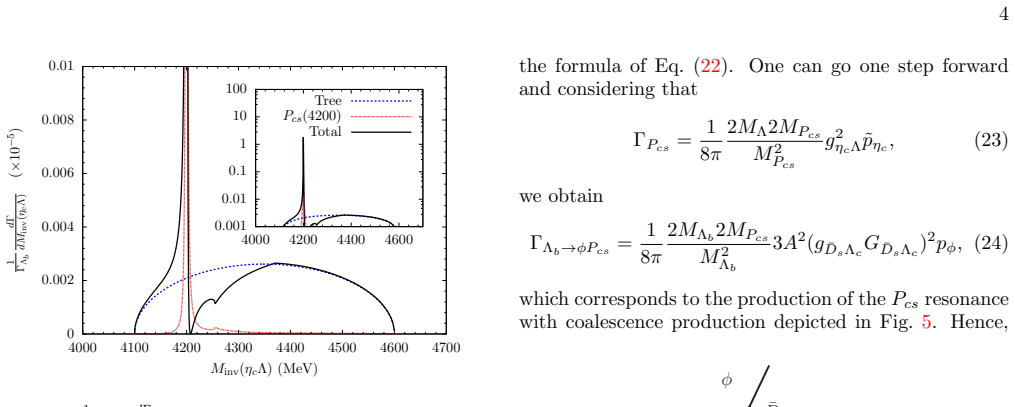
- The narrow width of 200 keV would produce a sharp peak in the eta_c Lambda spectrum.
Where Pith is reading between the lines
- The same coupling framework could be applied to predict rates in other Lambda_b or B-meson decays involving eta_c.
- Detection would help distinguish molecular-type interpretations from compact multiquark pictures for these states.
- Non-observation would require revisiting the strength of the coupled-channel effects used in the model.
Load-bearing premise
The P_cs(4200) state exists with the mass and narrow width of about 200 keV predicted by the prior coupled-channel calculation, and its production rate in this decay can be reliably estimated from the observed Lambda_b to phi D_s Lambda_c channel.
What would settle it
LHCb measuring no peak near 4200 MeV in the eta_c Lambda invariant mass or finding a branching fraction much smaller than 10^{-5} would show the predicted state is not produced at the expected rate.
Figures

read the original abstract
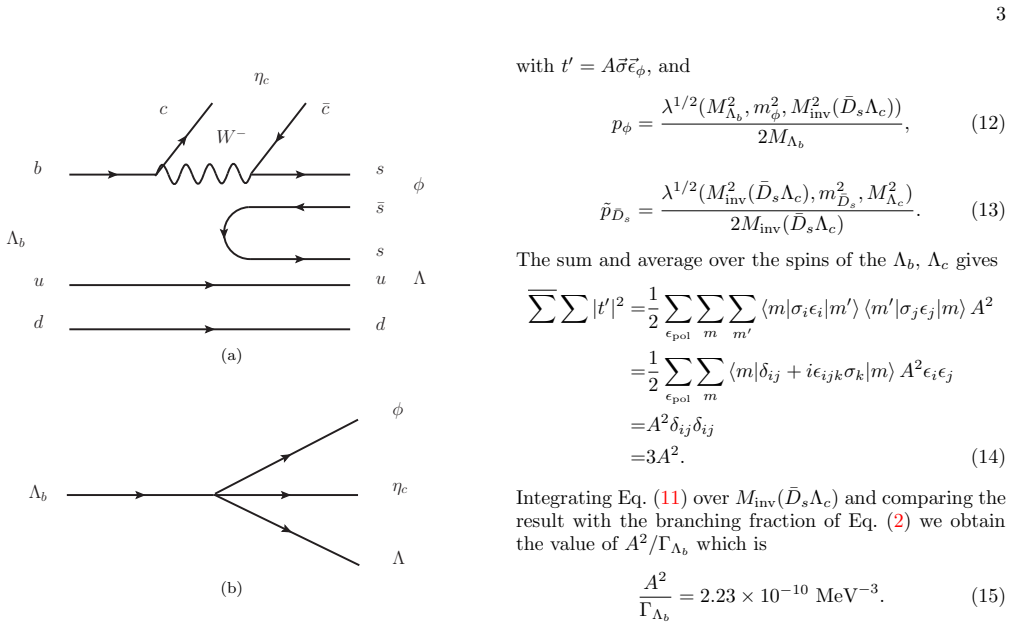
We propose the $\Lambda_b\to\phi \eta_c \Lambda$ reaction to observe a $P_{cs}$ state around $4200$ MeV, predicted at lower masses than expected from comparison with the $P_c$ states, stemming as a consequence of the important role played by coupled channels in the $P_{cs}$ case, which does not appear in the $P_c$ case. That state decays to $\eta_c \Lambda$ with a width of about $200$ keV. The reaction is related to $\Lambda_b^0\to\phi D_s^- \Lambda_c^+$, which has already been observed. We predict a branching fraction for $\Lambda_b\to\phi P_{cs}(4200)$; $P_{cs}\to\eta_c \Lambda$ of the order of $10^{-5}$, which is within present capabilities of the LHCb collaboration. The observation of this state would bring valuable light on the nature of the $P_c$ and $P_{cs}$ states and the role played by coupled channels in hadron structure and hadron reactions.
Editorial analysis
A structured set of objections, weighed in public.
Referee Report
Summary. The manuscript proposes the reaction Λ_b → φ η_c Λ to search for a P_cs(4200) state predicted by the authors' prior coupled-channel model. The state is claimed to decay to η_c Λ with a width of ~200 keV, and the product branching fraction for Λ_b → φ P_cs(4200); P_cs → η_c Λ is predicted to be of order 10^{-5}, accessible at LHCb via scaling from the observed Λ_b → φ D_s^- Λ_c^+ channel.
Significance. If the central prediction holds, the result would test the role of coupled channels in shifting P_cs masses below naive expectations from P_c analogs, providing a falsifiable link between theory and LHCb data on exotic baryons.
major comments (2)
- Abstract: the product branching fraction of order 10^{-5} is stated without any derivation, explicit coupling constants, or error propagation from the coupled-channel parameters; the claim therefore reduces directly to an output of the external prior model without independent verification here.
- Text relating the new mode to Λ_b^0 → φ D_s^- Λ_c^+: no matrix-element mapping, isospin factors, or phase-space scaling is supplied, so the numerical prediction cannot be reconstructed or varied within the present manuscript.
minor comments (1)
- Abstract: the width value (~200 keV) should be accompanied by a brief statement of its origin in the prior calculation for clarity.
Simulated Author's Rebuttal
We thank the referee for the careful reading of the manuscript and for highlighting the need for greater transparency in the presentation of our numerical estimates. We address the two major comments point by point below.
read point-by-point responses
-
Referee: Abstract: the product branching fraction of order 10^{-5} is stated without any derivation, explicit coupling constants, or error propagation from the coupled-channel parameters; the claim therefore reduces directly to an output of the external prior model without independent verification here.
Authors: We agree that the numerical value originates from our earlier coupled-channel calculation. The present manuscript is a proposal paper whose purpose is to identify an observable reaction and to give an order-of-magnitude estimate of its rate; it does not repeat the full dynamical calculation. We have revised the abstract and added a sentence in the introduction that explicitly attributes the branching fraction to the prior work and refers the reader to that reference for the coupling constants and parameter uncertainties. This makes the dependence on the external model transparent without duplicating material outside the scope of the present study. revision: partial
-
Referee: Text relating the new mode to Λ_b^0 → φ D_s^- Λ_c^+: no matrix-element mapping, isospin factors, or phase-space scaling is supplied, so the numerical prediction cannot be reconstructed or varied within the present manuscript.
Authors: We have inserted a new paragraph that supplies the scaling argument. The two final states have comparable phase space, and we assume that the weak-production matrix elements are of similar magnitude (differing at most by isospin factors of order one). The product branching fraction is then obtained by scaling the measured rate of the reference channel by the ratio of the partial width of P_cs(4200) → η_c Λ to the total width of the resonance. While a complete microscopic evaluation of the weak matrix elements lies beyond the scope of this work, the explicit scaling procedure now allows the reader to understand the origin of the 10^{-5} estimate and to vary the assumptions if desired. revision: yes
Circularity Check
Branching fraction prediction inherits mass, width and couplings directly from authors' prior coupled-channel model without independent derivation
specific steps
-
self citation load bearing
[Abstract]
"We propose the Λ_b→ϕ η_c Λ reaction to observe a P_cs state around 4200 MeV, predicted at lower masses than expected from comparison with the P_c states, stemming as a consequence of the important role played by coupled channels in the P_cs case... That state decays to η_c Λ with a width of about 200 keV. ... We predict a branching fraction for Λ_b→ϕ P_cs(4200); P_cs→η_c Λ of the order of 10^{-5}"
The mass, width, and the numerical branching-fraction estimate are taken directly from the authors' previous coupled-channel model (cited implicitly by the phrase 'predicted at lower masses... stemming as a consequence of... coupled channels'). The present paper supplies no independent calculation of the production amplitude or decay coupling; it only relates the new mode to the already-observed channel and re-uses the prior model's output values, so the claimed prediction reduces to those fitted inputs by construction.
-
fitted input called prediction
[Abstract]
"The reaction is related to Λ_b^0→ϕ D_s^- Λ_c^+, which has already been observed. We predict a branching fraction for Λ_b→ϕ P_cs(4200); P_cs→η_c Λ of the order of 10^{-5}"
The branching fraction is obtained by assuming a direct scaling from the measured rate of the observed channel, using the P_cs mass and width as fixed inputs from the prior fit. No explicit matrix-element calculation or error propagation is provided here; the numerical result is therefore statistically forced by the earlier model's parameters rather than constituting an independent prediction.
full rationale
The manuscript's central numerical claim (product branching fraction ~10^{-5}) is obtained by scaling the observed Lambda_b -> phi D_s^- Lambda_c^+ rate using the P_cs(4200) mass and ~200 keV width taken from the authors' earlier coupled-channel calculation. No new amplitude derivation, matrix-element mapping, or sensitivity check appears in the present work; the relation is asserted by reference to the prior model whose parameters were fitted to data. This reduces the 'prediction' to a re-expression of the earlier fit outputs.
Axiom & Free-Parameter Ledger
free parameters (1)
- coupled-channel model parameters
axioms (1)
- domain assumption Coupled channels dominate the formation of P_cs states and lower their mass relative to P_c states
invented entities (1)
-
P_cs(4200) resonance
no independent evidence
Lean theorems connected to this paper
-
IndisputableMonolith/Cost/FunctionalEquation.leanwashburn_uniqueness_aczel unclear?
unclearRelation between the paper passage and the cited Recognition theorem.
We predict a branching fraction for Λ_b → ϕ P_cs(4200); P_cs → η_c Λ of the order of 10^{-5}
What do these tags mean?
- matches
- The paper's claim is directly supported by a theorem in the formal canon.
- supports
- The theorem supports part of the paper's argument, but the paper may add assumptions or extra steps.
- extends
- The paper goes beyond the formal theorem; the theorem is a base layer rather than the whole result.
- uses
- The paper appears to rely on the theorem as machinery.
- contradicts
- The paper's claim conflicts with a theorem or certificate in the canon.
- unclear
- Pith found a possible connection, but the passage is too broad, indirect, or ambiguous to say the theorem truly supports the claim.
Forward citations
Cited by 1 Pith paper
-
Hidden-charm $uds\,c\bar c$ pentaquarks as flavor eigenstates in a constituent quark model
Imposing the SU(3) flavor eigenstate condition on udsc c-bar pentaquarks in a constituent quark model yields two structures matching the masses of P_cs(4338) and P_cs(4459) plus two additional predicted states below t...
Reference graph
Works this paper leans on
- [1]
- [2]
- [3]
- [4]
- [5]
-
[6]
J. J. Wu, R. Molina, E. Oset and B. S. Zou, Phys. Rev. Lett.105(2010), 232001
work page 2010
-
[7]
J. J. Wu, R. Molina, E. Oset and B. S. Zou, Phys. Rev. C84(2011), 015202
work page 2011
-
[8]
J. J. Wu, T. S. H. Lee and B. S. Zou, Phys. Rev. C85 (2012), 044002
work page 2012
-
[9]
C. W. Xiao, J. Nieves and E. Oset, Phys. Rev. D88 (2013), 056012
work page 2013
-
[10]
M. Karliner and J. L. Rosner, Phys. Rev. Lett.115 (2015) no.12, 122001
work page 2015
-
[11]
H. X. Chen, W. Chen, X. Liu and S. L. Zhu, Phys. Rept. 639(2016), 1-121
work page 2016
-
[12]
R. F. Lebed, R. E. Mitchell and E. S. Swanson, Prog. Part. Nucl. Phys.93(2017), 143-194
work page 2017
-
[13]
F. K. Guo, C. Hanhart, U. G. Meißner, Q. Wang, Q. Zhao and B. S. Zou, Rev. Mod. Phys.90(2018) no.1, 015004 [erratum: Rev. Mod. Phys.94(2022) no.2, 029901]
work page 2018
-
[14]
Y. R. Liu, H. X. Chen, W. Chen, X. Liu and S. L. Zhu, Prog. Part. Nucl. Phys.107(2019), 237-320
work page 2019
-
[15]
A. Ali, J. S. Lange and S. Stone, Prog. Part. Nucl. Phys. 97(2017), 123-198
work page 2017
-
[16]
H. X. Chen, W. Chen, X. Liu, Y. R. Liu and S. L. Zhu, Rept. Prog. Phys.86(2023) no.2, 026201
work page 2023
-
[17]
Z. Y. Yang, J. Song, W. H. Liang and E. Oset, Eur. Phys. J. C85, no.9, 954 (2025)
work page 2025
-
[18]
M. Z. Liu, Y. W. Pan, F. Z. Peng, M. S´ anchez S´ anchez, L. S. Geng, A. Hosaka and M. Pavon Valderrama, Phys. Rev. Lett.122, no.24, 242001 (2019)
work page 2019
-
[19]
Z. H. Guo and J. A. Oller, Phys. Lett. B793, 144-149 (2019)
work page 2019
-
[20]
M. L. Du, V. Baru, F. K. Guo, C. Hanhart, U. G. Meißner, J. A. Oller and Q. Wang, JHEP08, 157 (2021)
work page 2021
-
[21]
R. Chen, Z. F. Sun, X. Liu and S. L. Zhu, Phys. Rev. D 100, no.1, 011502 (2019)
work page 2019
-
[22]
J. He, Eur. Phys. J. C79, no.5, 393 (2019)
work page 2019
-
[23]
C. W. Xiao, J. Nieves and E. Oset, Phys. Rev. D100, no.1, 014021 (2019)
work page 2019
-
[24]
L. Meng, B. Wang, G. J. Wang and S. L. Zhu, Phys. Rev. D100, no.1, 014031 (2019)
work page 2019
-
[25]
M. Z. Liu, T. W. Wu, M. S´ anchez S´ anchez, M. P. Valder- rama, L. S. Geng and J. J. Xie, Phys. Rev. D103, no.5, 054004 (2021)
work page 2021
-
[26]
Y. Yamaguchi, H. Garc´ ıa-Tecocoatzi, A. Giachino, A. Hosaka, E. Santopinto, S. Takeuchi and M. Takizawa, Phys. Rev. D101, no.9, 091502 (2020)
work page 2020
- [27]
-
[28]
M. L. Du, Z. H. Guo and J. A. Oller, Phys. Rev. D104, no.11, 114034 (2021)
work page 2021
-
[29]
H. Xu, Q. Li, C. H. Chang and G. L. Wang, Phys. Rev. D101, no.5, 054037 (2020)
work page 2020
-
[30]
F. Z. Peng, J. X. Lu, M. S´ anchez S´ anchez, M. J. Yan and M. Pavon Valderrama, Phys. Rev. D103, no.1, 014023 (2021)
work page 2021
-
[31]
C. W. Xiao, J. X. Lu, J. J. Wu and L. S. Geng, Phys. Rev. D102, no.5, 056018 (2020)
work page 2020
-
[32]
F. Z. Peng, M. J. Yan, M. S´ anchez S´ anchez and M. P. Valderrama, Eur. Phys. J. C81, no.7, 666 (2021)
work page 2021
-
[33]
M. Z. Liu, Y. W. Pan and L. S. Geng, Phys. Rev. D103, no.3, 034003 (2021)
work page 2021
-
[34]
N. Yalikun, Y. H. Lin, F. K. Guo, Y. Kamiya and B. S. Zou, Phys. Rev. D104, no.9, 094039 (2021)
work page 2021
-
[35]
Z. Y. Lin, J. B. Cheng, B. L. Huang and S. L. Zhu, Phys. Rev. D108, no.11, 114014 (2023)
work page 2023
-
[36]
K. Chen, R. Chen, L. Meng, B. Wang and S. L. Zhu, Eur. Phys. J. C82, no.7, 581 (2022)
work page 2022
-
[37]
F. L. Wang and X. Liu, Phys. Lett. B835, 137583 (2022)
work page 2022
-
[38]
M. J. Yan, F. Z. Peng, M. S´ anchez S´ anchez and M. Pavon Valderrama, Phys. Rev. D107, no.7, 7 (2023)
work page 2023
-
[39]
C. W. Xiao, J. Nieves and E. Oset, Phys. Lett. B799, 135051 (2019) 6
work page 2019
-
[40]
L. Meng, B. Wang and S. L. Zhu, Phys. Rev. D107, no.1, 014005 (2023)
work page 2023
-
[41]
A. Giachino, A. Hosaka, E. Santopinto, S. Takeuchi, M. Takizawa and Y. Yamaguchi, Phys. Rev. D108, no.7, 074012 (2023)
work page 2023
-
[42]
K. Chen, Z. Y. Lin and S. L. Zhu, Phys. Rev. D106, no.11, 116017 (2022)
work page 2022
-
[43]
J. T. Zhu, S. Y. Kong and J. He, Phys. Rev. D107, no.3, 034029 (2023)
work page 2023
- [44]
-
[45]
H. W. Ke, F. Lu, H. Pang, X. H. Liu and X. Q. Li, Eur. Phys. J. C83, no.11, 1074 (2023)
work page 2023
- [46]
-
[47]
P. G. Ortega, D. R. Entem and F. Fernandez, Phys. Lett. B838, 137747 (2023)
work page 2023
- [48]
- [49]
- [50]
-
[51]
D. Gamermann, J. Nieves, E. Oset and E. Ruiz Arriola, Phys. Rev. D81, 014029 (2010)
work page 2010
- [52]
-
[53]
Navaset al.[Particle Data Group], Phys
S. Navaset al.[Particle Data Group], Phys. Rev. D110, no.3, 030001 (2024)
work page 2024
- [54]
-
[55]
Aaijet al.[LHCb], Nature Phys.18, no.7, 751-754 (2022)
R. Aaijet al.[LHCb], Nature Phys.18, no.7, 751-754 (2022)
work page 2022
-
[56]
Aaijet al.[LHCb], Nature Commun.13, no.1, 3351 (2022)
R. Aaijet al.[LHCb], Nature Commun.13, no.1, 3351 (2022)
work page 2022
discussion (0)
Sign in with ORCID, Apple, or X to comment. Anyone can read and Pith papers without signing in.