Recognition: no theorem link
Large Nc Truncations for SU(Nc) Lattice Yang-Mills Theory with Fermions
Pith reviewed 2026-05-16 08:22 UTC · model grok-4.3
The pith
A truncation with Krylov basis, energy limits, fermion caps and large-Nc scaling yields finite-state Hamiltonians for lattice QCD with staggered fermions.
A machine-rendered reading of the paper's core claim, the machinery that carries it, and where it could break.
Core claim
We introduce a truncation of lattice QCD coupled to staggered fermions that includes (i) a local Krylov truncation that generates allowed basis states; (ii) a maximum allowed electric energy per link; (iii) a limit on the number of fermions per site; and (iv) a truncation in the large Nc scaling of Hamiltonian matrix elements. Explicit truncated Hamiltonians for 1+1D and 2+1D lattices are given, and numerical simulations of string-breaking dynamics are performed.
What carries the argument
The four-part truncation (local Krylov basis generation plus electric-energy cutoff plus fermion-number limit plus large-Nc matrix-element scaling) that produces a finite-dimensional Hamiltonian while retaining confinement and string-breaking dynamics.
If this is right
- String-breaking dynamics can be evolved on quantum hardware in one and two spatial dimensions.
- The same truncation pattern can be applied to any fixed Nc once the large-Nc scaling rule is fixed.
- Matrix elements remain computable in closed form because only a finite number of basis states are retained per link.
- Confinement signatures such as the linear potential between static charges remain visible inside the truncated space.
Where Pith is reading between the lines
- The same cutoff pattern could be tested in three spatial dimensions by increasing the local Krylov depth and checking whether the string tension converges.
- Observables sensitive to the full gauge group, such as the plaquette expectation value, could serve as additional validation benchmarks beyond string breaking.
- Because the truncation is local, it may combine with existing tensor-network or variational methods that already work on small lattices.
Load-bearing premise
The chosen cutoffs and large-Nc scaling preserve the essential non-perturbative dynamics of the full SU(Nc) theory, including string breaking and confinement, without introducing uncontrolled errors.
What would settle it
A direct comparison showing that the time scale or probability of string breaking in the truncated model differs by more than a stated tolerance from the corresponding quantity in the untruncated theory on the same lattice.
Figures







read the original abstract
Quantum simulations of quantum chromodynamics (QCD) require a representation of gauge fields and fermions on the finitely many degrees of freedom available on a quantum computer. We introduce a truncation of lattice QCD coupled to staggered fermions that includes (i) a local Krylov truncation that generates allowed basis states; (ii) a maximum allowed electric energy per link; (iii) a limit on the number of fermions per site; and (iv) a truncation in the large N_c scaling of Hamiltonian matrix elements. Explicit truncated Hamiltonians for 1+1D and 2+1D lattices are given, and numerical simulations of string-breaking dynamics are performed.
Editorial analysis
A structured set of objections, weighed in public.
Referee Report
Summary. The manuscript introduces a truncation of lattice SU(Nc) Yang-Mills theory with staggered fermions consisting of (i) a local Krylov truncation generating allowed basis states, (ii) a maximum allowed electric energy per link, (iii) a limit on the number of fermions per site, and (iv) a truncation in the large-Nc scaling of Hamiltonian matrix elements. Explicit truncated Hamiltonians are constructed for 1+1D and 2+1D lattices, and numerical simulations of string-breaking dynamics are reported.
Significance. If the truncations are shown to preserve confinement and string breaking without uncontrolled errors, the approach would offer a concrete route to quantum simulation of QCD with a drastically reduced Hilbert space. The explicit Hamiltonian constructions for low-dimensional cases and the demonstration of string-breaking dynamics inside the truncated models constitute a useful technical contribution toward that goal.
major comments (1)
- [Numerical Simulations] Numerical Simulations section: the reported string-breaking dynamics lack any quantitative benchmark against the untruncated SU(Nc) theory, against known analytic results (e.g., exact Schwinger-model string tension in 1+1D), or against the limit in which the cutoffs are removed. No error bars, convergence tests with respect to the electric-energy or fermion-number cutoffs, or systematic uncertainty estimates are provided. This directly undermines the central claim that the four truncations preserve essential non-perturbative dynamics.
minor comments (1)
- [Abstract] The abstract states that simulations are performed but does not indicate the spatial dimensions or the specific observables (string tension, breaking distance, etc.) that are measured; adding this information would improve clarity.
Simulated Author's Rebuttal
We thank the referee for their careful reading of the manuscript and for recognizing the potential of the truncation approach for quantum simulation of QCD. We address the major comment on the numerical simulations below, providing a point-by-point response.
read point-by-point responses
-
Referee: Numerical Simulations section: the reported string-breaking dynamics lack any quantitative benchmark against the untruncated SU(Nc) theory, against known analytic results (e.g., exact Schwinger-model string tension in 1+1D), or against the limit in which the cutoffs are removed. No error bars, convergence tests with respect to the electric-energy or fermion-number cutoffs, or systematic uncertainty estimates are provided. This directly undermines the central claim that the four truncations preserve essential non-perturbative dynamics.
Authors: We agree that quantitative benchmarks and convergence tests are essential to substantiate the claim that the truncations preserve key non-perturbative features. In the revised manuscript we will add: (i) a direct comparison of the extracted string tension in the 1+1D truncated model (for Nc=2 and Nc=3) to the exact analytic Schwinger-model result; (ii) convergence plots of the string-breaking time and final meson separation as functions of the electric-energy cutoff and the maximum fermion number per site; (iii) statistical error bars obtained from an ensemble of time-evolution trajectories. These additions will be placed in a new subsection of the Numerical Simulations section. We note, however, that a direct numerical benchmark against the fully untruncated SU(Nc) theory remains infeasible for the lattice volumes and Nc values considered, precisely because the untruncated Hilbert space grows exponentially and is the reason the truncation scheme was introduced. revision: partial
- Direct quantitative comparison of string-breaking dynamics to the untruncated SU(Nc) theory for the system sizes and Nc values used in the simulations, owing to the exponential growth of the untruncated Hilbert space that renders classical simulation impossible.
Circularity Check
Explicit truncations introduced as cutoffs; no predictions reduce to inputs by construction
full rationale
The paper defines four truncation rules (local Krylov basis generation, per-link electric energy bound, per-site fermion number limit, and large-Nc scaling of matrix elements) and then performs numerical simulations of string-breaking dynamics inside the resulting finite Hamiltonians for 1+1D and 2+1D lattices. These rules are stated as explicit modeling choices rather than parameters fitted to any target observable. No equation in the derivation equates a claimed dynamical feature (e.g., string tension or confinement scale) back to the truncation cutoffs by algebraic identity. Self-citations to earlier truncation techniques exist but are not load-bearing for the central claim that the chosen cutoffs preserve essential non-perturbative physics; that claim remains an untested modeling assumption rather than a self-referential reduction.
Axiom & Free-Parameter Ledger
free parameters (2)
- maximum allowed electric energy per link
- maximum number of fermions per site
axioms (2)
- domain assumption Large-Nc scaling provides a valid approximation for Hamiltonian matrix elements in the truncated theory
- domain assumption Staggered fermion formulation remains consistent under the listed truncations
Forward citations
Cited by 1 Pith paper
-
Thermalization of SU(2) Lattice Gauge Fields on Quantum Computers
Quantum hardware simulation of SU(2) lattice gauge thermalization matches classical extrapolations up to 101 plaquettes after error mitigation, establishing feasibility for chaotic quantum field systems.
Reference graph
Works this paper leans on
-
[1]
We perform simulations for an initial string state|s 9⟩spanning 9 links (drawn in Fig
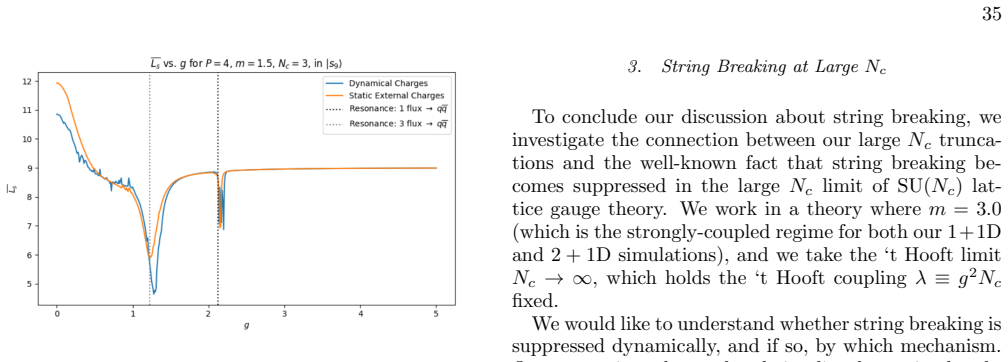
String Breaking in2 + 1D For a hexagonal plaquette chain consisting ofP= 4 plaquettes, we can now repeat much of the same analysis as in the 1 + 1D case above. We perform simulations for an initial string state|s 9⟩spanning 9 links (drawn in Fig. 19) atm= 1.5 andN c = 3, leavinggarbitrary for now. On the hexagonal lattice, the simplest way to break this s...
-
[2]
direct product repre- sentation
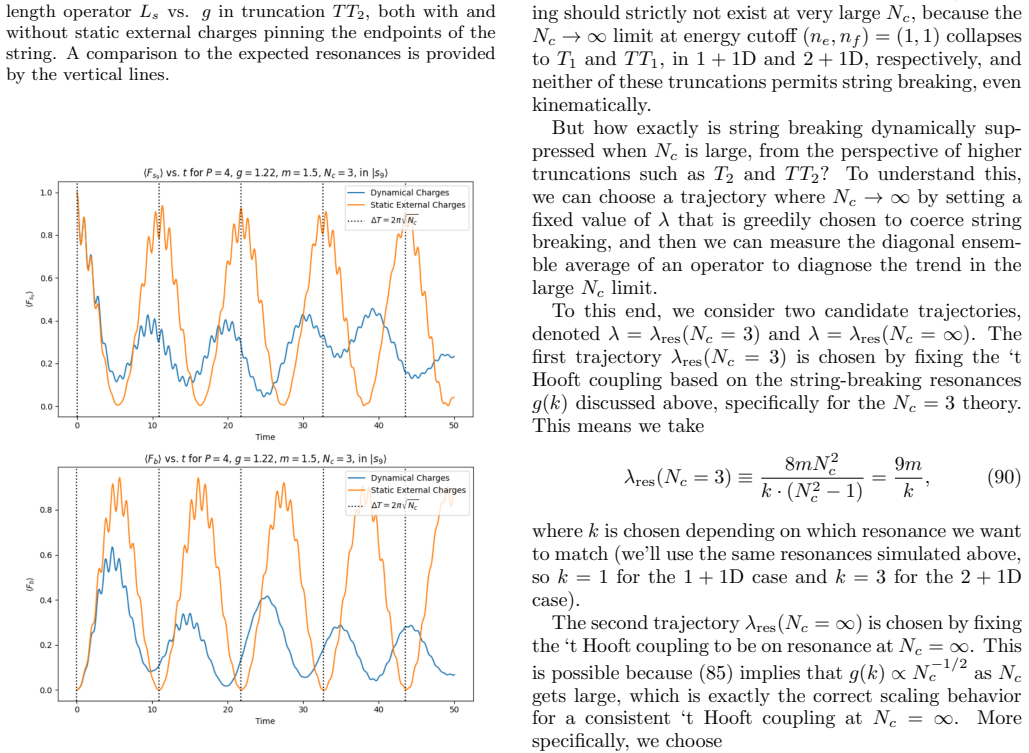
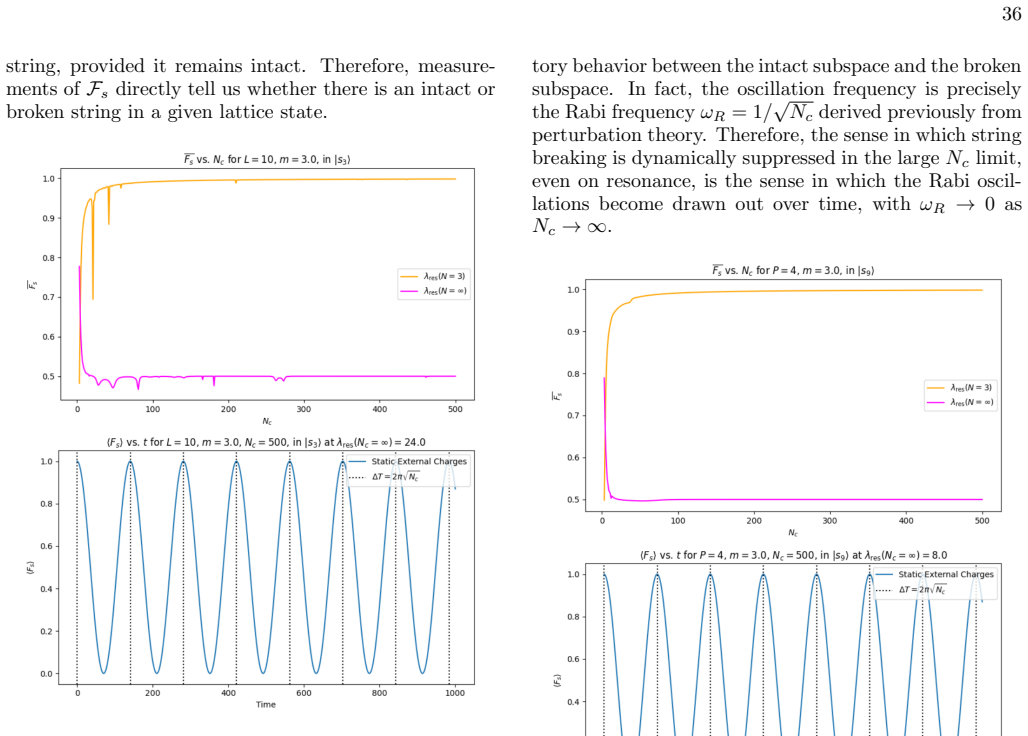
String Breaking at LargeN c To conclude our discussion about string breaking, we investigate the connection between our largeN c trunca- tions and the well-known fact that string breaking be- comes suppressed in the largeN c limit of SU(N c) lat- tice gauge theory. We work in a theory wherem= 3.0 (which is the strongly-coupled regime for both our 1+1D and...
-
[3]
Pure Gauge Theory A gauge-invariant state|ψ⟩on the entire lattice must remain invariant under every gauge transformation that acts only on a single vertex, i.e., transformations Ω n0,g : V →Gof the form Ωn0,g(n)≡ ( gifn=n 0, IdG ifn̸=n 0, (B1) 39 where IdG denotes the identity element inG. In fact, any finite gauge transformation on the lattice is generat...
-
[4]
Gauge Theory with Fermions Given the constructions in the pure gauge case, we now need to take into account the extra fermion degrees of freedom to upgrade our previous definitions. The primary object that enters the picture is a copy of the fermionic Fock space at each lattice site Pn ≡ NcM p=0 p^ j=1 VN ,(B8) whereV N ∼= CNc denotes the target s...
-
[5]
Weinberg,The Quantum Theory of Fields(Cam- bridge University Press, 1995)
S. Weinberg,The Quantum Theory of Fields(Cam- bridge University Press, 1995)
work page 1995
-
[6]
C. Gattringer and C. Lang,Quantum Chromodynamics on the Lattice: An Introductory Presentation(Springer Science & Business Media, 2009)
work page 2009
-
[7]
Zee,Quantum Field Theory in a Nutshell(Princeton University Press, 2003)
A. Zee,Quantum Field Theory in a Nutshell(Princeton University Press, 2003)
work page 2003
- [8]
-
[9]
J. B. Kogut, Rev. Mod. Phys.51, 659 (1979)
work page 1979
-
[10]
H. J. Rothe,Lattice Gauge Theories: An Introduction (Fourth Edition)(World Scientific Publishing Company, 2012)
work page 2012
-
[11]
K. G. Wilson, Physical Review D10, 2445 (1974)
work page 1974
-
[12]
K. G. Wilson, inNew Phenomena in Subnuclear Physics: Part A, edited by A. Zichichi (Springer US, Boston, MA, 1977) pp. 69–142
work page 1977
- [13]
- [14]
- [15]
-
[16]
Creutz,Lattice Gauge Theory and Monte Carlo Methods, Tech
M. Creutz,Lattice Gauge Theory and Monte Carlo Methods, Tech. Rep. BNL-42086 (Brookhaven National Lab. (BNL), Upton, NY (United States), 1988)
work page 1988
-
[17]
Creutz, Nuclear Physics B - Proceedings Supple- ments10, 1 (1989)
M. Creutz, Nuclear Physics B - Proceedings Supple- ments10, 1 (1989)
work page 1989
-
[18]
I. Montvay and G. M¨ unster,Quantum Fields on a Lat- tice, Cambridge Monographs on Mathematical Physics (Cambridge University Press, 1994)
work page 1994
-
[19]
T. D. Kieu and C. J. Griffin, Phys. Rev. E49, 3855 (1994)
work page 1994
- [20]
- [21]
-
[22]
G. S. Bali, H. Neff, T. D¨ ussel, T. Lippert, and K. Schilling (SESAM Collaboration), Phys. Rev. D71, 114513 (2005)
work page 2005
- [23]
- [24]
-
[25]
D. C. Hackett, K. Howe, C. Hughes, W. Jay, E. T. Neil, and J. N. Simone, Physical Review A99, 062341 (2019)
work page 2019
- [26]
-
[27]
Simulating QCD at finite density
P. de Forcrand, “Simulating qcd at finite density,” (2010), arXiv:1005.0539 [hep-lat]
work page internal anchor Pith review Pith/arXiv arXiv 2010
-
[28]
R. K. Ellis, W. J. Stirling, and B. R. Webber,QCD and Collider Physics(Cambridge University Press, 2003)
work page 2003
-
[29]
Schollw¨ ock, Annals of Physics January 2011 Special Issue,326, 96 (2011)
U. Schollw¨ ock, Annals of Physics January 2011 Special Issue,326, 96 (2011)
work page 2011
- [30]
-
[31]
S. Montangero,Introduction to Tensor Network Meth- ods: Numerical Simulations of Low-Dimensional Many- Body Quantum Systems(Springer International Pub- lishing, Cham, 2018)
work page 2018
-
[32]
Or´ us, Nature Reviews Physics1, 538 (2019)
R. Or´ us, Nature Reviews Physics1, 538 (2019)
work page 2019
- [34]
-
[35]
Tensor net- works for lattice gauge theories beyond one dimen- sion: A roadmap,
G. Magnifico, G. Cataldi, M. Rigobello, P. Majcen, D. Jaschke, P. Silvi, and S. Montangero, “Tensor net- works for lattice gauge theories beyond one dimen- sion: A roadmap,” (2024), arXiv:2407.03058 [cond- mat, physics:hep-lat, physics:hep-th, physics:physics, physics:quant-ph]
- [36]
-
[37]
T. Pichler, M. Dalmonte, E. Rico, P. Zoller, and S. Montangero, Physical Review X6, 011023 (2016)
work page 2016
- [38]
- [39]
-
[40]
Y. Kuno, S. Sakane, K. Kasamatsu, I. Ichinose, and T. Matsui, Physical Review D95, 094507 (2017)
work page 2017
-
[41]
P. Sala, T. Shi, S. K¨ uhn, M. C. Ba˜ nuls, E. Demler, and J. I. Cirac, Physical Review D98, 034505 (2018)
work page 2018
- [42]
-
[43]
J. Park, Y. Kuno, and I. Ichinose, Phys. Rev. A100, 013629 (2019)
work page 2019
-
[44]
F. M. Surace, P. P. Mazza, G. Giudici, A. Lerose, A. Gambassi, and M. Dalmonte, Phys. Rev. X10, 021041 (2020)
work page 2020
-
[45]
G. Magnifico, M. Dalmonte, P. Facchi, S. Pascazio, F. V. Pepe, and E. Ercolessi, Quantum4, 281 (2020)
work page 2020
-
[46]
S. Notarnicola, M. Collura, and S. Montangero, Physi- cal Review Research2, 013288 (2020)
work page 2020
- [47]
-
[48]
String breaking in a$2+1$d$\mathbb{Z} 2$lattice gauge theory,
U. Borla, J. J. Osborne, S. Moroz, and J. C. Halimeh, “String breaking in a$2+1$d$\mathbb{Z} 2$lattice gauge theory,” (2025), arXiv:2501.17929 [quant-ph]
-
[49]
String breaking dynamics and glueball formation in a$2+1$d lattice gauge theory,
K. Xu, U. Borla, S. Moroz, and J. C. Halimeh, “String breaking dynamics and glueball formation in a$2+1$d lattice gauge theory,” (2025), arXiv:2507.01950 [hep- lat]
-
[50]
Role of plaquette term in gen- uine$2+1$d string dynamics on quantum simulators,
Y. Tian, N. S. Srivatsa, K. Xu, J. J. Osborne, U. Borla, and J. C. Halimeh, “Role of plaquette term in gen- uine$2+1$d string dynamics on quantum simulators,” (2025), arXiv:2508.05736 [quant-ph]
- [51]
-
[52]
Roughening and dynam- ics of an electric flux string in a (2+1)d lattice gauge 50 theory,
F. D. Marcantonio, S. Pradhan, S. Vallecorsa, M. C. Ba˜ nuls, and E. R. Ortega, “Roughening and dynam- ics of an electric flux string in a (2+1)d lattice gauge 50 theory,” (2025), arXiv:2505.23853 [hep-lat]
-
[53]
W.-T. Xu, M. Knap, and F. Pollmann, Physical Review Letters135, 036503 (2025)
work page 2025
-
[54]
C. Artiaco, J. Barata, and E. Rico, “Out-of-equilibrium dynamics in a u(1) lattice gauge theory via local infor- mation flows: Scattering and string breaking,” (2025), arXiv:2510.16101 [quant-ph]
-
[55]
G. Cataldi, S. Orlando, and J. C. Halimeh, “Real-time string dynamics in a 2+1d non-abelian lattice gauge the- ory: String breaking, glueball formation, baryon block- ade, and tension reduction,” (2025), arXiv:2509.08868 [hep-lat]
-
[56]
String breaking and glueball dynam- ics in 2 + 1d quantum link electrodynamics,
J. Cao, R. Joshi, Y. Tian, N. S. Srivatsa, and J. C. Halimeh, “String breaking and glueball dynam- ics in 2 + 1d quantum link electrodynamics,” (2026), arXiv:2601.16166 [hep-lat]
-
[57]
G. Magnifico, G. Cataldi, M. Rigobello, P. Majcen, D. Jaschke, P. Silvi, and S. Montangero, Communi- cations Physics8, 322 (2025)
work page 2025
- [58]
- [59]
-
[60]
M. Aidelsburgeret al., Phil. Trans. Roy. Soc. Lond. A380, 20210064 (2021), arXiv:2106.03063 [cond- mat.quant-gas]
-
[61]
E. Zohar, Philosophical Transactions of the Royal Soci- ety A: Mathematical, Physical and Engineering Sciences 380, 20210069 (2021)
work page 2021
-
[62]
J. a. Barata, X. Du, M. Li, W. Qian, and C. A. Salgado, Phys. Rev. D106, 074013 (2022)
work page 2022
-
[63]
N. Klco, A. Roggero, and M. J. Savage, Reports on Progress in Physics85, 064301 (2022)
work page 2022
-
[64]
J. a. Barata, X. Du, M. Li, W. Qian, and C. A. Salgado, Phys. Rev. D108, 056023 (2023)
work page 2023
-
[65]
J. Barata, W. Gong, and R. Venugopalan, “Realtime dynamics of hyperon spin correlations from string frag- mentation in a deformed four-flavor Schwinger model,” (2024), arXiv:2308.13596 [hep-ph]
-
[66]
C. W. Bauer, Z. Davoudi, A. B. Balantekin, T. Bhat- tacharya, M. Carena, W. A. de Jong, P. Draper, A. El-Khadra, N. Gemelke, M. Hanada, D. Kharzeev, H. Lamm, Y.-Y. Li, J. Liu, M. Lukin, Y. Meurice, C. Monroe, B. Nachman, G. Pagano, J. Preskill, E. Ri- naldi, A. Roggero, D. I. Santiago, M. J. Savage, I. Sid- diqi, G. Siopsis, D. Van Zanten, N. Wiebe, Y. Ya...
work page 2023
-
[67]
C. W. Bauer, Z. Davoudi, N. Klco, and M. J. Savage, Nature Reviews Physics5, 420 (2023)
work page 2023
-
[68]
A. Di Meglio, K. Jansen, I. Tavernelli, C. Alexandrou, S. Arunachalam, C. W. Bauer, K. Borras, S. Carrazza, A. Crippa, V. Croft, R. de Putter, A. Delgado, V. Dun- jko, D. J. Egger, E. Fern´ andez-Combarro, E. Fuchs, L. Funcke, D. Gonz´ alez-Cuadra, M. Grossi, J. C. Hal- imeh, Z. Holmes, S. K¨ uhn, D. Lacroix, R. Lewis, D. Lucchesi, M. L. Martinez, F. Melo...
work page 2024
-
[69]
S. Hariprakash, N. S. Modi, M. Kreshchuk, C. F. Kane, and C. W. Bauer, Phys. Rev. A111, 022419 (2025), arXiv:2312.11637 [quant-ph]
-
[70]
Emergent gauge theory in ry- dberg atom arrays,
Y. Cheng and H. Zhai, “Emergent gauge theory in ry- dberg atom arrays,” (2024), arXiv:2401.07708 [cond- mat, physics:hep-lat, physics:hep-th, physics:quant-ph]
-
[71]
Stabilizing gauge theo- ries in quantum simulators: A brief review,
J. C. Halimeh and P. Hauke, “Stabilizing gauge theo- ries in quantum simulators: A brief review,” (2022), arXiv:2204.13709 [cond-mat]
-
[72]
Quantum algorithms for transport coefficients in gauge theories,
T. D. Cohen, H. Lamm, S. Lawrence, and Y. Yamauchi, “Quantum algorithms for transport coefficients in gauge theories,” (2021)
work page 2021
-
[73]
J. a. Barata and S. Mukherjee, Phys. Rev. D111, L031901 (2025)
work page 2025
-
[74]
K. Lee, F. Turro, and X. Yao, Physical Review D111, 054514 (2025)
work page 2025
- [75]
-
[76]
J. C. Halimeh, M. Aidelsburger, F. Grusdt, P. Hauke, and B. Yang, Nature Physics21, 25 (2025)
work page 2025
-
[77]
Efficient use of quantum computers for collider physics,
C. W. Bauer, “Efficient use of quantum computers for collider physics,” (2025), arXiv:2503.16602 [hep-ph]
-
[78]
Quantum simulation of out-of-equilibrium dynamics in gauge theories,
J. C. Halimeh, N. Mueller, J. Knolle, Z. Papi´ c, and Z. Davoudi, “Quantum simulation of out-of-equilibrium dynamics in gauge theories,” (2025), arXiv:2509.03586 [quant-ph]
- [79]
-
[80]
E. A. Martinez, C. A. Muschik, P. Schindler, D. Nigg, A. Erhard, M. Heyl, P. Hauke, M. Dalmonte, T. Monz, P. Zoller, and R. Blatt, Nature534, 516 (2016)
work page 2016
-
[81]
N. Klco, E. F. Dumitrescu, A. J. McCaskey, T. D. Mor- ris, R. C. Pooser, M. Sanz, E. Solano, P. Lougovski, and M. J. Savage, Physical Review A98, 032331 (2018)
work page 2018
discussion (0)
Sign in with ORCID, Apple, or X to comment. Anyone can read and Pith papers without signing in.