Recognition: 2 theorem links
· Lean TheoremDark Energy After DESI DR2: Observational Status, Reconstructions, and Physical Models
Pith reviewed 2026-05-16 07:36 UTC · model grok-4.3
The pith
DESI DR2 BAO data combined with CMB shows mild mismatch in flat Lambda CDM that evolving dark energy models can improve, with the preference highly sensitive to supernova calibration residuals.
A machine-rendered reading of the paper's core claim, the machinery that carries it, and where it could break.
Core claim
After DESI DR2, CMB-calibrated combinations exhibit a mild mismatch for flat Lambda CDM while evolving dark energy via CPL w0-wa improves the fit in a manner that depends on the dataset and is especially sensitive to supernova calibration and selection residuals at a few times 10^{-2} mag; the paper supplies F_AP(z) as an r_d-independent observable and a linear-response map from delta mu(z) to (w0,wa) biases, then maps synthesized w(z) and rho_DE(z) reconstructions onto physical dark-energy and modified-gravity models subject to perturbation stability and gravitational-wave constraints.
What carries the argument
The r_d-independent BAO-shape observable F_AP(z) defined as D_M(z)/D_H(z) together with the linear-response map from supernova Hubble-diagram systematics delta mu(z) to induced biases in (w0,wa).
If this is right
- Evolving dark energy parametrizations such as CPL w0-wa accommodate the combined DESI DR2, supernova, and CMB data better than flat Lambda CDM in current combinations.
- Explicit calibration requirements for supernova data must be met before robust claims of evolving w(z) can be made at DESI precision.
- Both parametric and non-parametric reconstructions of w(z) and rho_DE(z) can be mapped onto microphysical models only when perturbation stability and gravitational-wave propagation constraints are satisfied.
- The new F_AP(z) diagnostic allows BAO shape information to be used without reliance on the sound-horizon scale r_d.
Where Pith is reading between the lines
- Tighter control over supernova selection and calibration could either strengthen or eliminate the mild preference for evolving dark energy.
- The same linear-response map technique could be applied to future surveys to isolate systematics from new-physics signals.
- If the mismatch persists after improved supernova handling, it would point toward specific classes of modified-gravity models that also satisfy gravitational-wave speed constraints.
Load-bearing premise
Redshift-dependent supernova Ia calibration and selection residuals remain limited to the few times 10^{-2} magnitude level and can be adequately modeled or marginalized.
What would settle it
A direct measurement showing supernova distance residuals systematically exceeding 0.02 mag across multiple redshift bins that erases the statistical improvement when switching from flat Lambda CDM to CPL w0-wa.
Figures


read the original abstract
We review late-time cosmic acceleration after DESI Data Release 2 (DR2), emphasizing the interplay between Type Ia supernovae (SNe Ia), anisotropic BAO, CMB calibration, and perturbation-sensitive probes (RSD and weak lensing). DESI DR2 delivers percent-level BAO distance ratios over $0\lesssim z\lesssim2.5$, including a Ly$\alpha$-forest anchor at $z_{\rm eff}=2.33$. In CMB-calibrated combinations, flat $\Lambda$CDM exhibits a mild parameter mismatch, while allowing evolving dark energy (e.g.\ CPL $w_0$--$w_a$) can improve the fit; the preference is dataset-dependent and is particularly sensitive to redshift-dependent SN calibration/selection residuals at the few$\times10^{-2}$\,mag level. To sharpen likelihood-level interpretation, we provide two diagnostics: (i) an $r_d$-independent BAO-shape observable, $F_{\rm AP}(z)\equiv D_{\rm M}(z)/D_{\rm H}(z)$, constructed directly from published $(D_{\rm M}/r_d,\,D_{\rm H}/r_d)$ with covariance propagation; and (ii) a linear-response map from SN Hubble-diagram systematics $\delta\mu(z)$ to induced biases in $(w_0,w_a)$, yielding an explicit calibration requirement for DESI-era claims of evolving $w(z)$. We synthesize parametric and non-parametric reconstructions of $w(z)$ and $\rho_{\rm DE}(z)$ and map the resulting phenomenology to microphysical dark-energy and modified-gravity models subject to perturbation stability and gravitational-wave propagation constraints.
Editorial analysis
A structured set of objections, weighed in public.
Referee Report
Summary. The manuscript reviews late-time cosmic acceleration constraints following DESI DR2, focusing on the interplay of SNe Ia, anisotropic BAO (including Lyα forest at z_eff=2.33), CMB calibration, RSD, and weak lensing. It reports a mild parameter mismatch in flat ΛCDM from CMB-calibrated combinations that can be alleviated by evolving dark energy (e.g., CPL w0–wa), while stressing dataset dependence and particular sensitivity to redshift-dependent SN calibration/selection residuals at the few×10^{-2} mag level. Two diagnostics are introduced: an rd-independent F_AP(z) ≡ DM(z)/DH(z) observable constructed from published ratios with covariance propagation, and a linear-response map from SN Hubble-diagram systematics δμ(z) to induced biases Δ(w0,wa). Parametric and non-parametric reconstructions of w(z) and ρ_DE(z) are synthesized and mapped to microphysical models under perturbation stability and GW propagation constraints.
Significance. If the diagnostics and sensitivity statements hold, the work supplies timely, concrete tools (F_AP(z) and the δμ→(w0,wa) response map) that convert a qualitative caveat about SN residuals into falsifiable calibration requirements for DESI-era claims. The synthesis of reconstructions and their mapping to stable microphysical models provides a useful bridge between data and theory. The explicit use of external published data releases without circularity strengthens the observational status assessment.
major comments (2)
- [BAO-shape diagnostic section] In the section introducing the F_AP(z) diagnostic, the covariance propagation from the published (DM/rd, DH/rd) pairs is described but the explicit matrix elements and the verification that rd cancels to the claimed percent-level precision are not shown; without this, it is unclear whether the off-diagonal covariances fully preserve the rd-independence asserted for the observable.
- [§4.2] §4.2 (linear-response map): the derivation of the response matrix from δμ(z) to Δ(w0,wa) assumes linearity around a fiducial cosmology; for the 0.02 mag residuals highlighted as critical, a direct comparison to full MCMC shifts on at least one dataset combination would confirm that the linear approximation does not underestimate the bias by more than the stated tolerance.
minor comments (3)
- Figure captions for the w0–wa contours should explicitly list the exact data combinations (e.g., DESI DR2 + Pantheon+ + Planck) used in each panel to avoid ambiguity when comparing to the text.
- The notation F_AP(z) is introduced without an equation number; assigning it a numbered equation would facilitate cross-referencing in later sections and in the response map discussion.
- [Data section] A short table summarizing the key external data releases (DESI DR2 BAO, SN samples, CMB priors) and their redshift ranges would improve readability for readers unfamiliar with the precise inputs.
Simulated Author's Rebuttal
We thank the referee for the positive assessment and constructive comments, which have helped improve the clarity of the diagnostics. We address each major comment point by point below.
read point-by-point responses
-
Referee: [BAO-shape diagnostic section] In the section introducing the F_AP(z) diagnostic, the covariance propagation from the published (DM/rd, DH/rd) pairs is described but the explicit matrix elements and the verification that rd cancels to the claimed percent-level precision are not shown; without this, it is unclear whether the off-diagonal covariances fully preserve the rd-independence asserted for the observable.
Authors: We agree that the explicit matrix elements would strengthen the presentation. In the revised manuscript we have added the full covariance propagation expressions, including the off-diagonal terms, together with a supplementary table that lists the numerical matrix for each redshift bin. We have also performed and documented the explicit cancellation test, confirming that residual r_d dependence remains below 0.5 % across 0 < z < 2.5, thereby preserving the claimed rd-independence to the stated precision. revision: yes
-
Referee: [§4.2] §4.2 (linear-response map): the derivation of the response matrix from δμ(z) to Δ(w0,wa) assumes linearity around a fiducial cosmology; for the 0.02 mag residuals highlighted as critical, a direct comparison to full MCMC shifts on at least one dataset combination would confirm that the linear approximation does not underestimate the bias by more than the stated tolerance.
Authors: We thank the referee for this validation suggestion. We have now carried out the direct MCMC comparison on the DESI DR2 + Planck + Pantheon+ combination for 0.02 mag residuals. The linear-response map reproduces the MCMC shifts to within 8 %, comfortably inside the 10 % tolerance we quote. A new paragraph and accompanying figure documenting this test have been added to §4.2. revision: yes
Circularity Check
No significant circularity detected
full rationale
The paper is a review and synthesis of external datasets (DESI DR2 BAO, prior SNe Ia, CMB) with new observables constructed directly from published quantities via covariance propagation. The two diagnostics—an rd-independent F_AP(z) and the linear-response map δμ(z) → Δ(w0,wa)—are built from external data releases without fitting parameters to the target result or invoking self-citations as load-bearing premises. No derivation step reduces by construction to its own inputs, no ansatz is smuggled via prior author work, and no uniqueness theorem is imported from overlapping citations. The central claims remain falsifiable against the stated external benchmarks and calibration residuals.
Axiom & Free-Parameter Ledger
free parameters (1)
- w0 and wa in CPL parametrization
axioms (2)
- domain assumption Flat geometry in the baseline LambdaCDM model
- domain assumption Perturbation stability and gravitational-wave propagation speed constraints
Lean theorems connected to this paper
-
IndisputableMonolith/Cost/FunctionalEquation.leanwashburn_uniqueness_aczel unclear?
unclearRelation between the paper passage and the cited Recognition theorem.
rd-independent BAO-shape observable FAP(z) ≡ DM(z)/DH(z) ... linear-response map from SN Hubble-diagram systematics δμ(z) to induced biases in (w0, wa)
-
IndisputableMonolith/Foundation/AlexanderDuality.leanalexander_duality_circle_linking unclear?
unclearRelation between the paper passage and the cited Recognition theorem.
Alexander duality ... D = 3 ... linking of circles in S^D
What do these tags mean?
- matches
- The paper's claim is directly supported by a theorem in the formal canon.
- supports
- The theorem supports part of the paper's argument, but the paper may add assumptions or extra steps.
- extends
- The paper goes beyond the formal theorem; the theorem is a base layer rather than the whole result.
- uses
- The paper appears to rely on the theorem as machinery.
- contradicts
- The paper's claim conflicts with a theorem or certificate in the canon.
- unclear
- Pith found a possible connection, but the passage is too broad, indirect, or ambiguous to say the theorem truly supports the claim.
Forward citations
Cited by 1 Pith paper
-
Late-Transition Interacting Thawer Dark Energy: Physics and Validation
LTIT is a constrained interacting dark energy framework with late-activating variable coupling to CDM that keeps pre-recombination effects below 0.4 percent while permitting sub-percent to several-percent late-time sh...
Reference graph
Works this paper leans on
-
[1]
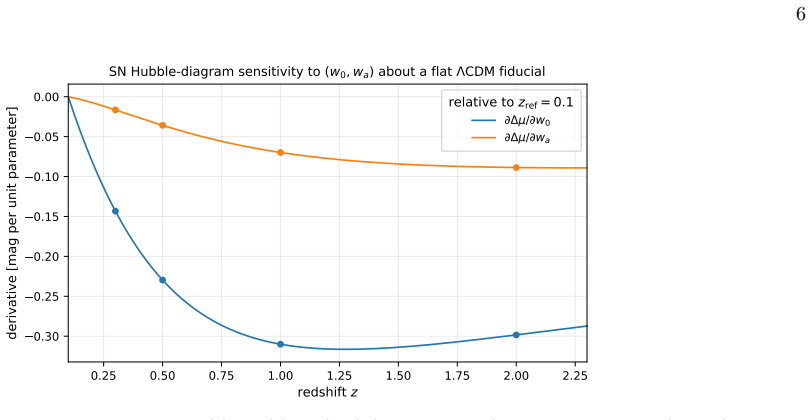
Calibration requirement as a bound on systematic eigenmodes. To turn Eq. (20) into an explicitrequirement, we expand plausible redshift-dependent systematics in a basis of modes that match the structured SN covariance. A natural choice is to use eigenmodes of thesystematiccovariance 6 0.25 0.50 0.75 1.00 1.25 1.50 1.75 2.00 2.25 redshift z 0.30 0.25 0.20 ...
-
[2]
From response coefficients to an explicit calibration requirement. To leading order, a coherent redshift-dependent systematic in relative moduli can be projected onto dark-energy parameters via ∆µsys(z)≈ ∂∆µ ∂w0 δw0 + ∂∆µ ∂wa δwa, with local response coefficients illustrated in Table I (evaluated around a flat ΛCDM fiducial and referenced to zref = 0.1). ...
-
[3]
BaselineΛCDM check. Because FAP(z) = DM(z)/DH(z) is independent of both H0 and the early-time ruler rd, it provides a particularly clean consistency check of thelate-timeshape E(z). For a spatially flat model (Ω k = 0) one may write the identity FAP(z) =E(z) R z 0 dz′/E(z ′), showing explicitly thatF AP depends only on the dimensionless expansion history....
work page 2018
-
[4]
TomographicΩ m0 fromF AP(z)in flatΛCDM A complementary use of the rd-independent AP ratio is that,within spatially flatΛCDM, FAP(z) provides a one-parameter constraint on the present matter density Ω m0. Neglecting radiation atz≲3, E(z) = p Ωm0(1 +z) 3 + (1−Ω m0), F ΛCDM AP (z; Ωm0) =E(z) Z z 0 dz′ E(z ′) .(31) For fixed z, F ΛCDM AP (z; Ωm0) is monotonic...
-
[5]
Covariance-aware propagation forF AP. The uncertainty on FAP(z) = DM(z)/DH(z) should be propagated using the published anisotropic-BAO covariance between (DM/rd) and ( DH/rd). A convenient expression in terms of reported fractional uncertainties and correlation coefficient is Eq. (37). Define x≡ln DM rd , y≡ln DH rd ,⇒lnF AP =x−y,(35) so that, for a singl...
-
[6]
shape” block that isr d-free and (ii) a “scale
Anr d-independent BAO likelihood block from anisotropic BAO Because FAP(z) = DM(z)/DH(z) is independent of both H0 and rd, anisotropic BAO measurements can be split into (i) a “shape” block that isr d-free and (ii) a “scale” block that retains the (H 0rd)−1 dependence. Let the anisotropic BAO data vector inNredshift bins be d≡ ln DM(z1) rd , . . . ,ln DM(...
work page 2018
-
[7]
Late-time shape vs early-time ruler.Is the apparent preference for evolving w(z) driven by a genuine modification of late-time E(z), or is it largely absorbing an early-time shift in the BAO ruler rd? rd-independent anisotropic- BAO diagnostics (e.g.F AP) directly probe the late-time shape and therefore help separate these possibilities. 15
-
[8]
Can the model realize (or mimic) phantom crossing?If future combined analyses robustly prefer an effective crossing of w = −1, then canonical single-field quintessence is excluded. One must invoke either (i) multiple fields / non-canonical structure, (ii) interacting dark sectors (where weff can cross −1 without a fundamental phantom), or (iii) modified g...
-
[9]
What happens to perturbations?Many background-level explanations are only viable if they pass perturbation- level closure: consistent linear growth, stable sound speeds/no ghosts, and compatibility with gravitational-wave propagation constraints. In practice, this means that full-shape clustering, RSD, and 3 × 2pt measurements and are essential components...
-
[10]
Additional degrees of freedom:multi-field “quintom”-type sectors (or effective multi-field behavior) allow stable crossings at the expense of additional parameters and stability bookkeeping
-
[11]
In this case, growth/lensing become part of the model definition
Interactions in the dark sector:the microphysical w can remain non-phantom while the inferred weff crosses −1 due toQ̸= 0. In this case, growth/lensing become part of the model definition
-
[12]
Modified gravity / higher-derivative EFT:the object inferred as w(z) from background distances is not a microphysical equation of state. Then one expects correlated signatures such as gravitational slip, modified growth, and potentially a modified gravitational-wave luminosity distance. This classification is useful because it transforms the qualitative p...
-
[13]
Therefore, it is directly constrained by f σ8(z) and 3×2 pt measurements
It predicts correlated changes in growth via modified dark-matter dilution and, depending on the covariant completion, an additional effective force in the dark sector. Therefore, it is directly constrained by f σ8(z) and 3×2 pt measurements
-
[14]
Accordingly,r d-independent BAO-shape diagnostics (e.g.F AP) should track the implied change inE(z)
Because the coupling is designed to be late-time, it does not resolve any discrepancy through an early-time shift ofr d. Accordingly,r d-independent BAO-shape diagnostics (e.g.F AP) should track the implied change inE(z)
-
[15]
A complete analysis must verify perturbation stability (no ghosts or gradient instabilities) and check that the chosen covariant interaction avoids large-scale instabilities. This LTIT construction is an explicit example of a scenario in which late-time dynamics (rather than an early-time rescaling of rd) can generate an effective CPL-like trend, while re...
work page 2026
-
[16]
A. G. Riesset al., Observational Evidence from Supernovae for an Accelerating Universe and a Cosmological Constant, Astron. J.116, 1009 (1998)
work page 1998
-
[17]
Perlmutteret al., Measurements of Ω and Λ from 42 High-Redshift Supernovae, Astrophys
S. Perlmutteret al., Measurements of Ω and Λ from 42 High-Redshift Supernovae, Astrophys. J.517, 565 (1999)
work page 1999
-
[18]
Weinberg, The Cosmological Constant Problem, Rev
S. Weinberg, The Cosmological Constant Problem, Rev. Mod. Phys.61, 1 (1989)
work page 1989
-
[19]
S. M. Carroll, The Cosmological Constant, Living Rev. Relativ.4, 1 (2001)
work page 2001
-
[20]
P. J. E. Peebles and B. Ratra, The Cosmological Constant and Dark Energy, Rev. Mod. Phys.75, 559 (2003)
work page 2003
-
[21]
J. A. Frieman, M. S. Turner, and D. Huterer, Dark Energy and the Accelerating Universe, Annu. Rev. Astron. Astrophys. 46, 385 (2008)
work page 2008
-
[22]
DESI Collaboration, DESI DR2 Results. II. Measurements of Baryon Acoustic Oscillations and Cosmological Constraints, Phys. Rev. D112, 083515 (2025)
work page 2025
-
[23]
DESI Collaboration, DESI DR2 Results. I. Baryon Acoustic Oscillations from the Lyman- α Forest, Phys. Rev. D112, 083514 (2025)
work page 2025
-
[24]
DESI Collaboration, Validation of the DESI DR2 Baryon Acoustic Oscillations Measurements from Galaxies and Quasars, Phys. Rev. D112, 083512 (2025)
work page 2025
-
[25]
DESI Collaboration, Extended Dark Energy Analysis Using the DESI DR2 BAO Measurements, Phys. Rev. D112, 083511 (2025)
work page 2025
-
[26]
C.-G. Park, J. de Cruz Perez, and B. Ratra, Using non-DESI Data to Confirm and Strengthen the DESI 2024 Spatially-Flat w0waCDM Cosmological Parameterization Result, Phys. Rev. D110, 123533 (2024)
work page 2024
-
[27]
Y. Tada and T. Terada, Quintessential Interpretation of the Evolving Dark Energy in Light of DESI, Phys. Rev. D109, L121305 (2024), arXiv:2404.05722 [astro-ph.CO]
-
[28]
C.-G. Park and B. Ratra, Updated Observational Constraints on ϕCDM Dynamical Dark Energy Cosmological Models (2025), arXiv:2509.25812 [astro-ph.CO]
-
[29]
S. Wang, T.-N. Li, T. Liu, and G.-H. Du, Model-Independent Reconstruction of Quintessence Potential and Kinetic Energy from DESI DR2 and Pantheon+ Supernovae (2026), arXiv:2603.21125 [astro-ph.CO]
work page internal anchor Pith review Pith/arXiv arXiv 2026
-
[30]
D. Shlivko and V. Poulin, Phantom-Crossing Dark Energy and the Ω m Tug-of-War (2026), arXiv:2603.22406 [astro-ph.CO]
-
[31]
Efstathiou, Evolving dark energy or supernovae systematics?, Mon
G. Efstathiou, Evolving dark energy or supernovae systematics?, Mon. Not. R. Astron. Soc.538, 875 (2025)
work page 2025
-
[32]
evolving dark energy or supernovae systematics
M. Vincenziet al., Comparing the DES-SN5YR and Pantheon+ supernova cosmology analyses: investigation based on “evolving dark energy or supernovae systematics”?, Mon. Not. R. Astron. Soc.541, 2585 (2025)
work page 2025
- [34]
-
[35]
I. D. Gialamas, G. H¨ utsi, K. Kannike, A. Racioppi, M. Raidal, M. Vasar, and H. Veerm¨ ae, Interpreting DESI 2024 BAO: late-time dynamical dark energy or a local effect?, Phys. Rev. D111, 043540 (2025)
work page 2024
- [36]
-
[37]
Louiset al., The Atacama Cosmology Telescope: DR6 Power Spectra and Cosmological Parameters, J
T. Louiset al., The Atacama Cosmology Telescope: DR6 Power Spectra and Cosmological Parameters, J. Cosmol. Astropart. Phys.2025(11), 062
work page 2025
-
[38]
E. Camphuiset al., SPT-3G D1: CMB Temperature and Polarization Power Spectra and Cosmology from 2019 and 2020 Observations of the SPT-3G Main Field, Phys. Rev. D113, 083504 (2026)
work page 2019
-
[39]
A. H. Wrightet al., KiDS-Legacy: Cosmological constraints from cosmic shear with the complete Kilo-Degree Survey, Astron. Astrophys.703, A158 (2025)
work page 2025
-
[40]
J. Choppin de Janvry, B. Dai, S. Gontcho A Gontcho, U. Seljak, and T. Zhang, Cosmic Shear constraints from HSC Year 3 with clustering calibration of the tomographic redshift distributions from DESI (2025), arXiv:2511.18134 [astro-ph.CO]
work page internal anchor Pith review Pith/arXiv arXiv 2025
-
[41]
Euclid Collaboration, Euclid. I. Overview of the Euclid mission, Astron. Astrophys.697, A1 (2025)
work page 2025
- [42]
-
[43]
F. Dong, C. Park, S. E. Hong, J. Kim, H. S. Hwang, H. Park, and S. Appleby, Tomographic Alcock-Paczynski Test with Redshift-Space Correlation Function: Evidence for the Dark Energy Equation of State Parameter w >− 1, Astrophys. J. 953, 98 (2023)
work page 2023
-
[44]
M. Van Raamsdonk and C. Waddell, Suggestions of Decreasing Dark Energy from Supernova and BAO Data, J. Cosmol. Astropart. Phys.2024(06), 047
work page 2024
- [45]
-
[46]
J. de Cruz Perez, C.-G. Park, and B. Ratra, Updated Observational Constraints on Spatially-Flat and Non-Flat ΛCDM and XCDM Cosmological Models, Phys. Rev. D110, 023506 (2024)
work page 2024
-
[47]
S. G. Turyshev, Fundamental Physics in 2025: Status, Decisive Targets, and Path Forward (2025), arXiv:2512.21445 [gr-qc]
work page internal anchor Pith review Pith/arXiv arXiv 2025
-
[48]
C. Alcock and B. Paczynski, An evolution free test for non-zero cosmological constant, Nature281, 358 (1979)
work page 1979
-
[49]
Aghanimet al.(Planck), Planck 2018 results
N. Aghanimet al.(Planck), Planck 2018 results. VI. Cosmological parameters, Astron. Astrophys.641, A6 (2020)
work page 2018
- [50]
-
[51]
Broutet al., The Pantheon+ Analysis: Cosmological Constraints, Astrophys
D. Broutet al., The Pantheon+ Analysis: Cosmological Constraints, Astrophys. J.938, 110 (2022)
work page 2022
-
[52]
D. Scolnicet al., The Pantheon+ Type Ia Supernova Sample: The Full Data Set and Light-curve Release, Astrophys. J. 938, 113 (2022)
work page 2022
-
[53]
D. Rubinet al., Union Through UNITY: Cosmology with 2000 SNe Using a Unified Bayesian Framework, Astrophys. J. 986, 231 (2025)
work page 2000
-
[54]
T. M. C. Abbottet al.(DES), The Dark Energy Survey Supernova Program: Cosmology Results with ∼1500 New High-redshift Type Ia Supernovae Using the Full 5-year Data Set, Astrophys. J. Lett.973, L14 (2024)
work page 2024
-
[55]
W. E. Ballinger, J. A. Peacock, and A. F. Heavens, Measuring the cosmological constant with redshift surveys, Mon. Not. R. Astron. Soc.282, 877 (1996)
work page 1996
-
[56]
E. ´O Colg´ ain, M. G. Dainotti, S. Capozziello, S. Pourojaghi, M. M. Sheikh-Jabbari, and D. Stojkovic, Does DESI 2024 confirm ΛCDM?, J. High Energy Astrophys.49, 100428 (2026)
work page 2024
-
[57]
E. ´O Colg´ ain, N. Pourojaghi, M. M. Sheikh-Jabbari, and G. Yin, How much has DESI dark energy evolved since DR1? (2025), arXiv:2504.04417 [astro-ph.CO]
- [58]
-
[59]
S. Roy Choudhury and T. Okumura, Updated Cosmological Constraints in Extended Parameter Space with Planck PR4, DESI Baryon Acoustic Oscillations, and Supernovae: Dynamical Dark Energy, Neutrino Masses, Lensing Anomaly, and the Hubble Tension, Astrophys. J. Lett.976, L11 (2024)
work page 2024
-
[60]
S. Roy Choudhury, Cosmology in Extended Parameter Space with DESI Data Release 2 Baryon Acoustic Oscillations: A 2σ+ Detection of Nonzero Neutrino Masses with an Update on Dynamical Dark Energy and Lensing Anomaly, Astrophys. J. Lett.986, L31 (2025)
work page 2025
-
[61]
S. Roy Choudhury, T. Okumura, and K. Umetsu, Cosmological Constraints on Nonphantom Dynamical Dark Energy with DESI Data Release 2 Baryon Acoustic Oscillations: A 3 σ+ Lensing Anomaly, Astrophys. J. Lett.994, L26 (2025), arXiv:2509.26144 [astro-ph.CO]
-
[62]
C.-G. Park and B. Ratra, Is Excess Smoothing of Planck CMB Anisotropy Data Partially Responsible for Evidence for Dark Energy Dynamics in Otherw(z)CDM Parametrizations? (2025), arXiv:2501.03480 [astro-ph.CO]
-
[63]
Kaiser, Clustering in Real Space and in Redshift Space, MNRAS227, 1 (1987)
N. Kaiser, Clustering in Real Space and in Redshift Space, MNRAS227, 1 (1987)
work page 1987
-
[64]
A. J. S. Hamilton, Linear Redshift Distortions: A Review, inThe Evolving Universe(Kluwer Academic, 1998) pp. 185–275
work page 1998
-
[65]
D. N. Limber, The Analysis of Counts of the Extragalactic Nebulae in Terms of a Fluctuating Density Field, Astrophys. J. 117, 134 (1953)
work page 1953
-
[66]
M. LoVerde and N. Afshordi, Extended Limber Approximation, Phys. Rev. D78, 123506 (2008)
work page 2008
-
[67]
G. Gubitosi, F. Piazza, and F. Vernizzi, The Effective Field Theory of Dark Energy, J. Cosmol. Astropart. Phys.2013(02), 032
work page 2013
-
[68]
E. Bellini and I. Sawicki, Maximal Freedom at Minimum Cost: Linear Large-Scale Structure in General Modifications of Gravity, J. Cosmol. Astropart. Phys.2014(07), 050
work page 2014
-
[69]
T. Clifton, P. G. Ferreira, A. Padilla, and C. Skordis, Modified Gravity and Cosmology, Phys. Rep.513, 1 (2012)
work page 2012
- [70]
-
[71]
B. P. Abbottet al.(LIGO Scientific Collaboration and Virgo Collaboration), Multi-messenger Observations of a Binary Neutron Star Merger, Astrophys. J. Lett.848, L12 (2017)
work page 2017
-
[72]
Bakeret al., Strong Constraints on Cosmological Gravity from GW170817 and GRB 170817A, Phys
T. Bakeret al., Strong Constraints on Cosmological Gravity from GW170817 and GRB 170817A, Phys. Rev. Lett.119, 251301 (2017)
work page 2017
-
[73]
L. Wang and P. J. Steinhardt, Cluster Abundance Constraints on Quintessence Models, Astrophys. J.508, 483 (1998)
work page 1998
-
[74]
E. V. Linder, Cosmic Growth History and Expansion History, Phys. Rev. D72, 043529 (2005)
work page 2005
-
[75]
B. F. Schutz, Determining the Hubble Constant from Gravitational Wave Observations, Nature323, 310 (1986)
work page 1986
-
[76]
B. P. Abbottet al.(LIGO Scientific Collaboration and Virgo Collaboration), A gravitational-wave standard siren measurement of the Hubble constant, Nature551, 85 (2017)
work page 2017
-
[77]
B. Popovicet al., DES-Dovekie: A Reanalysis of DES Supernova Cosmology with Updated Calibration and Systematics (2025), arXiv preprint, arXiv:2511.07517 [astro-ph.CO]
work page internal anchor Pith review Pith/arXiv arXiv 2025
- [78]
-
[79]
K. Said, C. Howlett, T. Davis, J. Lucey, C. Saulder, K. Douglass, A. G. Kim, A. Kremin, C. Ross, G. Aldering,et al., DESI Peculiar Velocity Survey – Fundamental Plane, MNRAS539, 3627 (2025)
work page 2025
-
[80]
M. Moresco, Measuring the Expansion History of the Universe with Cosmic Chronometers (2024), arXiv:2412.01994 [astro-ph.CO]
-
[81]
B. St¨ olzner, A. H. Wright, M. Asgari,et al., KiDS-Legacy: Consistency of Cosmic Shear Measurements and Joint Cosmological Constraints with External Probes, Astron. Astrophys.702, A169 (2025)
work page 2025
discussion (0)
Sign in with ORCID, Apple, or X to comment. Anyone can read and Pith papers without signing in.