REVIEW 3 major objections 5 minor 1 cited by
This paper establishes an exact relation tying (1+Δ/2)δ — the product of the Barrow deformation and Tsallis nonextensivity parameters — to the measured deceleration and jerk, collapsing the Barrow–Tsallis dark energy model to one parameter.
Reviewed by Pith at T0; open to challenge. T0 means a machine referee read the full paper against a public rubric. the ladder, T0–T4 →
T0 review · deepseek-v4-flash
2026-08-02 23:55 UTC pith:5YFS66RX
load-bearing objection Eq. (35) is an exact but model-class-dependent parameter reduction; the numerical estimate is undercut by an abstract/body mismatch and a prior-dominated uncertainty budget. the 3 major comments →
Cosmographic Connection Between Cosmological And Planck Scales: The Barrow-Tsallis Entropy
The pith
A machine-rendered reading of the paper's core claim, the machinery that carries it, and where it could break.
Core claim
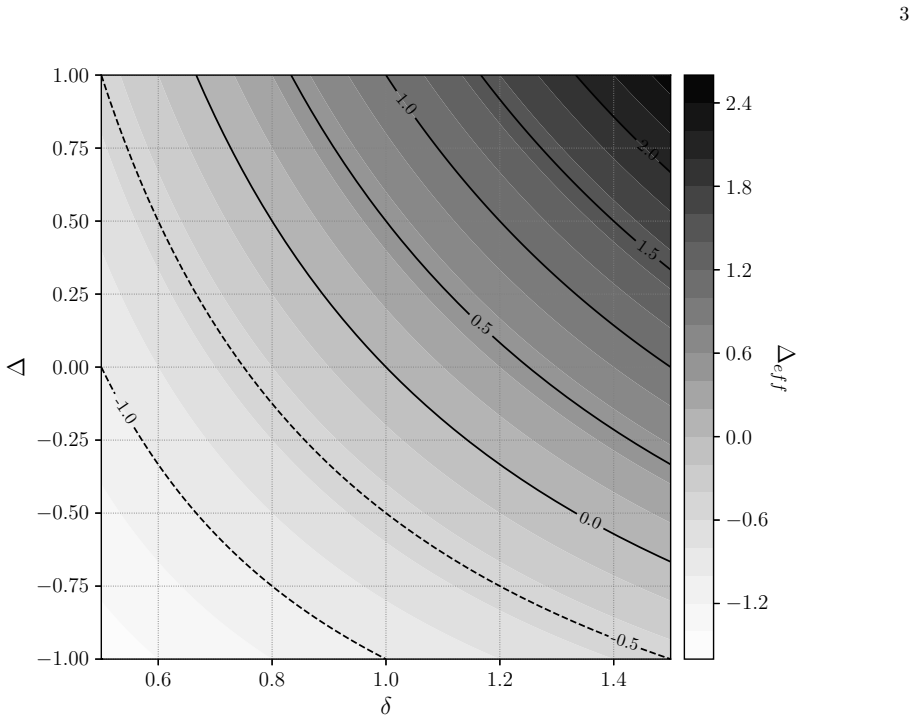
The central result is (1+Δ/2)δ = 2 − 3(1−j0)/[4(1+q0)^2(1−2q0)], where q0 and j0 are the present deceleration and jerk parameters. For any measured pair (q0, j0), all admissible (Δ, δ) pairs lie on this one-parameter curve, so the dark energy model is determined once either entropy parameter is fixed. The derivation is exact for the non-interacting power-law model class ρ_de ∝ H^α. The paper further shows that the fractional holographic dark energy exponent (3η−2)/η equals the same cosmographic function, yielding an allowed interval for j that shrinks to zero in the de Sitter limit. Applying the IR–UV correspondence to Barrow–Tsallis entropy gives the length-uncertainty bound δL ≥ γ^{−1/3} L
What carries the argument
The Barrow–Tsallis entropy S = γ(A/A_P)^{(1+Δ/2)δ} generates a holographic dark energy density ρ_de = 3βH^α with α = 4−2δ−δΔ. The cosmographic inversion solves the Friedmann and conservation equations for α in terms of the dimensionless combinations Hdot/H^2 and Hddot/H^3, which are exactly −(1+q) and j+3q+2, yielding α(q,j) = 3(1−j)/[2(1+q)^2(1−2q)]. Matching this to α = 4−2δ−δΔ produces Eq. (35). The same α(q,j) enters the fractional holographic dark energy relation and the UV-cutoff inequality, connecting macroscopic cosmic kinematics to microscopic Planck-scale length uncertainty.
Load-bearing premise
The derivation assumes the universe is exactly a two-component system — pressureless matter plus a dark-energy fluid with density 3βH^α and strictly constant α — with no interaction between the sectors; if α varies with time, or radiation, curvature, or dark-sector coupling are non-negligible, the cosmographic reconstruction α(q0,j0) and thus Eq. (35) breaks down. The numerical δ estimate additionally depends on the chosen uniform prior on Δ and uses a fixed j0 = 0.745 withou
What would settle it
Measure q(z) and j(z) at several redshifts using standard sirens and BAO data, insert each pair into α(q,j) = 3(1−j)/[2(1+q)^2(1−2q)], and check whether the reconstructed α is consistent with a single constant. Alternatively, if a measured (q,j) falls outside the allowed interval j_min(q) ≤ j ≤ j_max(q) for the fractional model with η ∈ [1,2], the constant-power-law model class — and with it Eq. (35) — is refuted.
If this is right
- If Eq. (35) is correct, more precise measurements of q0 and j0 directly constrain the combination δ(2+Δ) that controls the dark energy density, making jerk accuracy the key observational lever.
- The two-parameter Barrow–Tsallis model becomes one-parameter: determining either Δ or δ from theory or independent data fixes the other and makes sharp predictions for the dark energy equation of state.
- The fractional holographic dark energy scenario is constrained by the allowed interval j_min(q) ≤ j ≤ j_max(q); a measured (q,j) outside this interval rules out that scenario with the Hubble cutoff.
- The IR–UV correspondence generalizes the quantum-foam length-uncertainty scaling, so experiments probing spacetime foam (interferometry, gamma-ray dispersion) can in principle test the Barrow–Tsallis parameters through the exponent δ(2+Δ)/3.
- The paper's Monte Carlo estimates (δ ≈ 1.018 ± 0.174 for Δ ∈ [−0.5,0.5], δ ≈ 1.11 ± 0.57 for Δ ∈ [−1,1]) are statistically consistent with δ = 1, so current data do not yet require nonextensivity.
Where Pith is reading between the lines
- If the constant-α assumption holds, then α(q(t), j(t)) computed from Eq. (20) should be constant across cosmic time; measuring q and j at several redshifts would provide a direct consistency test, and any detected drift would falsify the entire model class.
- Because Eq. (35) fixes only the product δ(2+Δ), individual parameters may be better constrained by combining the cosmographic relation with independent entropy estimates, such as black-hole entropy or statistical-mechanics bounds.
- The near-unity value of δ suggests that, within current errors, Barrow–Tsallis entropy is observationally indistinguishable from Bekenstein–Hawking; the decisive improvement should come from gravitational-wave standard sirens reducing jerk uncertainties from roughly 100% to a few percent.
- If future large-scale surveys find (q,j) values consistently violating the allowed jerk interval for fractional holographic dark energy, that would disfavor the fractional-derivative extension while leaving the Barrow–Tsallis relation (which does not require the fractional exponent) intact.
Editorial analysis
A structured set of objections, weighed in public.
Referee Report
Summary. The paper derives, within a two-fluid Friedmann model composed of pressureless matter and a holographic dark-energy component with ρ_de = 3βH^α and constant α, an exact cosmographic reconstruction α(q,j) = (3/2)(j−1)/[(1+q)^2(q−1/2)] (Eq. 20). From this it obtains the central relation (1+Δ/2)δ = 2 − α(q0,j0)/2 (Eq. 35), which ties the Barrow parameter Δ to the Tsallis parameter δ and reduces the two-parameter Barrow–Tsallis model to a one-parameter model. The paper also presents a Monte Carlo estimate for δ, applies the reconstruction to fractional holographic dark energy, and derives a Károlyházy-type length-uncertainty bound from the Barrow–Tsallis entropy under the IR–UV correspondence. The algebraic derivation is internally consistent and correctly identified as conditional on the assumed non-interacting power-law model class.
Significance. If the model class is accepted, Eq. (35) is an elegant exact result: it converts measured cosmographic parameters q0, j0 into a constraint on the entropy parameters Δ and δ, with a clearly stated conditional status. The derivation is transparent and the paper explicitly acknowledges that model-choice uncertainty is not included. The main value is the reduction of a two-parameter entropic dark-energy model to a one-parameter model and the explicit link to the IR–UV correspondence. The significance is, however, limited by the fact that the numerical estimates are not reproducible from the text as written and the Planck-scale connection is only as secure as the underlying model assumptions.
major comments (3)
- [Abstract and §1 after Eq. (26)] The abstract reports Δ∈[-1,1] with δ=1.11±0.57, while the body text after Eq. (26) and in Fig. 3 reports Δ∈[-0.5,0.5] with δ≃1.018±0.174. This is a direct internal inconsistency in the central numerical result. Please reconcile the two statements and specify exactly which prior and which cosmographic error propagation (if any) were used for each number. As written, the quoted uncertainty and even the central value are not reproducible.
- [§1, Monte Carlo estimate near Eq. (26)] The body appears to fix q0=-0.580 and j0=0.745 and sample only Δ from a uniform prior, yielding σδ=0.174. The abstract, by contrast, claims to propagate the observational errors of q0 and j0 and to obtain a larger uncertainty. These are different calculations. In addition, j0=0.745 is used without any quoted uncertainty, although the text notes that current jerk determinations have uncertainties of order 100%. Since α(q0,j0) is proportional to j0−1, the error budget for δ is sensitive to the jerk error. Please provide the full Monte Carlo specification (distributions for q0, j0, Δ; number of samples; resulting histogram) and clarify that the body's σδ is dominated by the prior on Δ, not by cosmographic measurement error.
- [Abstract, §3, Eq. (35) and Eq. (39)] Equation (35) is exact only within the stated non-interacting, constant-α, matter-plus-power-law-dark-energy model class. The paper correctly notes this limitation, but the title and abstract claim that the relation 'determines the scaling of the microscopic length uncertainty in terms of the current cosmographic parameters' without carrying the model-dependence into the final statement. Because model-choice uncertainty is excluded from the quoted errors, the robustness of the Planck-scale connection is not quantified. I request a brief sensitivity discussion (e.g., the order-of-magnitude change in the inferred δ(2+Δ) from a small dark-sector interaction Q or from a slowly time-varying α) or an explicit recasting of the conclusions as in-model predictions. This is not a fatal flaw, but it is needed to calibrate the claimed significance.
minor comments (5)
- [Eq. (29)] The infrared length L in the fractional holographic dark energy density is not defined before the choice L=H^{-1}; please define L and clarify the dimensions.
- [Eq. (39)] The constant γ from Eq. (3) recurs in the length-uncertainty bound; please state explicitly that γ is the same constant and check the sign/dimensions of the exponent.
- [§1 after Eq. (21)] The statement that dα/dt=0 and dβ/dt=0 is asserted with a reference to [20]. Since this property is used to evaluate at t0, a one-line derivation or a more explicit citation target would improve verifiability.
- [Fig. 3 caption] The caption refers to 'the red part of the curve' illustrating the Monte Carlo distribution; if the figure is not reproduced in color, this is ambiguous. Please use a distinct line style or marker.
- [General] There are a few typographical and notational inconsistencies (e.g., β used in Eq. (33) after being defined as a model parameter; σ defined twice in §2). A careful proofread would remove these distractions.
Circularity Check
No material circularity: Eq. (35) is a conditional identity inside the stated HDE model class; the δ estimate is explicitly prior-dependent, and the cited self-works are not load-bearing.
full rationale
The central derivation chain is self-contained conditional on the stated model assumptions. The paper assumes Barrow–Tsallis holographic dark energy with ρ_de = 3βH^α and α = 4 − 2δ − δΔ (Eq. 5), then solves the non-interacting two-fluid Friedmann system (Eqs. 6–13) to obtain α(q,j) (Eqs. 14 and 20). Substituting the measured q0,j0 yields α(q0,j0), and equating it with the definition of α gives Eq. (35). The cosmographic inputs q0,j0 are external data, not outputs of the model; the algebra is explicit and exact under the assumed model class. Thus Eq. (35) does not reduce to a fitted parameter renamed as a prediction. The Monte Carlo estimate δ = 1.018 ± 0.174 is transparently a mapping of an adopted uniform prior on Δ through the exact curve δ(Δ; q0,j0); the paper states that cosmography fixes only the combination δ(2+Δ) and that an a priori distribution of Δ is required (Section 1), and the abstract explicitly excludes model-choice uncertainty from the quoted error. This is a disclosed limitation, not a hidden circular step. The self-citations ([10], [20], [37], [38]) are not load-bearing: the constancy of α and β follows from the model assumption ρ_de ∝ H^α with constant parameters, and the IR–UV bound used for Eq. (39) is the standard Bekenstein-type bound, re-derived in the text rather than imported solely from prior work. No circular step satisfies the requirement of an exhibited Eq.-to-Eq. reduction of a claimed prediction to its inputs.
Axiom & Free-Parameter Ledger
free parameters (3)
- Uniform prior on Barrow parameter Δ =
Δ ∈ [-0.5,0.5] in body; Δ ∈ [-1,1] in abstract
- Cosmographic inputs q0, j0 =
q0=-0.580, j0=0.745
- Fractional HDE normalization c_fr and exponent η =
not constrained
axioms (6)
- domain assumption Friedmann equations (6)-(7) and conservation equations (8)-(9) for pressureless dust plus holographic dark energy
- domain assumption Dark energy density is a pure power law in H with constant exponent: ρ_de = 3βH^α
- domain assumption Barrow-Tsallis entropy S_BT = γ(A/A_P)^{(1+Δ/2)δ} and the derived scaling α = 4−2δ−δΔ
- domain assumption IR-UV correspondence / holographic bound S ≤ S_BH and L=H^{-1} cutoff
- ad hoc to paper Barrow parameter range -1 ≤ Δ ≤ 1 and uniform prior distribution
- domain assumption Fractional HDE density ρ_de = 3c_fr^2 L^{(2-3η)/η} with η∈[1,2]
read the original abstract
One of the fundamental challenges of quantum gravity is to understand how the microscopic degrees of freedom of the cosmological horizon shape the evolution of the Universe. One possible approach to this problem is based on the Barrow--Tsallis entropy. This entropy accounts for both quantum gravitational effects and the nonextensive effects inherent in any long-range interaction. By employing an inverse cosmographic reconstruction of the model parameters, we derive a relation between the Barrow parameter, which encodes the microscopic deformation of the horizon geometry, and the Tsallis parameter, which characterizes macroscopic nonextensivity. Within the IR--UV correspondence, this relation determines the scaling of the microscopic length uncertainty in terms of the current cosmographic parameters and demonstrates how long-range nonextensive effects alter the standard Karolyhazy-type scaling. We also applied our cosmographic reconstruction method to evaluate the feasibility of using fractional derivatives to describe the late evolution of the Universe. Within the assumed non-interacting power-law holographic model class, the resulting algebraic relations are exact. For this fixed model class, the observational uncertainty of the reconstructed parameter combination is determined by the current uncertainties in the cosmographic parameters; the quoted uncertainty of $\delta$ additionally includes the adopted prior on $\Delta$, but not uncertainty associated with the model choice. Propagating the observational errors of the deceleration and jerk parameters and marginalizing over a uniform prior on the Barrow parameter within the adopted interval $\Delta \in [-1,1]$, we obtain the Monte Carlo estimate $\delta = 1.11 \pm 0.57$ for the nonextensivity parameter, with the jerk parameter providing the largest observational contribution to the error budget.
Figures


Forward citations
Cited by 1 Pith paper
-
Phantom-Divide Crossing in Barrow-Tsallis Holographic Dark Energy with a Scale-Dependent Barrow Exponent
For generalized-entropy holographic dark energy with a future-event-horizon cutoff, the phantom-divide crossing on the kinematic branch is unique, quintessence-to-phantom, and fixes the local entropy-scaling dimension...
Reference graph
Works this paper leans on
-
[1]
The conceptual and observational problems of the Standard Cosmological Model (SCM) [1, 2] and the long- standing futile attempts to directly capture the model’s main components (dark energy and dark matter) [3, 4] have led to the desire, at least at the phenomenological level, to construct a cosmological model representing a synthesis of gravity and therm...
Pith/arXiv arXiv 2026
-
[2]
rip-like
We also used our developed method for finding parameters of cosmological models to evaluate the feasibility of using fractional derivatives to describe the late evolution of the Universe. Following [29], we analyzed a scenario based on fractional holographic dark energy (FHDE). The fractional derivative generalizes the usual integer order of differentiati...
-
[3]
Using the Barrow–Tsallis entropy, we found a relationship between the parameters ∆ and δ, describing the microscopic structure of quantum foam (parameter ∆) and the macroscopic effects of the non-extensiveness of the horizon entropy, caused by the long-range nature of gravitational interaction (parameter δ). The main result obtained in the work consists i...
-
[4]
A necessary preliminary step preceding this procedure is the determination of the model’s parameters
The viability of any cosmological model is determined by its ability to reproduce observational results. A necessary preliminary step preceding this procedure is the determination of the model’s parameters. The density of holographic dark energy ρde ∝ H α constructed using the Barrow–Tsallis entropy is fixed by a combination of original entropy parameters...
-
[5]
Beyond ΛCDM: Problems, solutions, and the road ahead
Philip Bull et al. Beyond ΛCDM: Problems, solutions, and the road ahead. Phys. Dark Univ. , 12:56–99, 2016
2016
-
[6]
P. J. E. Peebles and Bharat Ratra. The Cosmological Constant and Dark Energy. Rev. Mod. Phys. , 75:559–606, 2003
2003
-
[7]
Copeland, M
Edmund J. Copeland, M. Sami, and Shinji Tsujikawa. Dynamics of dark energy. Int. J. Mod. Phys. D , 15:1753–1936, 2006
1936
-
[8]
Dark Energy and the Accelerating Universe
Joshua Frieman, Michael Turner, and Dragan Huterer. Dark Energy and the Accelerating Universe. Ann. Rev. Astron. Astrophys., 46:385–432, 2008
2008
-
[9]
Easson, Paul H
Damien A. Easson, Paul H. Frampton, and George F. Smoot. Entropic Accelerating Universe. Phys. Lett. B , 696:273–277, 2011
2011
-
[10]
Easson, Paul H
Damien A. Easson, Paul H. Frampton, and George F. Smoot. Entropic Inflation. Int. J. Mod. Phys. A , 27:1250066, 2012
2012
-
[11]
Padmanabhan
T. Padmanabhan. Gravity and the thermodynamics of horizons. Phys. Rept. , 406:49–125, 2005
2005
-
[12]
Padmanabhan
T. Padmanabhan. Thermodynamical Aspects of Gravity: New insights. Rept. Prog. Phys. , 73:046901, 2010
2010
-
[13]
Odintsov, and Tanmoy Paul
Shin’ichi Nojiri, Sergei D. Odintsov, and Tanmoy Paul. Different Aspects of Entropic Cosmology. Universe, 10(9):352, 2024
2024
-
[14]
Yu. L. Bolotin and V. V. Yanovsky. Cosmology based on entropy. 10 2023
2023
-
[15]
Bekenstein
Jacob D. Bekenstein. Black holes and entropy. Phys. Rev. D , 7:2333–2346, 1973
1973
-
[16]
S. W. Hawking. Black Holes and Thermodynamics. Phys. Rev. D , 13:191–197, 1976
1976
-
[17]
Possible Generalization of Boltzmann-Gibbs Statistics
Constantino Tsallis. Possible Generalization of Boltzmann-Gibbs Statistics. J. Statist. Phys. , 52:479–487, 1988
1988
-
[18]
John D. Barrow. The Area of a Rough Black Hole. Phys. Lett. B , 808:135643, 2020
2020
-
[19]
Odintsov, and Valerio Faraoni
Shin’ichi Nojiri, Sergei D. Odintsov, and Valerio Faraoni. From nonextensive statistics and black hole entropy to the holographic dark universe. Phys. Rev. D , 105(4):044042, 2022
2022
-
[20]
A Bayesian PINN Framework for Barrow-Tsallis Holographic Dark Energy with Neutrinos: Toward a Resolution of the Hubble Tension
Muhammad Yarahmadi and Amin Salehi. A Bayesian PINN Framework for Barrow-Tsallis Holographic Dark Energy with Neutrinos: Toward a Resolution of the Hubble Tension. 6 2025
2025
-
[21]
Holographic Dark Energy
Shuang Wang, Yi Wang, and Miao Li. Holographic Dark Energy. Phys. Rept. , 696:1–57, 2017
2017
-
[22]
Saridakis
Emmanuel N. Saridakis. Modified cosmology through spacetime thermodynamics and Barrow horizon entropy. JCAP, 07:031, 2020
2020
-
[23]
Saridakis
Emmanuel N. Saridakis. Barrow holographic dark energy. Phys. Rev. D , 102(12):123525, 2020
2020
-
[24]
Yu. L. Bolotin, V. A. Cherkaskiy, O. Yu. Ivashtenko, M. I. Konchatnyi, and L. G. Zazunov. APPLIED COSMOGRAPHY: A Pedagogical Review. 12 2018
2018
-
[25]
Yu. L. Bolotin, V. A. Cherkaskiy, O. A. Lemets, D. A. Yerokhin, and L. G. Zazunov. Cosmology In Terms Of The Deceleration Parameter. Part I. 2 2015
2015
-
[26]
Saikat Chakraborty, Charlotte Louw, Peter K. S. Dunsby, Kelly MacDevette, and Alvaro de la Cruz Dombriz. Dynamical dark energy in models with an evolution close to ΛCDM. Phys. Rev. D , 112(10):103518, 2025
2025
-
[27]
Constraints on Tsallis Cosmology from Big Bang Nucleosynthesis and the Relic Abundance of Cold Dark Matter Particles
Petr Jizba and Gaetano Lambiase. Constraints on Tsallis Cosmology from Big Bang Nucleosynthesis and the Relic Abundance of Cold Dark Matter Particles. Entropy, 25(11):1495, 2023
2023
-
[28]
Revisiting a non-parametric reconstruction of the deceleration parameter from combined background and the growth rate data
Purba Mukherjee and Narayan Banerjee. Revisiting a non-parametric reconstruction of the deceleration parameter from combined background and the growth rate data. Phys. Dark Univ. , 36:100998, 2022
2022
-
[29]
Observational constraints on the jerk parameter with the data of the Hubble parameter
Abdulla Al Mamon and Kazuharu Bamba. Observational constraints on the jerk parameter with the data of the Hubble parameter. Eur. Phys. J. C , 78(10):862, 2018
2018
-
[30]
Reconstruction and constraining of the jerk parameter from OHD and SNe Ia observations
Zhong-Xu Zhai, Ming-Jian Zhang, Zhi-Song Zhang, Xian-Ming Liu, and Tong-Jie Zhang. Reconstruction and constraining of the jerk parameter from OHD and SNe Ia observations. Phys. Lett. B , 727:8–20, 2013
2013
-
[31]
Cosmography with next-generation gravitational wave detectors
Hsin-Yu Chen, Jose María Ezquiaga, and Ish Gupta. Cosmography with next-generation gravitational wave detectors. Class. Quant. Grav. , 41(12):125004, 2024
2024
-
[32]
Towards a machine learning solution for hubble tension: Physics-Informed Neural Network (PINN) analysis of Tsallis Holographic Dark Energy in presence of neutrinos
Muhammad Yarahmadi and Amin Salehi. Towards a machine learning solution for hubble tension: Physics-Informed Neural Network (PINN) analysis of Tsallis Holographic Dark Energy in presence of neutrinos. Eur. Phys. J. C , 85(11):1301, 2025
2025
-
[33]
Fractional holographic dark energy
Oem Trivedi, Ayush Bidlan, and Paulo Moniz. Fractional holographic dark energy. Phys. Lett. B , 858:139074, 2024
2024
-
[34]
DESI DR2 results i: Baryon acoustic oscillations from the lyman alpha forest
DESI Collaboration. DESI DR2 results i: Baryon acoustic oscillations from the lyman alpha forest. Phys. Rev. D , 112(8):083514, 2025
2025
-
[35]
DESI DR2 results ii: Measurements of baryon acoustic oscillations and cosmological constraints
DESI Collaboration. DESI DR2 results ii: Measurements of baryon acoustic oscillations and cosmological constraints. Phys. Rev. D , 112(8):083515, 2025
2025
-
[36]
The dark energy survey: Cosmology results with ∼1500 new high-redshift type Ia supernovae using the full 5-year dataset
DES Collaboration. The dark energy survey: Cosmology results with ∼1500 new high-redshift type Ia supernovae using the full 5-year dataset. The Astrophysical Journal Letters , 973(1):L14, 2024
2024
-
[37]
B. O. Sánchez, D. Brout, M. Vincenzi, M. Sako, R. Kessler, et al. The dark energy survey supernova program: Light curves and 5-year data release. The Astrophysical Journal , 975(1):5, 2024
2024
-
[38]
Future Rip Scenarios in Fractional Holographic Dark Energy
Ayush Bidlan, Paulo Moniz, and Oem Trivedi. Future Rip Scenarios in Fractional Holographic Dark Energy. 1 2026
2026
-
[39]
Y. Jack Ng. Selected topics in Planck scale physics. Mod. Phys. Lett. A , 18:1073–1098, 2003
2003
-
[40]
Christiansen, Y
Wayne A. Christiansen, Y. Jack Ng, David J. E. Floyd, and Eric S. Perlman. Limits on Spacetime Foam. Phys. Rev. D , 83:084003, 2011
2011
-
[41]
Physics of limit values at planck scale
Yu.L.Bolotin, A.V.Tur, and V.V.Yanovsky. Physics of limit values at planck scale. arXiv: General Physics , 2020. 10
2020
-
[42]
Yu. L. Bolotin and V. V. Yanovsky. Barrow entropy and spacetime foam. Int. J. Mod. Phys. D , 34(04):2550015, 2025
2025
-
[43]
Karolyhazy
F. Karolyhazy. Gravitation and quantum mechanics of macroscopic objects. Nuovo Cim. A , 42:390–402, 1966
1966
discussion (0)
Sign in with ORCID, Apple, or X to comment. Anyone can read and Pith papers without signing in.