REVIEW 5 major objections 6 minor 2 cited by
Selective retrieval of stored fusion-layer parameters makes source-free audio-visual continual test-time adaptation practical, cutting catastrophic forgetting to a few percent.
Reviewed by Pith at T0; open to challenge. T0 means a machine referee read the full paper against a public rubric. the ladder, T0–T4 →
T0 review · deepseek-v4-flash
2026-08-02 22:03 UTC pith:QUJCZDAL
load-bearing objection AV-CTTA is a solid, well-engineered contribution to an underexplored problem—the selective retrieval idea is genuinely useful—but the retrieval criterion itself is under-validated, and the paper needs variance estimates and a sharper evaluation protocol before the headline numbers are fully trustworthy. the 5 major comments →
Audio-Visual Continual Test-Time Adaptation without Forgetting
The pith
A machine-rendered reading of the paper's core claim, the machinery that carries it, and where it could break.
Core claim
The paper's central discovery is that the attention fusion layer of an audio-visual transformer (the query, key, and value projection matrices of the joint encoder) exhibits strong intra- and cross-category transferability: adapting these weights on one corruption type—say Gaussian noise—improves accuracy on other corruption types that share low-level statistics, and often beats the source model on unrelated categories. This transferability suggests a remedy for catastrophic forgetting in continual test-time adaptation: instead of overwriting shared parameters as each new domain arrives, the model should store parameter snapshots together with modality-specific input statistics, and at each
What carries the argument
The central mechanism is a shared buffer of (statistics, parameters) pairs. Each element stores the channel-wise means and variances of the visual frames, the frequency-wise means and variances of the audio spectrogram, and the corresponding fusion-layer attention weights (WQ, WK, WV). At each time step, the current batch's statistics are modeled as diagonal Gaussian distributions, and the KL divergence between those and each stored element's distribution is computed in closed form (Eq. 16); the element with the smallest combined audio-visual KL distance below a threshold tau is retrieved. The retrieved parameters are re-inserted into the fusion layer, adapted with a confidence and negative-
Load-bearing premise
The method assumes that the raw first- and second-order statistics of the inputs—per-color-channel means and variances of frames and per-frequency-bin means and variances of spectrograms—are a reliable fingerprint of the current domain, so that a close statistical match selects the right fusion-layer parameters; if two distinct corruptions share similar low-order statistics, retrieval will pick the wrong starting point.
What would settle it
Compute the closed-form KL distance (Eq. 16) between the batch statistics of every pair of corruptions in Kinetics50-2C at severity 5. If any distinct pair has a combined distance below tau=0.01, run AV-CTTA while forcing retrieval of the partner's snapshot; a notable accuracy drop relative to using the correct snapshot would indicate the statistical proxy conflates distinct domains.
If this is right
- A deployed audio-visual model can adapt to an unpredictable sequence of corruptions without any source data, using only a buffer of parameter snapshots and input statistics.
- Adapting just the fusion layer's attention weights is enough to improve on the current domain and to transfer to future domains, so no normalization-layer updates or source-sample rehearsal are needed.
- The buffer can be small (e.g., 50 elements) without losing performance, because statistically redundant snapshots are merged.
- The method is robust to task order, batch size, and unimodal vs. bimodal corruption, holding up when only one modality is corrupted or when both shift together.
- On standard audio-visual benchmarks, mean accuracy rises above all compared continual adaptation baselines, and source-knowledge forgetting drops to roughly a tenth of what prior methods incur.
Where Pith is reading between the lines
- The success of low-order statistic matching suggests a general recipe: any architectural bottleneck that concentrates domain-specific knowledge (e.g., adapters, prompts) could be paired with a similar retrieval memory. A direct test would be to apply the same buffer scheme to other fusion designs where the statistics are computed at the feature level rather than the raw input.
- The method's reliance on channel-wise and frequency-wise moments raises a falsifiable hypothesis: corruptions that share first and second moments but differ in higher-order statistics (e.g., texture vs. sharpening) should be conflated by the retrieval and hurt accuracy. An oracle-label experiment would quantify how much headroom remains.
- The pair-merging strategy averages parameter snapshots, implicitly assuming the parameter space is locally convex. If parameter interpolations are harmful (as can happen with sharp minima), a distilling or functional-interpolation alternative might be needed for long streams.
- Because the buffer never stores raw samples, the scheme fits privacy-constrained deployment; a natural extension is to combine retrieval with forward-only (no-backprop) adaptation for very low-power settings.
Editorial analysis
A structured set of objections, weighed in public.
Referee Report
Summary. The paper studies source-free audio-visual continual test-time adaptation (CTTA), where a pre-trained CAV-MAE model encounters a sequence of corrupted audio-visual tasks and must adapt online without source data or task boundaries. The authors first show that adapting only the fusion-layer attention projections {W_Q, W_K, W_V} on one corruption transfers to other corruptions within and across categories. They then propose AV-CTTA, which maintains a shared buffer of fusion-layer parameter snapshots indexed by per-modality raw input statistics (means and diagonal variances). At each batch, the method computes KL divergences between current raw statistics and stored statistics, retrieves the closest snapshot if the divergence is below a threshold τ, performs an EMA update, and continues adaptation. If no snapshot is close, a new element is added; merging keeps the buffer within a budget η. Experiments on Kinetics50-C/VGGSound-C (unimodal corruptions) and Kinetics50-2C/VGGSound-2C (bimodal corruptions) report state-of-the-art mean accuracy and substantially reduced forgetting relative to READ (e.g., 2.9% vs. 27.9% source accuracy drop on VGGSound-2C).
Significance. If the claims hold after revision, this is a useful contribution to the underexplored area of audio-visual CTTA. The paper has concrete strengths: broad benchmark coverage including bimodal corruptions, a clear catastrophic-forgetting measurement, ablations over threshold, buffer size, batch size, distance metric, and task order, and a memory-bounded buffer that avoids storing raw data. The transferability observation for fusion-layer parameters is itself interesting and worth reporting. However, the central mechanism—selective retrieval based on raw-statistic KL divergence—is not yet causally isolated from the EMA updates, buffer merging, and resets, and several empirical ambiguities (loss sign, transductive evaluation, lack of error bars) currently make the SOTA and forgetting claims provisional.
major comments (5)
- [§4.2, Eq. (16); Table 3; Fig. 7] The load-bearing claim is that selective retrieval of stored W_Q/W_K/W_V snapshots, selected by raw-statistic KL divergence, drives the accuracy and forgetting gains. This is not isolated. AV-CTTA differs from READ by retrieval, EMA updates (Eqs. 6–8), buffer expansion, and merging, so a comparison to READ alone cannot attribute the gains to the retrieval criterion. Please add ablations: (a) random buffer selection, (b) oracle corruption labels as the retrieval key, and (c) always continuing from current parameters with EMA/merging unchanged. Also report retrieval accuracy (fraction of times n* matches the true corruption category) or a 15×15 retrieval confusion matrix. Table 3 only compares KL to a norm distance on the same raw statistics, so it does not validate that the proxy identifies transferable snapshots.
- [§5.1, Tables 1–2, Figs. 5 and 7] No error bars, standard deviations, or number of runs are reported. Several headline margins are small: Kinetics50-2C 50.29 vs. READ 48.81, VGGSound-C audio 30.71 vs. PTA 29.26, and VGGSound-C visual 56.20 vs. SuMi 55.28. Since test-batch order and optimizer noise can move these numbers, the SOTA claim needs repeated runs (or batch-order permutations) with means and variances. The forgetting reductions in Fig. 7 should also be reported with the same uncertainty information.
- [§4.4, Eq. (11); Algorithm 1, line 23] The adaptation loss is internally inconsistent. §4.4 defines L_ne = Σ p log p as a negative entropy loss and states L = L_conf + L_ne, while Algorithm 1 uses L = L_conf − L_ne. These are opposite objectives with respect to prediction entropy. Since this loss is the only update signal for W_Q/W_K/W_V, every experimental number depends on which sign is correct. Please state the exact loss used in the experiments, make the main text and pseudocode agree, and clarify the relationship to READ's original loss.
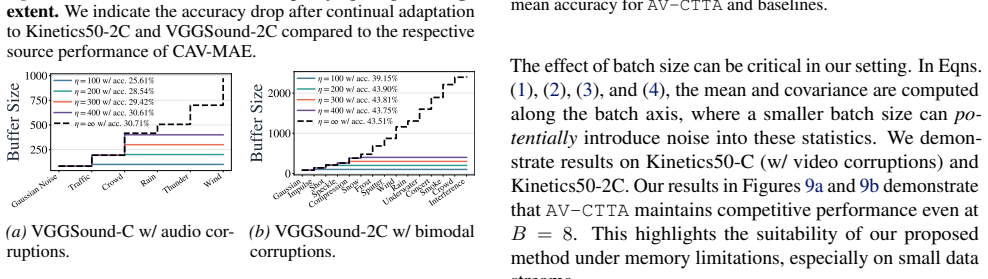
- [Section 3; Algorithm 1, lines 23–25] The evaluation protocol appears transductive. The problem statement says each batch is available once for a single forward pass, but Algorithm 1 computes a gradient step on x_t (line 24) and then returns y_t = f_θ(x_t) in line 25, i.e., current-batch accuracy is measured with parameters already updated on that same batch. This can inflate accuracy relative to a protocol where predictions are made before adaptation. Please report both pre- and post-adaptation predictions, clarify which protocol the reported numbers use, and confirm that baselines are evaluated identically.
- [§5.1, Fig. 5 vs. Table 5; Appendix D] The method depends on per-dataset hyperparameters τ and η, with no validation mechanism in a source-free online setting. τ is set to 0.005 for unimodal and 0.01 for bimodal corruptions, and the reported η varies across tables (e.g., Fig. 5 uses η=∞, but Table 5 shows VGGSound-2C improves from 43.51 at η=∞ to 43.90 at η=200, while VGGSound-C audio improves monotonically from 22.52 at η=50 to 30.71 at η=∞). Appendix D acknowledges that τ tuning is costly in deployment. Please provide a principled selection rule or evidence that a single fixed hyperparameter set works comparably across all datasets.
minor comments (6)
- [Abstract] The abstract names the proposed method AVReCAP, while the title, introduction, and body use AV-CTTA. Reconcile the naming in the final version.
- [Eqs. (3)–(4)] The audio statistic equations omit the frequency dimension: x_t_a is B×T×F, but μ_t_a and Σ_t_a are defined by summing over b and e without a frequency index, making it unclear how R^F is obtained. Spell out the summation over the frequency axis and the resulting dimensions.
- [Algorithm 1, lines 6–9] In the K=∅ branch, “continue” appears to skip the adaptation step and prediction for the first time step, whereas the main text says the first buffer element is stored after adapting at t=1. Clarify the intended flow so implementation matches the text.
- [§5.1, Fig. 5a] The text says AV-CTTA obtains a 1.25% improvement over READ on Kinetics50-2C, but Fig. 5a shows 50.29 vs. 48.81, a difference of 1.48 percentage points. Check and correct.
- [Appendix D] Typo: “scalibility” should be “scalability.”
- [Title and Fig. 7] The title claims adaptation “without forgetting,” but Fig. 7 reports a 2.9% source-accuracy drop for the proposed method. The claim is technically defined in the paper, but “minimizing forgetting” or “reduced forgetting” would be a more accurate title-level statement.
Circularity Check
No significant circularity: AV-CTTA's gains are empirically benchmarked; only minor non-load-bearing self-citations appear.
full rationale
The paper's central claim is that selective retrieval of stored fusion-layer (WQ/WK/WV) snapshots based on raw-statistic KL divergence (Eq. 16) improves continual test-time accuracy and mitigates catastrophic forgetting. This claim is supported by external benchmark experiments, not derived from its inputs. Eq. 16 is a standard closed-form KL divergence between diagonal Gaussians; it is not fitted to the reported accuracy numbers, and the reported accuracies are not defined in terms of the retrieval criterion. The buffer is populated online from test batches, and the evaluation compares against CAV-MAE source checkpoints and corruption benchmarks (Kinetics50-C/VGGSound-C, Kinetics50-2C/VGGSound-2C). No equation in Sections 4.1-4.4 reduces a predicted quantity to a fitted constant, and no uniqueness theorem or ansatz is imported from the authors' prior work to make the method forced. The self-citations to Maharana et al. 2025a (AVRobustBench, the READ modality-imbalance observation) and Maharana et al. 2025c (Appendix D, hyperparameter tuning cost) are motivational or benchmark-defining and are not load-bearing for the empirical results. Appendix D's acknowledged limitations (O(N) retrieval latency, dependence on threshold tau, architectural assumptions) are correctness/generality concerns, not circularity. The absence of an oracle-domain or random-retrieval ablation weakens causal attribution of the gains to the retrieval mechanism specifically, but a missing ablation is not a self-referential derivation. Therefore no circular step is exhibited; the appropriate finding is no significant circularity.
Axiom & Free-Parameter Ledger
free parameters (3)
- Retrieval threshold τ =
0.005 (unimodal), 0.01 (bimodal)
- Buffer size η =
50/100/200/300/400/∞ per dataset
- EMA smoothing factor β =
0.99
axioms (5)
- domain assumption Label spaces and label distributions are constant across source and target tasks: p(y^S)=p(y^t).
- domain assumption Raw modality means and diagonal variances are sufficient to represent distribution shift for retrieval.
- domain assumption Adapted fusion attention parameters transfer within and across corruption categories, so reusing past snapshots helps rather than hurts.
- domain assumption The target architecture is a late-fusion model (unimodal encoders plus a joint encoder with WQ/WK/WV), e.g., CAV-MAE.
- standard math Diagonal-covariance Gaussian KL divergence is a valid distance metric for this retrieval problem.
Cite this review
Pith. "Pith review of Audio-Visual Continual Test-Time Adaptation without Forgetting." pith.science (2026). https://pith.science/paper/QUJCZDAL
@misc{pith2026260218528,
  author       = {Pith},
  title        = {Pith review of: Audio-Visual Continual Test-Time Adaptation without Forgetting},
  year         = {2026},
  howpublished = {\url{https://pith.science/paper/QUJCZDAL}},
  note         = {Machine review of arXiv:2602.18528}
}
read the original abstract
Audio-visual continual test-time adaptation involves continually adapting a source audio-visual model at test-time, to unlabeled non-stationary domains, where either or both modalities can be distributionally shifted, which hampers online cross-modal learning and eventually leads to poor accuracy. While previous works have tackled this problem, we find that SOTA methods suffer from catastrophic forgetting where the model's performance drops well below even the source model due to continual parameter updates at test-time. In this work, we first show that adapting only the modality fusion layer to a target domain not only improves performance on that domain but can also enhance performance on subsequent domains. Based on this strong cross-task transferability of the fusion layer's parameters, we propose a method, $\texttt{AVReCAP}$, that improves test-time performance of the models without access to any source data. Our approach works by using a selective parameter retrieval mechanism that dynamically retrieves the best fusion layer parameters from a buffer using only a small batch of test data. These parameters are then integrated into the model, adapted to the current test distribution, and saved back for future use. Extensive experiments on benchmark datasets involving unimodal and bimodal corruptions show our proposed $\texttt{AVReCAP}$ significantly outperforms existing methods while minimizing catastrophic forgetting.
Figures






Forward citations
Cited by 2 Pith papers
-
Continual Test-Time Adaptation in Computer Vision: Methods, Benchmarks, and Future Directions
CTTA methods fall into optimization-based, parameter-efficient, and architecture-based families that adapt pretrained vision models online under continual unlabeled shifts while fighting forgetting and error accumulation.
-
Continual Test-Time Adaptation in Computer Vision: Methods, Benchmarks, and Future Directions
A hierarchical taxonomy and comparative review of continual test-time adaptation methods that adapt vision models online to non-stationary unlabeled streams while fighting forgetting and error accumulation.
Reference graph
Works this paper leans on
-
[5]
Botta: Bench- marking on-device test time adaptation.arXiv preprint arXiv:2504.10149,
Danilowski, M., Chatterjee, S., and Ghosh, A. Botta: Bench- marking on-device test time adaptation.arXiv preprint arXiv:2504.10149,
-
[7]
Guo, Z. and Jin, T. Smoothing the shift: Towards stable test-time adaptation under complex multimodal noises. arXiv preprint arXiv:2503.02616,
-
[8]
Hendrycks, D. and Dietterich, T. Benchmarking neural network robustness to common corruptions and perturba- tions.arXiv preprint arXiv:1903.12261,
Pith/arXiv arXiv 1903
-
[9]
Kim, J., Lee, H., Rho, K., Kim, J., and Chung, J. S. Equiav: Leveraging equivariance for audio-visual con- trastive learning.arXiv preprint arXiv:2403.09502,
-
[10]
Li, J. and Feng, S. Bridging modalities via progressive re-alignment for multimodal test-time adaptation.arXiv preprint arXiv:2511.22862,
-
[11]
Polyvit: Co- training vision transformers on images, videos and audio
Likhosherstov, V ., Arnab, A., Choromanski, K., Lucic, M., Tay, Y ., Weller, A., and Dehghani, M. Polyvit: Co- training vision transformers on images, videos and audio. arXiv preprint arXiv:2111.12993,
-
[13]
Liu, Z., Xu, Y ., Xu, Y ., Qian, Q., Li, H., Jin, R., Ji, X., and Chan, A. B. An empirical study on distribution shift robustness from the perspective of pre-training and data augmentation.arXiv preprint arXiv:2205.12753,
-
[14]
Test- time model adaptation with only forward passes.arXiv preprint arXiv:2404.01650,
Niu, S., Miao, C., Chen, G., Wu, P., and Zhao, P. Test- time model adaptation with only forward passes.arXiv preprint arXiv:2404.01650,
-
[17]
Wang, H., He, Z., Lipton, Z. C., and Xing, E. P. Learning robust representations by projecting superficial statistics out.arXiv preprint arXiv:1903.06256,
Pith/arXiv arXiv 1903
-
[18]
Zhang, M., Levine, S., and Finn, C. Memo: Test time robustness via adaptation and augmentation.Advances in neural information processing systems, 35:38629–38642, 2022a. Zhang, X., Zhou, L., Xu, R., Cui, P., Shen, Z., and Liu, H. Towards unsupervised domain generalization. In Proceedings of the IEEE/CVF Conference on Computer Vision and Pattern Recognition...
-
[19]
(σt u,i)2 (σn u,i)2 + (µt u,i −µ n u,i)2 (σn u,i)2 −1 + ln σn u,i σt u,i # = rX i=1
12 AV-CTTA Appendix A Additional Details ofAV-CTTA A.1 KL Divergence Between Modality-Specific Gaussian Distributions In Section 4.2, we utilize the KL divergence as a distance metric between the current modality-specific statistics and the stored buffer elements. We define the distributions at time-step t and for the nth buffer element as P t u =N(µ t u,...
2017
-
[20]
B.2 Source Model Architecture Following all prior A V-TTA methods, we use CA V-MAE (Gong et al., 2022c) as the default audio-visual recognition model
are visual-dominant and audio-dominant, respectively.This means that task-specific information is in the visual and audio modalities, respectively. B.2 Source Model Architecture Following all prior A V-TTA methods, we use CA V-MAE (Gong et al., 2022c) as the default audio-visual recognition model. CA V-MAE consists of 11-layer transformer encoders for bot...
2024
-
[21]
We use pre-trained weights of Kinetics50 and VGGSound, as released by (Yang et al., 2024)
and adopt CA V-MAE (Gong et al., 2022c) as the source model, which is used for inference. We use pre-trained weights of Kinetics50 and VGGSound, as released by (Yang et al., 2024). TENT2 (Wang et al., 2020): We adapt all the affine parameters of all LayerNorms and minimize the entropy of model predictions with a learning rate of1×10 −4 and an Adam optimiz...
2024
-
[23]
On average, AV-CTTA demonstrates strong robustness to task order variations compared to baselines, particularly in the difficult bimodal setting. Although a performance drop is observed during the initial tasks, continual adaptation allows the model to stabilize over time and converge to comparable accuracy across different task orderings. Overall, the se...
2023
-
[400]
In Kinetics50-C, the video is corrupted, whereas in VGGSound, the audio is corrupted
39.52 28.43 24.32 29.37 35.65 26.38 30.61 AV-CTTA(η=∞) 39.52 28.43 24.31 29.44 35.52 27.05 30.71 C Additional Results C.1 Results on a fixed buffer budgetη In Tables 4 and 6, we report additional results on Kinetics50-C and VGGSound, respectively. In Kinetics50-C, the video is corrupted, whereas in VGGSound, the audio is corrupted. As a reminder, the task...
2024
-
[2017]
Efficient lifelong learning with a-gem.arXiv preprint arXiv:1812.00420,
Chaudhry, A., Ranzato, M., Rohrbach, M., and Elhoseiny, M. Efficient lifelong learning with a-gem.arXiv preprint arXiv:1812.00420,
-
[2018]
Chaudhry, A., Rohrbach, M., Elhoseiny, M., Ajanthan, T., Dokania, P. K., Torr, P. H., and Ranzato, M. On tiny episodic memories in continual learning.arXiv preprint arXiv:1902.10486,
Pith/arXiv arXiv 1902
-
[2020]
Tent: Fully test-time adaptation by entropy minimiza- tion.arXiv preprint arXiv:2006.10726,
Wang, D., Shelhamer, E., Liu, S., Olshausen, B., and Darrell, T. Tent: Fully test-time adaptation by entropy minimiza- tion.arXiv preprint arXiv:2006.10726,
Pith/arXiv arXiv 2006
-
[2021]
Liu, J., Yang, S., Jia, P., Zhang, R., Lu, M., Guo, Y ., Xue, W., and Zhang, S. Vida: Homeostatic visual domain adapter for continual test time adaptation.arXiv preprint arXiv:2306.04344,
-
[2022]
Vg- gsound: A large-scale audio-visual dataset
Chen, H., Xie, W., Vedaldi, A., and Zisserman, A. Vg- gsound: A large-scale audio-visual dataset. InICASSP 2020-2020 IEEE International Conference on Acoustics, Speech and Signal Processing (ICASSP), pp. 721–725. IEEE,
2020
-
[2023]
Gong, T., Jeong, J., Kim, T., Kim, Y ., Shin, J., and Lee, S.-J. Note: Robust continual test-time adaptation against temporal correlation.Advances in Neural Information Processing Systems, 35:27253–27266, 2022a. Gong, Y ., Liu, A. H., Rouditchenko, A., and Glass, J. Uavm: Towards unifying audio and visual models.IEEE Signal Processing Letters, 29:2437–244...
-
[2024]
Rebuffi, S.-A., Kolesnikov, A., Sperl, G., and Lampert, C. H. icarl: Incremental classifier and representation learning. InProceedings of the IEEE conference on Computer Vision and Pattern Recognition, pp. 2001–2010,
2001
-
[2025]
Ba, J. L., Kiros, J. R., and Hinton, G. E. Layer normalization. arXiv preprint arXiv:1607.06450,
discussion (0)
Sign in with ORCID, Apple, or X to comment. Anyone can read and Pith papers without signing in.