REVIEW 4 major objections 4 minor 3 cited by
Vision-language self-correction only works when the model goes back to the image, marks the disputed region, and revises against that evidence rather than linguistic priors.
Reviewed by Pith at T0; open to challenge. T0 means a machine referee read the full paper against a public rubric. the ladder, T0–T4 →
T0 review · deepseek-v4-flash
2026-08-02 21:51 UTC pith:4NJT54U5
load-bearing objection MIRROR's closed-loop visual reflection is a good idea with solid internal ablations, but the headline gains are unsecured until the ReflectV/evaluation overlap is ruled out. the 4 major comments →
Bridging Modality Disconnect in Self-Reflection via Closed-Loop Visually Grounded Verification
The pith
A machine-rendered reading of the paper's core claim, the machinery that carries it, and where it could break.
Core claim
The central claim is that a vision-language model's reflection steps should be coupled to a visual grounding tool. When the model suspects an error, it emits a structured request naming the anchor phrase from its reflection; the tool grounds that phrase to coordinates, renders an overlay (point, box, ellipse, or mask), and feeds the marked image back to the model before the next answer. The paper argues this closed-loop 'region-based verification' converts self-correction from open-loop text generation into pixel-level evidence checking, and that this, not the dataset content alone, drives the gains—shown by the tool-free ablation dropping sharply on grounding-heavy tasks. Training the model
What carries the argument
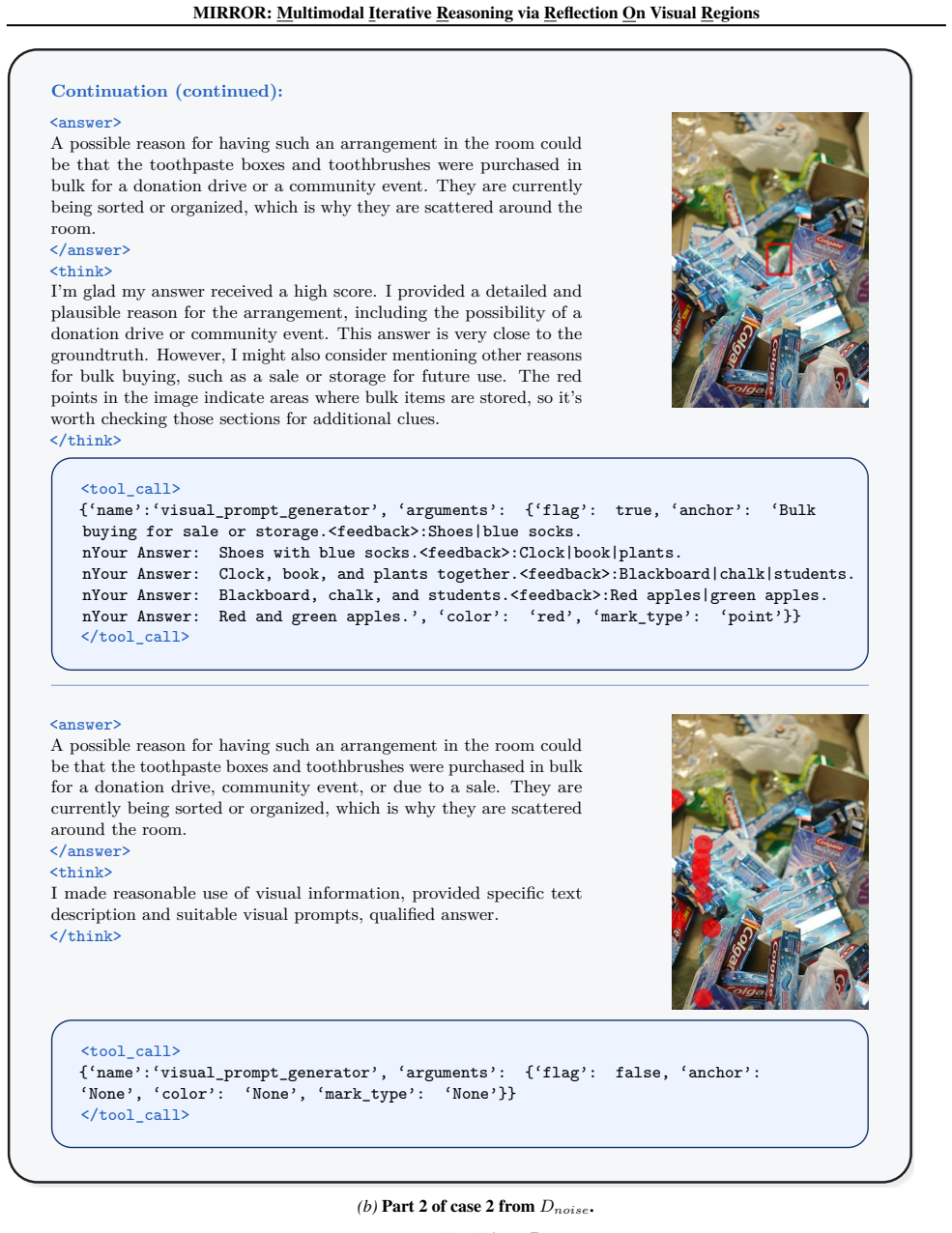
The load-bearing machinery is a repeated four-stage cycle—draft, critique, region-based verification, revision—driven by a visual prompt generator. The generator grounds a textual anchor from the model's reflection into image coordinates, segments the corresponding object, and overlays a colored marker, producing a new image that the VLM sees at the next turn. A multi-turn autoregressive loss trains the VLM to emit answer, reflection, and tool-call tokens jointly, while the ReflectV dataset supplies supervision for when to invoke the tool and how to revise from the marked evidence. The loop terminates when the model's reflection declares the answer verified.
Load-bearing premise
The headline gains assume the images used to build ReflectV were not taken from the same splits used for evaluation, but the paper does not state that evaluation images were excluded.
What would settle it
Compare the model's performance on a held-out set of images that were explicitly disjoint from ReflectV, or check the training set for image-level duplicates against the evaluation test splits; if the OCR, chart, and hallucination gains shrink to base-model levels, the reported improvement came from memorization rather than the closed-loop verification process.
If this is right
- Self-correction training for multimodal models should include explicit tool calls and marked-image inputs, not just textual critique and rewrite pairs.
- Because the verification is targeted, the loop can be cheaper than verbose text-only reflection, resolving errors in fewer tokens and less time.
- The mechanism transfers across model sizes, with a smaller trained model surpassing a larger base model on several benchmarks, suggesting it is a parameter-efficient route to stronger perception.
- The benefit is concentrated where errors are spatially localizable; the paper documents that abstract math and compositional attribute binding receive little or no help from the visual markers.
- A balanced mix of multi-turn reflective chains and single-turn QA is necessary—too many reflective chains induce a 'failure-first' bias that degrades otherwise correct answers.
Where Pith is reading between the lines
- The strongest unstated check is dataset hygiene: since ReflectV is built from public benchmarks that overlap with the evaluation suite, the reported gains should be re-measured on a provably disjoint held-out set before attributing them to the closed loop.
- If the effect survives that check, the framework should compose naturally with reinforcement learning on tool-use reward, where the marker's contribution to the final answer can be measured directly.
- The mark-verify-revise recipe generalizes to any perception task in which the model can name its uncertainty as a phrase—counting, referring expressions, spatial reasoning—so the paper's mechanism is likely a scaffold for agentic perception beyond VQA.
- The failure cases suggest the next bottleneck is not reflection but the tool's grounding ability; extending the generator from static markers to zoom, crop, or editing could push the same loop into abstract and attribute-heavy domains.
Editorial analysis
A structured set of objections, weighed in public.
Referee Report
Summary. The paper proposes MIRROR, a framework that equips a VLM with a closed-loop visual reflection process: after an initial answer, the model writes a reflective critique, optionally invokes a visual prompt generator (grounding text anchors with Molmo-7B and overlaying markers with SAM 2), and revises the answer based on the marked image. To train this behavior, the authors construct ReflectV, a ~24k-sample dataset built from public VQA/OCR/chart sources via a GPT-4V student–teacher pipeline, followed by filtering, keyword-to-region grounding, and rewriting teacher feedback as first-person self-reflection. They fine-tune Qwen2.5-VL-3B/7B with LoRA and report improvements over base models and prior reflection/'thinking-with-images' methods on general, OCR, hallucination, fine-grained perception, and math benchmarks.
Significance. If the empirical claims hold, MIRROR provides a reusable recipe for training VLMs to ground their self-corrections in visual evidence. The internal ablations are well designed: comparing MIRROR to a tool-free variant, to QA-only training, and across trajectory ratios isolates the proposed mechanism, and the data filtering analysis supports the dataset-quality argument. The ReflectV dataset itself could be a valuable community resource. However, the headline external numbers are not currently trustworthy because ReflectV is built from the same benchmark families used for evaluation, with no stated exclusion of evaluation splits and no overlap statistics, and the key trajectory ratio ρ=0.75 is selected on the evaluation metric itself. These issues must be resolved before the central claim that visual grounding, rather than textual reflection, drives the gains can be accepted.
major comments (4)
- [Appendix A.1 vs. Section 5, Tables 1-2] ReflectV is constructed from COCO, LLaVA, GQA, TextVQA, OCRVQA, DOCVQA, DVQA, and ChartQA, while Section 5 evaluates on TextVQA, ChartQA, OCRBench, and related benchmarks. The manuscript never states that evaluation splits were excluded during dataset construction, nor does it report overlap statistics. Since the training pipeline uses ground-truth annotations to synthesize teacher feedback and final answers (Section 4.1), even a small number of overlapping test examples could teach the model the exact answer, materially inflating reported gains such as +8.8 on OCRBench and +13.36 on HallusionBench. Without a clear disjointness statement, per-source overlap numbers, or release of ReflectV metadata, the external benchmark results cannot be interpreted as evidence for the proposed mechanism. The internal ablation comparing MIRROR and MIRROR-w/o-tool is less affected because both variants t
- [Section 5.3.3, Table 5] The trajectory ratio ρ=0.75 is selected as the configuration that maximizes MM-Vet in Table 5 and is then reported as the final model. There is no held-out validation split or a pre-specified selection criterion; this constitutes test-set tuning. The claim that the balanced strategy is optimal cannot be supported by the same table that was used to choose it. Please either fix ρ based on a held-out set or present the results as a model-selection curve with a separate validation evaluation.
- [Tables 1-5] All experiments report single numbers without error bars, repeated runs, or significance tests. Some differences are small relative to likely run-to-run variability (e.g., SeedBench-2-Plus: MIRROR-w/o-tool 70.36 vs. Qwen2.5-VL-7B 70.88; TextVQA: 85.37 vs. 84.90). Since the central claim is that MIRROR improves correctness and reduces hallucinations, the reader needs confidence intervals or at least multiple seeds for the main comparisons. This is especially important for hallucination benchmarks such as POPE and HallusionBench, where evaluation protocols and judge variability can dominate small point estimates.
- [Section 5.2, Table 3] The comparison against VL-Rethinker, PixelReasoner, DeepEyes, and Adaptive-CoF states that all methods are fine-tuned on Qwen2.5-VL-7B, but it is not clear whether the reported numbers are taken from the original papers or re-run under the same VLMEvalKit version, decoding settings, and visual-tool environment. Differences in evaluation protocol can easily produce several-point swings (e.g., +3.90 on OCRBench, +5.12 on POPE). Please clarify the source of these numbers and, if possible, re-run the baselines under identical conditions.
minor comments (4)
- [Table 7 vs. Table 5] The MIRROR-Raw row in Table 7 reports an overall MM-Vet score of 55.87, which is exactly the same as the ρ=0.5 row in Table 5. Please check whether this is a copy-paste error or a genuine coincidence; if genuine, the individual component scores should be re-verified.
- [Appendix B.1] Training details are incomplete. Please report learning rate, batch size, sequence length, LoRA dropout, warmup steps, and evaluation decoding parameters. The current text gives only LoRA rank/alpha, epochs, and hardware.
- [Section 5.2] The paper would benefit from explicitly stating whether the baseline numbers in Table 3 are from the original publications or from new runs. This is important for a fair comparison of 'reasoning models' and should be stated in the table caption or the experimental setup.
- [Appendix D.1, Table 8] The efficiency comparison reports time and tokens per sample but does not specify whether the numbers include the full MIRROR pipeline (Molmo grounding + SAM 2 segmentation) and what hardware/decoding settings were used. Since MIRROR invokes external tools, a breakdown of where the time is spent would help readers assess the applicability of the efficiency claim.
Circularity Check
Two headline validations reduce to the training/eval loop: TextVQA and ChartQA are both ReflectV sources and evaluation sets, and the reported MM-Vet number is the argmax of the ρ hyperparameter sweep.
specific steps
-
fitted input called prediction
[Appendix A.1 vs Section 5 (Tables 1–2); also Section 4.1–4.2]
"The data sources are curated from diverse public benchmarks, including COCO ..., GQA ..., TextVQA ..., OCRVQA ..., DOCVQA ..., DVQA ... and ChartQA ... . ... In the domain of OCR & Document Understanding, we utilize TextVQA ..., OCRBench ..., and ChartQA ... ."
The same benchmark families appear on both sides of the pipeline: TextVQA and ChartQA are used to build ReflectV, and TextVQA-Val/ChartQA-Test are reported as evaluation results. Dataset construction simulates teacher feedback from ground-truth annotations, and filtering requires the final student response to be semantically consistent with that ground truth. Since Eq. (3) trains on these ground-truth-aligned final answers, any overlapping evaluation sample can be memorized rather than solved by reflection. The paper never states that evaluation splits were excluded and reports no overlap statistics, so the claimed TextVQA/ChartQA gains are not shown to be independent predictions; as written they reduce to the training data by construction.
-
fitted input called prediction
[Section 5.3.3 (Table 5) vs Table 1]
"Conversely, lower ratios (ρ≤0.6 ) fail to provide sufficient supervision for complex verification, whereas our balanced strategy with ρ= 0.75 achieves the optimal performance across all metrics ... [Table 5:] ρ= 0.75 69.90 60.77 70.80 61.62 64.40 66.70 ... [Table 1:] MIRROR(ours) 7B 66.70 73.33 76.86 86.62 92.00 87.92"
ρ is a hyperparameter of the training-data mixture. The ablation in Table 5 selects ρ=0.75 on MM-Vet because it achieves the optimal performance across all metrics (overall 66.70), and Table 1 reports MIRROR(ours) with the same MM-Vet value (66.70). Thus the headline MM-Vet number is the argmax of the ρ sweep, i.e., a value fitted to the evaluation metric rather than a held-out prediction. This makes the comparison of MIRROR's MM-Vet against baselines partly forced by the selection step, not solely by the closed-loop reflection mechanism.
full rationale
This is an empirical systems paper rather than a mathematical derivation, so the relevant circularity is in the evidence chain. The central mechanism—closed-loop visual reflection—is a genuine intervention, and the paper includes useful internal controls: MIRROR-QA trained on the same data in single-turn form outperforms the base model but underperforms MIRROR, and removing the tool also degrades performance. Those comparisons are largely immune to the benchmark-overlap issue because both arms train on the same data. Moreover, several benchmarks used for the hallucination claims (POPE, HallusionBench, OCRBench) are not listed among ReflectV's sources, giving the mechanism some independent support. However, two headline external validations are not independent as reported. First, TextVQA and ChartQA are listed as ReflectV data sources (Appendix A.1) and also appear in the main evaluation tables (Section 5), with no stated split exclusion or overlap statistics; because the training objective maximizes the likelihood of ground-truth-aligned final answers, the reported gains on those benchmarks may be memorized inputs rather than evidence for the mechanism. Second, the multi-turn mixing ratio ρ is explicitly chosen by maximizing MM-Vet in Table 5, and the resulting 66.70 is then reported as the MIRROR result in Table 1, making that number the argmax of the hyperparameter sweep. The self-citation to FIRE for the dialogue-construction pipeline is by overlapping authors, but it is not load-bearing for the central claim because FIRE is a published, externally available pipeline and the paper's contribution is the visual-reflection extension. Overall, the framework is not circular by definition; the circularity is confined to the empirical validation, where two reported predictions reduce by construction to the training data or to the hyperparameter search, warranting a score of 6.
Axiom & Free-Parameter Ledger
free parameters (3)
- rho (multi-turn reflective chain ratio) =
0.75
- LoRA rank / alpha =
r=32, alpha=128
- training epochs =
3.0
axioms (5)
- domain assumption GPT-4V teacher scores and feedback are correct and visually faithful
- domain assumption Molmo-7B point grounding and SAM2 masks correctly localize anchor keywords
- domain assumption Qwen2.5-VL-7B visual consistency filter catches ungrounded prompts
- domain assumption Evaluation benchmarks are disjoint from ReflectV training data in both split and distribution
- domain assumption SFT on ReflectV transfers to unseen benchmarks
read the original abstract
In the era of Vision-Language Models (VLMs), enhancing multimodal reasoning capabilities remains a critical challenge, particularly in handling ambiguous or complex visual inputs, where initial inferences often lead to hallucinations or logic errors. Existing VLMs often produce plausible yet ungrounded answers, and even when prompted to "reflect", their corrections may remain detached from the image evidence. To address this, we propose the MIRROR framework for Multimodal Iterative Reasoning via Reflection On visual Regions. By embedding visual reflection as a core mechanism, MIRROR is formulated as a closed-loop process comprising draft, critique, region-based verification, and revision, which are repeated until the output is visually grounded. To facilitate training of this model, we construct **ReflectV**, a visual reflective dataset for multi-turn supervision that explicitly contains reflection triggers, region-based verification actions, and answer revision grounded in visual evidence. Experiments on both general vision-language benchmarks and representative vision-language reasoning benchmarks show that MIRROR improves correctness and reduces visual hallucinations, demonstrating the value of training reflection as an evidence-seeking, region-aware verification process rather than a purely textual revision step.
Figures




Forward citations
Cited by 3 Pith papers
-
BUS: Brain-Inspired Unsupervised Self-Reflection via Backward Prediction for Multimodal Reasoning
BUS enables unsupervised self-reflection in VLMs by training models to perform backward prediction—identifying which reasoning paths precede a sampled answer—yielding improvements on 8 visual reasoning benchmarks with...
-
BUS: Brain-Inspired Unsupervised Self-Reflection via Backward Prediction for Multimodal Reasoning
BUS trains VLMs for self-reflection without labels by verifying which sampled reasonings precede their own answers via backward prediction, improving multimodal reasoning.
-
ESC: Emotional Self-Correction for Reliable Vision-Language Models
ESC uses emotional cues triggered by an external verifier to enable training-free self-correction in VLMs, improving reliability on safety, hallucination, and reasoning benchmarks.
Reference graph
Works this paper leans on
-
[1]
diameter calculation and radius division
Limited Applicability in Abstract Domains.Despite these improvements, MIRROR still faces challenges in symbolic derivation involving complex spatial mapping. Figure 21 illustrates a geometry problem requiring the calculation of a circle’s radius using the Pythagorean theorem. While the model correctly performs the symbolic derivation in the text, its atte...
-
[2]
five petals and three leaves
Coarse-grained Attribute Binding.Furthermore, MIRROR encounters difficulties in fine-grained attribute binding under compositional constraints. As shown in Figure 22, the user queries for a specific flower defined by a compositional constraint:“five petals and three leaves. ”Although the underlying LLM correctly identifies the target option (E) via textua...
-
[3]
how many
**Avoid Redundancy** : Do not include interrogative words like "how many", "how much", "what" or explanatory words like "the amount of"
-
[4]
total",
**Core Elements** : Must include both the clear subject from the question and the key modifying words (e.g., "total", "average", "maximum") if mentioned
-
[5]
**Key Details** : Incorporate essential associated information (e.g., time, location, product type) related to the subject if specified
-
[7]
What rare species are depicted in the wildlife photograph?
**Avoid Over-Simplicity** : Do not answer with only 1-2 words; the phrase should clearly link the modifying word, subject and context. Examples: Example1: <question>: How many bikes are there in 2018? Your answer: bikes in 2018 Example2: <question>: What is the total revenue of Company A in 2021 and 2022? Your answer: total revenue of Company A in 2021 an...
2018
-
[8]
First, provide a direct answer to the user’s image-related query based on your initial observation
-
[9]
post-hoc reflection
Second, engage in a "post-hoc reflection" to strictly evaluate the accuracy of your initial answer and analyze visual evidence
-
[10]
Follow these rules strictly:
Third, determine if visual grounding tools are needed to verify or correct your answer. Follow these rules strictly:
-
[11]
Output Structure & Order: You must output exactly three parts in this specific order: <answer>Your Initial Answer</answer> <think>Your Reflection & Visual Analysis</think> <tool_call>JSON Function Call</tool_call>
-
[12]
Is this answer grounded in the image? Did I miss details?
Reflection Requirements (<think>): - In <think>, you must critique your<answer>. Ask yourself: "Is this answer grounded in the image? Did I miss details?" - You must explicitly identify specific visual regions that support or contradict your answer. - Describe these regions using specific mark types (arrow/point/circle/line/ellipse/mask/bbox) and colors. ...
-
[13]
- flag: Set toTrue if you detect errors, ambiguity, or need verification
Tool Call & Consistency: - Use thevisual_prompt_generatorfunction. - flag: Set toTrue if you detect errors, ambiguity, or need verification. Set toFalse ONLY if the answer is completely correct and verified. - anchor: This string MUST be consistent with the visual description provided in the<think>section. - mark_type & color: Must match the visualization...
-
[14]
type": "function
Function Signature: Continued on next page. 1 (a)Part 1 of system prompt. 24 MIRROR: Multimodal Iterative Reasoning via Reflection On Visual Regions Function Signature (continued): <tool_call> { "type": "function", "function": { "name": "visual_prompt_generator", "description": "Generates a visual overlay to verify specific image regions identified during...
-
[15]
Democrat
Identify the blue graph: The blue graph represents the "Democrat" data. 2. Locate the value 56 on the y-axis: The y-axis is labeled "Favorable view of NATO" and ranges from 0% to 80%. 3. Find the points on the blue graph that correspond to the value 56: We need to look for the horizontal lines that intersect the y-axis at 56%. By examining the graph: - Th...
2011
-
[16]
Images" connected to the
**Images**: The diagram shows "Images" connected to the "Footer" section, not directly to the "Subpages". 2. **Privacy policy**: The diagram shows "Privacy policy" connected to the "Subpages" section. 3. **Navigation links**: The diagram shows "Navigation links" connected to the "Header", "Footer", and "Subpages" sections. 4. **Contact info**: The diagram...
-
[17]
How to Focus in the Age of Distraction
The image is a mind map titled "How to Focus in the Age of Distraction." 2. It includes various strategies and tools to help manage distractions and improve focus. 3. The section labeled "BLOCKER PROGRAMS" is connected to "LOCKS YOU OUT OF THE INTERNET" and "LOCKS YOU OUT OF SPECIFIC SITES." 4. This suggests that blocker programs are tools designed to res...
-
[18]
**Identify the van**: The van is located in the center of the image, on the right side of the road. 2. **Observe the van’s position**: The van appears to be stationary, as there are no visible signs of motion blur or other vehicles overtaking it. 3. **Check for traffic signals or signs**: There are no visible traffic lights or signs that would indicate th...
-
[2022]
teacher’s evaluation
for parameter-efficient fine-tuning. The LoRA rank is set tor= 32with the scaling factorα= 128. B.2. Inference Details. We perform all evaluations using the SFT-adapted MIRROR model. And we use the same hardware settings in all experiments. To ensure high-quality visual grounding, the visual prompt generator is powered by Molmo-7B (Deitke et al., 2025), w...
2025
discussion (0)
Sign in with ORCID, Apple, or X to comment. Anyone can read and Pith papers without signing in.