REVIEW 2 major objections 6 minor 1 cited by
Giant radio pulses in the magnetar XTE J1810-197 detected with the IAR's telescopes
T0 review · 2 major / 6 minor · reviewed 2026-08-02 · deepseek-v4-flash
Pith's one-line read The magnetar XTE J1810-197 emitted 249 giant radio pulses in 2022-2023, with the brightest confined to about two percent of its rotation.
desk verdict Useful new IAR dataset for XTE J1810-197, but the cross-day phase-confined GP claim is an artifact of the manual daily alignment; the within-observation 2% is solid. read the letter →
The pith
A machine-rendered reading of the paper's core claim, the machinery that carries it, and where it could break.
The reading
What carries the argument
The central object is the giant pulse—a coherent radio burst far brighter than the ordinary pulsed emission and confined to a narrow rotational phase window. The analysis chain that carries the argument is a dedispersed single-pulse search at 1.4 GHz with 146-microsecond sampling and a signal-to-noise threshold of 8, followed by Gaussian fitting to measure widths and the radiometer equation to convert to flux densities. The distinguishing diagnostic is phase confinement: within an observation the bright pulses occupy only ~2% of the magnetar's 5.54-second period, and the authors align daily mean phases by hand to measure a ~2.4% cross-campaign window, which they translate to an emission-regi
What would settle it
Take the same 2022-2023 data and build a phase-coherent timing solution that covers the entire campaign without manual daily shifts—using, for example, frequencies where the folded profile remains detectable. If the unshifted giant-pulse phases scatter across more than a few percent of the rotation, the cross-day confinement claim fails. Alternatively, two longitude-separated telescopes observing the same pulse simultaneously would settle whether the phase window is intrinsic.
Extended reading notes
Core claim
In observations spanning 149 days, the magnetar XTE J1810-197 produced 249 single radio pulses that the authors classify as giant pulses: coherent, extremely bright bursts with flux densities up to 119 Jy and fluences up to 58 Jy ms, following a steep power-law energy distribution with index -4.0±0.3. The brightest pulses are confined to roughly 2% of the rotational phase within a single observation, and about 2.4% across the whole campaign once daily mean phases are aligned. The detected fluences overlap the faintest intermediate FRB-like bursts reported from SGR 1935+2154, but unlike those bursts, which appear at random rotational phases, these pulses stay locked to a narrow phase window.
Load-bearing premise
For days without a detected folded pulse profile, the authors aligned each day's pulses by manually shifting the mean phase to 0.5; if the pulse phase window actually drifts from day to day, the quoted 2.4% cross-day confinement and the 8.64-degree opening angle are products of that alignment rather than a measured property of the emission.
Editorial extensions
If this is right
- If the classification holds, XTE J1810-197 is a prolific giant-pulse emitter, with 249 pulses in 56 active days and rates reaching about 15 per hour.
- The steep power-law index means the total energy budget is dominated by the faintest detectable pulses, so the measured rates and fluxes are sensitivity-limited lower bounds.
- The narrow phase window implies a stable, compact emission region—an opening angle of about 8.6 degrees—rather than emission spread over the whole magnetosphere.
- The abrupt drop after the 20 January 2023 peak, with no X-ray flare, supports the idea that the radio-active state is a distinct magnetospheric state that can switch on and off independently of X-ray activity.
- The fluence overlap with the faintest SGR 1935+2154 bursts, combined with the phase-confinement difference, separates giant-pulse-like emission from FRB-like emission in magnetars.
Reading between the lines
- A direct test of the cross-day phase confinement would be a phase-coherent timing solution spanning the entire campaign or simultaneous observations from two longitude-separated telescopes; without that, the 2.4% value could be an artifact of the manual daily alignment.
- The steep power law predicts that a more sensitive telescope at 1.4 GHz would detect a much larger population of fainter giant pulses; this is testable by stacking or by longer integrations on the same source.
- If phase confinement is the key separator between giant pulses and FRB-like bursts, then searching SGR 1935+2154 during its radio-quiet phases for narrow, phase-stable pulses could reveal a hidden giant-pulse regime in that source.
- The abrupt turn-off suggests a magnetospheric state transition that may also appear in spin-down or polarization changes; future timing observations could look for a simultaneous shift in torque.
Signed reviews
Editorial analysis
A structured set of objections, weighed in public.
Referee Report
Summary. The paper reports a single-pulse search of the magnetar XTE J1810−197 using the IAR 30-m telescopes between 29 September 2022 and 14 July 2023. The authors detect 249 pulses at a fitted DM of 178.8 ± 0.1 pc cm⁻³, classify the whole sample as giant pulses, measure peak flux densities up to 119 Jy and fluences up to 58 Jy ms, fit power-law distributions to the flux and fluence, and find a peak detection rate near early 2023 followed by a rapid decline. They also present a MAXI X-ray analysis finding no significant intrinsic X-ray activity. The paper's central scientific claim is that XTE J1810−197 emits a bright, phase-confined GP population that is distinct from the normal single pulses and FRB-like bursts of SGR 1935+2154, and that this difference points to different emission conditions.
Significance. If the results hold, this is a valuable high-cadence monitoring dataset from a southern-hemisphere facility in an epoch not covered by other telescopes. The paper is transparent about its calibration assumptions and uses several independent checks, including two power-law fitting techniques, careful RFI handling, a waiting-time analysis, and a detailed MAXI contamination study. The main scientific significance is the proposed phenomenological distinction between XTE J1810−197 GPs and SGR 1935+2154 bursts. However, the phase-confinement pillar of that distinction is currently supported by a manual daily alignment that assumes the quantity the paper claims to measure; this needs to be fixed or substantially reworded before the headline comparison is reliable.
major comments (2)
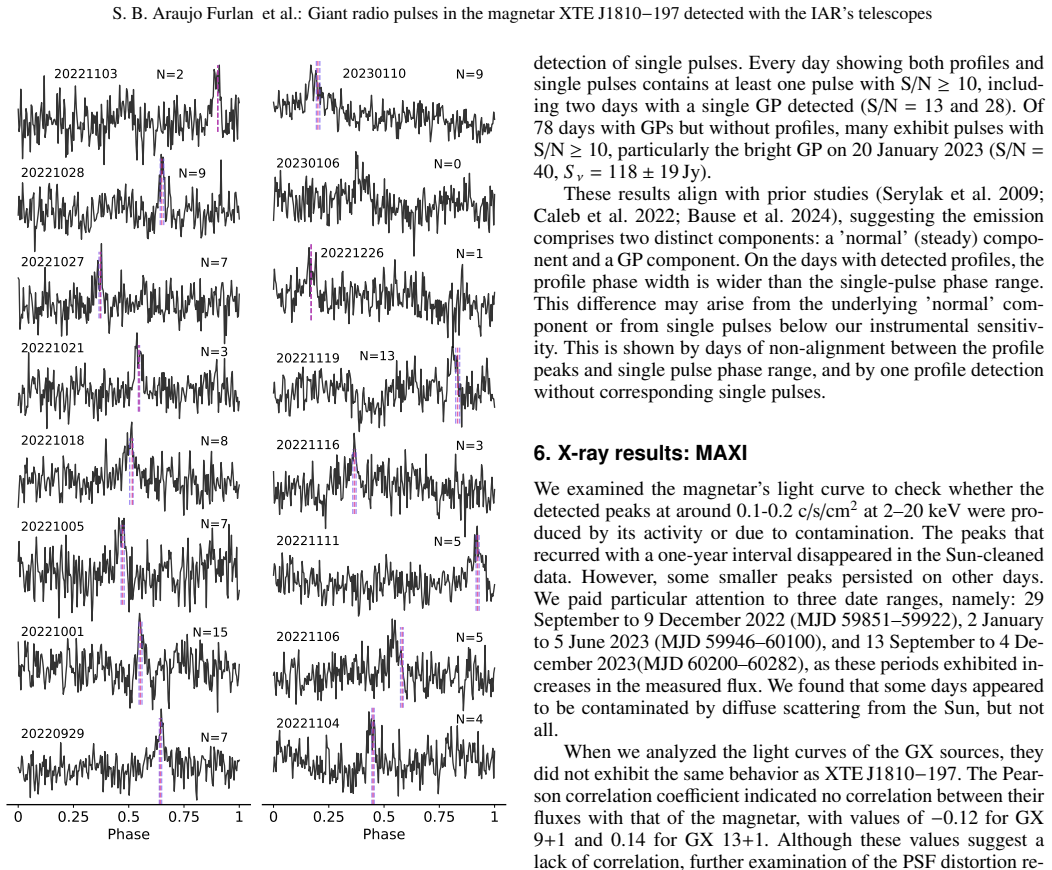
- [§5.2.3] The cross-day phase confinement is not a measured quantity. The text states: 'Since we had days with detected GPs but not an integrated pulse profile, this prevented us from consistently aligning the GPs based on a timing solution. Thus, we aligned the mean phase of each day by manually shifting each to 0.5, and applied the same shift to each individual phase.' This procedure forces each daily mean GP phase to 0.5 by construction. The quoted Δφ=0.0239 and the derived opening angle of 8.64° therefore measure only the maximum intra-day scatter relative to an arbitrarily chosen common mean, not an absolute phase alignment across days. Because 41 of the 56 GP days lack folded profiles, the cross-day phase distribution is largely determined by this manual shift. The abstract's 'limited to a ~2% of the rotational phase' is robust only in the within-observation form (Δφ=0.0196). This matters be
- [§3.1.1, Eq. (2)] The absolute flux scale rests on the assumption that T_N = 50 ± 8 K, measured only from mid-2023 onward, is constant over the campaign and identical for the ETTUS and ROACH boards. This assumption enters linearly into every peak flux density, fluence, luminosity, and the comparison with SGR 1935+2154 in Fig. 12. The Friis-equation argument for the board independence is plausible, but no in-campaign calibration or cross-check with a calibrator or a known pulsar is presented. Because the reported flux densities (up to 119 Jy), the steep power-law index, and the overlap claim with SGR bursts are central, please provide a quantitative sensitivity analysis (e.g., the effect of a ±30% T_N variation) or use available calibration data to constrain the stability. At minimum, state explicitly that all flux-based quantities are relative to this assumed scale and discuss how a violation of the assum
minor comments (6)
- [Abstract and §5.2.1] The abstract gives the peak activity date as '20 February 2023', while §5.2.1, Figure 7, and the summary give '20 January 2023'. These are inconsistent and must be reconciled.
- [§5.2.2] The text says 'The brightest pulse was detected on 10 January 2022 (MJD 59954)' — the year should be 2023.
- [§5.2.3] The paper says 'Of 78 days with GPs but without profiles', which is inconsistent with 56 total GP detection days and 16 profile days (one of which has no GPs). The correct number appears to be 41; please check.
- [Abstract and §4.1.2] The DM search range is stated as 100–400 pc cm⁻³ in the abstract but 100–500 pc cm⁻³ in §4.1.2. Harmonize these values.
- [Table 1] EQUAD is reported as −7.4(14), which is unphysical if it represents a quadrature-added noise term. Please justify or constrain it to non-negative values.
- [§5.2.3] Please clarify whether the 16 days with detected folded profiles were aligned with the timing model or also subjected to the manual shift. A description of how the 'mean phase of each day' was computed before shifting would also help the reader assess the procedure.
Circularity Check
Manual daily phase alignment imposes the cross-day 2.4% window and 8.64° opening angle; only the within-observation 2% is measured.
-
fitted input called prediction
[Section 5.2.3 (single-pulse phase analysis)]
"Since we had days with detected GPs but not an integrated pulse profile, this prevented us from consistently aligning the GPs based on a timing solution. Thus, we aligned the mean phase of each day by manually shifting each to 0.5, and applied the same shift to each individual phase."
Shifting each day's mean phase to 0.5 removes any day-to-day offset by construction. The reported cross-day maximum separation Δφ=0.0239 ('~2.4%') and the derived opening angle of 8.64° are computed after imposing the assumption that the GP phase window is the same every day, so they do not measure that stability. The within-observation Δφ=0.0196 is independent of this step, but the cross-day 2.4% claim and opening angle are artifacts of the manual shift. This manufactured phase confinement is then used as supporting evidence for GP classification (Sect. 7.1) and for the phase-confinement contrast with SGR 1935+2154 (Sect. 7.3), making the step load-bearing.
full rationale
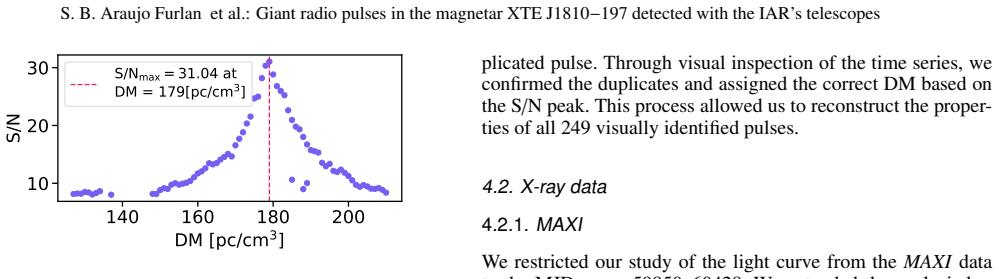
The central detections and characterizations — 249 single pulses, DM=178.8±0.1 pc cm^-3, flux/fluence power laws, rates, and the within-observation ~2% phase concentration — are derived from standard PRESTO/PSRCHIVE reduction, external calibration references, and the paper's own Gaussian/power-law fits, not from a self-citation chain. The GP classification is anchored to external flux-density comparisons (Caleb et al. 2022) and to the fitted power-law index, so it does not reduce to a self-citation. The one significant circular step is the cross-day phase analysis: daily mean phases are manually shifted to 0.5, and the resulting cross-day Δφ=0.0239 and 8.64° opening angle are then reported as if they measured the star's phase-confinement. Because the alignment itself imposes the daily registration, this specific 'prediction' is constructed rather than measured. The paper transparently describes the limitation, but the subsequent conclusions in Sects. 7.1 and 7.3 rely on the phase-confinement distinction. Hence the circularity is partial: one construction-tainted result used as supporting evidence, while the within-day 2% concentration and the bulk of the physical measurements remain independent.
Assumptions & free parameters
free parameters (7)
- Single-pulse S/N detection threshold =
8
- DM candidate selection window =
170–190 pc cm−3
- Flux-density completeness threshold =
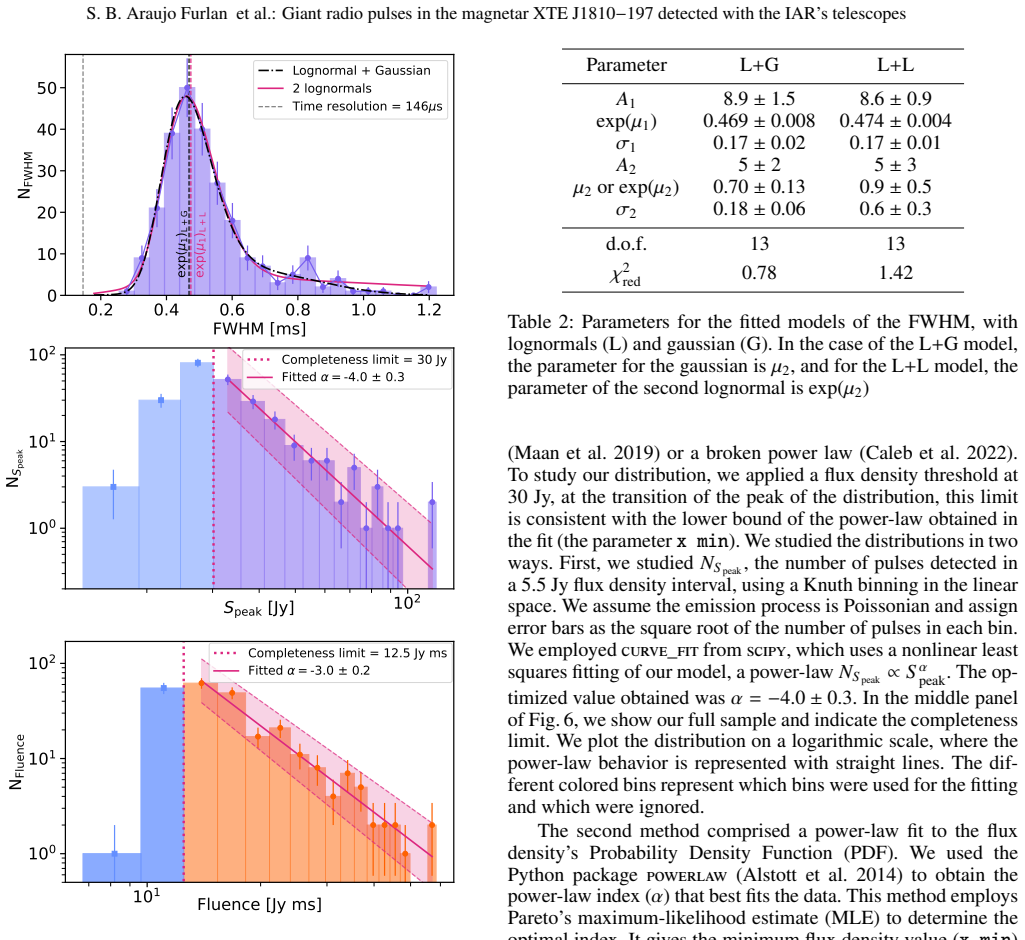
30 Jy
- Fluence completeness threshold =
12.5 Jy ms
- System noise temperature T_N =
50 ± 8 K
- Per-day phase alignment shift =
mean phase set to 0.5
- Timing model parameters =
ν=0.180420042(9) Hz; νdot=-2.69(5)e-13; νddot=5(1)e-21; EFAC=0.7(1); EQUAD=-7.4(14)
assumptions (8)
- standard math Radiometer equation (Eq. 2) gives flux density from S/N, system temperature, gain, bandwidth, and pulse width
- standard math Sensitivity limit formula (Eq. 5) with gain G and digitization factor beta≈1
- domain assumption Pulse arrival process is Poissonian
- ad hoc to paper System noise temperature is constant over the campaign and identical for ETTUS and ROACH boards
- ad hoc to paper The GP phase window is stable across observing days
- ad hoc to paper All detected single pulses are giant pulses
- domain assumption Source distance 2.5±0.5 kpc (Ding et al. 2020)
- standard math Brightness temperature above the 10^12 K Compton limit implies coherent emission
Cite this review
Pith. "Pith review of Giant radio pulses in the magnetar XTE J1810-197 detected with the IAR's telescopes." pith.science (2026). https://pith.science/paper/6FPZIUEE
@misc{pith2026260300295,
  author       = {Pith},
  title        = {Pith review of: Giant radio pulses in the magnetar XTE J1810-197 detected with the IAR's telescopes},
  year         = {2026},
  howpublished = {\url{https://pith.science/paper/6FPZIUEE}},
  note         = {Machine review of arXiv:2603.00295}
}
abstract
[...] We observed XTE J1810-197 between 29 September 2022 and 14 July 2023 with the radio telescopes at the Argentine Institute of Radioastronomy (IAR). We searched for single pulses in time series at a DM range of 100-400 pc cm-3 , with a threshold in signal-to-noise ratio (S/N) of 8. [...] We found 249 giant pulses at a DM mean value of 178.8$\pm$0.1 pc cm-3 . We measured peak flux densities up to 119 Jy, and fluences up to 58 Jy ms. We fitted a power law distribution to the flux density, obtaining an index of -4.0$\pm$0.3. We observed a maximum rate of approximately 15 pulses per hour on 20 February 2023, followed by an abrupt disappearance of transient radio emission, indicating a transition to a less active state. The brightest single pulses are limited to a $\sim$2$\%$ of the rotational phase and have similar fluence values to the reported intermediate FRB-like bursts of SGR 1935+2154. No significant X-ray activity in the MAXI data was detected during the radio observing period. This is the first study of single radio pulses of a magnetar using IAR data, showing the potential of the upgraded telescopes for investigating the transient radio sky. The properties of the single pulses detected here show the magnetar transient nature and capability to emit high-luminosity pulses. We compared the detected emission to FRB-like bursts and single pulses emitted by SGR 1935+2154. Even though the mechanism producing all the events should be coherent, the luminosity of the events, features on the dynamic spectra, and the difference between being phase confined or not, indicate that XTE J1810-197 presents GP emission, while SGR 1935+2154 only shows normal single pulses or FRB bursts. This could indicate that the conditions for producing each type of event differ.
Figures


Figures from the paper (8 more)





Forward citations
Cited by 1 Pith paper
-
First fast radio burst search campaign at the Argentine Institute of Radio Astronomy
The IAR campaign found one FRB candidate with DM 243 pc cm^-3 and S/N 8.2, backed by successful recovery of archival and injected bursts.
Reference graph
Works this paper leans on
-
[1]
2014, PLOS ONE, 9, e85777, publisher: Public Library of Science
Alstott, J., Bullmore, E., & Plenz, D. 2014, PLOS ONE, 9, e85777, publisher: Public Library of Science
2014
-
[2]
Antonopoulou, D., Haskell, B., & Espinoza, C. M. 2022, Reports on Progress in Physics, 85, 126901 Araujo Furlan, S. B., Gancio, G., Galante, C. A., & Romero, G. E. 2023, Boletin de la Asociacion Argentina de Astronomia La Plata Argentina, 64, 304
2022
-
[3]
L., Herrmann, W., & Spitler, L
Bause, M. L., Herrmann, W., & Spitler, L. G. 2024, A&A, 686, A144
2024
-
[4]
D., Ravi, V ., Belov, K
Bochenek, C. D., Ravi, V ., Belov, K. V ., et al. 2020, Nature, 587, 59
2020
-
[5]
2021, Monthly Notices of the Royal Astronomical Society, 504, 5244
Borghese, A., Rea, N., Turolla, R., et al. 2021, Monthly Notices of the Royal Astronomical Society, 504, 5244
2021
-
[6]
2022, MNRAS, 510, 1996
Caleb, M., Rajwade, K., Desvignes, G., et al. 2022, MNRAS, 510, 1996
2022
-
[7]
M., Halpern, J
Camilo, F., Ransom, S. M., Halpern, J. P., et al. 2016, ApJ, 820, 110
2016
-
[8]
M., Halpern, J
Camilo, F., Ransom, S. M., Halpern, J. P., et al. 2016, The Astrophysical Journal, 820, 110
2016
Show all 52 references
-
[9]
M., Halpern, J
Camilo, F., Ransom, S. M., Halpern, J. P., et al. 2006, Nature, 442, 892, pub- lisher: Nature Publishing Group
2006
-
[10]
E., Bailes, M., et al
Dai, S., Lower, M. E., Bailes, M., et al. 2019, ApJ, 874, L14
2019
-
[11]
E., Bailes, M., et al
Dai, S., Lower, M. E., Bailes, M., et al. 2019, The Astrophysical Journal Letters, 874, L14, publisher: The American Astronomical Society Del Palacio, S., Garcia, F., Combi, L., et al. 2018, The Astronomer’s Telegram, 12323, 1
2019
-
[12]
2024, Nature Astronomy, 8, 617
Desvignes, G., Weltevrede, P., Gao, Y ., et al. 2024, Nature Astronomy, 8, 617
2024
-
[13]
T., Lower, M
Ding, H., Deller, A. T., Lower, M. E., et al. 2020, Monthly Notices of the Royal Astronomical Society, 498, 3736
2020
-
[14]
Dong, F. A. & Chime/Frb Collaboration. 2022, The Astronomer’s Telegram, 15681, 1, aDS Bibcode: 2022ATel15681....1D
2022
-
[15]
M., Basuroski, A., Halley, K., et al
Doskoch, G. M., Basuroski, A., Halley, K., et al. 2024, The Astrophysical Jour- nal, 973, 87, publisher: American Astronomical Society
2024
-
[16]
Duncan, R. C. & Thompson, C. 1992, The Astrophysical Journal, 392, L9
1992
-
[17]
2021, Publications of the Astronomical Society of Japan, 73, 1563
Eie, S., Terasawa, T., Akahori, T., et al. 2021, Publications of the Astronomical Society of Japan, 73, 1563
2021
-
[18]
Esposito, P., Rea, N., & Israel, G. L. 2021, in Timing Neutron Stars: Pulsations, Oscillations and Explosions (Springer Berlin Heidelberg), 97–142
2021
-
[19]
O., Combi, L., et al
Gancio, G., Lousto, C. O., Combi, L., et al. 2020, A&A, 633, A84
2020
-
[20]
E., Astudillo, J., Saavedra, E
Gancio, G., Romero, G. E., Astudillo, J., Saavedra, E. A., & Combi, J. A. 2024, in Revista Mexicana de Astronomia y Astrofisica Conference Series, V ol. 56, Revista Mexicana de Astronomia y Astrofisica Conference Series, 131–133
2024
-
[21]
C., Chawla, P., et al
Giri, U., Andersen, B. C., Chawla, P., et al. 2023, Comprehensive Bayesian anal- ysis of FRB-like bursts from SGR 1935+2154 observed by CHIME/FRB, aDS Bibcode: 2023arXiv231016932G
2023
-
[22]
V ., Halpern, J
Gotthelf, E. V ., Halpern, J. P., Alford, J. A. J., et al. 2019, The Astrophysical Journal Letters, 874, L25
2019
-
[23]
P., Gotthelf, E
Halpern, J. P., Gotthelf, E. V ., Becker, R. H., Helfand, D. J., & White, R. L. 2005, 632
2005
-
[24]
B., Edwards, R
Hobbs, G. B., Edwards, R. T., & Manchester, R. N. 2006, MNRAS, 369, 655
2006
-
[25]
W., van Straten, W., & Manchester, R
Hotan, A. W., van Straten, W., & Manchester, R. N. 2004, Publica- tions of the Astronomical Society of Australia, 21, 302, aDS Bibcode: 2004PASA...21..302H
2004
-
[26]
2024, Nature, 626, 500
Hu, C.-P., Narita, T., Enoto, T., et al. 2024, Nature, 626, 500
2024
-
[27]
I., Markwardt, C
Ibrahim, A. I., Markwardt, C. B., Swank, J. H., et al. 2004, 609
2004
-
[28]
W., & Van Straten, W
Karuppusamy, R., Stappers, B. W., & Van Straten, W. 2010, Astronomy and Astrophysics, 515, A36
2010
-
[29]
Kaspi, V . M. & Beloborodov, A. M. 2017, Annual Review of Astronomy and Astrophysics, 55
2017
-
[30]
P., Jenkins, M., et al
Kirsten, F., Snelders, M. P., Jenkins, M., et al. 2021, Nature Astronomy, 5
2021
-
[31]
W., Jessner, A., Lyne, A
Kramer, M., Stappers, B. W., Jessner, A., Lyne, A. G., & Jordan, C. A. 2007, Monthly Notices of the Royal Astronomical Society, 377, 107
2007
-
[32]
Kuzmin, A. D. 2006, Chinese Journal of Astronomy and Astrophysics, 6, 34, publisher: IOP Publishing
2006
-
[33]
2025, Low-energy Radio Bursts from Magnetar XTE J1810$-$197: Implications for Fast Radio Bursts, arXiv:2511.13856 [astro-ph]
Lal, B., Maan, Y ., Abdelmaguid, M., et al. 2025, Low-energy Radio Bursts from Magnetar XTE J1810$-$197: Implications for Fast Radio Bursts, arXiv:2511.13856 [astro-ph]
2025
-
[34]
M., Champion, D
Lazarus, P., Kaspi, V . M., Champion, D. J., Hessels, J. W. T., & Dib, R. 2011, The Astrophysical Journal, 744, 97, publisher: The American Astronomical Society
2011
-
[35]
P., et al
Lentati, L., Alexander, P., Hobson, M. P., et al. 2014, MNRAS, 437, 3004
2014
-
[36]
2010, The Astrophysical Journal, 721, L33
Levin, L., Bailes, M., Bates, S., et al. 2010, The Astrophysical Journal, 721, L33
2010
-
[37]
G., Desvignes, G., et al
Levin, L., Lyne, A. G., Desvignes, G., et al. 2019, Monthly Notices of the Royal Astronomical Society, 488, 5251
2019
-
[38]
Lorimer, D. R. & Kramer, M. 2004, Handbook of Pulsar Astronomy, V ol. 4
2004
-
[39]
E., Johnston, S., Lyutikov, M., et al
Lower, M. E., Johnston, S., Lyutikov, M., et al. 2024, Nature Astronomy, 8, 606, publisher: Nature Publishing Group
2024
-
[40]
2018, The Astronomer’s Telegram, 12284, 1
Lyne, A., Levin, L., Stappers, B., et al. 2018, The Astronomer’s Telegram, 12284, 1
2018
-
[41]
& Aswathappa, H
Maan, Y . & Aswathappa, H. A. 2014, Monthly Notices of the Royal Astronomi- cal Society, 445, 3221
2014
-
[42]
C., Surnis, M
Maan, Y ., Joshi, B. C., Surnis, M. P., Bagchi, M., & Manoharan, P. K. 2019, The Astrophysical Journal, 882
2019
-
[43]
2009, Publications of the Astronomical Society of Japan, 61, 999, publisher: OUP ADS Bibcode: 2009PASJ...61..999M
Matsuoka, M., Kawasaki, K., Ueno, S., et al. 2009, Publications of the Astronomical Society of Japan, 61, 999, publisher: OUP ADS Bibcode: 2009PASJ...61..999M
2009
-
[44]
Nimmo, K., Hessels, J. W. T., Kirsten, F., et al. 2022, Nature Astronomy, 6, 393, publisher: Nature Publishing Group
2022
-
[45]
Olausen, S. A. & Kaspi, V . M. 2014, ApJS, 212, 6
2014
-
[46]
M., Van Leeuwen, J., & Kondratiev, V
Pastor-Marazuela, I., Straal, S. M., Van Leeuwen, J., & Kondratiev, V . I. 2023, Astronomy & Astrophysics, 672, A151
2023
-
[47]
2011, PRESTO: PulsaR Exploration and Search TOolkit, Astro- physics Source Code Library, record ascl:1107.017
Ransom, S. 2011, PRESTO: PulsaR Exploration and Search TOolkit, Astro- physics Source Code Library, record ascl:1107.017
2011
-
[48]
W., Weltevrede, P., et al
Serylak, M., Stappers, B. W., Weltevrede, P., et al. 2009, Monthly Notices of the Royal Astronomical Society, 394, 295
2009
-
[49]
2023, Magnetospheric physics of magnetars, arXiv:2309.05181 [astro- ph]
Tong, H. 2023, Magnetospheric physics of magnetars, arXiv:2309.05181 [astro- ph]
2023 arXiv
-
[50]
S., Bintley, D., et al
Torne, P., Bell, G. S., Bintley, D., et al. 2022, The Astrophysical Journal Letters, 925, L17 van Straten, W., Demorest, P., & Oslowski, S. 2012, Pulsar Data Anal- ysis with PSRCHIVE, iSSN: 1672-7673 V olume: 9 ADS Bibcode: 2012AR&T....9..237V
2022
-
[51]
2023, Science Advances, 9
Zhu, W., Xu, H., Zhou, D., et al. 2023, Science Advances, 9
2023
-
[52]
2023, Monthly Notices of the Royal Astronomical Society, 521, 4504, publisher: OUP ADS Bibcode: 2023MNRAS.521.4504Z Article number, page 12 of 12
Zubieta, E., Missel, R., Sosa Fiscella, V ., et al. 2023, Monthly Notices of the Royal Astronomical Society, 521, 4504, publisher: OUP ADS Bibcode: 2023MNRAS.521.4504Z Article number, page 12 of 12
2023
Reviewed August 2, 2026 · model on record in the stance chip above.
Discussion (0). Continue with ORCID to comment.