Recognition: 2 theorem links
· Lean TheoremComments on "Unified neutrino mixing and approximate μ-τ reflection symmetry" (Mod. Phys. Lett. A, 40 (2025) 26, 2550097 [arXiv:2502.18029 [hep-ph]])
Pith reviewed 2026-05-15 18:52 UTC · model grok-4.3
The pith
Correcting an omitted reality condition in neutrino mass matrices makes the predicted sum of masses compatible with newest data for both normal and inverted orderings.
A machine-rendered reading of the paper's core claim, the machinery that carries it, and where it could break.
Core claim
By restoring the omitted condition that M_ee and M_μτ must be real numbers in the approximate μ-τ reflection symmetric flavor neutrino mass matrix M_23, the predicted sum of neutrino masses falls inside the region allowed by the most recent DESI2024 and supernova Ia data for both normal ordering and inverted ordering, showing that the earlier exclusion based on older data is invalid.
What carries the argument
The approximate μ-τ reflection symmetric neutrino mass matrix M_23 with the added requirement that its (e,e) and (μ,τ) entries are real.
If this is right
- The unified neutrino mixing framework with approximate μ-τ symmetry survives present constraints for both mass orderings.
- Mass-sum predictions from the corrected matrices can now be used to guide searches for the ordering without immediate exclusion.
- Re-examination of other papers employing the same matrix forms may be needed if they also omitted the reality condition.
- Updated data releases can be directly compared against the revised allowed ranges for M_23.
Where Pith is reading between the lines
- Similar algebraic omissions could affect viability assessments in related neutrino mass models that assume symmetry under μ-τ exchange.
- Ongoing improvements in cosmological measurements of the neutrino mass sum will provide sharper tests of the corrected matrices.
- The result suggests that explicit reality constraints should be checked routinely when constructing symmetric mass matrices for phenomenology.
Load-bearing premise
That the reality condition on M_ee and M_μτ is the only missing piece and that the newest data set does not create fresh tensions with the model.
What would settle it
A future global fit that places the sum of neutrino masses outside the interval allowed by the corrected M_23 matrices under current cosmological bounds would rule out the claimed compatibility.
Figures
read the original abstract
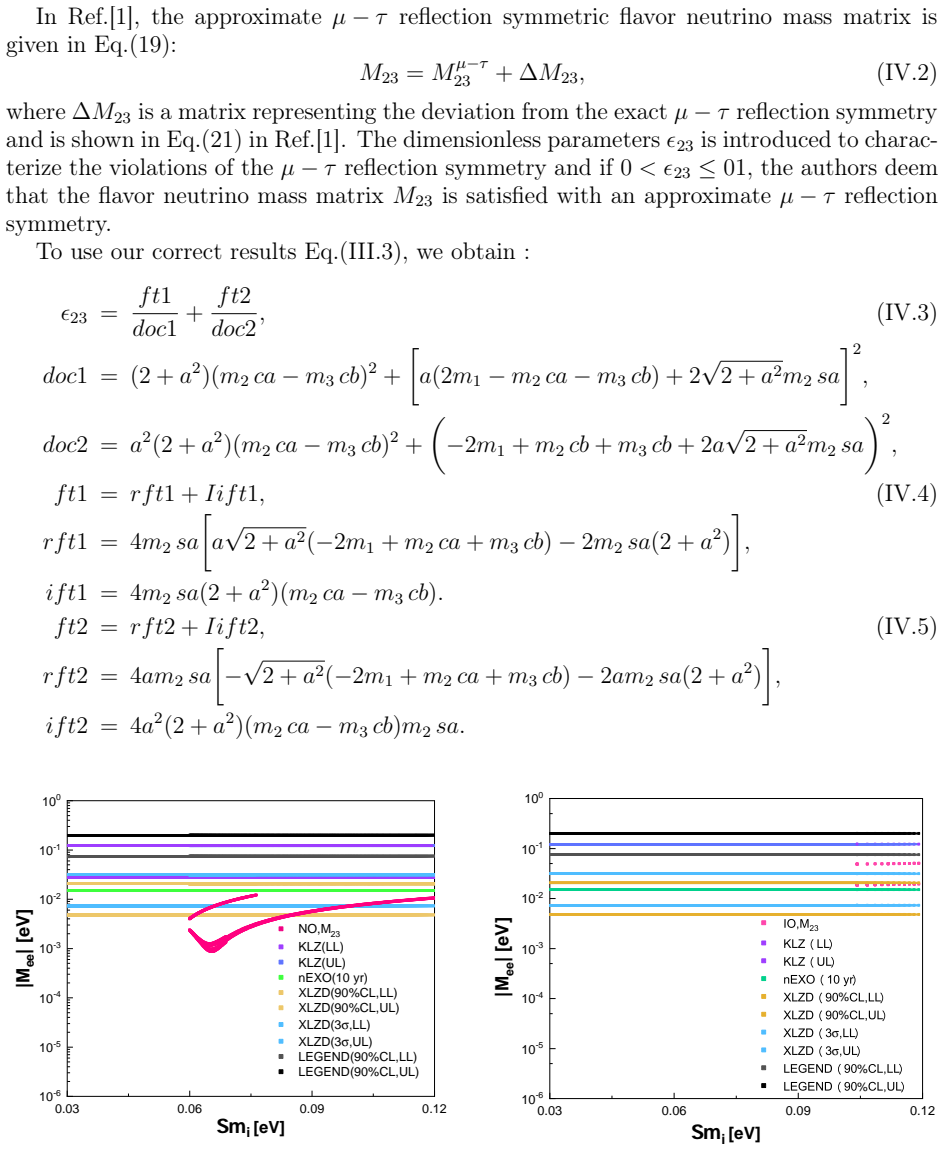
Resolving mass ordering is an important issue in the neutrino physics. In Ref.\cite{yt} the authors investigate the phenomenology of a unified neutrino mixing framework and reveal that the predicted sum of neutrino masses derived from an approximate $\mu-\tau$ reflection symmetric flavor neutrino mass matrix based on the unified neutrino mixing with an inverted mass ordering, is excluded from DESI2024 and Supernova Ia luminosity distance data. We note that in Ref.\cite{yt} an error is present in Eq.(20), {\it i.e.}, the expression for $ M_{23}^{\mu-\tau} $, a similar error also appears in Eq.(26) for $M_{13}^{\mu-\tau}$. That is, the condition that $M_{ee}$ and $M_{\mu\tau}$ are real is omitted. We impose this condition and analyze its consequences. Using the newest data\cite{azz}, it is obtained that the predicted sm derived from the approximate $\mu-\tau$ reflection symmetric neutrino mass matrices $M_{23}$ for both NO and IO are allowed. We note also that their conclusion is invalid, as it is based on outdated data.
Editorial analysis
A structured set of objections, weighed in public.
Referee Report
Summary. This comment identifies an algebraic omission in Ref. [yt]: the reality condition on the matrix elements M_ee and M_μτ is missing from the expressions for the approximate μ-τ reflection symmetric mass matrices M_23^{μ-τ} (Eq. 20) and M_13^{μ-τ} (Eq. 26). After imposing the omitted condition and recomputing the predicted sum of neutrino masses with the updated DESI2024 + SN Ia constraints from Ref. [azz], the authors conclude that both normal ordering (NO) and inverted ordering (IO) cases are allowed, rendering the original exclusion invalid because it relied on outdated data.
Significance. The correction restores consistency between the unified neutrino mixing framework with approximate μ-τ reflection symmetry and the latest cosmological bounds. By showing that the predicted sum of neutrino masses for both orderings now falls within the allowed range, the work clarifies the phenomenological viability of the model and illustrates how a single algebraic requirement can alter exclusion claims when combined with improved data. The argument is directly verifiable from the cited equations and independent external constraints.
minor comments (2)
- The abstract refers only to M_23 while the text also corrects M_13; a brief statement clarifying whether the same reality condition applies identically to both matrices would improve readability.
- Explicit numerical values of the corrected sum of neutrino masses (before and after the reality condition) would allow readers to verify the shift relative to the DESI2024 bounds without consulting the original reference.
Simulated Author's Rebuttal
We thank the referee for the careful review and the recommendation to accept our manuscript. The referee's summary accurately reflects the central correction we have identified and its implications for the viability of both mass orderings under updated cosmological constraints.
read point-by-point responses
-
Referee: This comment identifies an algebraic omission in Ref. [yt]: the reality condition on the matrix elements M_ee and M_μτ is missing from the expressions for the approximate μ-τ reflection symmetric mass matrices M_23^{μ-τ} (Eq. 20) and M_13^{μ-τ} (Eq. 26). After imposing the omitted condition and recomputing the predicted sum of neutrino masses with the updated DESI2024 + SN Ia constraints from Ref. [azz], the authors conclude that both normal ordering (NO) and inverted ordering (IO) cases are allowed, rendering the original exclusion invalid because it relied on outdated data.
Authors: We agree with the referee's summary. The missing reality condition on M_ee and M_μτ in the original expressions for M_23^{μ-τ} and M_13^{μ-τ} led to an erroneous exclusion of the inverted ordering when using older data. Imposing the condition and employing the latest DESI2024 + SN Ia bounds shows that the predicted neutrino mass sums for both orderings lie within the allowed range, thereby invalidating the prior exclusion claim. No changes to the manuscript are required. revision: no
Circularity Check
No significant circularity
full rationale
The comment paper identifies an algebraic omission (reality condition on M_ee and M_μτ) in the original paper's Eqs. (20) and (26), imposes the missing condition on the mass matrices M_23^{μ-τ} and M_13^{μ-τ}, and recomputes the predicted neutrino mass sum using explicitly cited external data (DESI2024 + SN Ia). The revised conclusion that both NO and IO cases are allowed follows directly from this correction plus the updated bounds; no fitted parameters, self-referential predictions, or self-citation chains are used. The derivation chain is self-contained against external benchmarks and does not reduce any claimed result to its own inputs by construction.
Axiom & Free-Parameter Ledger
axioms (1)
- domain assumption Neutrino mass matrix elements M_ee and M_μτ must be real under the imposed symmetry condition.
Lean theorems connected to this paper
-
IndisputableMonolith/Cost/FunctionalEquation.leanwashburn_uniqueness_aczel unclear?
unclearRelation between the paper passage and the cited Recognition theorem.
We note that in Ref.[1] an error is present in Eq.(20), i.e., the expression for M_{23}^{μ-τ}, ... the condition that M_ee and M_μτ are real is omitted. We impose this condition and analyze its consequences.
-
IndisputableMonolith/Foundation/RealityFromDistinction.leanreality_from_one_distinction unclear?
unclearRelation between the paper passage and the cited Recognition theorem.
Using the newest data[2], it is obtained that the predicted Σm_i derived from the approximate μ-τ reflection symmetric neutrino mass matrices M_{23} for both NO and IO are allowed.
What do these tags mean?
- matches
- The paper's claim is directly supported by a theorem in the formal canon.
- supports
- The theorem supports part of the paper's argument, but the paper may add assumptions or extra steps.
- extends
- The paper goes beyond the formal theorem; the theorem is a base layer rather than the whole result.
- uses
- The paper appears to rely on the theorem as machinery.
- contradicts
- The paper's claim conflicts with a theorem or certificate in the canon.
- unclear
- Pith found a possible connection, but the passage is too broad, indirect, or ambiguous to say the theorem truly supports the claim.
Forward citations
Cited by 1 Pith paper
-
Reply to "Comment on `Unified neutrino mixing and approximate $\mu-\tau$ reflection symmetry'[arXiv:2603.00885]''
Inverted neutrino ordering stays in tension with experimental bounds on the sum of neutrino masses under approximate μ-τ reflection symmetry in the model, even if allowed by effective mass |M_ee| data.
Reference graph
Works this paper leans on
- [1]
- [2]
-
[3]
Modified Tri-bimaximal neutrino mixing confront with JUNOθ 12 measurement,
Xiao-Gang He, Phys. Lett.B 874(2026) 140270,arXiv:2511.15978; Sandhya Choubey and Andreas Lund, arXiv:2602.05564; V. V. Vien, arXiv:2204.13935; P. Chakraborty, M. Dey, S. Roy, J.Phys.G 51(2024) 1, 015003, arXiv:2202.04874; Z.B. Todorovic, J. of High Energy Phys.gravitation and cosmology 8, (2022) 593, arXiv:2110.12973; C.-R. Hu, Z.-Z. Xing, Nucl. Phys.B97...
- [4]
-
[5]
Phys.B 1010, (2025), 116763, arXiv:2302.01623
Chao-Shang Huang, Nucl. Phys.B 1010, (2025), 116763, arXiv:2302.01623
-
[6]
K.S. Babu, E. Ma, and J.W.F. Valle, Phys. Lett.B 552, 207 (2003)
work page 2003
-
[7]
E. Ma, Mod. Phys. Lett.A 17, (2002) 2361. 6
work page 2002
-
[8]
DESI DR2 Results II: Measurements of Baryon Acoustic Oscillations and Cosmological Constraints
DESI Collaboration, Phys. Rev.D 112(2005) 083515, arXiv:2503.14738
work page internal anchor Pith review Pith/arXiv arXiv 2005
-
[9]
E.DiValentino, S.Gariazzo, andO.Mena, Phys.Rev.D 104, 083504(2021), arXiv:2106.15267 [Astro-ph.co]; N. Palanque-Delabrouille,et al., Jcap04, 038 (2020), arXiv:1911.09073 [As- troph.co]
-
[10]
Planck 2018 results. VI. Cosmological parameters
N. Aghanim,et al.(Planck), Astron.astrophys. 641,A 6, (2020), [Erratum: Astron.astrophys. 652,c 4, (2021)], arXiv:1807.06209 [Astro-ph.co]. In the recent paper, arXiv:2310.05474, the tightest95%C.L.bound on the neutrino mass is 0.34 eV
work page internal anchor Pith review Pith/arXiv arXiv 2020
-
[11]
Search for Majorana Neutrinos near the Inverted Mass Hierarchy Region with KamLAND-Zen
A. Gando,et al., Phys. Rev. Lett.117, 082503 (2016), [Addendum: Phys. Rev. Lett.117, 109903 (2016), arXiv:1605.02889[hep-ex]
work page internal anchor Pith review Pith/arXiv arXiv 2016
- [12]
- [13]
- [14]
-
[15]
Avrorin,et al., (Baikal-GVD), PoS ICRC2019, 1013 (2020), arXiv:1908.05450 [astro-ph.HE]
A. Avrorin,et al., (Baikal-GVD), PoS ICRC2019, 1013 (2020), arXiv:1908.05450 [astro-ph.HE]
-
[16]
Letter of Intent for KM3NeT 2.0
S. Adri´an-Mart´ınez,et al.(KM3Net), J. Phys.G 43, 084001 (2016), arXiv:1601.07459 [astro-ph.IM]
work page internal anchor Pith review Pith/arXiv arXiv 2016
-
[17]
Agostiniet al., Nature Astronomy4, 913 (2020), arXiv:2005.09493 [astro-ph.HE]
M. Agostini,et al., (P-ONE), Nature Astron.4, 913 (2020), arXiv:2005.09493 [astro-ph.HE]
-
[18]
A. Romero-Wolf,et al., in Latin American Strategy Forum for Research Infrastructure (2020), arXiv:2002.06475 [astro-ph.IM]. 7
discussion (0)
Sign in with ORCID, Apple, or X to comment. Anyone can read and Pith papers without signing in.