Recognition: 2 theorem links
· Lean TheoremExperimental Advances on Light Baryon Spectroscopy at BESIII Experiment
Pith reviewed 2026-05-15 16:51 UTC · model grok-4.3
The pith
BESIII data has revealed multiple new excited states of light baryons including nucleons and various hyperons.
A machine-rendered reading of the paper's core claim, the machinery that carries it, and where it could break.
Core claim
Through systematic analyses of the large data samples collected at BESIII, several new excited states have been identified in the light baryon sector: excited nucleons, Lambda hyperons, Sigma hyperons, Xi hyperons, and Omega hyperons. These observations expand the known spectrum of baryon resonances.
What carries the argument
Reconstruction of baryon resonance signals from invariant mass distributions in the decays of J/psi and psi(3686) mesons produced in electron-positron collisions.
If this is right
- New states provide benchmarks for theoretical calculations of baryon masses and widths in QCD-inspired models.
- Additional data helps fill gaps in the predicted spectrum of light baryons.
- Improved constraints on non-perturbative effects in strong interactions.
- Foundation for future precision measurements of resonance properties.
Where Pith is reading between the lines
- These discoveries may prompt updates to quark model classifications of baryons.
- Similar experimental strategies could be used to search for missing states in other sectors.
- Confirmation at higher luminosities would strengthen the case for these resonances being established particles.
Load-bearing premise
The peaks observed in the mass spectra represent actual new resonance states and are not artifacts from backgrounds or known state interferences.
What would settle it
Independent verification at another facility or a reanalysis that attributes the peaks to known effects or statistical fluctuations would disprove the new state interpretations.
Figures






read the original abstract
The BESIII experiment is currently the world's only electron-positron collider operating in the tau-charm physical energy region. Since starting data taking in 2009, BESIII has accumulated the world's largest data set in the center-of-mass energy range of 1.84-4.95 GeV, including approximately 10 billion $J/\psi$ events and 3 billion $\psi(3686)$ events, together with extensive data on open-charm hadron pair production near threshold regions. These unique datasets, characterized by high statistics and low background, provide unprecedented experimental conditions for studying light baryon spectroscopy. This article systematically reviews the progress made by BESIII in baryon spectroscopy, with a focus on recent breakthrough achievements, including the discovery of excited nucleon states, $\Lambda$ hyperon states, $\Sigma$ hyperon states, $\Xi$ hyperon states and $\Omega^{-}$ hyperon states. These results expand the spectrum of baryon excited states and provide crucial experimental support for understanding non-perturbative QCD and resolving the ``missing baryon resonances'' problem.
Editorial analysis
A structured set of objections, weighed in public.
Referee Report
Summary. This manuscript is a review summarizing the BESIII experiment's contributions to light baryon spectroscopy. It describes the unique high-statistics, low-background datasets (approximately 10 billion J/ψ events and 3 billion ψ(3686) events) collected in the 1.84-4.95 GeV range and highlights reported discoveries of excited states in the nucleon, Λ, Σ, Ξ, and Ω sectors, claiming these expand the known baryon spectrum and provide experimental support for non-perturbative QCD and the missing baryon resonances problem.
Significance. If the underlying resonance interpretations hold, the summarized results supply high-quality experimental benchmarks that can constrain quark models, lattice QCD calculations, and coupled-channel analyses, directly addressing discrepancies between predicted and observed light baryon states.
major comments (2)
- Abstract: the central claim that the reported structures constitute 'breakthrough achievements' and 'crucial experimental support' for resolving the missing resonances problem rests on the assumption that each peak corresponds to a genuine new resonance with established quantum numbers; the review does not summarize the partial-wave analysis details, background models, or interference terms from the original publications that would allow assessment of whether kinematic reflections or non-resonant amplitudes were rigorously excluded.
- Section on Ξ and Ω hyperon states: without explicit discussion of the fit qualities, resonance parameters, or cross-checks against known states in the summarized analyses, the robustness of the claimed new Ξ and Ω excitations cannot be evaluated independently from this review.
minor comments (2)
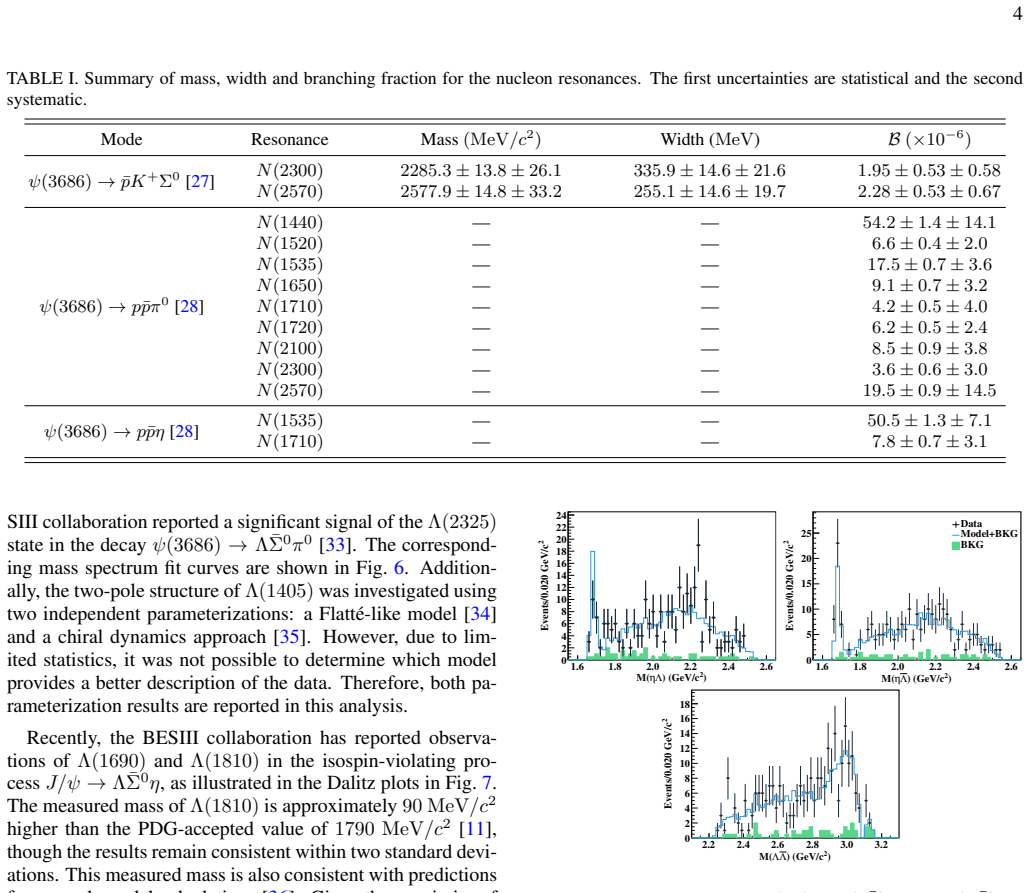
- The manuscript would benefit from a dedicated table compiling the newly reported resonance masses, widths, and quantum numbers with references to the original BESIII publications for each sector.
- Figure captions should explicitly state the center-of-mass energy range and integrated luminosity for each mass spectrum shown to allow readers to assess the statistical significance directly.
Simulated Author's Rebuttal
We thank the referee for the detailed and constructive review of our manuscript. We have addressed each major comment below and will incorporate clarifications to strengthen the review while preserving its scope as a summary of BESIII results.
read point-by-point responses
-
Referee: Abstract: the central claim that the reported structures constitute 'breakthrough achievements' and 'crucial experimental support' for resolving the missing resonances problem rests on the assumption that each peak corresponds to a genuine new resonance with established quantum numbers; the review does not summarize the partial-wave analysis details, background models, or interference terms from the original publications that would allow assessment of whether kinematic reflections or non-resonant amplitudes were rigorously excluded.
Authors: We agree that the review nature of the manuscript limits the inclusion of full technical details from each analysis. The resonance claims originate from published BESIII papers that performed dedicated partial-wave analyses, including background modeling and interference studies. To improve accessibility, we will revise the abstract and add a short paragraph in the introduction explicitly noting that quantum-number assignments and background exclusions are established in the cited original works (with references to the specific PWA methods used). This provides context without duplicating lengthy technical sections. revision: partial
-
Referee: Section on Ξ and Ω hyperon states: without explicit discussion of the fit qualities, resonance parameters, or cross-checks against known states in the summarized analyses, the robustness of the claimed new Ξ and Ω excitations cannot be evaluated independently from this review.
Authors: We will expand the relevant sections to include concise summaries of the fit qualities, extracted mass/width parameters, and cross-checks against known states as reported in the original BESIII publications. This addition will allow readers to better assess the robustness while maintaining the review's focus on experimental progress. revision: yes
Circularity Check
No circularity: experimental review with no derivations or fitted predictions
full rationale
This paper is a review summarizing BESIII experimental observations on light baryon spectroscopy, including discoveries of excited states from mass spectra. It contains no derivations, theoretical predictions, normalizations, or parameter fits that could reduce to inputs by construction. Claims rest on direct experimental data (e.g., accumulated J/ψ and ψ(3686) events) benchmarked against external QCD expectations, with no self-citation load-bearing steps, ansatz smuggling, or renaming of known results as new derivations. The structure is self-contained as a factual summary of published results without internal consistency loops.
Axiom & Free-Parameter Ledger
axioms (1)
- domain assumption Peaks in invariant mass distributions correspond to excited baryon resonances
Lean theorems connected to this paper
-
IndisputableMonolith/Cost/FunctionalEquation.leanwashburn_uniqueness_aczel unclear?
unclearRelation between the paper passage and the cited Recognition theorem.
partial wave analysis ... Breit-Wigner propagator with Blatt–Weisskopf barrier factor
-
IndisputableMonolith/Foundation/AlexanderDuality.leanalexander_duality_circle_linking unclear?
unclearRelation between the paper passage and the cited Recognition theorem.
missing baryon resonances problem ... quark model predictions
What do these tags mean?
- matches
- The paper's claim is directly supported by a theorem in the formal canon.
- supports
- The theorem supports part of the paper's argument, but the paper may add assumptions or extra steps.
- extends
- The paper goes beyond the formal theorem; the theorem is a base layer rather than the whole result.
- uses
- The paper appears to rely on the theorem as machinery.
- contradicts
- The paper's claim conflicts with a theorem or certificate in the canon.
- unclear
- Pith found a possible connection, but the passage is too broad, indirect, or ambiguous to say the theorem truly supports the claim.
Forward citations
Cited by 1 Pith paper
-
Interpretation of $\Omega(2012)$ as a $\Xi(1530)K$ molecular state
Ω(2012) is interpreted as a Ξ(1530)K molecular state with mass 2.00 ± 0.15 GeV and total decay width 0.96 MeV.
Reference graph
Works this paper leans on
-
[1]
Gell-Mann, A Schematic Model of Baryons and Mesons, Phys
M. Gell-Mann, A Schematic Model of Baryons and Mesons, Phys. Lett.8, 214 (1964)
work page 1964
-
[2]
Quark Models of Baryon Masses and Decays
S. Capstick and W. Roberts, Quark models of baryon masses and decays, Prog. Part. Nucl. Phys.45, S241 (2000), arXiv:nucl-th/0008028
work page internal anchor Pith review Pith/arXiv arXiv 2000
-
[3]
L. Y . Glozman, W. Plessas, K. Varga, and R. F. Wagenbrunn, Unified description of light and strange baryon spectra, Phys. Rev. D58, 094030 (1998), arXiv:hep-ph/9706507
work page internal anchor Pith review Pith/arXiv arXiv 1998
-
[4]
L. Y . Glozman and D. O. Riska, The Spectrum of the nucleons and the strange hyperons and chiral dynamics, Phys. Rept.268, 263 (1996), arXiv:hep-ph/9505422. 10
work page internal anchor Pith review Pith/arXiv arXiv 1996
-
[5]
C. Menapara and A. K. Rai, Spectroscopic investigation of light strangeS=−1 Λ,ΣandS=−2 Ξbaryons, Chin. Phys. C 45, 063108 (2021), arXiv:2104.00439 [hep-ph]
-
[6]
E. Wang, L.-S. Geng, J.-J. Wu, J.-J. Xie, and B.-S. Zou, Review of the Low-Lying Excited BaryonsΣ∗(1/2−), Chin. Phys. Lett. 41, 101401 (2024), arXiv:2406.07839 [hep-ph]
-
[7]
J.-J. Wu, R. Molina, E. Oset, and B. S. Zou, Prediction of nar- rowN ∗ andΛ ∗ resonances with hidden charm above 4 GeV, Phys. Rev. Lett.105, 232001 (2010), arXiv:1007.0573 [nucl- th]
work page internal anchor Pith review Pith/arXiv arXiv 2010
-
[8]
S. Capstick and W. Roberts,N πdecays of baryons in a rela- tivized model, Phys. Rev. D47, 1994 (1993)
work page 1994
-
[9]
N. Isgur and G. Karl, Positive Parity Excited Baryons in a Quark Model with Hyperfine Interactions, Phys. Rev. D19, 2653 (1979), [Erratum: Phys.Rev.D 23, 817 (1981)]
work page 1979
-
[10]
M. Ablikim et al. (BESIII), Future Physics Programme of BE- SIII, Chin. Phys. C44, 040001 (2020), arXiv:1912.05983 [hep- ex]
-
[11]
S. Navas et al. (Particle Data Group), Review of particle physics, Phys. Rev. D110, 030001 (2024)
work page 2024
-
[12]
Design and Construction of the BESIII Detector
M. Ablikim et al. (BESIII), Design and Construction of the BESIII Detector, Nucl. Instrum. Meth. A614, 345 (2010), arXiv:0911.4960 [physics.ins-det]
work page internal anchor Pith review Pith/arXiv arXiv 2010
-
[13]
C. Yu et al., BEPCII Performance and Beam Dynamics Studies on Luminosity, in 7th International Particle Accelerator Conference (2016) p. TUY A01
work page 2016
-
[14]
J. Lu, Y . Xiao, and X. Ji, Online monitoring of the center-of- mass energy from real data at BESIII, Radiat. Detect. Technol. Methods4, 337 (2020)
work page 2020
-
[15]
J.-W. Zhang et al., Suppression of top-up injection backgrounds with offline event filter in the BESIII experiment, Radiat. De- tect. Technol. Methods6, 289 (2022)
work page 2022
-
[16]
Li et al., Study of MRPC technology for BESIII endcap-TOF upgrade, Radiat
X. Li et al., Study of MRPC technology for BESIII endcap-TOF upgrade, Radiat. Detect. Technol. Methods1, 13 (2017)
work page 2017
-
[17]
Guo et al., The study of time calibration for upgraded end cap TOF of BESIII, Radiat
Y .-X. Guo et al., The study of time calibration for upgraded end cap TOF of BESIII, Radiat. Detect. Technol. Methods1, 15 (2017)
work page 2017
-
[18]
P. Cao et al., Design and construction of the new BESIII endcap Time-of-Flight system with MRPC Technology, Nucl. Instrum. Meth. A953, 163053 (2020)
work page 2020
-
[19]
S. U. Chung, Helicity coupling amplitudes in tensor formalism, Phys. Rev. D48, 1225 (1993), [Erratum: Phys.Rev.D 56, 4419 (1997)]
work page 1993
-
[20]
S. U. Chung, A General formulation of covariant helicity cou- pling amplitudes, Phys. Rev. D57, 431 (1998)
work page 1998
-
[21]
Eta-meson production in the resonance energy region
V . Shklyar, H. Lenske, and U. Mosel,η-meson production in the resonance-energy region, Phys. Rev. C87, 015201 (2013), arXiv:1206.5414 [nucl-th]
work page internal anchor Pith review Pith/arXiv arXiv 2013
-
[22]
High statistics study of the reaction $\gamma p\to p\;2\pi^0$
V . Sokhoyan et al. (CBELSA/TAPS), High-statistics study of the reactionγp→p2π 0, Eur. Phys. J. A51, 95 (2015), [Er- ratum: Eur.Phys.J.A 51, 187 (2015)], arXiv:1507.02488 [nucl- ex]
work page internal anchor Pith review Pith/arXiv arXiv 2015
-
[23]
B. C. Hunt and D. M. Manley, Updated determination ofN ∗ resonance parameters using a unitary, multichannel formalism, Phys. Rev. C99, 055205 (2019), arXiv:1810.13086 [nucl-ex]
work page internal anchor Pith review Pith/arXiv arXiv 2019
-
[24]
First results on nucleon resonance photocouplings from the $\gamma p \to \pi^+\pi^-p$ reaction
E. Golovatch et al. (CLAS), First results on nucleon resonance photocouplings from theγp→π +π−preaction, Phys. Lett. B 788, 371 (2019), arXiv:1806.01767 [nucl-ex]
work page internal anchor Pith review Pith/arXiv arXiv 2019
-
[25]
J. Z. Bai et al. (BES), Study ofN ∗ production fromJ/ψ→ p¯pη, Phys. Lett. B510, 75 (2001), arXiv:hep-ex/0105011
work page internal anchor Pith review Pith/arXiv arXiv 2001
-
[26]
Observation of two new $N^*$ resonances in $\psi(3686) \rightarrow p\bar{p}\pi^0$
M. Ablikim et al. (BESIII), Observation of two newN ∗ reso- nances in the decayψ(3686)→p¯pπ 0, Phys. Rev. Lett.110, 022001 (2013), arXiv:1207.0223 [hep-ex]
work page internal anchor Pith review Pith/arXiv arXiv 2013
-
[27]
M. Ablikim et al. (BESIII), Observation of a New ExcitedΣ State inψ(3686)→¯pK +Σ0+c.c., (2026), arXiv:2602.11501 [hep-ex]
-
[28]
Partial wave analyses of $\psi(3686)\to p\bar{p}\pi^0$ and $\psi(3686)\to p\bar{p}\eta$
M. Ablikim et al. (BESIII), Partial wave analyses of ψ(3686)→p¯pπ 0 andψ(3686)→p¯pη, Phys. Rev. D111, 032011 (2025), arXiv:2412.06247 [hep-ex]
work page internal anchor Pith review Pith/arXiv arXiv 2025
-
[29]
M. Ablikim et al. (BESIII), Measurement ofψ(3686)→Λ ¯Λη andψ(3686)→Λ ¯Λπ0 decays, Phys. Rev. D106, 072006 (2022), arXiv:2207.14350 [hep-ex]
-
[30]
M. Ablikim et al. (BESIII), Study ofψ(3686)→Λ ¯Λω, Phys. Rev. D106, 112011 (2022), arXiv:2207.11666 [hep-ex]
-
[31]
M. Ablikim et al. (BESIII), Determination of Spin-Parity Quan- tum Numbers for the Narrow Structure near thep ¯ΛThreshold ine +e− →pK − ¯Λ+c.c., Phys. Rev. Lett.131, 151901 (2023), arXiv:2303.01989 [hep-ex]
-
[32]
M. Ablikim et al. (BESIII), Precise measurement of the branch- ing fractions ofJ/ψ→ ¯Λπ+Σ− +c.c.andJ/ψ→ ¯Λπ−Σ+ + c.c., Phys. Rev. D108, 112012 (2023), arXiv:2306.10319 [hep- ex]
-
[33]
M. Ablikim et al. (BESIII), Partial wave analysis ofψ(3686)→ Λ¯Σ0π0+c.c, JHEP02, 212, arXiv:2408.00495 [hep-ex]
-
[34]
S. U. Chung, J. Brose, R. Hackmann, E. Klempt, S. Spanier, and C. Strassburger, Partial wave analysis in K matrix formalism, Annalen Phys.4, 404 (1995)
work page 1995
-
[35]
D. Jido, J. A. Oller, E. Oset, A. Ramos, and U. G. Meissner, Chiral dynamics of the twoΛ(1405)states, Nucl. Phys. A725, 181 (2003), arXiv:nucl-th/0303062
work page internal anchor Pith review Pith/arXiv arXiv 2003
-
[36]
U. Loring, B. C. Metsch, and H. R. Petry, The Light baryon spectrum in a relativistic quark model with instanton induced quark forces: The Strange baryon spectrum, Eur. Phys. J. A10, 447 (2001), arXiv:hep-ph/0103290
work page internal anchor Pith review Pith/arXiv arXiv 2001
-
[37]
M. Ablikim et al. (BESIII), Amplitude analysis and branch- ing fraction measurement ofJ/ψ→Λ ¯Σ0η+ c.c, (2026), arXiv:2601.07617 [hep-ex]
-
[38]
H. Zhang, J. Tulpan, M. Shrestha, and D. M. Manley, Mul- tichannel parametrization of ¯KNscattering amplitudes and extraction of resonance parameters, Phys. Rev. C88, 035205 (2013), arXiv:1305.4575 [hep-ph]
work page internal anchor Pith review Pith/arXiv arXiv 2013
- [39]
-
[40]
C. Menapara and A. K. Rai, Hadron Spectroscopy: Light, Strange Baryons, Few Body Syst.65, 63 (2024), arXiv:2405.06417 [hep-ph]
-
[41]
M. Ablikim et al. (BESIII), Observation of the decay ψ(3686)→Σ 0 ¯Σ0ω10.1103/PhysRevD.111.092007 (2025), arXiv:2503.18620 [hep-ex]
-
[42]
M. Ablikim et al. (BESIII), Observation ofΛ + c →Λa 0(980)+ and Evidence forΣ(1380) + inΛ + c →Λπ +η, Phys. Rev. Lett. 134, 021901 (2025), arXiv:2407.12270 [hep-ex]
-
[43]
J.-J. Wu, S. Dulat, and B. S. Zou, Evidence for a newΣ ∗ reso- nance withJ P = 1/2− in the old data ofK −p→Λπ +π− re- action, Phys. Rev. D80, 017503 (2009), arXiv:0906.3950 [hep- ph]
work page internal anchor Pith review Pith/arXiv arXiv 2009
-
[44]
$\Sigma^*_{1/2^-}(1380)$ in the $\Lambda^+_c \to \eta \pi^+ \Lambda$ decay
J.-J. Xie and L.-S. Geng,Σ ∗ 1/2−(1380)in theΛ + c →ηπ +Λde- cay, Phys. Rev. D95, 074024 (2017), arXiv:1703.09502 [hep- ph]
work page internal anchor Pith review Pith/arXiv arXiv 2017
-
[45]
R. T. Ross, T. Buran, J. L. Lloyd, J. H. Mulvey, and D. Rado- jicic,Ξπresonance with mass 1606 MeV/c 2, Phys. Lett. B38, 177 (1972)
work page 1972
-
[46]
A. d. Bellefon, A. Berthon, and P. Billoir, ReactionsK −p→ Ξ−K 0 +π + 0 between 2210 and 2435 MeV Ecm, Nuovo Cim. A 11 28, 289 (1975)
work page 1975
-
[47]
Briefel et al., Search forΞ ∗ Production inK −pInteractions at 2.87 GeV/c, Phys
E. Briefel et al., Search forΞ ∗ Production inK −pInteractions at 2.87 GeV/c, Phys. Rev. D16, 2706 (1977)
work page 1977
-
[48]
M. Sumihama et al. (Belle), Observation ofΞ(1620) 0 and ev- idence forΞ(1690) 0 inΞ + c →Ξ −π+π+ decays, Phys. Rev. Lett.122, 072501 (2019), arXiv:1810.06181 [hep-ex]
work page internal anchor Pith review Pith/arXiv arXiv 2019
-
[49]
M. Ablikim et al. (BESIII), Measurement of the cross section fore +e− →Ξ −¯Ξ+ and observation of an excitedΞbaryon, Phys. Rev. Lett.124, 032002 (2020), arXiv:1910.04921 [hep- ex]
-
[50]
M. I. Adamovich et al. (W A89), Production ofΞ ∗ resonances inΣ − induced reactions at 345 GeV/c, Eur. Phys. J. C11, 271 (1999), arXiv:hep-ex/9907021
work page internal anchor Pith review Pith/arXiv arXiv 1999
-
[51]
M. Ablikim et al. (BESIII), Study of excitedΞstates in ψ(3686)→K −Λ¯Ξ+ +c.c., Phys. Rev. D109, 072008 (2024), arXiv:2308.15206 [hep-ex]
-
[52]
R. Molina, W.-H. Liang, C.-W. Xiao, Z.-F. Sun, and E. Oset, Two states for theΞ(1820)resonance, Phys. Lett. B856, 138872 (2024), arXiv:2309.03618 [hep-ph]
-
[53]
Observation of an excited $\Omega^-$ baryon
J. Yelton et al. (Belle), Observation of an ExcitedΩ − Baryon, Phys. Rev. Lett.121, 052003 (2018), arXiv:1805.09384 [hep- ex]
work page internal anchor Pith review Pith/arXiv arXiv 2018
- [54]
-
[55]
S. Capstick and N. Isgur, Baryons in a relativized quark model with chromodynamics, Phys. Rev. D34, 2809 (1986)
work page 1986
-
[56]
R. N. Faustov and V . O. Galkin, Strange baryon spectroscopy in the relativistic quark model, Phys. Rev. D92, 054005 (2015), arXiv:1507.04530 [hep-ph]
work page internal anchor Pith review Pith/arXiv arXiv 2015
-
[57]
Strangeness -2 and -3 Baryons in a Constituent Quark Model
M. Pervin and W. Roberts, Strangeness -2 and -3 baryons in a constituent quark model, Phys. Rev. C77, 025202 (2008), arXiv:0709.4000 [nucl-th]
work page internal anchor Pith review Pith/arXiv arXiv 2008
-
[58]
Xi and Omega baryons in the Skyrme model
Y . Oh,ΞandΩbaryons in the Skyrme model, Phys. Rev. D75, 074002 (2007), arXiv:hep-ph/0702126
work page internal anchor Pith review Pith/arXiv arXiv 2007
-
[59]
G. P. Engel, C. B. Lang, D. Mohler, and A. Sch ¨afer (BGR), QCD with Two Light Dynamical Chirally Improved Quarks: Baryons, Phys. Rev. D87, 074504 (2013), arXiv:1301.4318 [hep-lat]
work page internal anchor Pith review Pith/arXiv arXiv 2013
- [60]
-
[61]
Q.-H. Shen, J.-X. Lu, L.-S. Geng, X. Liu, and J.-J. Xie, Radia- tive decays of theΩ(2012)as a hadronic molecule, Phys. Rev. D113, 036014 (2026), arXiv:2510.13623 [hep-ph]
-
[62]
M. Ablikim et al. (BESIII), Evidence for Two ExcitedΩ − Hy- perons, Phys. Rev. Lett.134, 131903 (2025), arXiv:2411.11648 [hep-ex]
-
[63]
R. G. Edwards, N. Mathur, D. G. Richards, and S. J. Wal- lace (Hadron Spectrum), Flavor structure of the excited baryon spectra from lattice QCD, Phys. Rev. D87, 054506 (2013), arXiv:1212.5236 [hep-ph]
work page internal anchor Pith review Pith/arXiv arXiv 2013
- [64]
- [65]
-
[66]
E. B. Levichev, A. N. Skrinsky, G. M. Tumaikin, and Y . M. Shatunov, Electron–positron beam collision studies at the Bud- ker Institute of Nuclear Physics, Phys. Usp.61, 405 (2018)
work page 2018
-
[67]
Achasov et al., STCF conceptual design report (V olume 1): Physics & detector, Front
M. Achasov et al., STCF conceptual design report (V olume 1): Physics & detector, Front. Phys. (Beijing)19, 14701 (2024), arXiv:2303.15790 [hep-ex]
discussion (0)
Sign in with ORCID, Apple, or X to comment. Anyone can read and Pith papers without signing in.