Recognition: no theorem link
Quantum Thermalization beyond Non-Integrability and Quantum Scars in a Multispecies Bose-Josephson Junction
Pith reviewed 2026-05-15 00:04 UTC · model grok-4.3
The pith
Quantum thermalization occurs in both chaotic and integrable regimes of a three-species Bose-Josephson junction but fails in the separable limit.
A machine-rendered reading of the paper's core claim, the machinery that carries it, and where it could break.
Core claim
In this multispecies Bose-Josephson junction, quantum thermalization occurs in the chaotic and integrable regimes while it breaks down in the separable limit, showing that non-integrability is not a necessary condition for thermalization. Athermal states identified in the chaotic regime are classifiable as quantum scars and remain consistent with a weak form of the Eigenstate Thermalization Hypothesis.
What carries the argument
The three-species Bose-Josephson junction with mutual interactions, classified into chaotic, integrable, and separable regimes and examined via the Eigenstate Thermalization Hypothesis.
If this is right
- Thermalization can appear in integrable quantum systems that lack chaos.
- The separable limit produces ergodicity breaking that prevents thermalization.
- Quantum scars act as stable athermal states inside otherwise chaotic regimes.
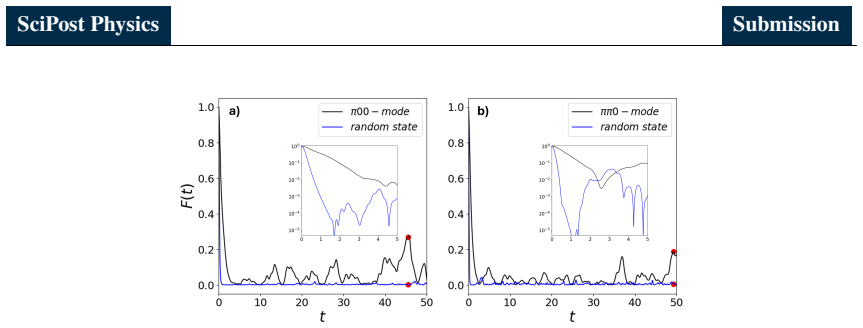
- Collective semiclassical behavior in the junction produces identifiable scars.
Where Pith is reading between the lines
- Similar junctions realized with ultracold atoms could be used to test thermalization without external baths.
- The result suggests thermalization criteria may apply more broadly to integrable models than previously thought.
- Extensions to other multispecies systems could reveal whether scars and thermalization coexist in the same parameter space.
Load-bearing premise
The classification into chaotic, integrable, and separable regimes correctly describes the isolated internal dynamics without hidden external effects.
What would settle it
Direct observation of thermalization in the separable limit or its clear absence in the integrable regime under the same isolation conditions would falsify the central claim.
Figures




read the original abstract
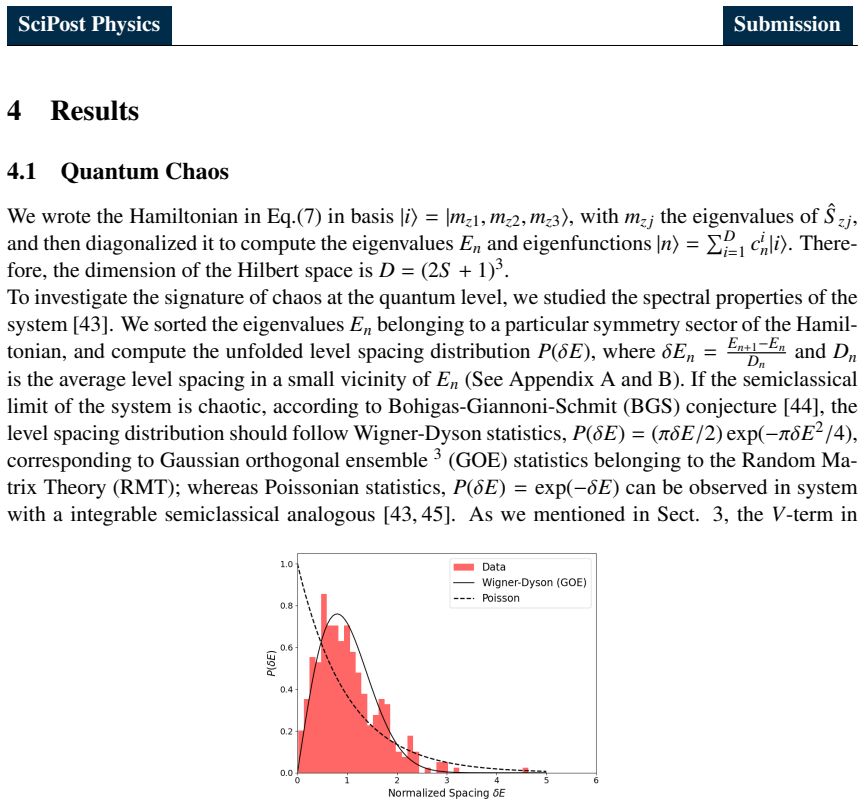
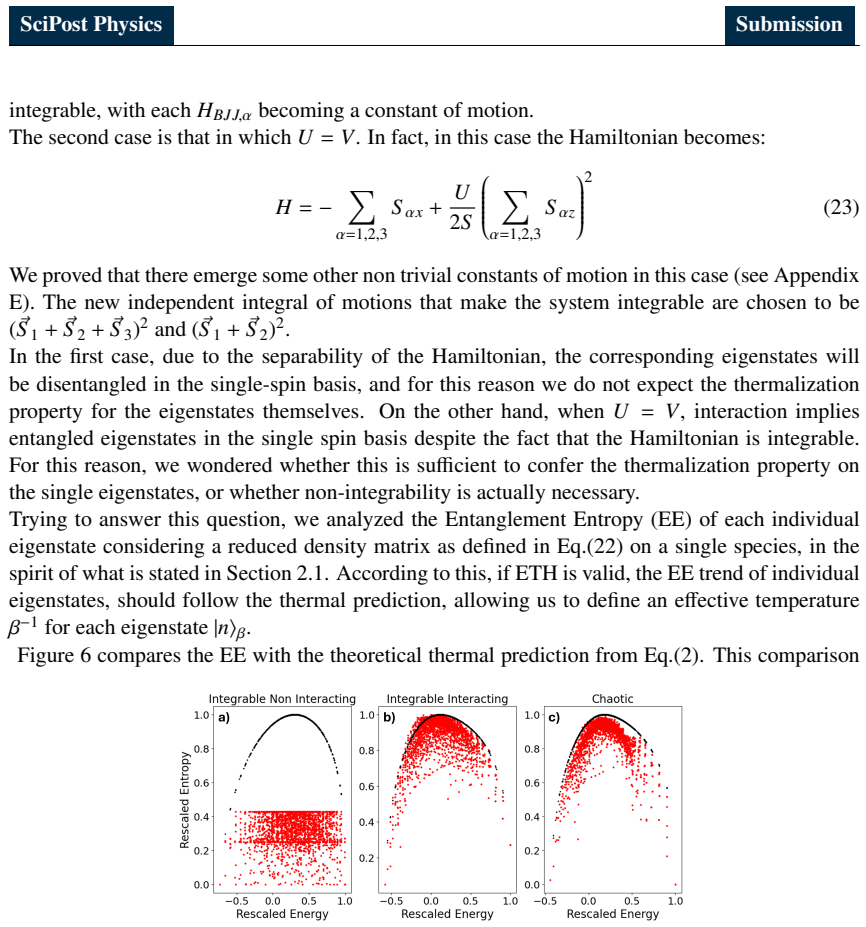
This work investigates the relationship between quantum chaos and thermalization in a three-species Bose-Josephson Junction (BJJ) with mutual interactions, without coupling to any external environment. The analysis is grounded in the Eigenstate Thermalization Hypothesis (ETH), the modern framework for quantum thermalization, in which non-integrability and chaos are historically assumed as prerequisites. After a thorough characterization of quantum chaos in this system, we examine the occurrence of thermal behavior expected when ETH holds. We identify three distinct regimes: chaotic, integrable, and separable. Remarkably, quantum thermalization occurs in both the chaotic and integrable regimes, while it breaks down in the separable limit - supporting that non-integrability is not a necessary condition for thermalization. Furthermore, since the system exhibits collective phenomena in the semiclassical limit, we identify athermal states in the chaotic regime classifiable as quantum scars, which show no signs of thermalization, consistently with a weak form of ETH. These findings contribute to the understanding of ergodicity breaking, emerging statistical behavior, and non-equilibrium dynamics in ultracold many-body quantum systems.
Editorial analysis
A structured set of objections, weighed in public.
Referee Report
Summary. The manuscript examines quantum thermalization and chaos in a three-species Bose-Josephson junction with mutual interactions and no external coupling. Grounded in the Eigenstate Thermalization Hypothesis (ETH), it identifies chaotic, integrable, and separable regimes, claiming that thermalization occurs in both chaotic and integrable cases (but fails in the separable limit), thereby arguing that non-integrability is not required for thermalization. It further identifies athermal states in the chaotic regime as quantum scars consistent with weak ETH.
Significance. If the central claims hold, the work is significant for challenging the historical link between non-integrability/chaos and ETH-style thermalization, offering a concrete example where thermalization appears in an integrable regime. This could broaden understanding of ergodicity breaking and statistical behavior in ultracold many-body systems with collective semiclassical dynamics, while the quantum-scar identification adds to the literature on weak ETH violations.
major comments (3)
- [Abstract and integrable-regime analysis] Abstract and integrable-regime section: The central claim that quantum thermalization occurs in the integrable regime (and thus that non-integrability is unnecessary) is load-bearing. Integrable systems generically relax to a generalized Gibbs ensemble (GGE) fixed by all conserved charges rather than the standard canonical/microcanonical ensemble assumed under ETH. The manuscript must explicitly compare long-time averages and eigenstate expectations of local observables against both the canonical thermal predictions and the full GGE constructed from the integrals of motion; without this test, apparent thermalization may simply reflect GGE physics.
- [Regime characterization] Regime-identification section: The separation into chaotic, integrable, and separable regimes underpins all conclusions. The diagnostics (level statistics, Lyapunov exponents, or similar) must be shown to correctly isolate a truly integrable regime with the expected conserved quantities, and the absence of external coupling must be verified to exclude hidden environmental effects that could induce effective non-integrability.
- [Athermal states and quantum scars] Quantum-scars subsection: The classification of athermal states in the chaotic regime as quantum scars requires quantitative support beyond qualitative statements. The manuscript should include semiclassical diagnostics such as overlaps with unstable periodic orbits or scarring measures in the collective phase space to distinguish these states from other ergodicity-breaking mechanisms.
minor comments (2)
- [Abstract] The abstract states the central result but omits any mention of system sizes, interaction parameters, or numerical convergence; adding one sentence on these would improve accessibility.
- [Figures] Figure captions should be self-contained, explicitly labeling the three regimes and the observables used to diagnose thermalization versus scarring.
Simulated Author's Rebuttal
We thank the referee for the careful and constructive report. The comments raise important points about the strength of our central claims, and we address each one below. We will revise the manuscript to incorporate the requested clarifications and additional analyses.
read point-by-point responses
-
Referee: [Abstract and integrable-regime analysis] Abstract and integrable-regime section: The central claim that quantum thermalization occurs in the integrable regime (and thus that non-integrability is unnecessary) is load-bearing. Integrable systems generically relax to a generalized Gibbs ensemble (GGE) fixed by all conserved charges rather than the standard canonical/microcanonical ensemble assumed under ETH. The manuscript must explicitly compare long-time averages and eigenstate expectations of local observables against both the canonical thermal predictions and the full GGE constructed from the integrals of motion; without this test, apparent thermalization may simply reflect GGE physics.
Authors: We agree that an explicit comparison to the GGE is necessary to substantiate the claim that thermalization occurs beyond GGE physics. In our model the integrable regime possesses a small number of conserved quantities (species populations and total energy) whose associated GGE reduces to the microcanonical ensemble for the local observables examined. To make this rigorous we will add direct comparisons of long-time averages and eigenstate expectations against both the canonical ensemble and the full GGE in the revised manuscript. revision: yes
-
Referee: [Regime characterization] Regime-identification section: The separation into chaotic, integrable, and separable regimes underpins all conclusions. The diagnostics (level statistics, Lyapunov exponents, or similar) must be shown to correctly isolate a truly integrable regime with the expected conserved quantities, and the absence of external coupling must be verified to exclude hidden environmental effects that could induce effective non-integrability.
Authors: We will expand the regime-identification section with additional figures and discussion that explicitly connect the level statistics and Lyapunov exponents to the conserved quantities present in the integrable regime. The Hamiltonian is defined without external coupling; we will add an explicit verification that no hidden environmental terms are present. revision: yes
-
Referee: [Athermal states and quantum scars] Quantum-scars subsection: The classification of athermal states in the chaotic regime as quantum scars requires quantitative support beyond qualitative statements. The manuscript should include semiclassical diagnostics such as overlaps with unstable periodic orbits or scarring measures in the collective phase space to distinguish these states from other ergodicity-breaking mechanisms.
Authors: We will strengthen the quantum-scars subsection by adding quantitative semiclassical diagnostics, including overlaps with unstable periodic orbits and scarring measures evaluated in the collective phase space, to provide rigorous support for the scar identification. revision: yes
Circularity Check
No circularity: regimes and thermalization diagnostics are independently defined
full rationale
The paper first characterizes the three regimes (chaotic, integrable, separable) via independent diagnostics such as level-spacing statistics, eigenstate delocalization measures, and the structure of the Hamiltonian in the absence of external coupling. Thermalization is subsequently tested by direct comparison of long-time averages and diagonal ensemble expectations against the microcanonical/canonical predictions for local observables. No equation or claim reduces a 'prediction' to a fitted input by construction, nor does the central result rely on a self-citation chain whose validity is presupposed. The abstract and manuscript structure treat the ETH framework as an external reference rather than deriving it internally, and the observation of thermalization in the integrable regime is presented as an empirical outcome of the numerics rather than a definitional tautology. The derivation chain therefore remains self-contained against external benchmarks.
Axiom & Free-Parameter Ledger
axioms (1)
- domain assumption Eigenstate Thermalization Hypothesis provides the correct criterion for quantum thermalization in isolated systems
Forward citations
Cited by 1 Pith paper
-
Quantum many-body scars leading to time-translation symmetry breaking in kicked interacting spin models
Quantum many-body scars in a kicked long-range Ising model produce time-translation symmetry breaking via π-paired Floquet doublets, yielding period-doubling oscillations that scale to last exponentially long in syste...
Reference graph
Works this paper leans on
-
[1]
2003.The computation factory: de Prony’s project for making tables in the 1790s
L. Pitaevskii and S. Stringari,Bose-Einstein Condensation and Superfluidity, Oxford Uni- versity Press, ISBN 9780198758884, doi:10.1093/acprof:oso/9780198758884.001.0001 (2016)
work page doi:10.1093/acprof:oso/9780198758884.001.0001 2016
-
[2]
M. Melé-Messeguer, S. Paganelli, B. Juliá-Díaz, A. Sanpera and A. Polls,Spin-driven spatial symmetry breaking of spinor condensates in a double well, Phys. Rev. A86, 053626 (2012), doi:10.1103/PhysRevA.86.053626
-
[3]
V . Karle, N. Defenu and T. Enss,Coupled superfluidity of binary bose mixtures in two dimensions, Phys. Rev. A99, 063627 (2019), doi:10.1103/PhysRevA.99.063627
-
[4]
M. Albiez, R. Gati, J. Fölling, S. Hunsmann, M. Cristiani and M. K. Oberthaler,Direct observation of tunneling and nonlinear self-trapping in a single bosonic josephson junction, Phys. Rev. Lett.95, 010402 (2005), doi:10.1103/PhysRevLett.95.010402
-
[5]
S. Levy, E. Lahoud, I. Shomroni and J. Steinhauer,The ac and dc josephson effects in a bose–einstein condensate, Nature449(7162), 579 (2007), doi:10.1038/nature06186
-
[6]
F. S. Cataliotti, S. Burger, C. Fort, P. Maddaloni, F. Minardi, A. Trombettoni, A. Smerzi and M. Inguscio,Josephson junction arrays with bose-einstein condensates, Science293(5531), 843 (2001), doi:10.1126/science.1062612,https://www.science.org/doi/pdf/10. 1126/science.1062612
-
[7]
T. Kinoshita, T. Wenger and D. S. Weiss,A quantum newton’s cradle, Nature440(7086), 900 (2006), doi:10.1038/nature04693
-
[8]
S. Hofferberth, I. Lesanovsky, B. Fischer, T. Schumm and J. Schmiedmayer,Non- equilibrium coherence dynamics in one-dimensional bose gases, Nature449(7160), 324 (2007), doi:10.1038/nature06149. 16 SciPost Physics Submission
-
[9]
M. Cheneau, P. Barmettler, D. Poletti, M. Endres, P. Schauß, T. Fukuhara, C. Gross, I. Bloch, C. Kollath and S. Kuhr,Light-cone-like spreading of correlations in a quantum many-body system, Nature481(7382), 484 (2012), doi:10.1038/nature10748
-
[10]
A. M. Kaufman, M. E. Tai, A. Lukin, M. Rispoli, R. Schittko, P. M. Preiss and M. Greiner, Quantum thermalization through entanglement in an isolated many-body system, Science 353(6301), 794 (2016), doi:10.1126/science.aaf6725,https://www.science.org/doi/ pdf/10.1126/science.aaf6725
-
[11]
S. Sinha and S. Sinha,Chaos and quantum scars in bose-josephson junction coupled to a bosonic mode, Phys. Rev. Lett.125, 134101 (2020), doi:10.1103/PhysRevLett.125.134101
-
[12]
A. Russomanno, M. Fava and R. Fazio,Weak ergodicity breaking in josephson-junction arrays, Phys. Rev. B106, 035123 (2022), doi:10.1103/PhysRevB.106.035123
-
[13]
S. Sinha and S. Sinha,Dissipative bose-josephson junction coupled to bosonic baths, Phys. Rev. E100, 032115 (2019), doi:10.1103/PhysRevE.100.032115
-
[14]
D. Mondal, S. Sinha, S. Ray, J. Kroha and S. Sinha,Classical route to ergodicity and scarring phenomena in a two-component bose-josephson junction, Phys. Rev. A106, 043321 (2022), doi:10.1103/PhysRevA.106.043321
-
[15]
M. Taglieber, A.-C. V oigt, T. Aoki, T. W. Hänsch and K. Dieckmann,Quantum degenerate two-species fermi-fermi mixture coexisting with a bose-einstein condensate, Phys. Rev. Lett. 100, 010401 (2008), doi:10.1103/PhysRevLett.100.010401
-
[16]
M. Baldovin, G. Gradenigo, A. Vulpiani and N. Zanghì,On the foundations of statistical me- chanics, Physics Reports1132, 1 (2025), doi:https://doi.org/10.1016/j.physrep.2025.05.003, On the foundations of statistical mechanics
-
[17]
Srednicki,Chaos and quantum thermalization, Phys
M. Srednicki,Chaos and quantum thermalization, Phys. Rev. E50, 888 (1994), doi:10.1103/PhysRevE.50.888
-
[18]
J. M. Deutsch,Eigenstate thermalization hypothesis, Reports on Progress in Physics81(8), 082001 (2018), doi:10.1088/1361-6633/aac9f1
-
[19]
A. Polkovnikov, K. Sengupta, A. Silva and M. Vengalattore,Colloquium: Nonequilib- rium dynamics of closed interacting quantum systems, Rev. Mod. Phys.83, 863 (2011), doi:10.1103/RevModPhys.83.863
-
[20]
J. R. Garrison and T. Grover,Does a single eigenstate encode the full hamiltonian?, Phys. Rev. X8, 021026 (2018), doi:10.1103/PhysRevX.8.021026
-
[21]
S. Sinha, S. Ray and S. Sinha,Classical route to ergodicity and scarring in collec- tive quantum systems, Journal of Physics: Condensed Matter36(16), 163001 (2024), doi:10.1088/1361-648X/ad1bf5
-
[22]
D. A. Abanin, E. Altman, I. Bloch and M. Serbyn,Colloquium: Many-body lo- calization, thermalization, and entanglement, Rev. Mod. Phys.91, 021001 (2019), doi:10.1103/RevModPhys.91.021001
-
[23]
M. Schreiber, S. S. Hodgman, P. Bordia, H. P. Lüschen, M. H. Fischer, R. V osk, E. Altman, U. Schneider and I. Bloch,Observation of many-body localization of interacting fermions in a quasirandom optical lattice, Science349(6250), 842 (2015), doi:10.1126/science.aaa7432, https://www.science.org/doi/pdf/10.1126/science.aaa7432. 17 SciPost Physics Submission
-
[24]
J.-Y . Desaules, F. Pietracaprina, Z. Papi´c, J. Goold and S. Pappalardi,Extensive multipartite entanglement from su(2) quantum many-body scars, Phys. Rev. Lett.129, 020601 (2022), doi:10.1103/PhysRevLett.129.020601
-
[25]
E. J. Heller,Bound-state eigenfunctions of classically chaotic hamiltonian systems: Scars of periodic orbits, Phys. Rev. Lett.53, 1515 (1984), doi:10.1103/PhysRevLett.53.1515
-
[26]
M. Serbyn, D. A. Abanin and Z. Papi ´c,Quantum many-body scars and weak breaking of ergodicity, Nature Physics17(6), 675 (2021), doi:10.1038/s41567-021-01230-2
-
[27]
M. Cattaneo, M. Baldovin, D. Lucente, P. Muratore-Ginanneschi and A. Vulpiani,Ther- malization is typical in large classical and quantum harmonic systems, Phys. Rev. Res.7, L032002 (2025), doi:10.1103/h9fj-ylgm
-
[28]
Alba,Eigenstate thermalization hypothesis and integrability in quantum spin chains, Phys
V . Alba,Eigenstate thermalization hypothesis and integrability in quantum spin chains, Phys. Rev. B91, 155123 (2015), doi:10.1103/PhysRevB.91.155123
-
[29]
T. N. Ikeda, Y . Watanabe and M. Ueda,Finite-size scaling analysis of the eigenstate ther- malization hypothesis in a one-dimensional interacting bose gas, Phys. Rev. E87, 012125 (2013), doi:10.1103/PhysRevE.87.012125
-
[30]
S. Trotzky, Y .-A. Chen, A. Flesch, I. P. McCulloch, U. Schollwöck, J. Eisert and I. Bloch,Probing the relaxation towards equilibrium in an isolated strongly correlated one- dimensional bose gas, Nature physics8(4), 325 (2012), doi:10.1038/nphys2232
-
[31]
H.-H. Lai and K. Yang,Entanglement entropy scaling laws and eigenstate typicality in free fermion systems, Phys. Rev. B91, 081110 (2015), doi:10.1103/PhysRevB.91.081110
-
[32]
M. Storms and R. R. P. Singh,Entanglement in ground and excited states of gapped free- fermion systems and their relationship with fermi surface and thermodynamic equilibrium properties, Phys. Rev. E89, 012125 (2014), doi:10.1103/PhysRevE.89.012125
-
[33]
P. Łyd˙ zba, R.´Swi˛ etek, M. Mierzejewski, M. Rigol and L. Vidmar,Normal weak eigenstate thermalization, Phys. Rev. B110, 104202 (2024), doi:10.1103/PhysRevB.110.104202
-
[34]
J. M. Magán,Random free fermions: An analytical example of eigenstate thermalization, Phys. Rev. Lett.116, 030401 (2016), doi:10.1103/PhysRevLett.116.030401
-
[35]
R. Nandkishore and D. A. Huse,Many-body localization and thermalization in quantum sta- tistical mechanics, Annu. Rev. Condens. Matter Phys.6(1), 15 (2015), doi:10.1146/annurev- conmatphys-031214-014726
-
[36]
J. M. Magán and S. Paganelli,Codification volume of an operator algebra and its irreversible growth through thermal processes, Phys. Rev. A90, 032103 (2014), doi:10.1103/PhysRevA.90.032103
-
[37]
H. Bernien, S. Schwartz, A. Keesling, H. Levine, A. Omran, H. Pichler, S. Choi, A. S. Zibrov, M. Endres, M. Greineret al.,Probing many-body dynamics on a 51-atom quantum simulator, Nature551(7682), 579 (2017), doi:10.1038/nature24622
-
[38]
I. Aleksandr and A. Khinchin,Mathematical foundations of statistical mechanics, Courier Corporation (1949)
work page 1949
-
[39]
M. V . Berry,Regular and irregular semiclassical wavefunctions, Journal of Physics A: Mathematical and General10(12), 2083 (1977), doi:10.1088/0305-4470/10/12/016. 18 SciPost Physics Submission
-
[40]
G. Biroli, C. Kollath and A. M. Läuchli,Effect of rare fluctuations on the ther- malization of isolated quantum systems, Phys. Rev. Lett.105, 250401 (2010), doi:10.1103/PhysRevLett.105.250401
-
[41]
A. J. Leggett,Bose-einstein condensation in the alkali gases: Some fundamental concepts, Rev. Mod. Phys.73, 307 (2001), doi:10.1103/RevModPhys.73.307
-
[42]
G. J. Milburn, J. Corney, E. M. Wright and D. F. Walls,Quantum dynamics of an atomic bose-einstein condensate in a double-well potential, Phys. Rev. A55, 4318 (1997), doi:10.1103/PhysRevA.55.4318
-
[43]
Haake,Quantum signatures of chaos, In B
F. Haake,Quantum signatures of chaos, In B. Kramer, ed.,Quantum Coherence in Mesoscopic Systems, pp. 583–595. Springer US, Boston, MA, ISBN 978-1-4899-3698-1, doi:10.1007/978-1-4899-3698-1_38 (1991)
-
[44]
O. Bohigas, M. J. Giannoni and C. Schmit,Characterization of chaotic quantum spectra and universality of level fluctuation laws, Phys. Rev. Lett.52, 1 (1984), doi:10.1103/PhysRevLett.52.1
-
[45]
M. V . Berry and M. Tabor,Level clustering in the regular spectrum, Proceedings of the Royal Society of London. A. Mathematical and Physical Sciences356(1686), 375 (1977), doi:10.1098/rspa.1977.0140,https://royalsocietypublishing.org/rspa/ article-pdf/356/1686/375/62525/rspa.1977.0140.pdf
-
[46]
V . Oganesyan and D. A. Huse,Localization of interacting fermions at high temperature, Phys. Rev. B75, 155111 (2007), doi:10.1103/PhysRevB.75.155111
-
[47]
Y . Y . Atas, E. Bogomolny, O. Giraud and G. Roux,Distribution of the ratio of consec- utive level spacings in random matrix ensembles, Phys. Rev. Lett.110, 084101 (2013), doi:10.1103/PhysRevLett.110.084101
-
[48]
J. M. Radcliffe,Some properties of coherent spin states, Journal of Physics A: General Physics4(3), 313 (1971), doi:10.1088/0305-4470/4/3/009
-
[49]
L. D’Alessio, Y . Kafri, A. Polkovnikov and M. Rigol,From quantum chaos and eigenstate thermalization to statistical mechanics and thermodynamics, Advances in Physics65(3), 239 (2016), doi:10.1080/00018732.2016.1198134
-
[50]
M. V . Berry,The bakerian lecture, 1987. quantum chaology, Proceedings of the Royal Society of London. A. Mathematical and Physical Sciences413(1844), 183 (1987), doi:10.1098/rspa.1987.0109,https://royalsocietypublishing.org/rspa/ article-pdf/413/1844/183/66695/rspa.1987.0109.pdf
-
[51]
L. F. Santos and M. Rigol,Onset of quantum chaos in one-dimensional bosonic and fermionic systems and its relation to thermalization, Phys. Rev. E81, 036206 (2010), doi:10.1103/PhysRevE.81.036206
-
[52]
E. J. Torres-Herrera, J. A. Méndez-Bermúdez and L. F. Santos,Level repulsion and dy- namics in the finite one-dimensional anderson model, Phys. Rev. E100, 022142 (2019), doi:10.1103/PhysRevE.100.022142
-
[53]
A. A. Elkamshishy and C. H. Greene,Observation of wigner-dyson level statis- tics in a classically integrable system, Phys. Rev. E103, 062211 (2021), doi:10.1103/PhysRevE.103.062211. 19
discussion (0)
Sign in with ORCID, Apple, or X to comment. Anyone can read and Pith papers without signing in.