Recognition: 2 theorem links
· Lean TheoremMapping the redshift drift at various redshifts through cosmography
Pith reviewed 2026-05-13 18:32 UTC · model grok-4.3
The pith
Cosmographic Taylor and Padé expansions reconstruct the redshift drift to agree with LambdaCDM and omega0 omega1CDM at 1-2 sigma levels.
A machine-rendered reading of the paper's core claim, the machinery that carries it, and where it could break.
Core claim
By constraining the cosmographic parameters (H0, q0, j0) through Taylor and Padé modeling of the Hubble rate on SNeIa plus GRB data and then on the same data plus DESI BAO, the authors build a mock Sandage-Loeb catalog and repeat the fits; they find Taylor reconstruction compatible at 1 sigma with omega0 omega1CDM, Padé improving q0 agreement with LambdaCDM, overall consistency weakening to 2 sigma once BAO are included, and the mock drift sample primarily tightening bounds on q0 and j0 while allowing direct comparison of the reconstructed drift to standard model predictions.
What carries the argument
Second-order Taylor expansion and (2,1) Padé approximant of the Hubble rate H(z), which fix the redshift drift formula through the cosmographic parameters H0, q0 and j0.
If this is right
- Taylor reconstruction stays compatible at 1 sigma with omega0 omega1CDM for the SNeIa plus GRB dataset.
- Padé parameterization improves agreement of q0 with the LambdaCDM value compared with Taylor.
- Adding DESI BAO data reduces agreement with both reference models to the 2 sigma level.
- Inclusion of the mock Sandage-Loeb sample tightens bounds mainly on q0 and j0, producing moderate shifts in central values.
- Reconstructed drift curves can be compared directly to the behavior predicted by LambdaCDM and omega0 omega1CDM.
Where Pith is reading between the lines
- This cosmographic approach could help select optimal redshift windows for actual Sandage-Loeb observations where model differences are largest.
- Larger deviations in real drift data than reported here might signal the need for higher-order terms in the expansions at elevated redshifts.
- The method supplies a model-independent link between distance-based data and direct expansion-rate tests that could flag inconsistencies in dark energy inferences.
- Extending the same framework to higher redshifts or additional parameters might expose tensions in the jerk that current samples do not yet resolve.
Load-bearing premise
The Taylor and Padé expansions accurately represent the Hubble rate over the full redshift range of the data and mock catalog without large truncation errors or bias.
What would settle it
Actual Sandage-Loeb redshift drift observations lying outside the 2 sigma uncertainty bands around the drift curves predicted by the best-fit cosmographic models to the combined SNeIa, GRB and BAO dataset.
Figures


read the original abstract
The redshift drift provides a kinematic test of the cosmic expansion history through the slow time variation of the redshift of comoving sources. Motivated by the expected Sandage-Loeb measurements from future facilities, we investigate the drift within a cosmographic framework, modeling the Hubble rate through both a second-order Taylor expansion and a $(2,1)$ Pad\'e approximant. We constrain the cosmographic parameters $(H_0,q_0,j_0)$ by combining Pantheon+ and SH0ES type Ia supernovae with gamma-ray bursts and then examine the impact of adding baryon acoustic oscillation measurements from the second DESI data release. The resulting constraints are used to construct a mock Sandage-Loeb catalog, after which the analyses are repeated including the simulated drift data. In this way, we assess the internal consistency of the reconstructed background rather than perform an independent forecast. Accordingly, we find that, for the SNeIa+GRB analysis, the Taylor reconstruction is compatible at the $1\sigma$ level with the $\omega_0\omega_1$CDM scenario, whereas the Pad\'e parameterization improves the agreement of $q_0$ with the $\Lambda$CDM paradigm. Once DESI BAO data are included, the agreement with the reference background models weakens to the $2\sigma$ level. The addition of the mock Sandage-Loeb sample mainly tightens the bounds on $q_0$ and $j_0$, with moderate shifts in the central values. We finally compare the reconstructed redshift drift with the corresponding behavior predicted by the $\Lambda$CDM and $\omega_0\omega_1$CDM scenarios.
Editorial analysis
A structured set of objections, weighed in public.
Referee Report
Summary. The paper investigates the redshift drift using a cosmographic approach, modeling the Hubble rate H(z) via a second-order Taylor expansion and a (2,1) Padé approximant. It constrains the parameters (H0, q0, j0) from Pantheon+ SNeIa combined with GRBs, examines the effect of adding DESI BAO data, generates a mock Sandage-Loeb catalog from the resulting posteriors, and repeats the fits to assess internal consistency and compatibility with ΛCDM and ω0ω1CDM scenarios at the 1σ–2σ level.
Significance. If the truncated expansions remain faithful representations of the expansion history across the full redshift range of the data, the analysis offers a kinematic, model-independent route to forecasting and interpreting future Sandage-Loeb drift measurements, with the mock-data exercise showing how such observations would primarily tighten bounds on q0 and j0 while providing direct comparisons to standard background models.
major comments (2)
- [Abstract and Methods (cosmographic modeling)] The second-order Taylor and (2,1) Padé expansions for H(z) are applied to GRB data reaching z ≈ 8 without any reported convergence or accuracy tests against a fiducial numerical H(z); given that even Padé approximants can deviate by >10% at z > 2 when higher-order terms are present, this directly affects the reliability of the reconstructed drift and the claimed 1σ/2σ compatibility levels with ω0ω1CDM and ΛCDM.
- [Abstract and Results (mock catalog construction)] The mock Sandage-Loeb catalog is constructed directly from the cosmographic posteriors obtained from the real-data fits, so re-including it only probes internal consistency of the reconstruction rather than supplying an independent external check; this circularity weakens the evidential support for the statements on how future drift data would tighten constraints.
minor comments (1)
- [Abstract] The abstract refers to repeated analyses with the simulated drift data but provides no explicit description of the likelihood function, covariance treatment, or error budget adopted in the joint fits.
Simulated Author's Rebuttal
We thank the referee for the thorough review and valuable comments on our manuscript. We address each of the major comments point by point below, providing our responses and indicating the revisions made to the manuscript.
read point-by-point responses
-
Referee: [Abstract and Methods (cosmographic modeling)] The second-order Taylor and (2,1) Padé expansions for H(z) are applied to GRB data reaching z ≈ 8 without any reported convergence or accuracy tests against a fiducial numerical H(z); given that even Padé approximants can deviate by >10% at z > 2 when higher-order terms are present, this directly affects the reliability of the reconstructed drift and the claimed 1σ/2σ compatibility levels with ω0ω1CDM and ΛCDM.
Authors: We recognize that the lack of explicit convergence tests for the cosmographic expansions at high redshifts is a valid concern, as the approximations may not hold perfectly up to z ≈ 8. Cosmography is typically applied at low z, but extending it to GRB redshifts is common in the literature for model-independent analyses. In the revised manuscript, we will add a section or appendix providing accuracy tests by comparing the Taylor and Padé H(z) to a fiducial numerical integration from a reference model (e.g., ΛCDM with best-fit parameters), reporting the percentage deviations as a function of z. This will allow readers to assess the reliability and adjust the interpretation of the compatibility levels accordingly. We maintain that the 1σ/2σ compatibilities are based on the posterior overlaps from the fits, but acknowledge the potential impact of approximation errors. revision: yes
-
Referee: [Abstract and Results (mock catalog construction)] The mock Sandage-Loeb catalog is constructed directly from the cosmographic posteriors obtained from the real-data fits, so re-including it only probes internal consistency of the reconstruction rather than supplying an independent external check; this circularity weakens the evidential support for the statements on how future drift data would tighten constraints.
Authors: We appreciate this observation and note that our manuscript already clarifies the intent in the abstract: 'In this way, we assess the internal consistency of the reconstructed background rather than perform an independent forecast.' The mock data exercise is designed to illustrate the potential impact of future drift measurements that are consistent with the current cosmographic reconstruction, showing how they would refine the constraints on q0 and j0. To address the concern about circularity, we will revise the relevant sections to more explicitly frame it as an internal consistency test and discuss its implications for interpreting future data within this framework, without overstating it as an external validation. This still provides useful information on the sensitivity of the parameters. revision: partial
Circularity Check
Mock Sandage-Loeb catalog generated from fitted cosmographic posteriors tests internal consistency by construction
specific steps
-
fitted input called prediction
[Abstract]
"The resulting constraints are used to construct a mock Sandage-Loeb catalog, after which the analyses are repeated including the simulated drift data. In this way, we assess the internal consistency of the reconstructed background rather than perform an independent forecast."
The mock drift data are generated directly from the posterior of the fit to Pantheon+ SNeIa, GRBs and DESI BAO. Re-fitting the same cosmographic parameters after adding this mock therefore reproduces consistency with the original fit by construction, rather than testing the reconstruction against truly external information.
full rationale
The paper fits cosmographic parameters (H0, q0, j0) to real SNeIa+GRB+DESI data using Taylor and Padé expansions for H(z), then explicitly constructs the mock Sandage-Loeb drift catalog from those same posteriors before re-including it in the fit. This step reduces to a self-consistency check rather than an independent prediction or external validation, as acknowledged in the abstract. The central claims of 1σ/2σ compatibility with reference models therefore rest partly on this tautological loop, though the initial constraints on real data and the expansion forms themselves remain independent of the mock. No other load-bearing reductions to self-citation or self-definition were identified in the derivation chain.
Axiom & Free-Parameter Ledger
free parameters (3)
- H0
- q0
- j0
axioms (1)
- domain assumption The background expansion can be described by a Taylor or Padé expansion of the Hubble rate around z=0 that remains valid at the redshifts of the observations and mock catalog.
Lean theorems connected to this paper
-
IndisputableMonolith/Cost/FunctionalEquation.leanwashburn_uniqueness_aczel unclear?
unclearRelation between the paper passage and the cited Recognition theorem.
modeling the Hubble rate through both a second-order Taylor expansion and a (2,1) Padé approximant... constrain the cosmographic parameters (H0,q0,j0)
-
IndisputableMonolith/Foundation/RealityFromDistinction.leanreality_from_one_distinction unclear?
unclearRelation between the paper passage and the cited Recognition theorem.
The redshift drift... Δv ≡ c Δz / (1+z) = c H0 Δt0 [1 − H(z)/H0(1+z)]
What do these tags mean?
- matches
- The paper's claim is directly supported by a theorem in the formal canon.
- supports
- The theorem supports part of the paper's argument, but the paper may add assumptions or extra steps.
- extends
- The paper goes beyond the formal theorem; the theorem is a base layer rather than the whole result.
- uses
- The paper appears to rely on the theorem as machinery.
- contradicts
- The paper's claim conflicts with a theorem or certificate in the canon.
- unclear
- Pith found a possible connection, but the passage is too broad, indirect, or ambiguous to say the theorem truly supports the claim.
Forward citations
Cited by 1 Pith paper
-
Nonlinear Relativistic Effects on Cosmological Redshift Drift
Second-order relativistic effects on redshift drift are computed, showing distortions appear only at this order with enhanced nonlinear bispectrum contributions at low redshift and large momenta.
Reference graph
Works this paper leans on
-
[1]
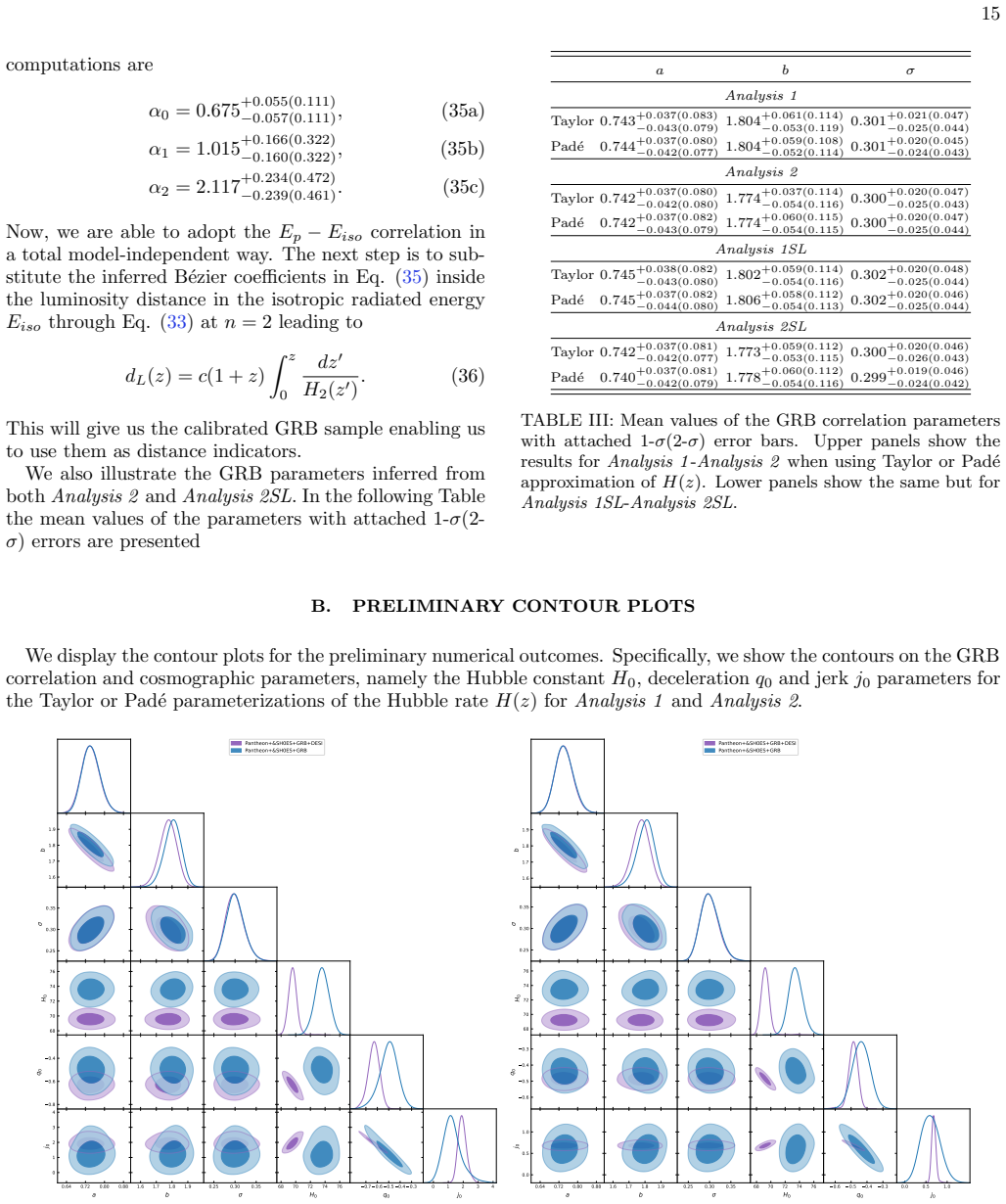
in both scenarios of adoptingH(z) written in terms of Taylor or Pad´ e. This is also the case of the jerk pa- rameterj 0 which finds no agreement with the prediction from both ΛCDM andω 0ω1CDM models. On the other hand, the constraints on the deceleration parameterq 0 are the same as inAnalysis 1when using Taylor while the agreement degrades to the 2-σwit...
-
[2]
finding maximum deviation from 1 at 5.4σwhen DESI-DR2 is combined with the DESY5-SNeIa sample. 9 3.0 2.5 2.0 1.5 1.0 0.5 0.0 z [yrs 1] 1e 10 CDM 0 1CDM Pantheon+&SH0ES+GRB+SL Pantheon+&SH0ES+GRB+DESI+SL 0 1 2 3 4 5 z 2.5 2.0 1.5 1.0 0.5 0.0 z [yrs 1] 1e 10 FIG. 1: Behavior of the redshift drift ˙zin units of yrs −1 for the flat ΛCDM andω 0ω1CDM models com...
-
[3]
As can be seen from the contours and from Tabs. I-II, introducing the SL mock data in our computations leads to a reduction in the uncertainties on the deceleration and jerk parameters. H0 q0 j0 Taylor Analysis 1SL 73.39+0.977(2.026) −1.030(2.001) −0.438+0.040(0.082) −0.040(0.081) 0.607+0.085(0.177) −0.089(0.174) Analysis 2SL 69.24+0.514(1.042) −0.532(1.0...
- [4]
-
[5]
G. C. McVittie, ApJ136, 334 (1962)
work page 1962
-
[6]
Loeb, ApJ Lett.499, L111 (1998), astro- ph/9802122
A. Loeb, ApJ Lett.499, L111 (1998), astro- ph/9802122
-
[7]
Cosmic dynamics in the era of Extremely Large Telescopes
J. Liske, A. Grazian, E. Vanzella, M. Dessauges, M. Viel, et al., MNRAS386, 1192 (2008), 0802.1532
work page Pith review arXiv 2008
-
[8]
H. R. Kloeckner, D. Obreschkow, C. Martins, A. Rac- canelli, D. Champion, et al., inAdvancing Astrophysics with the Square Kilometre Array (AASKA14)(2015), p. 27, 1501.03822
work page Pith review arXiv 2015
-
[9]
P.-S. Corasaniti, D. Huterer, and A. Melchiorri, Phys. Rev. D75, 062001 (2007), astro-ph/0701433
-
[10]
M. Martinelli, S. Pandolfi, C. J. A. P. Martins, and P. E. Vielzeuf, Phys. Rev. D86, 123001 (2012), 1210.7166
- [11]
-
[12]
M. Quartin and L. Amendola, Phys. Rev. D81, 043522 (2010), 0909.4954
- [13]
-
[14]
J.-J. Geng, J.-F. Zhang, and X. Zhang, JCAP2014, 006 (2014), 1404.5407
-
[15]
J.-J. Geng, J.-F. Zhang, and X. Zhang, JCAP2014, 018 (2014), 1407.7123
-
[16]
B. Moraes and D. Polarski, Phys. Rev. D84, 104003 (2011), 1110.2525
-
[17]
J.-J. Geng, Y.-H. Li, J.-F. Zhang, and X. Zhang, Euro- pean Physical Journal C75, 356 (2015), 1501.03874
- [18]
-
[19]
M. Moresco, L. Amati, L. Amendola, S. Birrer, J. P. Blakeslee, et al., Living Reviews in Relativity25, 6 (2022), 2201.07241
- [20]
-
[21]
DESI DR2 Results II: Measurements of Baryon Acoustic Oscillations and Cosmological Constraints
M. Abdul Karim, J. Aguilar, S. Ahlen, S. Alam, L. Allen, et al., Phys. Rev. D112, 083515 (2025), 2503.14738
work page internal anchor Pith review Pith/arXiv arXiv 2025
-
[22]
S. M. Carroll, W. H. Press, and E. L. Turner, Annual Rev. of Astron. Astrophys.30, 499 (1992)
work page 1992
- [23]
-
[24]
P. J. Peebles and B. Ratra, Reviews of Modern Physics 75, 559 (2003), astro-ph/0207347
work page Pith review arXiv 2003
- [25]
- [26]
-
[27]
Y. Carloni, O. Luongo, and M. Muccino, Phys. Rev. D 111, 023512 (2025), 2404.12068
-
[28]
D. Sapone and S. Nesseris, Phys. Rev. D112, 063523 (2025), 2412.01740
-
[29]
S. Nesseris, Y. Akrami, and G. D. Starkman, arXiv e- prints arXiv:2503.22529 (2025), 2503.22529
- [30]
-
[31]
E. Silva, M. A. Sabogal, M. Scherer, R. C. Nunes, E. Di Valentino, and S. Kumar, Phys. Rev. D111, 123511 (2025), 2503.23225
-
[32]
E. ´O Colg´ ain and M. M. Sheikh-Jabbari, MNRAS542, L24 (2025), 2412.12905
-
[33]
G. Rodrigues, R. de Souza, and J. Alcaniz, Phys. Rev. D112, 103519 (2025), 2506.22373
-
[34]
E. ´O Colg´ ain, M. G. Dainotti, S. Capozziello, S. Pouro- jaghi, M. M. Sheikh-Jabbari, and D. Stojkovic, Jour- nal of High Energy Astrophysics49, 100428 (2026), 2404.08633
- [35]
-
[36]
S. Weinberg,Gravitation and Cosmology: Principles and Applications of the General Theory of Relativity (1972)
work page 1972
-
[37]
E. R. Harrison, Nature260, 591 (1976)
work page 1976
-
[38]
Jerk, snap, and the cosmological equation of state
M. Visser, Classical and Quantum Gravity21, 2603 (2004), gr-qc/0309109
work page Pith review arXiv 2004
-
[39]
Visser, General Relativity and Gravitation37, 1541 (2005)
M. Visser, General Relativity and Gravitation37, 1541 (2005)
work page 2005
-
[40]
M. Visser, Catto¨ en, and C. , inDark Matter in Astro- physics and Particle Physics, Dark 2009, edited by H. V. Klapdor-Kleingrothaus and I. V. Krivosheina (2010), pp. 287–300, 0906.5407
-
[41]
Luongo, Modern Physics Letters A26, 1459 (2011)
O. Luongo, Modern Physics Letters A26, 1459 (2011)
work page 2011
- [42]
-
[43]
O. Luongo and H. Quevedo, Gen. Rel. Grav.46, 1649 (2014), 1211.0626
- [44]
-
[45]
S. Capozziello, R. D’Agostino, and O. Luongo, JCAP 2018, 008 (2018), 1709.08407
-
[46]
S. Capozziello, R. D’Agostino, and O. Luongo, Interna- tional Journal of Modern Physics D28, 1930016 (2019), 1904.01427
- [47]
-
[48]
A. Heinesen and H. J. Macpherson, JCAP2022, 057 (2022), 2111.14423
-
[49]
S. Capozziello, P. K. S. Dunsby, and O. Luongo, MN- RAS509, 5399 (2022), 2106.15579
-
[50]
R. D’Agostino and R. C. Nunes, Phys. Rev. D108, 023523 (2023), 2307.13464
- [51]
- [52]
- [53]
-
[54]
On the Metric $f(R)$ gravity Viability in Accounting for the Binned Supernovae Data
A. Valletta, G. Montani, M. G. Dainotti, and E. Fazzari, arXiv e-prints arXiv:2512.19568 (2025), 2512.19568
work page internal anchor Pith review Pith/arXiv arXiv 2025
- [55]
-
[56]
The Hubble series: Convergence properties and redshift variables
C. Catto¨ en and M. Visser, Classical and Quantum Grav- ity24, 5985 (2007), 0710.1887
work page Pith review arXiv 2007
- [57]
- [58]
-
[59]
Cosmographic analysis of the equation of state of the universe through Pad\'e approximations
C. Gruber and O. Luongo, Phys. Rev. D89, 103506 (2014), 1309.3215
work page Pith review arXiv 2014
-
[60]
S. Capozziello, R. D’Agostino, and O. Luongo, MNRAS 494, 2576 (2020), 2003.09341
-
[61]
S. Capozziello, R. D’Agostino, and O. Luongo, MNRAS 476, 3924 (2018), 1712.04380
-
[62]
The Pantheon+ Analysis: The Full Dataset and Light-Curve Release
D. Scolnic, D. Brout, A. Carr, A. G. Riess, T. M. Davis, et al., ApJ938, 113 (2022), 2112.03863
work page internal anchor Pith review Pith/arXiv arXiv 2022
-
[63]
A. G. Riess, W. Yuan, L. M. Macri, D. Scolnic, D. Brout, et al., ApJ Lett.934, L7 (2022), 2112.04510
work page internal anchor Pith review Pith/arXiv arXiv 2022
- [64]
-
[65]
Addressing the circularity problem in the $E_\text{p}-E_\text{iso}$ correlation of Gamma-Ray Bursts
L. Amati, R. D’Agostino, O. Luongo, M. Muccino, and M. Tantalo, MNRAS486, L46 (2019), 1811.08934
work page Pith review arXiv 2019
-
[66]
A. Montiel, J. I. Cabrera, and J. C. Hidalgo, MNRAS 501, 3515 (2021), 2003.03387
- [67]
-
[68]
M. Muccino, O. Luongo, and D. Jain, MNRAS523, 4938 (2023), 2208.13700
- [69]
- [70]
- [71]
-
[72]
The Cosmic Linear Anisotropy Solving System (CLASS) I: Overview
J. Lesgourgues, arXiv e-prints arXiv:1104.2932 (2011), 1104.2932
work page Pith review arXiv 2011
-
[73]
D. Blas, J. Lesgourgues, and T. Tram, JCAP2011, 034 (2011), 1104.2933
work page internal anchor Pith review arXiv 2011
-
[74]
The Cosmic Linear Anisotropy Solving System ( CLASS) III: Comparison with CAMB for LambdaCDM,
J. Lesgourgues, arXiv e-prints arXiv:1104.2934 (2011), 1104.2934
-
[75]
MontePython 3: boosted MCMC sampler and other features
T. Brinckmann and J. Lesgourgues, Physics of the Dark Universe24, 100260 (2019), 1804.07261
work page Pith review arXiv 2019
-
[76]
B. Audren, J. Lesgourgues, K. Benabed, and S. Prunet, JCAP2013, 001 (2013), 1210.7183
work page Pith review arXiv 2013
-
[77]
Planck 2018 results. VI. Cosmological parameters
Planck Collaboration, N. Aghanim, Y. Akrami, M. Ash- down, J. Aumont, and C. Baccigalupi, A&A641, A6 (2020), 1807.06209
work page internal anchor Pith review Pith/arXiv arXiv 2020
-
[78]
E. Fazzari, W. Giar` e, and E. Di Valentino, arXiv e- prints arXiv:2509.16196 (2025), 2509.16196
- [79]
- [80]
discussion (0)
Sign in with ORCID, Apple, or X to comment. Anyone can read and Pith papers without signing in.