Nonreciprocal current induced by dissipation in time-reversal symmetric systems
Pith reviewed 2026-05-10 20:28 UTC · model grok-4.3
The pith
Dissipation induces nonreciprocal current in time-reversal symmetric noncentrosymmetric crystals through interband processes.
A machine-rendered reading of the paper's core claim, the machinery that carries it, and where it could break.
Core claim
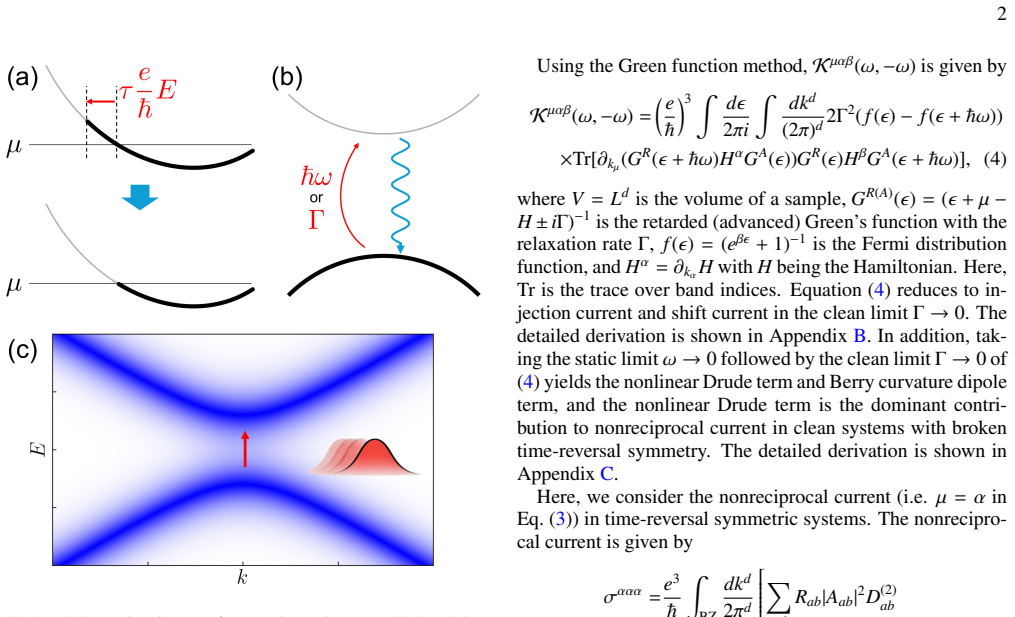
We show that the nonreciprocal current appears in a dissipative system through interband processes. The nonreciprocal current is inversely proportional to the lifetime τ and has a close relationship to the geometric quantity called the shift vector. The current mechanism is suitable for minigap systems where the energy gap and relaxation strength are comparable. We present a numerical simulation of the nonreciprocal current in the one-dimensional Rice-Mele model.
What carries the argument
The shift vector, which encodes the real-space displacement of electron wavefunctions during interband transitions and thereby generates the dissipative nonreciprocal current.
Load-bearing premise
Interband dissipative processes dominate the transport response once the energy gap and relaxation strength become comparable in magnitude.
What would settle it
Measurement of a nonreciprocal current whose size scales exactly as 1 over the relaxation time in a dissipative, time-reversal symmetric minigap system such as the Rice-Mele chain.
Figures

read the original abstract
We study nonreciprocal current response in noncentrosymmetric crystals under time-reversal symmetry. We reveal that the nonreciprocal current appears in a dissipative system through interband processes. We derive a formula for the nonreciprocal current using the Green's function technique. The nonreciprocal current of the present mechanism turns out to be of $O(1/\tau)$ ($\tau$: the lifetime of Bloch electrons) and arises from the shift of the electron wave packet during the interband processes which has a geometric origin. We present a numerical simulation of the nonreciprocal current in the one-dimensional Rice-Mele model and give its order estimation for nonmagnetic polar semiconductors.
Editorial analysis
A structured set of objections, weighed in public.
Referee Report
Summary. The paper claims that nonreciprocal current can arise in time-reversal symmetric but noncentrosymmetric systems purely through dissipative interband processes. The resulting current scales inversely with the quasiparticle lifetime τ and is geometrically linked to the shift vector. The mechanism is argued to be relevant specifically in minigap systems where the gap is comparable to the relaxation rate, and is illustrated by a numerical simulation of the one-dimensional Rice-Mele model.
Significance. If the derivation and scaling are confirmed, the result would identify a dissipation-enabled route to nonreciprocity that respects TRS, connecting nonlinear transport to the shift vector in a regime accessible to minigap materials. The numerical check in a standard tight-binding model provides a concrete test case, though the strength of the evidence depends on the explicit formulas and data shown in the full text.
major comments (3)
- [Derivation of dissipative response] The central claim that the nonreciprocal current is inversely proportional to τ and arises from interband processes requires the explicit response-function derivation (likely in the section following the abstract) to be shown; without the formula for the dissipative conductivity, it is impossible to verify that the 1/τ scaling follows directly rather than being imposed by the regime choice.
- [Numerical simulation] The numerical simulation in the Rice-Mele model is presented as support, but the manuscript must report the specific parameters (gap size relative to relaxation strength, range of τ values) and the extracted scaling of the nonreciprocal current; if the fit to 1/τ is only qualitative or limited to a narrow window, the claim that interband processes dominate cannot be assessed.
- [Geometric interpretation] The stated relationship to the shift vector needs an explicit equation linking the nonreciprocal conductivity to the shift-vector integral; if this connection is only heuristic, the geometric interpretation remains unproven and weakens the central claim.
minor comments (2)
- [Abstract] The abstract and introduction should clarify the precise definition of the nonreciprocal current (e.g., the second-order conductivity component) to avoid ambiguity with other nonlinear responses.
- [Figures] Figure captions for the Rice-Mele simulation should include the values of the gap, relaxation rate, and τ used, as well as error bars or convergence checks.
Simulated Author's Rebuttal
We thank the referee for their careful reading and constructive comments on our manuscript. We address each major comment point by point below and have revised the manuscript to improve clarity and provide the requested details.
read point-by-point responses
-
Referee: [Derivation of dissipative response] The central claim that the nonreciprocal current is inversely proportional to τ and arises from interband processes requires the explicit response-function derivation (likely in the section following the abstract) to be shown; without the formula for the dissipative conductivity, it is impossible to verify that the 1/τ scaling follows directly rather than being imposed by the regime choice.
Authors: The explicit derivation of the dissipative conductivity is given in Section II using the Kubo response with a finite-lifetime broadening. The 1/τ scaling for the nonreciprocal term emerges directly from the imaginary part of the interband Green's functions in the zero-frequency limit. To facilitate verification, we have added the full analytic expression for the nonreciprocal conductivity as a new boxed equation in the revised manuscript. revision: yes
-
Referee: [Numerical simulation] The numerical simulation in the Rice-Mele model is presented as support, but the manuscript must report the specific parameters (gap size relative to relaxation strength, range of τ values) and the extracted scaling of the nonreciprocal current; if the fit to 1/τ is only qualitative or limited to a narrow window, the claim that interband processes dominate cannot be assessed.
Authors: We agree that more quantitative details are required. In the revised manuscript we have expanded the figure caption and added a supplementary panel that reports the gap-to-relaxation ratio (Δ/Γ ≈ 2), the range of τ values simulated, and the extracted power-law fit to the nonreciprocal current versus τ, confirming the inverse scaling over the window where interband processes dominate. revision: yes
-
Referee: [Geometric interpretation] The stated relationship to the shift vector needs an explicit equation linking the nonreciprocal conductivity to the shift-vector integral; if this connection is only heuristic, the geometric interpretation remains unproven and weakens the central claim.
Authors: The link follows from the microscopic interband matrix elements, which are expressed in terms of the shift vector. We have inserted an explicit integral expression for the nonreciprocal conductivity in terms of the shift vector, the occupation derivative, and the Lorentzian broadening factor in the revised manuscript, thereby making the geometric connection rigorous. revision: yes
Circularity Check
No significant circularity detected in derivation
full rationale
The central result follows from a response-function calculation of interband dissipative processes under time-reversal symmetry, yielding a current that scales as 1/τ and is tied to the shift vector when gap and relaxation rates are comparable. This is not obtained by fitting a parameter to data and then relabeling the fit as a prediction, nor by self-defining the target quantity, nor by importing a uniqueness theorem from the authors' prior work. The 1D Rice-Mele numerical check supplies an independent consistency test outside the analytic expressions. No load-bearing step collapses to an input by construction.
Axiom & Free-Parameter Ledger
axioms (2)
- domain assumption Time-reversal symmetry holds and the crystal is noncentrosymmetric
- domain assumption Interband processes dominate the dissipative response when gap and relaxation strength are comparable
Lean theorems connected to this paper
-
IndisputableMonolith/Cost/FunctionalEquation.leanwashburn_uniqueness_aczel unclear?
unclearRelation between the paper passage and the cited Recognition theorem.
K μ α β(ω,−ω) given by trace over retarded/advanced Green's functions with relaxation Γ; leading Γ dependence extracted via digamma asymptotics (Eqs. 5–11)
-
IndisputableMonolith/Foundation/AlexanderDuality.leanalexander_duality_circle_linking unclear?
unclearRelation between the paper passage and the cited Recognition theorem.
Shift vector R_ab = Im ∂_kα(log A_ba) + diagonal Berry-connection terms; interband contribution isolated in two-band Rice-Mele model
What do these tags mean?
- matches
- The paper's claim is directly supported by a theorem in the formal canon.
- supports
- The theorem supports part of the paper's argument, but the paper may add assumptions or extra steps.
- extends
- The paper goes beyond the formal theorem; the theorem is a base layer rather than the whole result.
- uses
- The paper appears to rely on the theorem as machinery.
- contradicts
- The paper's claim conflicts with a theorem or certificate in the canon.
- unclear
- Pith found a possible connection, but the passage is too broad, indirect, or ambiguous to say the theorem truly supports the claim.
Forward citations
Cited by 2 Pith papers
-
Quantum-geometric shift of quasiequilibrium: Origin of nonreciprocal current driven by quantum-metric dipole
The work identifies a quantum-geometric shift of quasiequilibrium, arising from finite wave-packet spread during relaxation, as the origin of nonreciprocal current driven by the quantum-metric dipole.
-
Nonreciprocal conductance in uniformly dissipative devices
Uniformly dissipative Rashba nanowires with skewed magnetic fields exhibit nonreciprocal conductance from interference-induced differences in transmission times between left- and right-moving electrons.
discussion (0)
Sign in with ORCID, Apple, or X to comment. Anyone can read and Pith papers without signing in.