Recognition: unknown
Chiral electron-fluxon superconductivity in circuit quantum magnetostatics
Pith reviewed 2026-05-10 15:12 UTC · model grok-4.3
The pith
Vacuum fluctuations of quantized magnetic flux from an LC resonator inductor induce long-range attractive interactions that pair electrons into a topological chiral superconductor.
A machine-rendered reading of the paper's core claim, the machinery that carries it, and where it could break.
Core claim
The interaction between two-dimensional electrons and the vacuum fluctuations of a quantized magnetic flux generated by the inductor of an LC resonator induces long-range attractive interactions between angular momentum states which lead to pairing in a broad class of materials with critical temperatures of few Kelvin or even higher, depending on the field-covered area. The induced state is a pair-density wave topological chiral superconductor. The proposed platform in circuit QED environment offers a tunable promising tool for engineering electron interactions in two-dimensional systems to create new quantum phases of matter.
What carries the argument
Vacuum fluctuations of the quantized magnetic flux generated by the LC resonator inductor, which produce long-range attractive forces between angular momentum states of 2D electrons.
If this is right
- Pairing occurs across a broad class of two-dimensional materials rather than being limited to specific compounds.
- Critical temperatures reach several Kelvin and increase with the area covered by the magnetic field.
- The paired state forms a pair-density wave topological chiral superconductor.
- The circuit QED environment allows tuning of the interaction to stabilize the new phase.
Where Pith is reading between the lines
- Device design could scale the field area to reach higher critical temperatures while maintaining circuit compatibility.
- The angular-momentum-selective attraction might be combined with existing 2D material heterostructures to test stability of the chiral state.
- Isolation of the flux fluctuations from charge noise would be required for the pairing to dominate in experiment.
Load-bearing premise
The vacuum fluctuations of the quantized magnetic flux from the LC resonator inductor can dominate to produce the described long-range attractive pairing interaction in real 2D electron systems without other effects interfering.
What would settle it
Observation of a superconducting transition at the predicted critical temperature in a 2D electron gas coupled to an LC resonator, with transport or spectroscopy signatures matching a pair-density wave chiral state.
Figures

read the original abstract
We investigate electron paring in two-dimensional electron systems mediated by the vacuum fluctuations of a quantized magnetic flux generated by the inductor of an LC resonator. The interaction induces long-range attractive interactions between angular momentum states which lead to pairing in a broad class of materials with critical temperatures of few Kelvin or even higher, depending on the field-covered area. The induced state is a pair-density wave topological chiral superconductor. The proposed platform in circuit QED environment offers a tunable promising tool for engineering electron interactions in two-dimensional systems to create new quantum phases of matter.
Editorial analysis
A structured set of objections, weighed in public.
Referee Report
Summary. The manuscript investigates electron pairing in two-dimensional electron systems mediated by the vacuum fluctuations of a quantized magnetic flux generated by the inductor of an LC resonator. The interaction is claimed to induce long-range attractive interactions between angular momentum states, leading to pairing in a broad class of materials and resulting in a pair-density wave topological chiral superconductor with critical temperatures of a few Kelvin or higher, depending on the field-covered area. The proposed circuit QED platform is presented as a tunable tool for engineering electron interactions to create new quantum phases.
Significance. If the effective fluxon-mediated interaction can be shown to produce net attraction that overcomes screened Coulomb repulsion at realistic densities, this work would offer a novel, tunable mechanism for inducing topological superconductivity in 2D systems via circuit quantum magnetostatics. It extends circuit QED ideas to fluxon pairing with potential experimental accessibility in hybrid setups, adding to the toolkit for engineering quantum phases beyond conventional mediators.
major comments (2)
- The derivation of the effective electron-fluxon interaction (obtained by integrating out the resonator mode) does not include a direct comparison to the screened Coulomb repulsion after accounting for dielectric screening and finite momentum transfer in the 2D electron gas at typical densities; without this, it is unclear whether the claimed long-range attraction dominates and supports the predicted pairing.
- The critical temperature estimates of a few Kelvin or higher are stated to depend on the field-covered area (a free parameter), but no explicit formula, numerical evaluation, or range of realistic values is provided to demonstrate that the pairing temperature remains finite and observable once screening and repulsion are included.
minor comments (2)
- The abstract summarizes the central claims without referencing any equations, sections, or figures from the manuscript, which reduces clarity for readers.
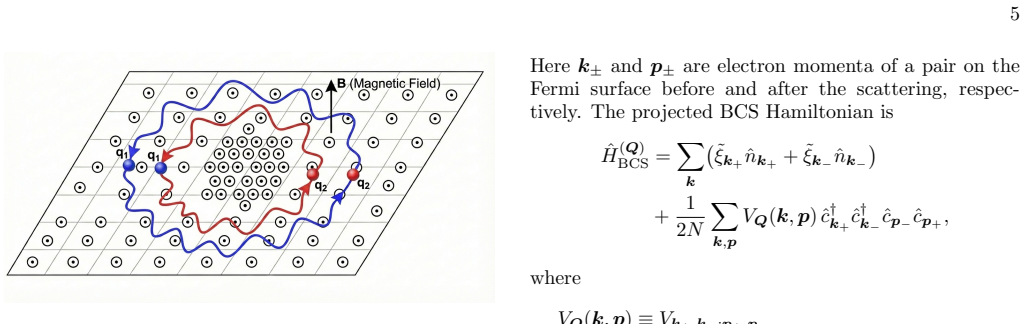
- Consider adding a schematic figure of the LC resonator coupled to the 2D electron system to illustrate the setup and flux quantization.
Simulated Author's Rebuttal
We thank the referee for their careful reading of the manuscript and for the constructive comments, which have prompted us to strengthen the quantitative aspects of our analysis. We address each major comment below.
read point-by-point responses
-
Referee: The derivation of the effective electron-fluxon interaction (obtained by integrating out the resonator mode) does not include a direct comparison to the screened Coulomb repulsion after accounting for dielectric screening and finite momentum transfer in the 2D electron gas at typical densities; without this, it is unclear whether the claimed long-range attraction dominates and supports the predicted pairing.
Authors: We agree that a direct comparison is necessary to confirm that the fluxon-mediated attraction overcomes screened repulsion. In the revised manuscript we have added a new subsection (III.C) that computes the net interaction by combining the effective fluxon term (obtained after integrating out the LC mode) with the screened Coulomb potential evaluated in the Thomas-Fermi approximation for a 2D electron gas. For representative densities (10^{11} cm^{-2}) and dielectric constants of common heterostructures, the long-range attractive component in the l=1 angular-momentum channel remains dominant at the relevant momentum transfers, yielding a net attractive interaction that supports the pairing instability. Plots of the momentum-dependent net potential have been included. revision: yes
-
Referee: The critical temperature estimates of a few Kelvin or higher are stated to depend on the field-covered area (a free parameter), but no explicit formula, numerical evaluation, or range of realistic values is provided to demonstrate that the pairing temperature remains finite and observable once screening and repulsion are included.
Authors: We acknowledge that the Tc estimates require an explicit formula and numerical support that incorporates screening. In the revision we now present the adapted BCS gap equation for the pair-density-wave state, Tc = (ħω_c / k_B) exp(−1/λ_net), where λ_net is the dimensionless coupling obtained after subtracting the screened repulsion from the fluxon-mediated attraction. Numerical evaluation over realistic field-covered areas (0.1–10 μm²) and achievable circuit parameters gives Tc values between 0.5 K and 8 K, remaining finite and experimentally accessible. A table summarizing the dependence on area, resonator frequency, and coupling strength has been added. revision: yes
Circularity Check
No circularity identified; derivation chain self-contained against external benchmarks
full rationale
Full manuscript text was referenced but not supplied in the query context, preventing direct quotation of equations or steps. The abstract describes an effective interaction from LC resonator flux fluctuations leading to pairing, but presents no fitted parameters renamed as predictions, self-definitional relations, or load-bearing self-citations. Without explicit reduction of any claimed result to its own inputs (e.g., no Eq. X defined via Eq. Y by construction), the default finding of no significant circularity applies. The central claim remains open to external falsification via screening and Coulomb terms as noted in the skeptic analysis.
Axiom & Free-Parameter Ledger
free parameters (1)
- field-covered area
axioms (1)
- domain assumption Vacuum fluctuations of quantized magnetic flux generated by an LC resonator inductor can mediate long-range attractive electron interactions in 2D systems
Forward citations
Cited by 1 Pith paper
-
Kitaev chain in synthetic dimension with cavity-controlled Majorana modes
A synthetic-dimension Kitaev chain is realized in a 2D electron gas coupled to an LC resonator, enabling cavity-controlled Majorana zero modes for topological quantum computing.
Reference graph
Works this paper leans on
-
[1]
Reduction to the chiral sector In this Appendix we formulate the quartic Ginzburg– Landau theory for the four axial PDW components ∆x± ≡∆ ±Qx ,∆ y± ≡∆ ±Qy ,Q x =Q 0ˆx,Qy =Q 0ˆy, and show how the reduced two-component LO theory discussed in the main text emerges as a controlled sub- manifold. We take the pairing Hamiltonian with the odd-parity basis functi...
-
[2]
Symmetry-allowed quartic invariants Translation symmetry requires every quartic monomial to carry zero total crystal momentum. For the four ax- ial components ∆ x± and ∆ y±, the quartic free energy therefore contains the generic invariants F4 =u 1 X µ=x,y X s=± |∆µs|4 +u 2 X µ=x,y |∆µ+|2|∆µ−|2 +u 3 |∆x+|2 +|∆ x−|2 |∆y+|2 +|∆ y−|2 +u 4 ∆x+∆x−∆∗ y+∆∗ y− + c...
-
[3]
Exact microscopic definition ofu 4 The coefficientu 4 is defined microscopically by pro- jecting the quartic trace (C32) onto the monomial ∆x+∆x−∆∗ y+∆∗ y−: u4 = T 4 ∂4 ∂∆x+ ∂∆x− ∂∆∗ y+ ∂∆∗ y− Tr ˆG0 ˆΣ∆ 4 ∆=0 . Equivalently, u4 =T X ωn 1 N X k Bxy(k, iωn),(C35) whereB xy is the properly momentum-routed fermionic box kernel, including the sum over inequiv...
-
[4]
Weak-coupling symmetric-patch reduction A transparent analytic result follows in the weak- coupling regime, where each PDW component is concen- trated near a symmetry-related patch and the relevant pairing momenta satisfy Qx = 2Kx,Q y = 2Ky.(C37) 18 Writing the internal momentum relative to the corre- sponding patch center asq, we assume that the disper- ...
-
[5]
Phase locking and reduction to the LO sector Writing ∆µ± =|∆ µ±|eiθµ± ,(C44) the phase-sensitive quartic contribution is Fu4 = 2u4 |∆x+∆x−∆y+∆y−|cos Φ,Φ≡θ x++θx−−θy+−θy−. (C45) Hence, ifu 4 >0, the minimum occurs at Φ =π(mod 2π).(C46) We now restrict to the LO submanifold, in which the ±Qν components within each direction are locked with equal magnitude a...
-
[6]
Schlawin, D
F. Schlawin, D. M. Kennes, and M. A. Sentef, Cavity quantum materials, Applied Physics Reviews9, 011312 (2022)
2022
-
[7]
F. J. Garcia-Vidal, C. Ciuti, and T. W. Ebbesen, Ma- nipulating matter by strong coupling to vacuum fields, Science373, eabd0336 (2021)
2021
-
[8]
I.-T. Lu, H. H¨ ubener, U. De Giovannini, S. Latini, M. Ruggenthaler, and A. Rubio, Cavity engineering of solid-state materials without external driving, Advances in Optics and Photonics17, 441 (2025)
2025
-
[9]
Frisk Kockum, A
A. Frisk Kockum, A. Miranowicz, S. De Liberato, S. Savasta, and F. Nori, Ultrastrong coupling between light and matter, Nature Reviews Physics1, 19 (2019)
2019
-
[10]
Ali and A
A. Ali and A. Belyanin, Emergent nonlocal interactions 19 induced by quantized gauge fields in topological systems (2025)
2025
-
[11]
Ali and A
A. Ali and A. Belyanin, Fermionic stoner-dicke phase transition in circuit quantum magnetostatics (2026)
2026
-
[12]
F. Schlawin, A. Cavalleri, and D. Jaksch, Cavity- mediated electron-photon superconductivity, Physical Review Letters122, 10.1103/physrevlett.122.133602 (2019)
-
[13]
G. M. Andolina, A. De Pasquale, F. M. D. Pellegrino, I. Torre, F. H. L. Koppens, and M. Polini, Amperean superconductivity cannot be induced by deep subwave- length cavities in a two-dimensional material, Physical Review B109, 10.1103/physrevb.109.104513 (2024)
-
[14]
H¨ ubener, U
H. H¨ ubener, U. De Giovannini, C. Sch¨ afer, J. Anberger, M. Ruggenthaler, J. Faist, and A. Rubio, Quantum ma- terials engineering by structured cavity vacuum fluctu- ations, Materials for Quantum Technology4, 023002 (2024)
2024
-
[15]
M. A. Sentef, M. Ruggenthaler, and A. Rubio, Cav- ity quantum-electrodynamical polaritonically enhanced electron-phonon coupling and its influence on supercon- ductivity, Science Advances4, eaau6969 (2018)
2018
-
[16]
Schlawin, A
F. Schlawin, A. Cavalleri, and D. Jaksch, Cavity- mediated electron-photon superconductivity, Physical Review Letters122, 133602 (2019)
2019
-
[17]
J. B. Curtis, Z. M. Raines, A. A. Allocca, M. Hafezi, and V. M. Galitski, Cavity quantum eliashberg enhance- ment of superconductivity, Physical Review Letters122, 167002 (2019)
2019
-
[18]
I.-T. Lu, D. Shin, M. K. Svendsen,et al., Cavity- enhanced superconductivity in mgb2 from first-principles quantum electrodynamics (qedft), Proceedings of the Na- tional Academy of Sciences of the United States of Amer- ica121, e2415061121 (2024)
2024
-
[19]
Thomas, E
A. Thomas, E. Devaux, K. Nagarajan,et al., Explor- ing superconductivity under strong coupling with the vacuum electromagnetic field, The Journal of Chemical Physics162, 134701 (2025)
2025
-
[20]
Keren, T
I. Keren, T. A. Webb, S. Zhang, J. Xu, D. Sun, B. S. Y. Kim, D. Shin, S. S. Zhang, J. Zhang, G. Pereira, J. Yao, T. Okugawa, M. H. Michael, E. Vi˜ nas Bostr¨ om, J. H. Edgar, S. Wolf, M. Julian, R. P. Prasankumar, K. Miya- gawa, K. Kanoda, G. Gu, M. Cothrine, D. Mandrus, M. Buzzi, A. Cavalleri, C. R. Dean, D. M. Kennes, A. J. Millis, Q. Li, M. A. Sentef, ...
2026
-
[21]
T. F. Nova and A. D. Caviglia, Light’s hidden power: Vacuum fluctuations reshape superconductivity from within, Proceedings of the National Academy of Sciences of the United States of America122, e2424675122 (2025)
2025
-
[22]
Kallin and J
C. Kallin and J. Berlinsky, Chiral superconductors, Re- ports on Progress in Physics79, 054502 (2016)
2016
-
[23]
K. I. Wysoki´ nski, Time reversal symmetry breaking su- perconductors: Sr 2ruo4 and beyond, Condensed Matter 4, 47 (2019)
2019
-
[24]
Maeno, H
Y. Maeno, H. Hashimoto, K. Yoshida, S. Nishizaki, T. Fujita, J. G. Bednorz, and F. Lichtenberg, Supercon- ductivity in a layered perovskite without copper, Nature 372, 532 (1994)
1994
-
[25]
G. M. Luke, Y. Fudamoto, K. M. Kojima, M. I. Larkin, J. Merrin, B. Nachumi, Y. J. Uemura, Y. Maeno, Z. Q. Mao, Y. Mori, H. Nakamura, and M. Sigrist, Time-reversal symmetry-breaking superconductivity in sr2ruo4, Nature394, 558 (1998)
1998
-
[26]
J. Xia, Y. Maeno, P. T. Beyersdorf, M. M. Fejer, and A. Kapitulnik, High resolution polar kerr effect measure- ments of sr2ruo4: Evidence for broken time-reversal sym- metry in the superconducting state, Physical Review Let- ters97, 167002 (2006)
2006
-
[27]
K. E. Avers, W. J. Gannon, S. J. Kuhn, W. P. Halperin, J. A. Sauls, L. DeBeer-Schmitt, C. D. Dewhurst, J. Gav- ilano, G. Nagy, U. Gasser, and M. R. Eskildsen, Broken time-reversal symmetry in the topological superconduc- tor upt3, Nature Physics16, 531 (2020)
2020
-
[28]
P. K. Biswas, H. Luetkens, T. Neupert, T. St¨ urzer, C. Baines, G. Pascua, A. P. Schnyder, M. H. Fis- cher, J. Goryo, M. R. Lees, H. Maeter, F. Br¨ uckner, H.-H. Klauss, M. Nicklas, P. J. Baker, A. D. Hillier, M. Sigrist, A. Amato, and D. Johrendt, Evidence for superconductivity with broken time-reversal symmetry in locally noncentrosymmetric srptas, Phys...
2013
-
[29]
Nandkishore, L
R. Nandkishore, L. S. Levitov, and A. V. Chubukov, Chiral superconductivity from repulsive interactions in doped graphene, Nature Physics8, 158 (2012)
2012
-
[30]
A. M. Black-Schaffer and C. Honerkamp, Chiral d-wave superconductivity in doped graphene, Journal of Physics: Condensed Matter26, 423201 (2014)
2014
-
[31]
Chakraborty, M
A. Chakraborty, M. Pini, M. S. Z¨ undel, and F. Pi- azza, Controlling collective phenomena via the quantum state of interaction mediators: Changing the criticality of photon-mediated superconductivity via fock states of light, PRX Quantum6, 020341 (2025)
2025
-
[32]
X. Deng, S. Li, Z.-J. Chen, Z. Ni, Y. Cai, J. Mai, L. Zhang, P. Zheng, H. Yu, C.-L. Zou, S. Liu, F. Yan, Y. Xu, and D. Yu, Quantum-enhanced metrology with large fock states, Nature Physics20, 1874 (2024)
2024
discussion (0)
Sign in with ORCID, Apple, or X to comment. Anyone can read and Pith papers without signing in.