Detecting entanglement from few partial transpose moments and their decay via weight enumerators
Pith reviewed 2026-05-10 15:32 UTC · model grok-4.3
The pith
Any three partial transpose moments can detect entanglement via a power inequality.
A machine-rendered reading of the paper's core claim, the machinery that carries it, and where it could break.
Core claim
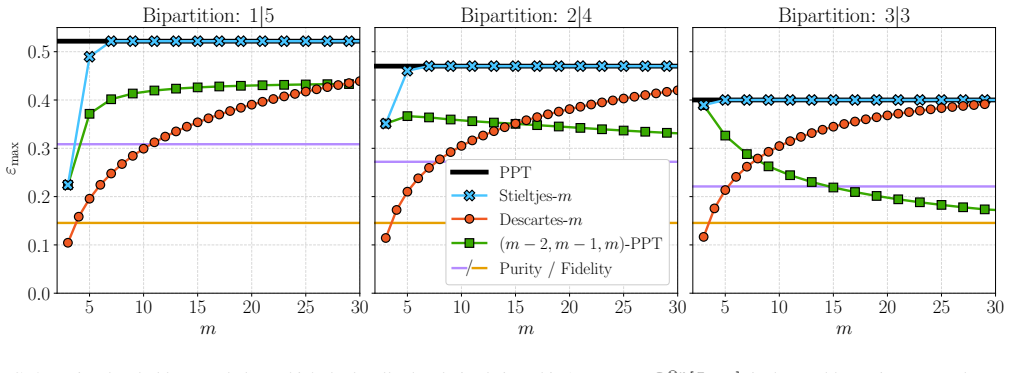
A state must be entangled whenever its partial transpose moments satisfy p_l > p_k^x p_m^{1-x} for any k < l < m, where x = (m-l)/(m-k) and p_j = Tr[ (ρ^Γ)^j ]. For stabilizer states under global depolarization, the first five moments decide the PPT property completely. The Stieltjes-m criterion coincides with the full PPT criterion precisely when ρ^Γ has at most (m+1)/2 distinct eigenvalues. Quantum weight enumerators capture the exponential decay of p_k under local white noise for arbitrary states.
What carries the argument
The three-moment inequality p_l > p_k^x p_m^{1-x} that follows from positivity of the moment sequence of any positive semidefinite operator and is violated precisely when the partial transpose has negative eigenvalues.
Load-bearing premise
The moment sequence of any positive semidefinite matrix obeys the power-law inequality between any three chosen orders k < l < m.
What would settle it
Preparing a separable state, computing or measuring its PT moments for some k < l < m, and checking whether p_l exceeds p_k^x p_m^{1-x} would directly test the criterion.
Figures

read the original abstract
The $p_3$-PPT criterion is an experimentally viable relaxation of the well-known positive partial transposition (PPT) criterion for the certification of quantum entanglement. Recently, it has been generalized to various families of entanglement criteria based on the PT moments $p_k=$Tr$[(\rho^\Gamma)^k]$, where $\rho^\Gamma$ denotes the partially transposed density matrix of a quantum state $\rho$. While most of these generalizations are strictly more powerful than the $p_3$-PPT criterion, their $m$-th level versions usually rely on the availability of $p_k$ for all moment orders $k\le m$. Here, we show that one can alternatively compare any three PT moments of orders $k<l<m$, which can significantly reduce experimental overheads. More precisely, we show that any state satisfying $p_l>p_k^xp_m^{1-x} $ must be entangled, where $x=(m-l)/(m-k)$. Using the example of locally depolarized GHZ states, we identify the most promising versions of these three-moment criteria and compare their performance with a broad range of entanglement criteria. In the case of globally depolarized stabilizer states, we prove that having access to $p_k$ for $k \le 5$ is sufficient to reproduce the full PPT criterion. More generally, we show that the Stieltjes-$m$ criterion is as powerful as the PPT criterion whenever $\rho^\Gamma$ has no more than $(m+1)/2$ distinct eigenvalues. Finally, we introduce a notion of quantum weight enumerators that capture the decay of $p_k$ under local white noise for arbitrary quantum states and illustrate this concept for an AME state. Our results contribute to the growing body of literature on higher-moment PPT relaxations and modern applications of weight enumerators in quantum error correction and information theory.
Editorial analysis
A structured set of objections, weighed in public.
Referee Report
Summary. The manuscript proposes entanglement criteria based on comparing any three partial transpose moments p_k = Tr[(ρ^Γ)^k] for integers k < l < m. It claims that violation of the inequality p_l ≤ p_k^x p_m^{1-x} (with x = (m-l)/(m-k)) certifies entanglement, derives this from properties of moment sequences of PSD matrices, compares the resulting three-moment criteria on locally depolarized GHZ states against existing criteria, proves that moments up to order 5 recover the full PPT criterion for globally depolarized stabilizer states, shows that the Stieltjes-m criterion is equivalent to PPT when ρ^Γ has at most (m+1)/2 distinct eigenvalues, and introduces quantum weight enumerators to describe the decay of PT moments under local white noise (illustrated for an AME state).
Significance. If the derivations hold, the three-moment criteria reduce experimental overhead relative to full m-moment relaxations while remaining strictly stronger than the p3-PPT criterion in some regimes. The equivalence results for stabilizer states and low-eigenvalue PT spectra are strong and practical; the weight-enumerator construction extends existing tools from quantum error correction to moment decay analysis and is a clear methodological contribution.
major comments (2)
- [three-moment criteria section] § on three-moment criteria (around the statement of the main inequality): the manuscript should explicitly derive or cite the convexity of t ↦ log Tr(A^t) for normalized PSD A (a direct consequence of Hölder's inequality on eigenvalues) and confirm that the resulting bound p_l ≤ p_k^x p_m^{1-x} holds for any real exponents, not merely integers; this is the load-bearing step for all claimed criteria.
- [stabilizer states section] Stabilizer-states theorem (the claim that k ≤ 5 suffices to reproduce full PPT for globally depolarized stabilizer states): the proof should specify whether the moment sequence is used to reconstruct the spectrum of ρ^Γ or to bound its negative eigenvalues, and should state the precise noise parameter range over which the equivalence holds.
minor comments (2)
- [Abstract] The abstract introduces 'quantum weight enumerators' without a one-sentence definition; adding a brief parenthetical description would improve accessibility.
- [numerical comparisons] In the GHZ-state comparison figures, label the axes and legends consistently with the moment orders k, l, m used in each three-moment criterion.
Simulated Author's Rebuttal
We thank the referee for their careful reading of the manuscript and their recommendation for minor revision. We are grateful for the constructive comments, which help improve the clarity of the presentation. We address each major comment below.
read point-by-point responses
-
Referee: [three-moment criteria section] § on three-moment criteria (around the statement of the main inequality): the manuscript should explicitly derive or cite the convexity of t ↦ log Tr(A^t) for normalized PSD A (a direct consequence of Hölder's inequality on eigenvalues) and confirm that the resulting bound p_l ≤ p_k^x p_m^{1-x} holds for any real exponents, not merely integers; this is the load-bearing step for all claimed criteria.
Authors: We thank the referee for pointing this out. The convexity of the function t ↦ log Tr(A^t) for a normalized positive semidefinite operator A indeed follows directly from Hölder's inequality applied to its eigenvalues (or equivalently, from the convexity of the cumulant generating function). This implies the log-convexity of the moment sequence, yielding p_l ≤ p_k^x p_m^{1-x} for real k < l < m. While the manuscript focuses on integer moments for experimental relevance, the inequality holds more generally. We will add an explicit derivation and citation in the revised manuscript to make this load-bearing step clear. revision: yes
-
Referee: [stabilizer states section] Stabilizer-states theorem (the claim that k ≤ 5 suffices to reproduce full PPT for globally depolarized stabilizer states): the proof should specify whether the moment sequence is used to reconstruct the spectrum of ρ^Γ or to bound its negative eigenvalues, and should state the precise noise parameter range over which the equivalence holds.
Authors: We agree that the proof in the stabilizer-states section can be clarified. The moments up to order 5 are used to bound the possible negative eigenvalues of ρ^Γ (rather than reconstructing the full spectrum), leveraging the specific structure of globally depolarized stabilizer states where the eigenvalue distribution is constrained. The equivalence to the PPT criterion holds for all depolarizing noise parameters p in the range where the state remains PPT, i.e., when the smallest eigenvalue of ρ^Γ is non-negative. We will revise the proof to explicitly state this distinction and the precise range of the noise parameter. revision: yes
Circularity Check
No significant circularity; derivation rests on standard convexity of log-moment functions
full rationale
The central three-moment criterion follows directly from the convexity of t ↦ log Tr(A^t) for any PSD operator A with Tr(A)=1, which is a standard consequence of Hölder's inequality applied to the eigenvalues; the paper invokes this to obtain p_l ≤ p_k^x p_m^{1-x} and notes that violation certifies non-PSD partial transpose. No parameter is fitted to the target entanglement claim, no self-citation is load-bearing for the inequality itself, and the weight-enumerator and Stieltjes-m extensions are independent mathematical statements about moment sequences and eigenvalue counts. The derivation chain is therefore self-contained against external benchmarks and does not reduce to its own inputs by construction.
Axiom & Free-Parameter Ledger
axioms (1)
- standard math Moment sequences of positive semidefinite operators obey certain inequalities (e.g., related to Stieltjes moment problems)
invented entities (1)
-
quantum weight enumerators
no independent evidence
Forward citations
Cited by 1 Pith paper
-
Online Estimation of Partial Transpose Moments via Fast Classical Updates
Partial transpose moments can be estimated online exactly in subcubic time per shot via column-pair sweeps on locally factorized Pauli snapshots.
Reference graph
Works this paper leans on
-
[1]
F. Aruteet al., Quantum supremacy using a programmable su- perconducting processor, Nature574, 505 (2019)
work page 2019
-
[2]
Y . Kimet al., Evidence for the utility of quantum computing before fault tolerance, Nature618, 500 (2023)
work page 2023
-
[3]
D. Bluvstein and et al., Logical quantum processor based on reconfigurable atom arrays, Nature626, 58 (2024)
work page 2024
-
[4]
Acharyaet al., Quantum error correction below the surface code threshold, Nature638, 920 (2025)
R. Acharyaet al., Quantum error correction below the surface code threshold, Nature638, 920 (2025)
work page 2025
-
[5]
Mind the gaps: The fraught road to quantum advantage
J. Eisert and J. Preskill, Mind the gaps: The fraught road to quantum advantage (2025), arXiv:2510.19928
work page internal anchor Pith review arXiv 2025
- [6]
-
[7]
M. Kliesch and I. Roth, Theory of quantum system certification, PRX Quantum2, 010201 (2021)
work page 2021
-
[8]
E. T. Campbell, B. M. Terhal, and C. Vuillot, Roads towards fault-tolerant universal quantum computation, Nature549, 172 (2017)
work page 2017
-
[9]
S. J. Freedman and J. F. Clauser, Experimental test of local hidden-variable theories, Phys. Rev. Lett.28, 938 (1972)
work page 1972
- [10]
-
[11]
Weihset al., Violation of Bell’s Inequality under strict Ein- stein locality conditions, Phys
G. Weihset al., Violation of Bell’s Inequality under strict Ein- stein locality conditions, Phys. Rev. Lett.81, 5039 (1998)
work page 1998
-
[12]
B. Hensenet al., Loophole-free Bell inequality violation us- ing electron spins separated by 1.3 kilometres, Nature526, 682 (2015)
work page 2015
-
[13]
S. Storzet al., Loophole-free Bell inequality violation with su- perconducting circuits, Nature617, 265 (2023)
work page 2023
-
[14]
R. F. Werner, Quantum states with Einstein-Podolsky-Rosen correlations admitting a hidden-variable model, Phys. Rev. A 40, 4277 (1989)
work page 1989
-
[15]
R. Horodecki, P. Horodecki, and M. Horodecki, Violating Bell inequality by mixed spin-1/2 states: necessary and sufficient condition, Phys. Lett. A200, 340 (1995)
work page 1995
-
[16]
Terhal, Detecting quantum entanglement, J
B. Terhal, Detecting quantum entanglement, J. Theo. Comp. Sc. 287, 313 (2002)
work page 2002
-
[17]
G ¨uhneet al., Detection of entanglement with few local mea- surements, Phys
O. G ¨uhneet al., Detection of entanglement with few local mea- surements, Phys. Rev. A66, 062305 (2002)
work page 2002
-
[18]
O. G ¨uhne and G. T ´oth, Entanglement detection, Physics Rep. 474, 1 (2009)
work page 2009
-
[19]
D. Hangleiter, M. Kliesch, M. Schwarz, and J. Eisert, Direct certification of a class of quantum simulations, Quantum Sci. Technol.2, 015004 (2017)
work page 2017
-
[20]
Bourennaneet al., Experimental Detection of Multipartite Entanglement using Witness Operators, Phys
M. Bourennaneet al., Experimental Detection of Multipartite Entanglement using Witness Operators, Phys. Rev. Lett.92, 087902 (2004)
work page 2004
-
[21]
Leibfriedet al., Creation of a six-atom Schr ¨odinger cat state, Nature438, 639 (2005)
D. Leibfriedet al., Creation of a six-atom Schr ¨odinger cat state, Nature438, 639 (2005)
work page 2005
-
[22]
Huanget al., Experimental generation of an eight- photon Greenberger–Horne–Zeilinger state, Nat
Y .-F. Huanget al., Experimental generation of an eight- photon Greenberger–Horne–Zeilinger state, Nat. Commun.2, 546 (2011)
work page 2011
-
[23]
Zhanget al., Experimental Greenberger-Horne-Zeilinger- type six-photon quantum nonlocality, Phys
C. Zhanget al., Experimental Greenberger-Horne-Zeilinger- type six-photon quantum nonlocality, Phys. Rev. Lett.115, 260402 (2015)
work page 2015
-
[24]
Wanget al., 18-Qubit entanglement with six photons’ three degrees of freedom, Phys
X.-L. Wanget al., 18-Qubit entanglement with six photons’ three degrees of freedom, Phys. Rev. Lett.120, 260502 (2018)
work page 2018
-
[25]
A. Omranet al., Generation and manipulation of Schr ¨odinger cat states in Rydberg atom arrays, Science365, 570 (2019)
work page 2019
-
[26]
G. J. Mooneyet al., Generation and verification of 27-qubit Greenberger-Horne-Zeilinger states in a superconducting quan- tum computer, J. Phys. Commun.5, 095004 (2021)
work page 2021
- [27]
-
[28]
S. Caoet al., Generation of genuine entanglement up to 51 su- perconducting qubits, Nature619, 738 (2023)
work page 2023
-
[29]
S. A. Moseset al., A Race-Track Trapped-Ion Quantum Pro- cessor, Phys. Rev. X13, 041052 (2023)
work page 2023
-
[30]
J. F. Kamet al., Characterization of entanglement on supercon- ducting quantum computers of up to 414 qubits, Phys. Rev. Res. 6, 033155 (2024)
work page 2024
-
[31]
Big cats: Entanglement in 120 qubits and beyond.arXiv preprint arXiv:2510.09520, 2025
A. Javadi-Abhariet al., Big cats: entanglement in 120 qubits and beyond (2025), arXiv:2510.09520
-
[32]
S. Chen, J. Cotler, H.-Y . Huang, and J. Li, Exponential Separa- tions Between Learning With and Without Quantum Memory, inProc. IEEE 62nd Annu. Symp. Found. Comput. Sci. (FOCS 2021)(2022) p. 574
work page 2021
-
[33]
F. A. Bovinoet al., Direct measurement of nonlinear properties of bipartite quantum states, Phys. Rev. Lett.95, 240407 (2005)
work page 2005
-
[34]
Islamet al., Measuring entanglement entropy in a quantum many-body system, Nature528, 77 (2015)
R. Islamet al., Measuring entanglement entropy in a quantum many-body system, Nature528, 77 (2015)
work page 2015
-
[35]
A. M. Kaufmanet al., Quantum thermalization through entan- glement in an isolated many-body system, Science353, 794 (2016)
work page 2016
-
[36]
D. Bluvsteinet al., A quantum processor based on coherent transport of entangled atom arrays, Nature604, 451 (2022)
work page 2022
-
[37]
D. Milleret al., Experimental measurement and a physi- 11 cal interpretation of quantum shadow enumerators (2024), arXiv:2408.16914
-
[38]
A. R. R. Carvalho, F. Mintert, and A. Buchleitner, Decoher- ence and multipartite entanglement, Phys. Rev. Lett.93, 230501 (2004)
work page 2004
-
[39]
F. Mintert, M. Ku ´s, and A. Buchleitner, Concurrence of mixed multipartite quantum states, Phys. Rev. Lett.95, 260502 (2005)
work page 2005
-
[40]
F. Mintert and A. Buchleitner, Observable entanglement mea- sure for mixed quantum states, Phys. Rev. Lett.98, 140505 (2007)
work page 2007
- [41]
-
[42]
Peres, Separability criterion for density matrices, Phys
A. Peres, Separability criterion for density matrices, Phys. Rev. Lett.77, 1413 (1996)
work page 1996
-
[43]
M. Horodecki, P. Horodecki, and R. Horodecki, Separability of mixed states: necessary and sufficient conditions, Phys. Lett. A 223, 1 (1996)
work page 1996
-
[44]
Rains, A semidefinite program for distillable entanglement, IEEE Trans
E. Rains, A semidefinite program for distillable entanglement, IEEE Trans. Inf. Theory47, 2921 (2001)
work page 2001
-
[45]
M. B. Plenio, Logarithmic Negativity: A Full entanglement monotone that is not convex, Phys. Rev. Lett.95, 090503 (2005)
work page 2005
-
[46]
Y . Zhou, P. Zeng, and Z. Liu, Single-Copies Estimation of En- tanglement Negativity, Phys. Rev. Lett.125, 200502 (2020)
work page 2020
-
[47]
Elbenet al., Mixed-state entanglement from local random- ized measurements, Phys
A. Elbenet al., Mixed-state entanglement from local random- ized measurements, Phys. Rev. Lett.125, 200501 (2020)
work page 2020
-
[48]
X.-D. Yu, S. Imai, and O. G ¨uhne, Optimal entanglement certi- fication from moments of the partial transpose, Phys. Rev. Lett. 127, 060504 (2021)
work page 2021
-
[49]
Nevenet al., Symmetry-resolved entanglement detection us- ing partial transpose moments, npj Quant
A. Nevenet al., Symmetry-resolved entanglement detection us- ing partial transpose moments, npj Quant. Inf.7, 152 (2021)
work page 2021
-
[50]
Liuet al., Detecting entanglement in quantum many- body Systems via permutation moments, Phys
Z. Liuet al., Detecting entanglement in quantum many- body Systems via permutation moments, Phys. Rev. Lett.129, 260501 (2022)
work page 2022
-
[51]
Ali, Partial transpose moments, principal minors and entan- glement detection, Quantum Inf
M. Ali, Partial transpose moments, principal minors and entan- glement detection, Quantum Inf. Process.22, 207 (2023)
work page 2023
-
[52]
Carrascoet al., Entanglement phase diagrams from partial transpose moments, Phys
J. Carrascoet al., Entanglement phase diagrams from partial transpose moments, Phys. Rev. A109, 012422 (2024)
work page 2024
- [53]
- [54]
-
[55]
P. Horodecki and A. Ekert, Method for direct detection of quan- tum entanglement, Phys. Rev. Lett.89, 127902 (2002)
work page 2002
-
[56]
A. K. Ekertet al., Direct estimations of linear and nonlinear functionals of a quantum state, Phys. Rev. Lett.88, 217901 (2002)
work page 2002
-
[57]
M. S. Leifer, N. Linden, and A. Winter, Measuring polyno- mial invariants of multiparty quantum states, Phys. Rev. A69, 052304 (2004)
work page 2004
-
[58]
Y . Subas ¸ı, L. Cincio, and P. J. Coles, Entanglement spec- troscopy with a depth-two quantum circuit, J. Phys. A52, 044001 (2019)
work page 2019
-
[59]
M. Oszmaniec, D. J. Brod, and E. F. Galv ˜ao, Measuring re- lational information between quantum states, and applications, New J. Phys.26, 013053 (2024)
work page 2024
-
[60]
Y . Quek, E. Kaur, and M. M. Wilde, Multivariate trace estima- tion in constant quantum depth, Quantum8, 1220 (2024)
work page 2024
-
[61]
K. Zhou, C. Yi, W.-Z. Yan, Z. Hou, H. Zhu, G.-Y . Xiang, C.-F. Li, and G.-C. Guo, Experimental realization of genuine three- copy collective measurements for optimal information extrac- tion, Phys. Rev. Lett.134, 210201 (2025)
work page 2025
-
[62]
Bhatia,Matrix Analysis, 1st ed., Grad
R. Bhatia,Matrix Analysis, 1st ed., Grad. Texts Math., V ol. 169 (Springer, NY , 1997)
work page 1997
- [63]
-
[64]
K. M. R. Audenaert and M. B. Plenio, When are correlations quantum?, New J. Phys.8, 266 (2006)
work page 2006
-
[65]
K. Zyczkowski, P. Horodecki, A. Sanpera, and M. Lewenstein, V olume of the set of separable states, Phys. Rev. A58, 883 (1998)
work page 1998
-
[66]
Entanglement in quantum information theory
J. Eisert, Entanglement in quantum information theory (2001), PhD thesis, University of Potsdam, arXiv:quant-ph/0610253
work page Pith review arXiv 2001
-
[67]
G. Vidal and R. F. Werner, Computable measure of entangle- ment, Phys. Rev. A65, 032314 (2002)
work page 2002
-
[68]
Entanglement in the stabilizer formalism
D. Fattalet al., Entanglement in the stabilizer formalism (2004), arXiv:quant-ph/0406168
work page Pith review arXiv 2004
-
[69]
C. Simon and J. Kempe, Robustness of multiparty entangle- ment, Phys. Rev. A65, 052327 (2002)
work page 2002
-
[70]
Kay, Optimal detection of entanglement in Greenberger- Horne-Zeilinger states, Phys
A. Kay, Optimal detection of entanglement in Greenberger- Horne-Zeilinger states, Phys. Rev. A83, 020303 (2011)
work page 2011
- [71]
-
[72]
S. Flammia and Y .-K. Liu, Direct fidelity estimation from few Pauli measurements, Phys. Rev. Lett.106, 230501 (2011)
work page 2011
-
[73]
T. Tanizawaet al., Simplest fidelity-estimation method for graph states with depolarizing noise (2023), arXiv:2304.10952
-
[74]
P. Shor and R. Laflamme, Quantum analog of the MacWilliams identities for classical coding tHheory, Phys. Rev. Lett.78, 1600 (1997)
work page 1997
-
[75]
H. Aschauer, J. Calsamiglia, M. Hein, and H. J. Briegel, Local invariants for multi-partite entangled states allowing for a sim- ple entanglement criterion, Quant. Inf. Comput. 4, 383 (2004)
work page 2004
-
[76]
Rains, Quantum weight enumerators, IEEE Trans
E. Rains, Quantum weight enumerators, IEEE Trans. Inf. Th. 44, 1388 (1998)
work page 1998
-
[77]
Milleret al., Shor–Laflamme distributions of graph states and noise robustness of entanglement, J
D. Milleret al., Shor–Laflamme distributions of graph states and noise robustness of entanglement, J. Phys. A56, 335303 (2023)
work page 2023
-
[78]
Rains, Polynomial invariants of quantum codes, IEEE Trans
E. Rains, Polynomial invariants of quantum codes, IEEE Trans. Inf. Theory46, 54 (2000)
work page 2000
-
[79]
Terras,Fourier Analysis on Finite Groups and Applications (CUP, 1999)
A. Terras,Fourier Analysis on Finite Groups and Applications (CUP, 1999)
work page 1999
-
[80]
R. Laflamme, C. Miquel, J. P. Paz, and W. H. Zurek, Perfect quantum error correcting code, Phys. Rev. Lett.77, 198 (1996)
work page 1996
discussion (0)
Sign in with ORCID, Apple, or X to comment. Anyone can read and Pith papers without signing in.