REVIEW 3 major objections 2 minor 1 cited by
In arithmetic transformers the grokking delay is a decoder bottleneck: the encoder already holds parity and residue structure long before accuracy rises.
Reviewed by Pith at T0; open to challenge. T0 means a machine referee read the full paper against a public rubric. the ladder, T0–T4 →
T0 review · grok-4.5
2026-07-13 15:56 UTC pith:Y5YZUJBB
load-bearing objection Abstract sketches a clean encoder-decoder story for grokking delay on Collatz with transplant and base-ablation numbers, but the supplied body is an unrelated institutional-alignment essay with zero methods, curves, or data. the 3 major comments →
The Long Delay to Arithmetic Generalization: When Learned Representations Outrun Behavior
The pith
A machine-rendered reading of the paper's core claim, the machinery that carries it, and where it could break.
Core claim
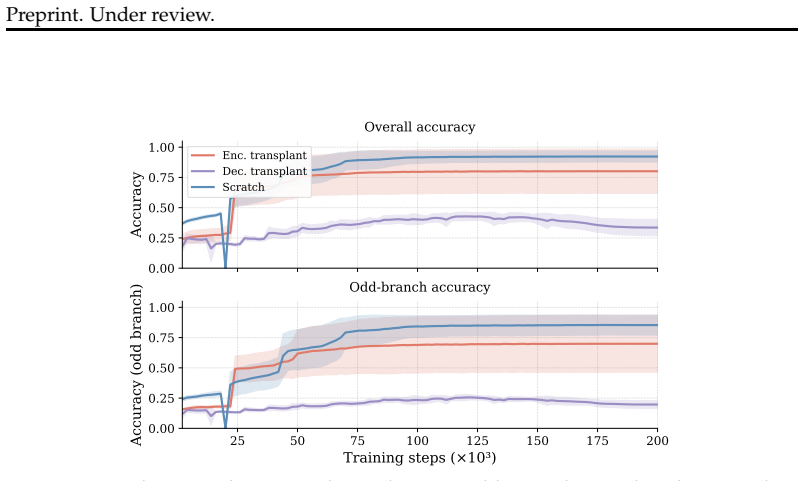
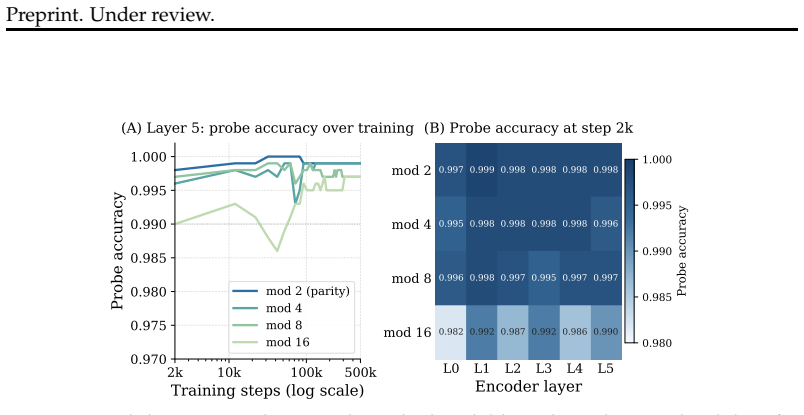
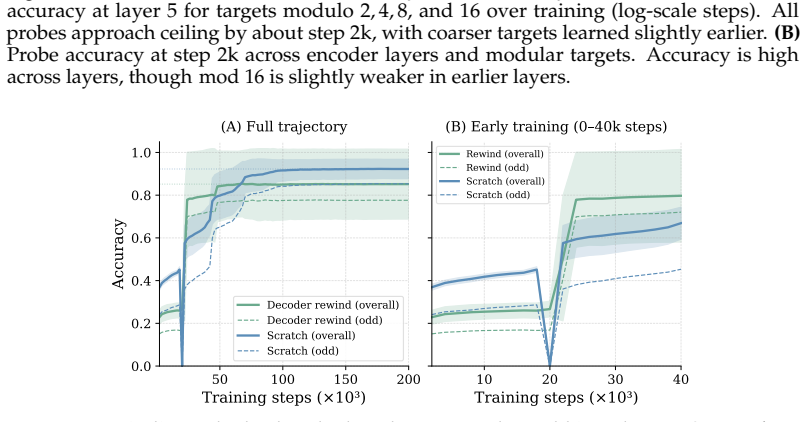
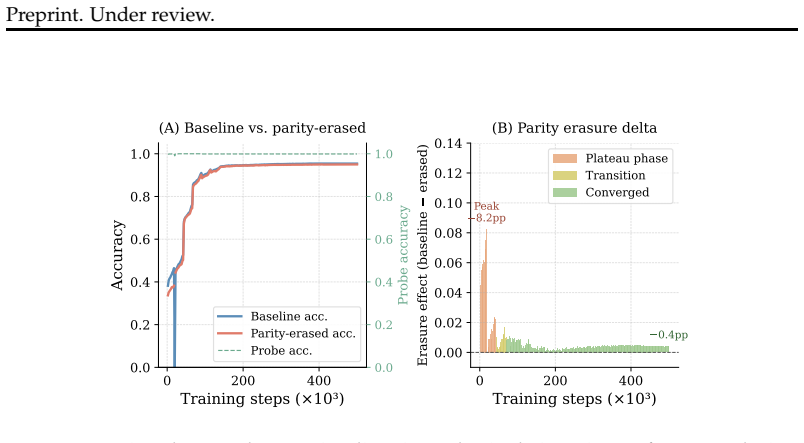
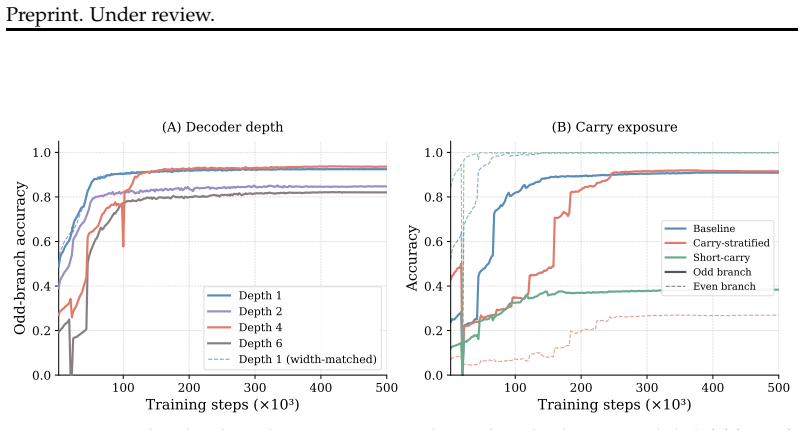
In encoder-decoder transformers trained on one-step Collatz prediction, the long delay between training-set fit and generalization is caused by limited decoder access to structure the encoder has already learned, not by delayed acquisition of that structure. Early encoder organization of parity and residue appears within a few thousand steps while accuracy remains near chance; transplanting a trained encoder accelerates grokking by 2.75 times, transplanting a trained decoder hurts, and freezing a converged encoder while retraining only the decoder eliminates the plateau and raises final accuracy from 86.1 percent to 97.6 percent. Choice of numeral base further modulates how much local digit
What carries the argument
The decoder-bottleneck hypothesis, tested by encoder/decoder transplant and freeze-retrain interventions: a trained encoder supplies usable parity/residue organization that a fresh decoder can rapidly exploit, while a trained decoder actively interferes; numeral base supplies the inductive bias that determines how readable that organization is.
Load-bearing premise
The early parity and residue patterns the encoder forms are the actual causal features the decoder later uses for generalization, not merely correlated side-effects of a mature encoder.
What would settle it
Destroy or scramble only the early parity/residue organization in a partially trained encoder (leaving other statistics intact), then continue training or transplant it; if grokking speed and final accuracy remain unchanged, the claimed structure is not causal for the delay.
If this is right
- Grokking delays on other modular or recursive arithmetic tasks should shorten when a pre-structured encoder is supplied or frozen.
- Numeral bases that factorially align with the target map will systematically outperform misaligned bases even under identical architectures and data.
- Joint end-to-end training can be suboptimal; staged training that first freezes an encoder may raise both speed and final accuracy.
- Binary or power-of-two representations may be specially prone to irreversible collapse on Collatz-like maps.
- Interpretability methods that probe only final outputs will miss structure that is already present but inaccessible to the decoder.
Where Pith is reading between the lines
- The same encoder-decoder asymmetry may explain grokking on modular addition or group-composition tasks once residual or parity features are isolated.
- Curriculum or multi-base training that first presents an aligned base could bootstrap a decoder that later transfers to harder bases.
- If the bottleneck is architectural rather than optimization-specific, decoder-only capacity increases or cross-attention redesigns should shrink the plateau without needing transplants.
- Representation collapse in binary may be detectable by monitoring singular values of encoder embeddings long before accuracy moves.
Editorial analysis
A structured set of objections, weighed in public.
Referee Report
Summary. The abstract claims that, in encoder–decoder transformers trained on one-step Collatz prediction, the long grokking delay is a decoder-access bottleneck rather than a failure of representation learning: the encoder organizes parity and residue structure within a few thousand steps while accuracy stays near chance for tens of thousands more. Causal interventions are said to support this (encoder transplant accelerates grokking 2.75×; decoder transplant hurts; freezing a converged encoder and retraining only the decoder eliminates the plateau and reaches 97.6 % vs 86.1 % joint training). Numeral base is further claimed to act as an inductive bias, with bases whose factorization aligns with Collatz arithmetic (e.g., base 24) reaching 99.8 % while binary collapses. The supplied full manuscript body, however, is an unrelated essay on institutional design for AI alignment (property rights, designer capture, Nash traps, Coase/Hayek/North citations, and Chai 2025a–d), containing none of the architecture, task, training curves, transplant protocols, freeze experiments, or base ablations asserted in the abstract.
Significance. If the abstract’s causal story were supported by the experiments it describes, the work would be a useful contribution to the grokking literature: it would supply concrete intervention evidence that representation learning can precede behavioral generalization and that decoder access, not encoder acquisition, can be the rate-limiting step, together with a clear inductive-bias account of numeral-base effects. Those results would be of interest to researchers studying algorithmic generalization and modular transformer training. As submitted, however, the body supplies none of that evidence, so the claimed significance cannot be assessed or realized.
major comments (3)
- The manuscript body is wholly unrelated to the abstract. The abstract asserts encoder–decoder Collatz experiments, transplant/freeze interventions, quantitative acceleration factors (2.75×), accuracy numbers (97.6 % vs 86.1 %, 99.8 % base-24, binary failure), and a decoder-bottleneck interpretation. The supplied full text instead discusses institutional design, property rights, designer capture, low-productivity Nash traps, and cites Coase, Hayek, North, Alchian, and Chai 2025a–d. There are no methods, architectures, training curves, causal protocols, tables, or figures that could support any of the abstract’s claims. The central scientific content is therefore absent; the paper cannot be evaluated on its stated contributions.
- Because the experimental content is missing, the load-bearing causal claim—that early encoder parity/residue organization is the task-relevant structure whose limited decoder access produces the grokking delay—cannot be checked for confounds (generic encoder maturity, optimization state, capacity, or non-causal correlated features). The transplant and freeze results that would adjudicate this claim do not appear in the manuscript.
- The base-dependent inductive-bias claim (factorization alignment with the Collatz map explaining learnability differences across 15 bases) is likewise unsupported: no base-ablation table, representation-collapse analysis for binary, or factorization argument is present in the body.
minor comments (2)
- The body text itself is fragmentary and mid-sentence in places (e.g., opening paragraphs cut off, repeated control characters, incomplete sentences about Exploration parameters), independent of the topic mismatch.
- Bibliography mixes classic institutional-economics references with unpublished Chai 2025a–d manuscripts and standard AI-alignment citations, but none of these are connected to the abstract’s empirical program.
Circularity Check
No circular derivation exists: abstract Collatz/encoder-transplant claims have no supporting body; the supplied text is an unrelated institutional-alignment essay with only ordinary bibliography self-cites.
full rationale
Circularity requires a claimed derivation or prediction that reduces, by the paper's own equations or load-bearing self-citation, to its inputs by construction. The supplied full text contains none of the abstract's objects (encoder-decoder Collatz models, parity/residue probes, transplant/freeze interventions, base ablations, accuracy numbers). It is instead fragmented political-economy prose on AI alignment-by-design, failure modes (designer capture, low-engagement Nash traps, environmental shift), and standard citations (Coase, Hayek, North, Alchian, etc.). Bibliography entries Chai (2025a–d) are self-citations to submitted manuscripts, but they are not invoked as uniqueness theorems or fitted ansätze that force a central result; the body never closes a derivation loop. Because there is no derivation chain to walk, none of the six circularity patterns apply. The abstract–body mismatch is a severe integrity/completeness failure, not circularity. Score 0 is therefore the correct, non-manufactured finding.
Axiom & Free-Parameter Ledger
free parameters (3)
- training_horizon_and_plateau_thresholds
- model_and_optimization_hyperparameters
- numeral_base_set_and_encoding
axioms (3)
- domain assumption One-step Collatz prediction is a representative algorithmic task for studying grokking delays in transformers.
- domain assumption Encoder transplant / decoder transplant / encoder-freeze interventions primarily isolate access to learned structure rather than confounding optimization state or capacity effects.
- ad hoc to paper Alignment between a base’s factorization and Collatz map arithmetic is the relevant inductive bias explaining base-dependent accuracy.
invented entities (1)
-
decoder bottleneck hypothesis (for grokking delay)
no independent evidence
read the original abstract
Grokking in transformers trained on algorithmic tasks is characterized by a long delay between training-set fit and abrupt generalization, but the source of that delay remains poorly understood. In encoder-decoder arithmetic models, we argue that this delay reflects limited access to already learned structure rather than failure to acquire that structure in the first place. We study one-step Collatz prediction and find that the encoder organizes parity and residue structure within the first few thousand training steps, while output accuracy remains near chance for tens of thousands more. Causal interventions support the decoder bottleneck hypothesis. Transplanting a trained encoder into a fresh model accelerates grokking by 2.75 times, while transplanting a trained decoder actively hurts. Freezing a converged encoder and retraining only the decoder eliminates the plateau entirely and yields 97.6% accuracy, compared to 86.1% for joint training. What makes the decoder's job harder or easier depends on numeral representation. Across 15 bases, those whose factorization aligns with the Collatz map's arithmetic (e.g., base 24) reach 99.8% accuracy, while binary fails completely because its representations collapse and never recover. The choice of base acts as an inductive bias that controls how much local digit structure the decoder can exploit, producing large differences in learnability from the same underlying task.
Figures




Forward citations
Cited by 1 Pith paper
-
Weight Decay Regimes in Grokking Transformers: Cheap Online Diagnostics
Weight decay controls distinct learning regimes in grokking transformers on modular arithmetic, tracked by new cheap attention-based diagnostics with empirical critical value and exponent fits.
Reference graph
Works this paper leans on
-
[1]
Alchian, A. A. (1965). Some Economics of Property Rights. Il Politico, 30(4), 816 ��829
1965
-
[2]
A., & Demsetz, H
Alchian, A. A., & Demsetz, H. (1972). Production, Information Costs, and Economic Organization. American Economic Review, 62(5), 777��795
1972
-
[3]
Cheung, S. N. S. (1983). The Contractual Nature of the Firm. Journal of Law and Economics, 26(1), 1 ��21
1983
-
[4]
Cheung, S. N. S. (1998). The Transaction Costs Paradigm. Economic Inquiry, 36(4), 514 ��521
1998
-
[5]
Coase, R. H. (1937). The Nature of the Firm. Economica, 4(16), 386��405
1937
-
[6]
Coase, R. H. (1960). The Problem of Social Cost. Journal of Law and Economics, 3, 1 ��44
1960
-
[7]
Hayek, F. A. (1945). The Use of Knowledge in Society. American Economic Review, 35(4), 519 ��530
1945
-
[8]
North, D. C. (1990). Institutions, Institutional Change and Economic Performance. Cambridge University Press
1990
-
[9]
Williamson, O. E. (1985). The Economic Institutions of Capitalism. Free Press. ������������
1985
-
[10]
Amodei, D., et al. (2016). Concrete Problems in AI Safety. arXiv:1606.06565
Pith/arXiv arXiv 2016
-
[11]
Bai, Y., et al. (2022). Training a Helpful and Harmless Assistant with Reinforcement Learning from Human Feedback. arXiv:2204.05862
Pith/arXiv arXiv 2022
-
[12]
Christiano, P., et al. (2017). Deep Reinforcement Learning from Human Preferences. NeurIPS
2017
-
[13]
Ngo, R., Chan, L., & Mindermann, S. (2024). The Alignment Problem from a Deep Learning Perspective. ICLR
2024
-
[14]
Ouyang, L., et al. (2022). Training Language Models to Follow Instructions with Human Feedback. NeurIPS
2022
-
[15]
Russell, S. (2019). Human Compatible: Artificial Intelligence and the Problem of Control. Viking. ����������������
2019
-
[16]
Berlin, I. (1958). Two Concepts of Liberty. Oxford University Press
1958
-
[17]
Rawls, J. (1971). A Theory of Justice. Harvard University Press
1971
discussion (0)
Sign in with ORCID, Apple, or X to comment. Anyone can read and Pith papers without signing in.