REVIEW 3 major objections 2 minor 1 cited by
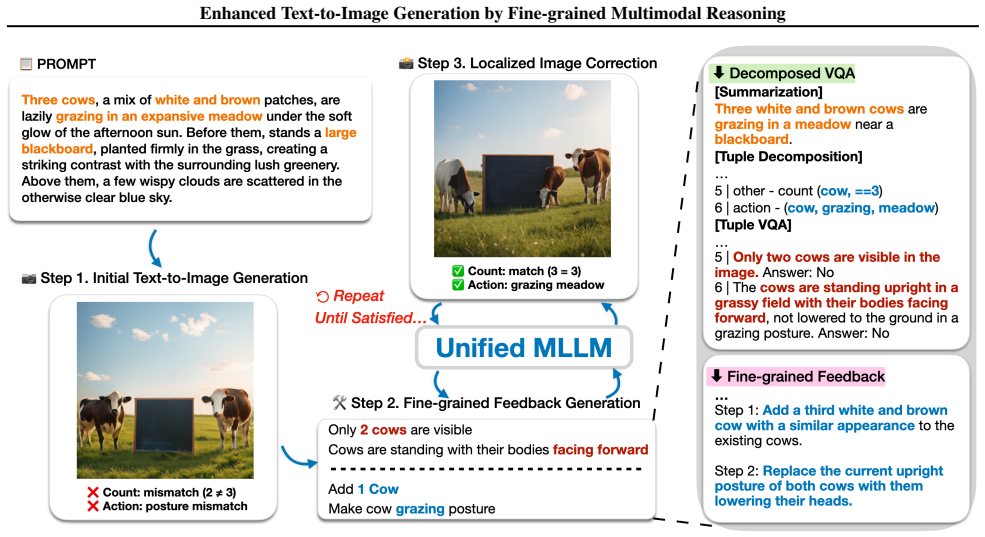
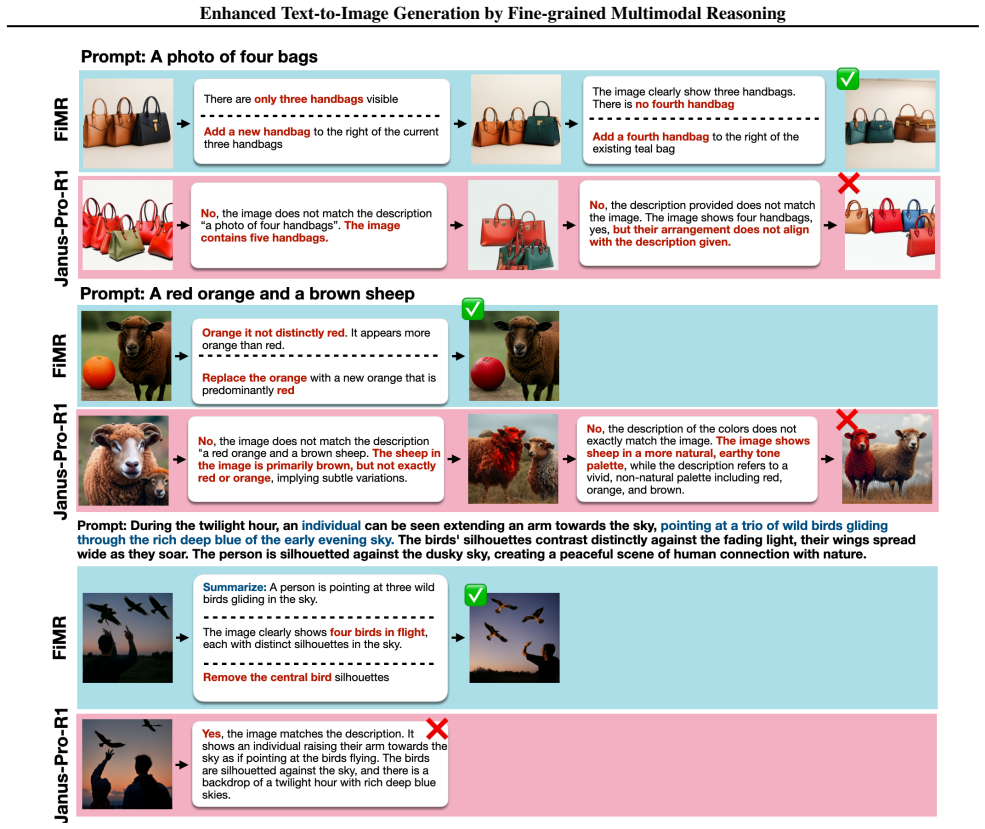
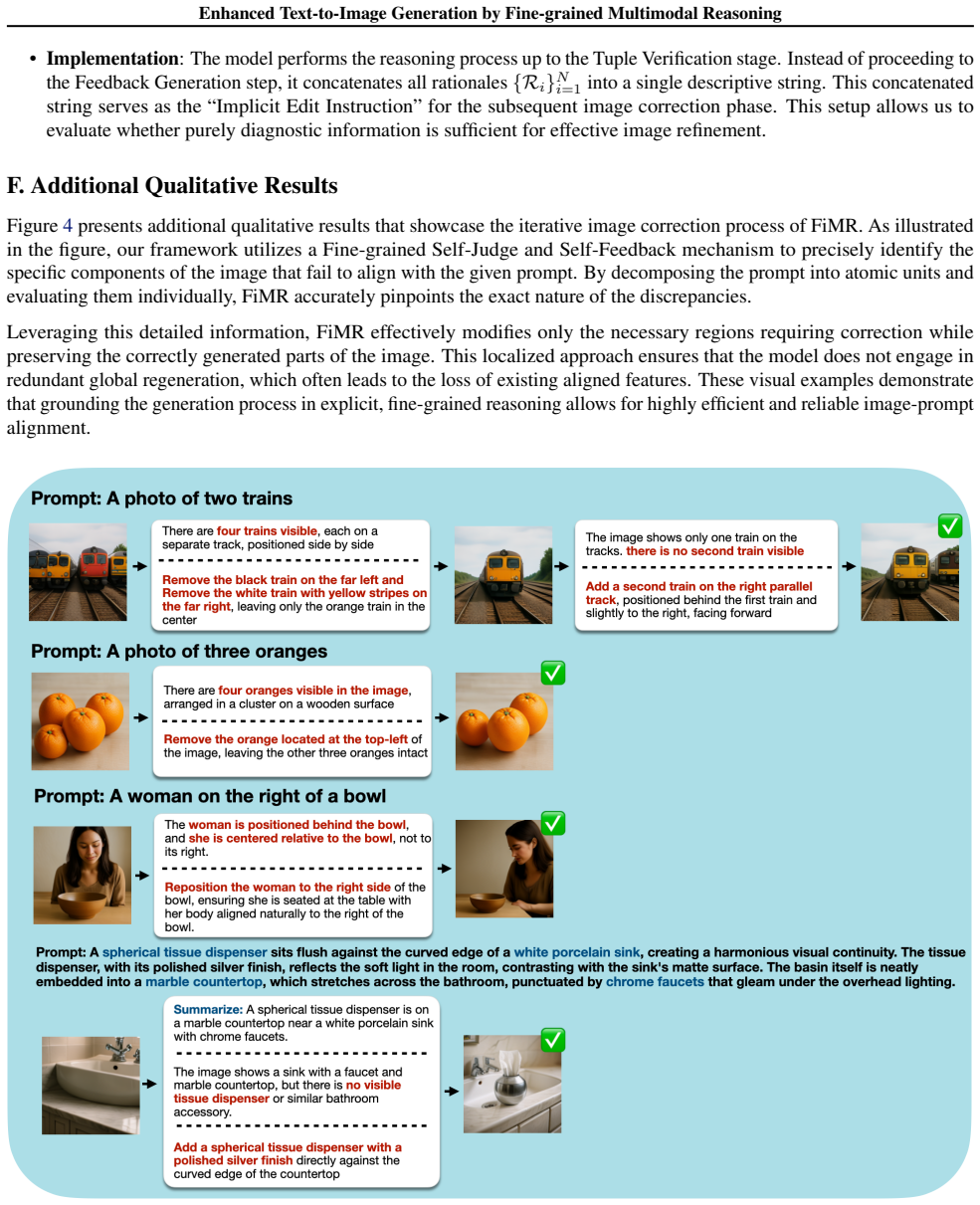
A multimodal model can improve its own images by decomposing a prompt into visual requirements, scoring each one, and refining only what fails.
Reviewed by Pith at T0; open to challenge. T0 means a machine referee read the full paper against a public rubric. the ladder, T0–T4 →
T0 review · grok-4.5
2026-07-12 20:48 UTC pith:MLZKOIP6
load-bearing objection Abstract describes a clean fine-grained self-refine + step-level GRPO package for compositional T2I, but the supplied body is encoding-corrupted, so the claimed gains cannot be audited here. the 3 major comments →
FiRe: Fine-grained Multimodal Reasoning for Enhanced Image Generation
The pith
A machine-rendered reading of the paper's core claim, the machinery that carries it, and where it could break.
Core claim
Fine-grained multimodal reasoning—decompose the text prompt into key visual requirements, self-judge whether each is satisfied in the generated image, then apply localized refinement from the model’s own precise feedback—systematically improves text-to-image generation by unified MLLMs, and this process can be strengthened by step-level rewards and advantages inside a GRPO-style trainer (FiRe-GRPO) rather than sparse final-outcome rewards alone.
What carries the argument
FiRe’s multi-step loop (requirement decomposition → per-requirement self-judgment → localized refinement), trained with FiRe-GRPO: the reasoning is cast as a step-level decision process with step-specific rewards and step-level advantages so credit assignment is granular instead of outcome-only.
Load-bearing premise
The model’s own checks of fine-grained visual requirements are accurate and calibrated enough that the feedback it writes actually improves the image instead of locking in its own mistakes or biases.
What would settle it
On a held-out compositional benchmark, measure whether images after FiRe refinement score higher on the same per-requirement checks when those checks are done by an independent judge (human or a stronger external model); if refined images do not improve under external verification, or if step-level rewards track only self-agreement rather than true visual correctness, the central claim fails.
Editorial analysis
A structured set of objections, weighed in public.
Referee Report
Summary. The paper proposes FiRe, a fine-grained multimodal reasoning pipeline for text-to-image generation with unified MLLMs. It decomposes a prompt into key visual requirements, has the model self-judge whether each requirement is satisfied in a generated image, and then performs localized refinement from that self-generated feedback. To train the multi-step process, the authors introduce FiRe-GRPO, which treats reasoning as step-level decision-making, defines step-specific rewards, and computes step-level advantages to address sparse outcome-only credit assignment in standard GRPO. The abstract claims consistent gains over competitive T2I and reasoning-based baselines, especially on compositional benchmarks. The supplied full manuscript body is encoding-corrupted and unreadable, so methods, equations, ablations, and tables cannot be verified from the provided text.
Significance. If the claims hold under a readable manuscript and proper evaluation, the work would matter for compositional text-to-image control: moving beyond prompt rewriting or holistic image–text scores toward attribute-level reflection and localized edit feedback is a natural and useful direction for unified MLLMs. Step-level GRPO with step-specific rewards is also a concrete RL design choice that could transfer to other multi-step multimodal generation settings. Those contributions are currently only asserted at abstract level; without recoverable experiments, reward definitions, or judgment-quality measurements, significance cannot yet be established.
major comments (3)
- The full manuscript body provided for review is encoding-corrupted (mojibake throughout) and unusable. Sections, equations, tables, ablations, baselines, and statistical results cannot be inspected. A formal technical review of the central claims is therefore not possible from the supplied source; a clean, complete PDF/text is required before acceptance-level evaluation.
- Abstract / method claim: the pipeline’s load-bearing step is self-judgment of fine-grained visual requirements and the precision of the resulting localized feedback. Both the refinement loop and FiRe-GRPO’s step-specific rewards rest on those judgments being accurate and well-calibrated. The abstract reports no human agreement rates, judgment-accuracy ablations, oracle-feedback comparisons, or failure analysis of misjudged attributes. Without such evidence (presumably intended for the methods/experiments sections, which are unreadable here), the claimed compositional gains remain under-supported.
- Abstract / FiRe-GRPO: the paper asserts that step-level rewards and step-level advantages fix sparse outcome-based GRPO for multi-step reasoning. That is a free design choice (reward scales, step count, group size) and an empirical axiom, not a derivation. Even once the body is readable, the review will need explicit reward definitions, ablations of step-level vs. outcome-only GRPO, and evidence that credit assignment—not merely extra compute or better decoding—drives the reported gains.
minor comments (2)
- The arXiv footer fragment visible in the corrupted dump lists a different ID/category (cs.RO / 2604.13492) than the stated paper (cs.CV / 2604.13491); this should be corrected in any resubmission.
- Once a clean manuscript is available, ensure notation for step-specific rewards, advantages, and the decomposition/judgment/refinement interface is defined before first use, and that compositional benchmark names and metrics are fully specified in tables.
Circularity Check
Empirical methods paper with no derivation-by-construction; residual self-judgment loop is a calibration risk, not circular forcing of the claimed gains.
full rationale
FiRe is an empirical multimodal T2I methods paper: it proposes a multi-step pipeline (prompt decomposition → per-requirement self-judgment → localized refinement) plus FiRe-GRPO step-level rewards/advantages, then reports outperformance on external compositional text-to-image benchmarks. There is no closed-form prediction, uniqueness theorem, or fitted parameter that is renamed as an independent result. The abstract’s load-bearing claim is experimental superiority over baselines, not a first-principles derivation. The only structural self-reference is the method’s use of the MLLM to judge its own generations and to supply step-specific RL rewards—an RLAIF-style design choice that can inflate internal scores if the judge shares generator biases, but that does not make the reported external-benchmark gains true by construction. The supplied full manuscript body is encoding-corrupted and unreadable, so no equation-level reduction (Eq. X ≡ Eq. Y) or load-bearing self-citation chain can be exhibited. Under the circularity criteria, this is an honest near-zero finding: residual self-evaluation risk belongs to correctness/calibration, not to circular derivation.
Axiom & Free-Parameter Ledger
free parameters (2)
- step-specific reward weights / scales in FiRe-GRPO
- number of reasoning/refinement steps and group size for GRPO
axioms (3)
- domain assumption Unified MLLMs can decompose prompts into key visual requirements and reliably self-judge satisfaction of those requirements in generated images.
- ad hoc to paper Step-level rewards and step-level advantages yield better credit assignment than sparse outcome-only GRPO for this multi-step generation process.
- domain assumption Compositional text-to-image benchmarks used for evaluation measure the fine-grained control the method targets.
invented entities (2)
-
FiRe multi-step fine-grained multimodal reasoning pipeline
no independent evidence
-
FiRe-GRPO (step-level GRPO with step-specific rewards/advantages)
no independent evidence
read the original abstract
With the rapid progress of Multimodal Large Language Models (MLLMs), unified MLLMs that jointly perform image understanding and generation have advanced significantly. However, despite the inherent reasoning capabilities of unified MLLMs for self-reflection and self-refinement, their use in text-to-image generation remains largely underexplored. Meanwhile, existing multimodal reasoning-based image generation methods mostly rely on prompt augmentation or holistic image-text alignment judgments, without fine-grained reflection and refinement of detailed prompt attributes, leading to limited fine-grained control. To address this limitation, we propose FiRe, a Fine-grained Multimodal Reasoning method for enhanced image generation by MLLM. In specific, FiRe performs a fine-grained multi-step reasoning by first decomposing the prompt into key visual requirements and then self-judging their satisfaction in the generated image, followed by localized refinement according to self-generated precise feedback. In addition, to further strengthen the MLLM's multimodal reasoning ability, we introduce FiRe-GRPO, a reinforcement learning method tailored to FiRe. Since standard Group Relative Policy Optimization (GRPO) suffers from sparse, outcome-based rewards in multi-step reasoning, we formulate our reasoning process as a step-level decision-making problem, design step-specific rewards, and compute step-level advantages for granular credit assignment within GRPO. Extensive experiments demonstrate that FiRe consistently outperforms competitive text-to-image baselines, including existing reasoning-based methods, with particularly substantial gains on compositional text-to-image benchmarks.
Figures


Forward citations
Cited by 1 Pith paper
-
Recursive Self-Improvement in AI: From Bounded Self-Refinement to Autonomous Research Loops
A survey of 1,250 papers organizes AI self-improvement along two axes—what is improved and loop closure—finding that demonstrated self-improvement strength tracks a verification hierarchy from formal verifiers down to...
Reference graph
Works this paper leans on
-
[1]
��������������� ������ �������������� �������� ���� �������� ��������������� ����� ������ ���������� �������� ���� ������ ���� ������ �������� ���� ��� ����� ���� ���������� ���� ��������� ��� ������ ������ �������������� �� ���� ��������� �� ������� ������� ��� �������� ���������� ���� ������ ��� ����� ������������ ������ ������� ��� ������� ������� ����...
Pith/arXiv arXiv 2026
discussion (0)
Sign in with ORCID, Apple, or X to comment. Anyone can read and Pith papers without signing in.