AIM2DAT: A Python-based Automated Ab Initio Material Modeling and Data Analysis Toolkit
Pith reviewed 2026-07-01 08:46 UTC · model grok-4.3
The pith
AIM2DAT provides a Python interface for automating ab initio materials modeling, big data handling, high-throughput DFT workflows, database queries, screening, and machine learning integration.
A machine-rendered reading of the paper's core claim, the machinery that carries it, and where it could break.
Core claim
AIM2DAT is a Python-based toolkit offering a user-friendly interface to generate and handle big data, design high-throughput workflows based on density functional theory calculations, and analyze the output, with key features that include interfaces to online databases for structure query and analysis, high-throughput screening routines, and seamless integration of machine learning models, demonstrated across use-cases from photocathode materials to metal-organic frameworks.
What carries the argument
The AIM2DAT Python package, which supplies modules for database interfacing, high-throughput workflow design, output analysis, and machine learning model integration in ab initio materials modeling.
If this is right
- Researchers can query online databases and analyze structures without writing custom scripts for each query.
- High-throughput screening of candidate materials can be set up and run with reduced manual intervention.
- Machine learning models can be inserted directly into DFT-based analysis pipelines for faster property prediction.
- Large volumes of DFT output data can be processed and organized systematically rather than case by case.
Where Pith is reading between the lines
- The same structure could be adapted to other electronic-structure codes beyond those used in the examples.
- Workflow templates from the toolkit might shorten the time from idea to first dataset in new materials projects.
- Similar automation patterns could apply to experimental data streams once file formats are standardized.
Load-bearing premise
The toolkit's database interfaces, screening routines, and machine learning integrations work reliably and deliver the stated automation gains in the described use-cases.
What would settle it
A researcher reproduces one of the paper's use-cases, such as photocathode screening, and finds that substantial manual steps or data-handling errors remain despite using the package.
Figures


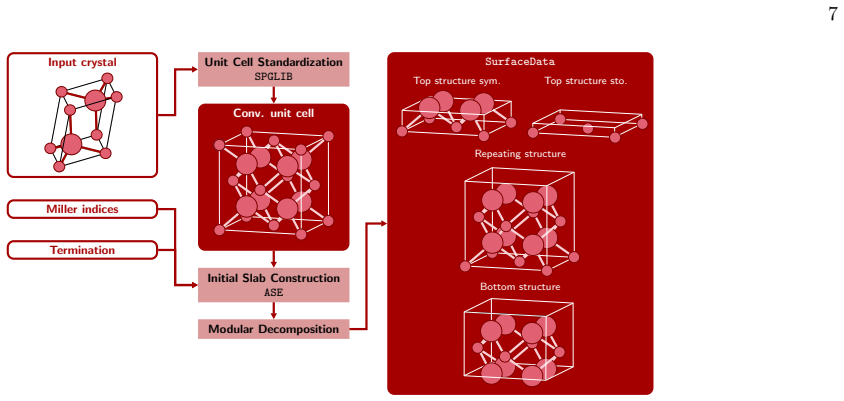


read the original abstract
The emergence of data-driven computational materials science offers unprecedented opportunities to explore complex material landscapes, complementing experimental research with the discovery of novel compounds. To enable these developments, it is essential to establish robust, reliable, and easy-to-use software supporting workflow automation and large dataset processing. Herein, we introduce the Automated Ab Initio Materials Modeling and Data Analysis Toolkit (aim2dat), a Python package offering a user-friendly interface to generate and handle big data, design high-throughput workflows based on density functional theory calculations, and analyze the output. Its key features include interfaces to online databases for structure query and analysis, high-throughput screening routines, and seamless integration of machine learning models. The capabilities of aim2dat are showcased with a variety of use-cases, ranging from photocathode materials to metal-organic frameworks.
Editorial analysis
A structured set of objections, weighed in public.
Referee Report
Summary. The manuscript introduces the AIM2DAT Python package as a toolkit for automated ab initio materials modeling and data analysis. It claims to provide a user-friendly interface for generating and handling large datasets, designing high-throughput DFT-based workflows, interfacing with online databases for structure queries, performing screening routines, and integrating machine learning models, with capabilities demonstrated via use-cases ranging from photocathode materials to metal-organic frameworks.
Significance. If the described interfaces and routines function reliably, the package could meaningfully support data-driven computational materials science by streamlining workflow automation and dataset processing. The emphasis on seamless integration of database access, screening, and ML components addresses a practical need in the field, though the absence of quantitative validation limits assessment of its impact relative to existing tools.
major comments (1)
- [Abstract] Abstract: The description of intended capabilities (user-friendly interface for big data generation, high-throughput DFT workflows, database interfaces, screening routines, and ML integration) provides no benchmarks, error analysis, performance metrics, or validation against known results or existing packages. This is load-bearing for the central claim that aim2dat enables 'robust, reliable' automation, as the practical utility and correctness of the showcased use-cases cannot be evaluated from the provided information alone.
Simulated Author's Rebuttal
We thank the referee for their review and the opportunity to improve the manuscript. We address the major comment below.
read point-by-point responses
-
Referee: [Abstract] Abstract: The description of intended capabilities (user-friendly interface for big data generation, high-throughput DFT workflows, database interfaces, screening routines, and ML integration) provides no benchmarks, error analysis, performance metrics, or validation against known results or existing packages. This is load-bearing for the central claim that aim2dat enables 'robust, reliable' automation, as the practical utility and correctness of the showcased use-cases cannot be evaluated from the provided information alone.
Authors: We agree that the abstract, as a concise overview, does not include specific benchmarks, error analysis, or performance metrics. The manuscript demonstrates the toolkit's capabilities through multiple use-cases (photocathode materials, metal-organic frameworks, etc.) that serve as practical validation of the workflows. We will revise the abstract to explicitly note that robustness and reliability are illustrated via these use-cases in the main text. This change will be made in the revised version. revision: yes
Circularity Check
No circularity: software description with no derivations or predictions
full rationale
The manuscript is a software-description paper introducing the aim2dat Python package for workflow automation, database interfacing, high-throughput screening, and ML integration. No equations, derivations, fitted parameters, predictions, or uniqueness theorems are present in the abstract or described structure. The central claim is the existence and utility of the toolkit, which is self-contained as a description of implemented features and use-cases. No load-bearing steps reduce to inputs by construction, self-citation, or renaming. This matches the default expectation for non-circular software papers.
Axiom & Free-Parameter Ledger
Forward citations
Cited by 1 Pith paper
-
A Practical Guide for Diagnosing Imaginary Phonon Modes in Metal--Organic Frameworks: The Case of MOF-5
A finite-displacement workflow is established to isolate numerical artifacts causing imaginary phonon modes in MOF-5 and to analyze remaining modes via mapping and Monte Carlo distortions for dynamical stability assessment.
Reference graph
Works this paper leans on
-
[1]
Cheng, R
L. Cheng, R. S. Assary, X. Qu, A. Jain, S. P. Ong, N. N. Rajput, K. Persson, and L. A. Curtiss, Accel- erating electrolyte discovery for energy storage with high-throughput screening, J. Phys. Chem. Lett.6, 283 (2015)
2015
-
[2]
Benayad, D
A. Benayad, D. Diddens, A. Heuer, A. N. Krishnamoor- thy, M. Maiti, F. L. Cras, M. Legallais, F. Rahmanian, Y. Shin, H. Stein,et al., High-throughput experimen- tation and computational freeway lanes for accelerated battery electrolyte and interface development research, Adv. Energy Mater.12, 2102678 (2022)
2022
-
[3]
Y. Lim, H. Park, A. Walsh, and J. Kim, Accelerat- ing CO2 direct air capture screening for metal-organic frameworks with a transferable machine learning force field, Matter8, 102203 (2025)
2025
-
[4]
J. Wu, L. Torresi, M. Hu, P. Reiser, J. Zhang, J. S. Rocha-Ortiz, L. Wang, Z. Xie, K. Zhang, B.-w. Park, A. Barabash, Y. Zhao, J. Luo, Y. Wang, L. L¨ uer, L.- L. Deng, J. A. Hauch, D. M. Guldi, M. E. P´ erez-Ojeda, S. I. Seok, P. Friederich, and C. J. Brabec, Inverse design workflow discovers hole-transport materials tailored for perovskite solar cells, S...
2024
-
[5]
A. S. Rosen, J. M. Notestein, and R. Q. Snurr, Identi- fying promising metal–organic frameworks for hetero- geneous catalysis via high-throughput periodic density functional theory, J. Comput. Chem.40, 1305 (2019), https://onlinelibrary.wiley.com/doi/pdf/10.1002/jcc.25787
-
[6]
R. Tran, J. Lan, M. Shuaibi, B. M. Wood, S. Goyal, A. Das, J. Heras-Domingo, A. Kolluru, A. Rizvi, N. Shoghi, A. Sriram, F. Therrien, J. Abed, O. Voznyy, E. H. Sargent, Z. Ulissi, and C. L. Zitnick, The open catalyst 2022 (oc22) dataset and challenges for oxide electrocatalysts, ASC Catal.13, 3066 (2023)
2022
-
[7]
Hafner, C
J. Hafner, C. Wolverton, and G. Ceder, Toward compu- tational materials design: The impact of density func- tional theory on materials research, MRS Bull.31, 659 (2006)
2006
-
[8]
S. P. Huber, S. Zoupanos, M. Uhrin, L. Talirz, L. Kahle, R. H¨ auselmann, D. Gresch, T. M¨ uller, A. V. Yaku- tovich, C. W. Andersen, F. F. Ramirez, C. S. Adorf, F. Gargiulo, S. Kumbhar, E. Passaro, C. Johnston, A. Merkys, A. Cepellotti, N. Mounet, N. Marzari, B. Kozinsky, and G. Pizzi, Aiida 1.0, a scalable com- putational infrastructure for automated re...
2020
-
[9]
Uhrin, S
M. Uhrin, S. P. Huber, J. Yu, N. Marzari, and G. Pizzi, Workflows in aiida: Engineering a high-throughput, event-based engine for robust and modular computa- tional workflows, Comp. Mater. Sci.187, 110086 (2021)
2021
-
[10]
A. Jain, S. P. Ong, W. Chen, B. Medasani, X. Qu, M. Kocher, M. Brafman, G. Petretto, G.-M. Rignanese, G. Hautier, D. Gunter, and K. A. Persson, Fireworks: a dynamic workflow system designed for high-throughput applications, Concurr. Comput. Pract. Exp.27, 5037 (2015)
2015
-
[11]
Mathew, J
K. Mathew, J. H. Montoya, A. Faghaninia, S. Dwarakanath, M. Aykol, H. Tang, I. heng Chu, T. Smidt, B. Bocklund, M. Horton, J. Dagdelen, B. Wood, Z.-K. Liu, J. Neaton, S. P. Ong, K. Persson, and A. Jain, Atomate: A high-level interface to gen- erate, execute, and analyze computational materials science workflows, Comp. Mater. Sci.139, 140 (2017)
2017
-
[12]
Janssen, S
J. Janssen, S. Surendralal, Y. Lysogorskiy, M. Todorova, T. Hickel, R. Drautz, and J. Neugebauer, pyiron: An integrated development environment for computational materials science, Comp. Mater. Sci.163, 24 (2019)
2019
-
[13]
C. R. C. Rˆ ego, J. Schaarschmidt, T. Schl¨ oder, M. Penaloza-Amion, S. Bag, T. Neumann, T. Strunk, and W. Wenzel, Simstack: An intuitive workflow framework, Front. Mater.9, 10.3389/fmats.2022.877597 (2022)
-
[14]
G. R. Schleder, A. C. M. Padilha, C. M. Acosta, M. Costa, and A. Fazzio, From DFT to machine learn- ing: recent approaches to materials science–a review, J. Phys. Mater.2, 032001 (2019)
2019
-
[15]
Schmidt, M
J. Schmidt, M. R. G. Marques, S. Botti, and M. A. L. Marques, Recent advances and applications of ma- chine learning in solid-state materials science, npj Com- put. Mater.5, 83 (2019)
2019
-
[16]
Westermayr, M
J. Westermayr, M. Gastegger, K. T. Sch¨ utt, and R. J. Maurer, Perspective on integrating machine learning into computational chemistry and materials science, J. Chem. Phys.154, 230903 (2021)
2021
-
[17]
D. Xu, Q. Zhang, X. Huo, Y. Wang, and M. Yang, Advances in data-assisted high-throughput computa- tions for material design, MGE Advances1, e11 (2023), https://onlinelibrary.wiley.com/doi/pdf/10.1002/mgea.11
-
[18]
N. N. Nyangiwe, Applications of density functional the- ory and machine learning in nanomaterials: A review, Next Mater.8, 100683 (2025). 15
2025
-
[19]
V. Gharakhanyan, L. Barroso-Luque, Y. Yang, M. Shuaibi, K. Michel, D. S. Levine, M. Dzamba, X. Fu, M. Gao, X. Liu, H. Ni, K. Noori, B. M. Wood, M. Uyttendaele, A. Boromand, C. L. Zitnick, N. Marom, Z. W. Ulissi, and A. Sriram, Open Molecular Crystals 2025 (OMC25) dataset and models, Sci. Data 10.1038/s41597-026-06628-2 (2026)
-
[20]
S. P. Huber, M. Minotakis, M. Bercx, T. Reents, K. Eimre, N. Paulish, N. H¨ ormann, M. Uhrin, N. Marzari, and G. Pizzi, Mc3d: the materials cloud computational database of experimentally known stoi- chiometric inorganics, Digit. Discov.5, 1114 (2026)
2026
-
[21]
V. I. Hegde, C. K. H. Borg, Z. del Rosario, Y. Kim, M. Hutchinson, E. Antono, J. Ling, P. Saxe, J. E. Saal, and B. Meredig, Quantifying uncertainty in high- throughput density functional theory: A comparison of aflow, materials project, and oqmd, Phys. Rev. Materi- als7, 053805 (2023)
2023
-
[22]
S. A. Tawfik, Computational material science has a data problem, J. Chem. Inf. Model.65, 5823 (2025)
2025
-
[23]
Bosoni, L
E. Bosoni, L. Beal, M. Bercx, P. Blaha, S. Bl¨ ugel, J. Br¨ oder, M. Callsen, S. Cottenier, A. Degomme, V. Dikan, K. Eimre, E. Flage-Larsen, M. Fornari, A. Garcia, L. Genovese, M. Giantomassi, S. P. Huber, H. Janssen, G. Kastlunger, M. Krack, G. Kresse, T. D. K¨ uhne, K. Lejaeghere, G. K. H. Madsen, M. Marsman, N. Marzari, G. Michalicek, H. Mirhosseini, T...
2023
-
[24]
Janssen, J
J. Janssen, J. George, J. Geiger, M. Bercx, X. Wang, C. Ertural, J. Schaarschmidt, A. M. Ganose, G. Pizzi, T. Hickel, and J. Neugebauer, A python workflow defini- tion for computational materials design, Digit. Discov. 4, 3149 (2025)
2025
-
[25]
Himanen, A
L. Himanen, A. Geurts, A. S. Foster, and P. Rinke, Data-driven materials science: status, challenges, and perspectives, Adv. Sci.6, 1900808 (2019)
2019
-
[26]
Reeves-McLaren and S
N. Reeves-McLaren and S. M.-L. Christensen, Data in- tegrity in materials science in the era of ai: balancing accelerated discovery with responsible science and inno- vation, J. Mater. Chem. A14, 276 (2026)
2026
-
[27]
M. D. Wilkinson, M. Dumontier, I. J. Aalbersberg, G. Appleton, M. Axton, A. Baak, N. Blomberg, J.-W. Boiten, L. B. da Silva Santos, P. E. Bourne,et al., The fair guiding principles for scientific data management and stewardship, Sci. Data3, 1 (2016)
2016
-
[28]
Scheffler, M
M. Scheffler, M. Aeschlimann, M. Albrecht, T. Bereau, H.-J. Bungartz, C. Felser, M. Greiner, A. Groß, C. T. Koch, K. Kremer,et al., Fair data enabling new horizons for materials research, Nature604, 635 (2022)
2022
-
[29]
Bai and X
X. Bai and X. Zhang, Artificial intelligence-powered ma- terials science, Nano-Micro Lett.17, 135 (2025). [30]aim 2datgithub repository. [31]aim 2datdocumentation
2025
-
[30]
J. E. Saal, S. Kirklin, M. Aykol, B. Meredig, and C. Wolverton, Materials design and discovery with high- throughput density functional theory: The open quan- tum materials database (oqmd), JOM65, 1501 (2013)
2013
-
[31]
A. Jain, S. P. Ong, G. Hautier, W. Chen, W. D. Richards, S. Dacek, S. Cholia, D. Gunter, D. Skinner, G. Ceder, and K. A. Persson, Commentary: The mate- rials project: A materials genome approach to accelerat- ing materials innovation, APL Mater.1, 011002 (2013), https://doi.org/10.1063/1.4812323
-
[32]
N. S. Bobbitt, K. Shi, B. J. Bucior, H. Chen, N. Tracy- Amoroso, Z. Li, Y. Sun, J. H. Merlin, J. I. Siep- mann, D. W. Siderius, and R. Q. Snurr, Mofx-db: An online database of computational adsorption data for nanoporous materials, J. Chem. Eng. Data68, 483 (2023), https://doi.org/10.1021/acs.jced.2c00583
-
[33]
C. W. Andersen, R. Armiento, E. Blokhin, G. J. Conduit, S. Dwaraknath, M. L. Evans, ´A. Fekete, A. Gopakumar, S. Graˇ zulis, A. Merkys, F. Mohamed, C. Oses, G. Pizzi, G.-M. Rignanese, M. Scheidgen, L. Talirz, C. Toher, D. Winston, R. Aversa, K. Choud- hary, P. Colinet, S. Curtarolo, D. Di Stefano, C. Draxl, S. Er, M. Esters, M. Fornari, M. Giantomassi, M....
2021
-
[34]
Talirz, S
L. Talirz, S. Kumbhar, E. Passaro, A. V. Yakutovich, V. Granata, F. Gargiulo, M. Borelli, M. Uhrin, S. P. Huber, S. Zoupanos, C. S. Adorf, C. W. Andersen, O. Sch¨ utt, C. A. Pignedoli, D. Passerone, J. Van- deVondele, T. C. Schulthess, B. Smit, G. Pizzi, and N. Marzari, Materials Cloud, a platform for open com- putational science, Sci. Data7, 299 (2020)
2020
-
[35]
Scheidgen, L
M. Scheidgen, L. Himanen, A. N. Ladines, D. Sikter, M. Nakhaee, ´Ad´ am Fekete, T. Chang, A. Golparvar, J. A. M´ arquez, S. Brockhauser, S. Br¨ uckner, L. M. Ghir- inghelli, F. Dietrich, D. Lehmberg, T. Denell, A. Al- bino, H. N¨ asstr¨ om, S. Shabih, F. Dobener, M. K¨ uhbach, R. Mozumder, J. F. Rudzinski, N. Daelman, J. M. Pizarro, M. Kuban, C. Salazar, ...
2023
-
[36]
Curtarolo, W
S. Curtarolo, W. Setyawan, G. L. Hart, M. Jah- natek, R. V. Chepulskii, R. H. Taylor, S. Wang, J. Xue, K. Yang, O. Levy, M. J. Mehl, H. T. Stokes, D. O. Demchenko, and D. Morgan, Aflow: An auto- matic framework for high-throughput materials discov- ery, Comp. Mater. Sci.58, 218 (2012)
2012
-
[37]
Fredericks, K
S. Fredericks, K. Parrish, D. Sayre, and Q. Zhu, Pyx- tal: A python library for crystal structure generation and symmetry analysis, Comput. Phys. Commun.261, 107810 (2021)
2021
-
[38]
A. H. Larsen, J. J. Mortensen, J. Blomqvist, I. E. Castelli, R. Christensen, M. Du lak, J. Friis, M. N. Groves, B. Hammer, C. Hargus, E. D. Hermes, P. C. Jennings, P. B. Jensen, J. Kermode, J. R. Kitchin, E. L. Kolsbjerg, J. Kubal, K. Kaasbjerg, S. Lysgaard, J. B. Maronsson, T. Maxson, T. Olsen, L. Pastewka, A. Pe- terson, C. Rostgaard, J. Schiøtz, O. Sch...
2017
-
[39]
S. P. Ong, W. D. Richards, A. Jain, G. Hautier, M. Kocher, S. Cholia, D. Gunter, V. L. Chevrier, K. A. Persson, and G. Ceder, Python materials genomics (py- matgen): A robust, open-source python library for ma- terials analysis, Comp. Mater. Sci.68, 314 (2013)
2013
-
[40]
P. Eastman, R. Galvelis, R. P. Pel´ aez, C. R. A. Abreu, S. E. Farr, E. Gallicchio, A. Gorenko, M. M. Henry, F. Hu, J. Huang, A. Kr¨ amer, J. Michel, J. A. Mitchell, V. S. Pande, J. P. Rodrigues, J. Rodriguez- Guerra, A. C. Simmonett, S. Singh, J. Swails, P. Turner, Y. Wang, I. Zhang, J. D. Chodera, G. De Fabritiis, and T. E. Markland, Openmm 8: Molecular...
-
[41]
H.-D. Saßnick, F. Machado Ferreira De Araujo, J. Edzards, and C. Cocchi, Impact of ligand substitution and metal node exchange in the electronic properties of scandium terephtha- late frameworks, Inorg. Chem.63, 2098 (2024), https://doi.org/10.1021/acs.inorgchem.3c03945
-
[42]
Edzards, H.-D
J. Edzards, H.-D. Saßnick, J. S. Andreo, and C. Cocchi, Tuning structural and electronic properties of metal- organic framework 5 by metal substitution and linker functionalization, J. Chem. Phys.160, 184706 (2024)
2024
-
[43]
A. R. Oganov and M. Valle, How to quantify energy landscapes of solids, J. Chem. Phys.130, 104504 (2009), https://doi.org/10.1063/1.3079326
-
[44]
Pizzi, A
G. Pizzi, A. Cepellotti, R. Sabatini, N. Marzari, and B. Kozinsky, Aiida: automated interactive in- frastructure and database for computational science, Comp. Mater. Sci.111, 218 (2016)
2016
-
[45]
T. D. K¨ uhne, M. Iannuzzi, M. Del Ben, V. V. Ry- bkin, P. Seewald, F. Stein, T. Laino, R. Z. Khal- iullin, O. Sch¨ utt, F. Schiffmann, D. Golze, J. Wil- helm, S. Chulkov, M. H. Bani-Hashemian, V. Weber, U. Borˇ stnik, M. Taillefumier, A. S. Jakobovits, A. Laz- zaro, H. Pabst, T. M¨ uller, R. Schade, M. Guidon, S. Andermatt, N. Holmberg, G. K. Schenter, A...
2020
-
[46]
G. L. Hart, L. J. Nelson, and R. W. Forcade, Gen- erating derivative structures at a fixed concentration, Comp. Mater. Sci.59, 101 (2012)
2012
-
[47]
A. O. de-la Roza, E. R. Johnson, and V. Lua˜ na, Critic2: A program for real-space analysis of quantum chemi- cal interactions in solids, Comput. Phys. Commun.185, 1007 (2014)
2014
-
[48]
T. A. Manz and N. G. Limas, Introducing ddec6 atomic population analysis: part 1. charge partitioning theory and methodology, RSC Adv.6, 47771 (2016)
2016
-
[49]
H.-D. Saßnick and C. Cocchi, Exploring ce- sium–tellurium phase space via high-throughput calculations beyond semi-local density-functional theory, J. Chem. Phys.156, 104108 (2022), https://doi.org/10.1063/5.0082710
-
[50]
pandas development team, pandas-dev/pandas: Pan- das (2020)
T. pandas development team, pandas-dev/pandas: Pan- das (2020)
2020
-
[51]
W. McKinney, Data Structures for Statistical Comput- ing in Python, inProceedings of the 9th Python in Sci- ence Conference, edited by St´ efan van der Walt and Jarrod Millman (2010) pp. 56 – 61
2010
-
[52]
J. D. Hunter, Matplotlib: A 2d graphics environment, Comput. Sci. Eng.9, 90 (2007)
2007
-
[53]
P. T. Inc., Collaborative data science (2015)
2015
-
[54]
M. Kuban, S. Rigamonti, M. Scheidgen, and C. Draxl, Density-of-states similarity descriptor for unsuper- vised learning from materials data, Sci. Data9, 10.1038/s41597-022-01754-z (2022)
-
[55]
Pedregosa, G
F. Pedregosa, G. Varoquaux, A. Gramfort, V. Michel, B. Thirion, O. Grisel, M. Blondel, P. Prettenhofer, R. Weiss, V. Dubourg, J. Vanderplas, A. Passos, D. Cournapeau, M. Brucher, M. Perrot, and E. Duches- nay, Scikit-learn: Machine learning in Python, Journal of Machine Learning Research12, 2825 (2011)
2011
-
[56]
Saßnick and C
H.-D. Saßnick and C. Cocchi, Automated analysis of surface facets: the example of cesium telluride, npj Comput. Mater.10, 38 (2024)
2024
-
[57]
Saßnick and C
H.-D. Saßnick and C. Cocchi, Crystal Structure Pre- diction of Cs–Te with Supervised Machine Learning, Adv. Theory Simul. , 2401344 (2025)
2025
-
[58]
H.-D. Saßnick and C. Cocchi, Data for ‘exploring cesium-tellurium phase space via high-throughput cal- culations beyond the generalized-gradient approxima- tion’, Zenodo 10.5281/zenodo.5779128 (2021)
-
[59]
H.-D. Saßnick and C. Cocchi, Data for ‘automated anal- ysis of surface facets: the example of cesium telluride’, Zenodo 10.5281/zenodo.8233715 (2023)
-
[60]
Cairns and J
R. Cairns and J. Samson, Metal photocathodes as sec- ondary standards for absolute intensity measurements in the vacuum ultraviolet, J. Opt. Soc. America56, 1568 (1966)
1966
-
[61]
Downey, L
S. Downey, L. Builta, D. Moir, T. Ringler, and J. Saun- ders, Simple laser-driven, metal-photocathode electron source, Appl. Phys. Lett.49, 911 (1986)
1986
-
[62]
M. Hada, Y. Nishina, and T. Kato, Exploring struc- tures and dynamics of molecular assemblies: Ultra- fast time-resolved electron diffraction measurements, Acc. Chem. Res.54, 731 (2020)
2020
-
[63]
Y. Zhu and H. Durr, The future of electron microscopy, Phys. Today68, 10.1063/PT.3.2747 (2015)
-
[64]
Callegari, A
C. Callegari, A. N. Grum-Grzhimailo, K. L. Ishikawa, K. C. Prince, G. Sansone, and K. Ueda, Atomic, molec- ular and optical physics applications of longitudinally coherent and narrow bandwidth free-electron lasers, Phys. Rep.904, 1 (2021)
2021
-
[65]
Zhang, Y
X. Zhang, Y. Zhang, Y. Qian, C. Feng, J. Zhang, Y. Jiang, and Z. Pan, Spectral response characteris- tics of transmission-mode alkali telluride photocathodes working from vacuum-ultraviolet to ultraviolet band, J. Vac. Sci. Technol. B35, 061202 (2017)
2017
-
[66]
Schaber, R
J. Schaber, R. Xiang, and N. Gaponik, Review of pho- tocathodes for electron beam sources in particle accel- erators, J. Mater. Chem. C11, 3162 (2023)
2023
-
[67]
S. K. Mohanty, M. Krasilnikov, A. Oppelt, F. Stephan, D. Sertore, L. Monaco, C. Pagani, and W. Hillert, Development and characterization of multi-alkali anti- monide photocathodes for high-brightness rf photoinjec- tors, Micromachines14, 1182 (2023). 17
2023
-
[68]
Souadia, A
Z. Souadia, A. Bouhemadou, R. Khenata, and Y. Al- Douri, Structural, elastic and lattice dynamical proper- ties of the alkali metal tellurides: first-principles study, Physica B521, 204 (2017)
2017
-
[69]
Cocchi, S
C. Cocchi, S. Mistry, M. Schmeißer, J. K¨ uhn, and T. Kamps, First-principles many-body study of the electronic and optical properties of csk 2sb, a semi- conducting material for ultra-bright electron sources, J. Phys. Condens. Matter.31, 014002 (2019)
2019
-
[70]
Cocchi, S
C. Cocchi, S. Mistry, M. Schmeißer, R. Amador, J. K¨ uhn, and T. Kamps, Electronic structure and core electron fingerprints of caesium-based multi-alkali anti- monides for ultra-bright electron sources, Sci. Rep.9, 18276 (2019)
2019
-
[71]
Amador, H.-D
R. Amador, H.-D. Saßnick, and C. Cocchi, Electronic structure and optical properties of na2ksb and nak2sb from first-principles many-body theory, J. Phys. Con- dens. Matter.33, 365502 (2021)
2021
-
[72]
Saßnick and C
H.-D. Saßnick and C. Cocchi, Electronic structure of cesium-based photocathode materials from density functional theory: performance of PBE, SCAN, and HSE06 functionals, Electr. Struct.3, 027001 (2021)
2021
-
[73]
Cocchi and H.-D
C. Cocchi and H.-D. Saßnick, Ab initio quantum– mechanical predictions of semiconducting photocathode materials, Micromachines12, 1002 (2021)
2021
-
[74]
Zhong, Z
Q. Zhong, Z. Dai, W. Wang, Y. Zhao, and S. Meng, Quartic anharmonicity and ultra-low lattice thermal conductivity of alkali antimonide compounds m 3sb (m= k, rb and cs), Int. J. Energy Res.45, 6958 (2021)
2021
-
[75]
Sharma, M
G. Sharma, M. Sajjad, and N. Singh, Impressive elec- tronic and thermal transports in csk2sb: a thermoelec- tric perspective, ASC Appl. Energy Mater.6, 11179 (2023)
2023
-
[76]
Santana-Andreo, H.-D
J. Santana-Andreo, H.-D. Saßnick, and C. Cocchi, Thermodynamic stability and vibrational properties of multi-alkali antimonides, J. Phys. Mater.7, 035004 (2024)
2024
-
[77]
Schier and C
R. Schier and C. Cocchi, Electronic and optical excita- tions of k-sb and na-sb crystals, Phys. Rev. Materials9, 053804 (2025)
2025
-
[78]
Bellersen, M
H. Bellersen, M. Guerrini, and C. Cocchi, Ultrafast pho- toexcitation of semiconducting photocathode materials, Phys. Rev. B112, 024314 (2025)
2025
-
[79]
G. Wang, J. Zhang, C. Huang, D. A. Dimitrov, A. Alexander, and E. I. Simakov, First-principles study of structural, elastic, electronic, transport proper- ties, and dielectric breakdown of cs2te photocathode, Sci. Rep.15, 2780 (2025)
2025
-
[80]
E. R. Antoniuk, P. Schindler, W. A. Schroeder, B. Dun- ham, P. Pianetta, T. Vecchione, and E. J. Reed, Novel ultrabright and air-stable photocathodes discov- ered from machine learning and density functional the- ory driven screening, Adv. Mater.33, 2104081 (2021)
2021
discussion (0)
Sign in with ORCID, Apple, or X to comment. Anyone can read and Pith papers without signing in.