Controlled Penumbral Inflation from Monodromic Valleys
Pith reviewed 2026-06-30 22:42 UTC · model grok-4.3
The pith
Local branch data dictate whether monodromic valleys support controlled inflationary plateaus in the penumbra.
A machine-rendered reading of the paper's core claim, the machinery that carries it, and where it could break.
Core claim
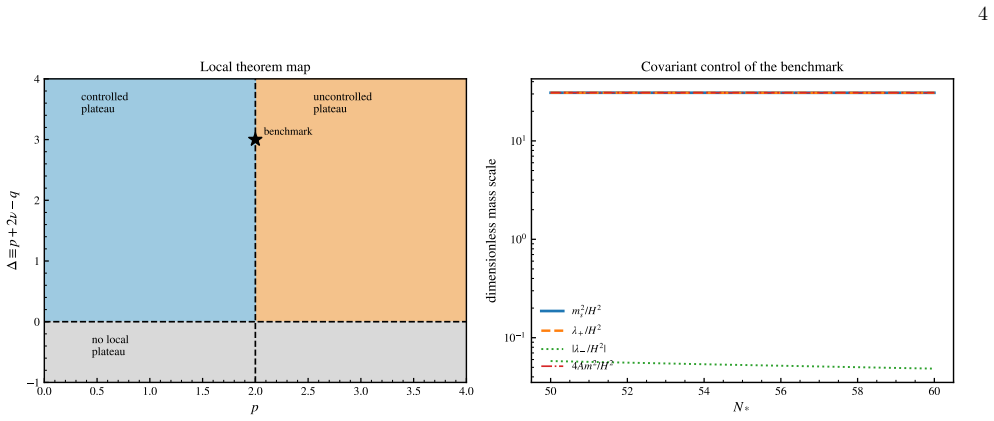
In the penumbra where asymptotic symmetries are partially broken, the axion-saxion effective theory with a branch-displacing odd term generates a plateau when Delta equals p plus 2 nu minus q is positive, while covariant single-clock control further requires p less than 2 or p equals 2 with 12 A_pm squared over dV_0 much greater than 1 over the observational window. The covariant control theorem shows that local branch data alone decide support for a controlled plateau, isolating the first controlled penumbral inflationary window and providing a minimal analytic family with closed-form valley and invariant attractor equation for the two-field dynamics.
What carries the argument
The covariant control theorem that uses local branch data to determine whether a monodromic valley supports a controlled inflationary plateau.
If this is right
- Penumbra valleys are split into three categories: no plateau, uncontrolled plateau, and controlled plateau.
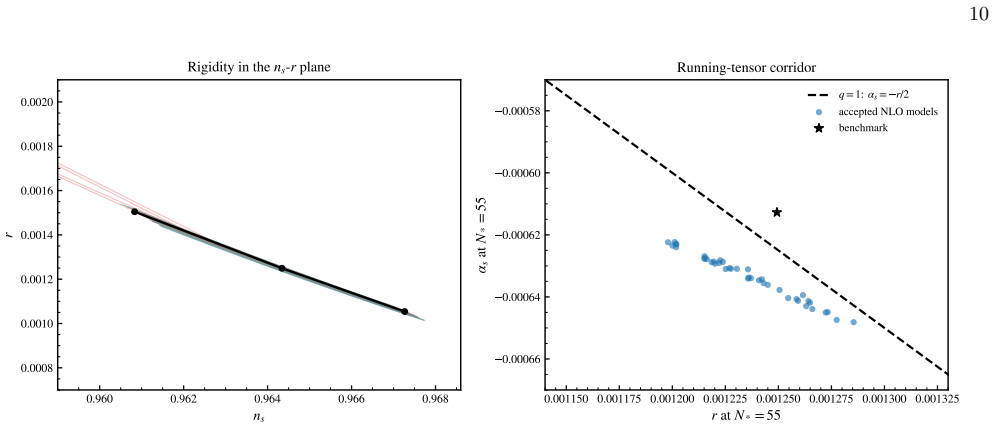
- The controlled corridor targets r approximately 10 to the minus 3 with the correlated running alpha_s approximately equal to minus r over 2 for the d equals q equals 1 benchmark.
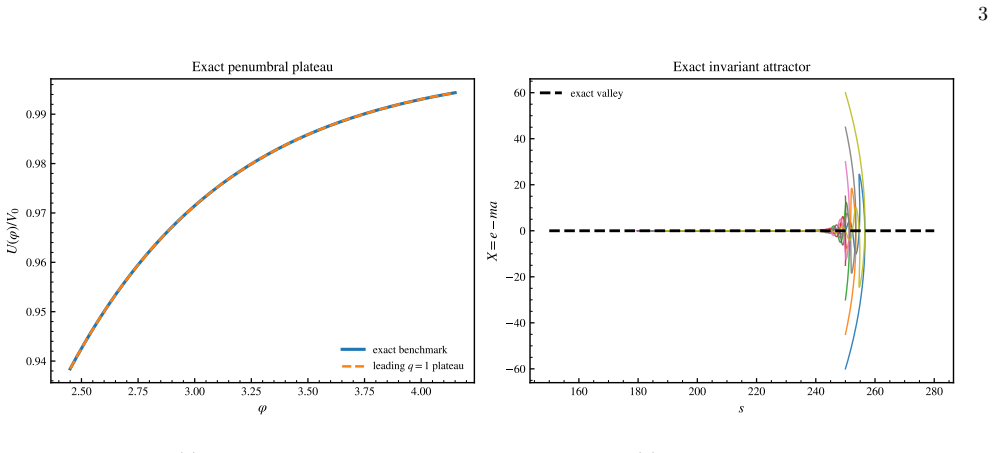
- A minimal analytic family supplies a closed-form valley and an invariant attractor equation that governs the full two-field dynamics.
- The realization remains predictive under the next penumbral order.
Where Pith is reading between the lines
- The local-data filter could be applied to scan other classes of monodromic potentials for additional controlled windows.
- The invariant attractor equation offers a route to quantify deviations from single-clock behavior in nearby regimes.
- The parameter conditions on p, q, and Delta supply concrete targets for numerical checks of backreaction in explicit string compactifications.
Load-bearing premise
The backreaction of heavy moduli can be exactly quantified using only local branch data in the penumbra regime, allowing the axion-saxion effective theory to capture the full dynamics without higher-order corrections spoiling the control conditions.
What would settle it
Observation or non-observation of the specific correlation alpha_s approximately equal to minus r over 2 at r approximately 10 to the minus 3 by LiteBIRD or CMB-S4 would test whether the controlled corridor identified by the theorem is realized.
Figures



read the original abstract
Realizing controlled, single-clock inflation in string theory is fundamentally obstructed by the backreaction of heavy moduli. We show that in the \emph{penumbra} -- the near-boundary regime of complex-structure moduli space where asymptotic symmetries are partially broken -- this obstruction can be exactly quantified. We derive a covariant control theorem demonstrating that local branch data dictate whether a monodromic valley supports a controlled inflationary plateau, thereby isolating the first controlled penumbral inflationary window. The result turns the penumbra from a geometric regime into a dynamical filter. In the axion-saxion effective theory, a branch-displacing odd term generates a plateau when $\Delta\equiv p+2\nu-q>0$, while covariant single-clock control further requires $p<2$, or $p=2$ with $12A_pm^2/(dV_0)\gg1$ over the observational window. This splits penumbral valleys into no plateau, uncontrolled plateau, and controlled plateau before global completion is attempted. We identify a minimal analytic family with a closed-form valley and an invariant attractor equation for the full two-field dynamics, providing the first exactly solvable penumbral realization that remains predictive under the next penumbral order. The controlled corridor targets $r\sim10^{-3}$ with the correlated running $\alpha_s\simeq-r/2$ for the $d=q=1$ benchmark, providing a falsifiable target for LiteBIRD/CMB-S4.
Editorial analysis
A structured set of objections, weighed in public.
Referee Report
Summary. The paper claims to derive a covariant control theorem showing that local branch data in the penumbra regime of complex-structure moduli space determine whether monodromic valleys support controlled single-clock inflation. It isolates conditions Δ ≡ p + 2ν − q > 0 with p < 2 (or p = 2 and 12 A_pm²/(d V_0) ≫ 1) for a controlled plateau in the axion-saxion effective theory, identifies a minimal analytic family with closed-form valley and invariant two-field attractor equation, and targets a controlled corridor with r ∼ 10^{-3} and α_s ≃ −r/2 for the d = q = 1 benchmark as a falsifiable prediction for LiteBIRD/CMB-S4.
Significance. If the control theorem and exact backreaction quantification hold, the work would convert the penumbra into a dynamical filter for controlled inflation in string theory and supply the first exactly solvable penumbral realization with explicit, falsifiable CMB targets.
major comments (2)
- [Abstract] Abstract: the control theorem is asserted to demonstrate that local branch data exactly quantify backreaction and isolate controlled plateaus, but no derivation steps, error estimates, or explicit two-field attractor equation are supplied; this is load-bearing for the central claim that the axion-saxion EFT captures the full dynamics without higher-order corrections.
- [Abstract] Abstract, benchmark d = q = 1: the target r ∼ 10^{-3} with α_s ≃ −r/2 is obtained only after imposing the p = 2 control requirement 12 A_pm²/(d V_0) ≫ 1 over the observational window; this indicates the controlled regime is selected by parameter tuning rather than derived independently from the theorem.
minor comments (2)
- [Introduction] The terms 'penumbra' and 'monodromic valley' are introduced without immediate reference to prior literature or precise geometric definitions; add these in the introduction.
- The manuscript should include at least one explicit check (analytic or numeric) that the control conditions remain satisfied along the full inflationary trajectory, not only at the benchmark point.
Simulated Author's Rebuttal
We thank the referee for the careful reading and for identifying points that can improve the clarity of the abstract. We respond to each major comment below. The derivations and attractor equation are present in the body of the manuscript; we will revise the abstract to make this explicit.
read point-by-point responses
-
Referee: [Abstract] Abstract: the control theorem is asserted to demonstrate that local branch data exactly quantify backreaction and isolate controlled plateaus, but no derivation steps, error estimates, or explicit two-field attractor equation are supplied; this is load-bearing for the central claim that the axion-saxion EFT captures the full dynamics without higher-order corrections.
Authors: The covariant control theorem, including the explicit quantification of backreaction from local branch data (Δ ≡ p + 2ν − q > 0), the error estimates on higher-order corrections, and the derivation of the invariant two-field attractor equation, are given in full in Sections 3–5. The abstract is a summary and does not reproduce these intermediate steps. We will revise the abstract to add a sentence pointing to these sections and to state the attractor equation explicitly, thereby addressing the concern that the central claim lacks visible support in the abstract itself. revision: yes
-
Referee: [Abstract] Abstract, benchmark d = q = 1: the target r ∼ 10^{-3} with α_s ≃ −r/2 is obtained only after imposing the p = 2 control requirement 12 A_pm²/(d V_0) ≫ 1 over the observational window; this indicates the controlled regime is selected by parameter tuning rather than derived independently from the theorem.
Authors: The control theorem itself supplies the necessary and sufficient conditions (Δ > 0 together with p < 2 or the stated inequality when p = 2) that define the controlled regime. The d = q = 1 benchmark is the minimal analytic family that satisfies these conditions while remaining exactly solvable; the quoted values of r and α_s are then computed as predictions inside that regime. The theorem therefore determines the allowed parameter space independently; the benchmark simply realizes one point inside it. We therefore see no need to alter the presentation on this point. revision: no
Circularity Check
No significant circularity detected
full rationale
The paper claims to derive a covariant control theorem from local branch data that determines whether monodromic valleys support controlled plateaus, with explicit conditions such as Δ ≡ p + 2ν − q > 0 and the p=2 case requiring 12 A_pm²/(d V_0) ≫ 1. The r ∼ 10^{-3} and α_s ≃ −r/2 values are presented for the d=q=1 benchmark as a falsifiable target of the resulting model, not as a fitted input renamed as prediction. No self-citation chains, self-definitional reductions, or ansatz smuggling are exhibited in the supplied text. The derivation is self-contained within the stated effective-theory regime and does not reduce to its inputs by construction.
Axiom & Free-Parameter Ledger
free parameters (4)
- p
- q
- nu
- A_pm
axioms (1)
- domain assumption The backreaction of heavy moduli can be exactly quantified in the penumbra using local branch data.
invented entities (2)
-
penumbra
no independent evidence
-
monodromic valley
no independent evidence
Forward citations
Cited by 1 Pith paper
-
CMB Test of the Higgs Origin of Dark-Photon Dark Matter
CMB isocurvature distinguishes Higgsed dark-photon DM production histories via a model-independent response formalism, requiring q_eff >=2 and initial displacements >3.5e4 H_* for perturbative full-abundance cases.
Reference graph
Works this paper leans on
-
[1]
Monodromy in the CMB: Gravity Waves and String Inflation
E. Silverstein and A. Westphal, Monodromy in the CMB: Gravity waves and string inflation, Phys. Rev. D78, 106003 (2008), arXiv:0803.3085 [hep-th]
work page internal anchor Pith review Pith/arXiv arXiv 2008
-
[2]
Gravity Waves and Linear Inflation from Axion Monodromy
L. McAllister, E. Silverstein, and A. Westphal, Gravity waves and linear inflation from axion monodromy, Phys. Rev. D82, 046003 (2010), arXiv:0808.0706 [hep-th]
work page internal anchor Pith review Pith/arXiv arXiv 2010
-
[3]
A Natural Framework for Chaotic Inflation
N. Kaloper and L. Sorbo, A natural framework for chaotic inflation, Phys. Rev. Lett.102, 121301 (2009), arXiv:0811.1989 [hep-th]
work page internal anchor Pith review Pith/arXiv arXiv 2009
-
[4]
Oscillations in the CMB from Axion Monodromy Inflation
R. Flauger, L. McAllister, E. Pajer, A. Westphal, and G. Xu, Oscillations in the cmb from axion monodromy inflation, JCAP (06), 009, arXiv:0907.2916 [hep-th]
work page internal anchor Pith review Pith/arXiv arXiv
-
[5]
X. Dong, B. Horn, E. Silverstein, and A. Westphal, Sim- ple exercises to flatten your potential, Phys. Rev. D84, 026011 (2011), arXiv:1011.4521 [hep-th]
work page internal anchor Pith review Pith/arXiv arXiv 2011
-
[6]
F-term Axion Monodromy Inflation
F. Marchesano, G. Shiu, and A. M. Uranga, F-term axion monodromy inflation, JHEP (09), 184, arXiv:1404.3040 [hep-th]
work page internal anchor Pith review Pith/arXiv arXiv
-
[7]
The Challenge of Realizing F-term Axion Monodromy Inflation in String Theory
R. Blumenhagen, D. Herschmann, and E. Plauschinn, The challenge of realizing F-term axion monodromy in- flation in string theory, JHEP (01), 007, arXiv:1409.7075 [hep-th]
work page internal anchor Pith review Pith/arXiv arXiv
-
[8]
Tuning and Backreaction in F-term Axion Monodromy Inflation
A. Hebecker, P. Mangat, F. Rompineve, and L. T. Witkowski, Tuning and backreaction in F-term axion monodromy inflation, Nucl. Phys. B894, 456 (2015), arXiv:1411.2032 [hep-th]
work page internal anchor Pith review Pith/arXiv arXiv 2015
-
[9]
Flat Monodromies and a Moduli Space Size Conjecture
A. Hebecker, P. Henkenjohann, and L. T. Witkowski, Flat monodromies and a moduli space size conjecture, JHEP (12), 033, arXiv:1708.06761 [hep-th]
work page internal anchor Pith review Pith/arXiv arXiv
-
[10]
Backreacted Axion Field Ranges in String Theory
F. Baume and E. Palti, Backreacted axion field ranges in string theory, JHEP (08), 043, arXiv:1602.06517 [hep- th]
work page internal anchor Pith review Pith/arXiv arXiv
-
[11]
Backreaction Issues in Axion Monodromy and Minkowski 4-forms
I. Valenzuela, Backreaction issues in axion mon- odromy and minkowski 4-forms, JHEP (06), 098, arXiv:1611.00394 [hep-th]
work page internal anchor Pith review Pith/arXiv arXiv
-
[12]
Mass Hierarchies and Dynamical Field Range
A. Landete and G. Shiu, Mass hierarchies and dy- namical field range, Phys. Rev. D98, 066012 (2018), arXiv:1806.01874 [hep-th]
work page internal anchor Pith review Pith/arXiv arXiv 2018
- [13]
- [14]
- [15]
-
[16]
The UV Sensitivity of Axion Monodromy Inflation
E. Pajer, D.-G. Wang, and B. Zhang, The UV sensitiv- ity of axion monodromy inflation, SciPost Phys.20, 097 (2026), arXiv:2412.05762 [hep-th]
work page internal anchor Pith review Pith/arXiv arXiv 2026
-
[17]
Superconformal Inflationary $\alpha$-Attractors
R. Kallosh, A. Linde, and D. Roest, Superconformal in- flationaryα-attractors, JHEP (11), 198, arXiv:1311.0472 [hep-th]
work page internal anchor Pith review Pith/arXiv arXiv
-
[18]
J. J. M. Carrasco, R. Kallosh, A. Linde, and D. Roest, The hyperbolic geometry of cosmological attractors, Phys. Rev. D92, 041301 (2015), arXiv:1504.05557 [hep- th]
work page internal anchor Pith review Pith/arXiv arXiv 2015
-
[19]
The Unity of Cosmological Attractors
M. Galante, R. Kallosh, A. Linde, and D. Roest, Unity of cosmological inflation attractors, Phys. Rev. Lett.114, 141302 (2015), arXiv:1412.3797 [hep-th]
work page internal anchor Pith review Pith/arXiv arXiv 2015
-
[20]
Cosmological Attractors from $\alpha$-Scale Supergravity
D. Roest and M. Scalisi, Cosmological attractors from α-scale supergravity, Phys. Rev. D92, 043525 (2015), arXiv:1503.07909 [hep-th]
work page internal anchor Pith review Pith/arXiv arXiv 2015
-
[21]
R. Kallosh and A. Linde, Escher in the sky, Comptes Rendus Physique16, 914 (2015), arXiv:1503.06785 [hep- th]
work page internal anchor Pith review Pith/arXiv arXiv 2015
-
[22]
S. Lanza and A. Westphal, Uplifts in the penumbra: Features of the moduli potential away from infinite- distance boundaries, JHEP (05), 071, comparison with the present Letter: Ref. [22] identified penumbral complex-structure valleys with axion monodromy and backreaction-induced flattening, but its explicit valleys did not establish controlled slow-roll i...
-
[23]
Comment on the penumbra analysis, the penumbra anal- ysis identified long uplift-like penumbral valleys, but it did not claim controlled slow-roll inflation because the analyzed directions retained an excessively steep late de Sitter slope and global-sector instabilities remained un- resolved. The additional ingredient supplied here is the local displaced...
- [24]
- [25]
- [26]
-
[27]
Lanza, Machine learning the breakdown of tame effective theories, Eur
S. Lanza, Machine learning the breakdown of tame effective theories, Eur. Phys. J. C84, 631 (2024), arXiv:2311.03437 [hep-th]
-
[28]
It is not a claim that K¨ ahler sta- bilization, uplift, or the full tower spectrum have already been globally completed
Comment on local control, here “control” denotes co- variant adiabatic single-clock control inside the local complex-structure effective theory: the entropy mode is heavier than the Hubble scale, the turn rate is negligi- ble, and the reduced light trajectory is reliable over the observational window. It is not a claim that K¨ ahler sta- bilization, uplif...
-
[29]
Adiabatic and entropy perturbations from inflation
C. Gordon, D. Wands, B. A. Bassett, and R. Maartens, Adiabatic and entropy perturbations from inflation, Phys. Rev. D63, 023506 (2001), arXiv:astro-ph/0009131 [astro-ph]
work page internal anchor Pith review Pith/arXiv arXiv 2001
-
[30]
The Effective Field Theory of Multifield Inflation
L. Senatore and M. Zaldarriaga, The effective field theory of multifield inflation, JHEP (04), 024, arXiv:1009.2093 [hep-th]
work page internal anchor Pith review Pith/arXiv arXiv 2093
-
[31]
Effective theories of single field inflation when heavy fields matter
A. Achucarro, J.-O. Gong, S. Hardeman, G. A. Palma, and S. P. Patil, Effective theories of single field in- flation when heavy fields matter, JHEP (05), 066, arXiv:1201.6342 [hep-th]
work page internal anchor Pith review Pith/arXiv arXiv
-
[32]
Heavy fields, reduced speeds of sound and decoupling during inflation
A. Achucarro, V. Atal, S. Cespedes, J.-O. Gong, G. A. Palma, and S. P. Patil, Heavy fields, reduced speeds of sound, and decoupling during inflation, Phys. Rev. D86, 121301 (2012), arXiv:1205.0710 [hep-th]
work page internal anchor Pith review Pith/arXiv arXiv 2012
-
[33]
Geometrical Destabilization of Inflation
S. Renaux-Petel and K. Turzynski, Geometrical destabi- lization of inflation, Phys. Rev. Lett.117, 141301 (2016), arXiv:1510.01281 [astro-ph.CO]
work page internal anchor Pith review Pith/arXiv arXiv 2016
-
[34]
In an ex- plicit compactification, flux quantization discretizes the allowed coefficients and replaces continuous tuning by a finite lattice search
Comment on benchmark normalization and flux discrete- ness, the benchmark ratios should be read as local ef- fective coefficients in a flux expansion: the dimension- less odd-to-even branch ratio is mild, while the overall scale is fixed by the observed scalar amplitude. In an ex- plicit compactification, flux quantization discretizes the allowed coeffici...
-
[35]
This is stronger than the existence of a single tuned benchmark
Comment on predictive stability, predictive stability means that, after the heavy-control filter is imposed, the complete next penumbral order changes only subleading exponential coefficients and leaves the leading running– tensor relation and the narrow observational corridor in- tact. This is stronger than the existence of a single tuned benchmark
-
[36]
On the Geometry of the String Landscape and the Swampland
H. Ooguri and C. Vafa, On the geometry of the string landscape and the swampland, Nucl. Phys. B766, 21 (2007), arXiv:hep-th/0605264 [hep-th]
work page internal anchor Pith review Pith/arXiv arXiv 2007
-
[37]
De Sitter Space and the Swampland
G. Obied, H. Ooguri, L. Spodyneiko, and C. Vafa, De sitter space and the swampland (2018), arXiv:1806.08362 [hep-th]
work page internal anchor Pith review Pith/arXiv arXiv 2018
- [38]
- [39]
-
[40]
F-theory flux vacua at large complex structure
F. Marchesano, D. Prieto, and M. Wiesner, F-theory flux vacua at large complex structure, JHEP (08), 077, arXiv:2105.09326 [hep-th]
work page internal anchor Pith review Pith/arXiv arXiv
-
[41]
Planck 2018 results. X. Constraints on inflation
Y. Akramiet al.(Planck), Planck 2018 results. X. con- straints on inflation, Astron. Astrophys.641, A10 (2020), arXiv:1807.06211 [astro-ph.CO]
work page internal anchor Pith review Pith/arXiv arXiv 2018
-
[42]
M. Tristramet al.(BICEP/Keck and Planck), Im- proved limits on the tensor-to-scalar ratio using BICEP and Planck data, Phys. Rev. D105, 083524 (2022), arXiv:2112.07961 [astro-ph.CO]
-
[43]
T. Ghignaet al.(LiteBIRD), The LiteBIRD mission to explore cosmic inflation, arXiv e-prints (2024), arXiv:2406.02724 [astro-ph.IM]
- [44]
-
[45]
Supplemental material, sM denotes the Supplemental Material accompanying this Letter. It contains the local reduction, entropy-mass derivation, closed-form bench- mark details, complete next-order deformation scan, flux- expansion justification, and reproducibility diagnostics. 7 Supplementary Material This Supplemental Material gives the derivations and ...
discussion (0)
Sign in with ORCID, Apple, or X to comment. Anyone can read and Pith papers without signing in.