REVIEW 3 major objections 1 minor 1 cited by
Self-generated turbulence in cosmic filaments confines ultra-high-energy nuclei below the EV scale, suppressing their escape and causing heavy nuclei to photodisintegrate into secondary protons.
Reviewed by Pith at T0; open to challenge. T0 means a machine referee read the full paper against a public rubric. the ladder, T0–T4 →
T0 review · grok-4.3
2026-06-30 20:21 UTC pith:TT5MO2U6
load-bearing objection The paper extends self-confinement to mixed nuclei in a leaky-box setup and shows photodisintegration can supply secondary protons below the ankle for cluster-compatible parameters, but the outcome depends on NRSI dominating the turbulence. the 3 major comments →
Self-confinement of ultra-high-energy nuclei in cosmic filaments: implications for the UHECR spectrum and composition
The pith
A machine-rendered reading of the paper's core claim, the machinery that carries it, and where it could break.
Core claim
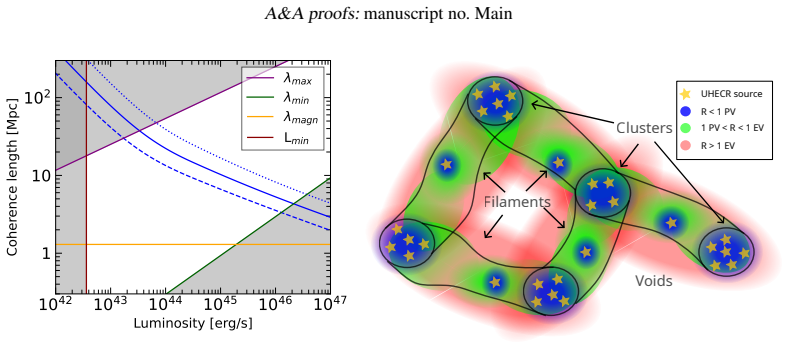
Extending the self-confinement scenario to a mixed nuclear composition in an effective leaky-box model that includes escape, photodisintegration, and secondary production shows that self-generated turbulence suppresses the escaping flux below the EV scale for source luminosities and magnetic-field coherence lengths compatible with UHECR sources in galaxy clusters propagating through cosmic filaments. During confinement, heavy nuclei efficiently photodisintegrate, producing secondary protons that contribute below the ankle and help account for the observed composition.
What carries the argument
Effective leaky-box model of the confinement region that incorporates escape, photodisintegration, secondary production, and turbulence generated by the non-resonant streaming instability.
Load-bearing premise
The non-resonant streaming instability dominates turbulence generation and sets the confinement time in the leaky-box model for the chosen source luminosities and coherence lengths.
What would settle it
Detection of an unsuppressed flux of heavy nuclei below the EV scale from cluster-hosted sources, or a cosmogenic neutrino flux exceeding the levels predicted for the extreme configurations, would falsify the suppression.
If this is right
- Escaping flux of UHECRs is suppressed below the EV scale for source parameters compatible with galaxy clusters and filaments.
- Heavy nuclei photodisintegrate during confinement, yielding secondary protons that contribute below the ankle.
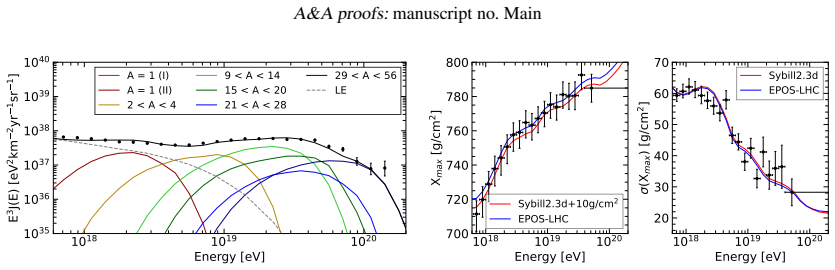
- The resulting spectrum and composition are compatible with Auger measurements.
- The predicted cosmogenic neutrino flux remains within current limits.
- The diffuse gamma-ray background constrains the most extreme source configurations.
Where Pith is reading between the lines
- The mechanism implies that viable UHECR sources must reside in environments whose magnetic coherence lengths allow the instability to operate before external turbulence takes over.
- Future high-statistics composition measurements below the ankle could directly test the predicted secondary-proton fraction.
- The same transport physics could be applied to lower-energy cosmic-ray populations escaping from other magnetized structures.
Editorial analysis
A structured set of objections, weighed in public.
Referee Report
Summary. The paper extends the self-confinement scenario for UHECRs to a mixed nuclear composition using a leaky-box model that incorporates escape, photodisintegration, and secondary production. It claims that turbulence generated by the non-resonant streaming instability can suppress the escaping flux below the EV scale for source luminosities and coherence lengths compatible with galaxy-cluster sources in cosmic filaments; during confinement, heavy nuclei photodisintegrate to produce secondary protons that contribute below the ankle. The resulting spectrum and composition are compared to Auger data, and associated cosmogenic neutrino and gamma-ray fluxes are computed, remaining compatible with limits except for extreme cases.
Significance. If the central assumption holds, the work supplies a transport-based mechanism that accounts for the hard low-rigidity spectrum and composition transition without requiring unusual source injection spectra. The inclusion of secondary protons from photodisintegration and the explicit computation of neutrino and gamma-ray backgrounds are concrete strengths that allow falsifiable tests against existing and future data.
major comments (3)
- [Abstract / leaky-box model] Abstract and model description: the suppression of flux below the EV scale is presented as an outcome of self-generated turbulence, yet it is obtained only after selecting source luminosities (~10^44 erg/s) and coherence lengths (~kpc) stated to be 'compatible' with the desired effect; no demonstration is given that the result is independent of these choices or that it survives variation within the plausible range.
- [Model / NRSI dominance] Instability section: the leaky-box confinement time is tied directly to the non-resonant streaming instability growth rate, but no quantitative comparison is supplied showing that this rate exceeds damping or external turbulence (filament shear, pre-existing cluster fields) for the adopted parameters; if resonant streaming or external turbulence instead sets the scattering rate, the suppression and secondary-proton contribution both disappear.
- [Results / Auger comparison] Comparison with Auger: the abstract states that the model 'reproduces' the observed spectrum and composition for plausible parameters, yet no quantitative fit metrics, error treatment, or sensitivity tests to the free parameters (luminosity, coherence length) are reported, preventing assessment of whether the agreement is robust or post-hoc.
minor comments (1)
- [Model description] Notation for the coherence length and source luminosity should be defined explicitly at first use with units.
Simulated Author's Rebuttal
We thank the referee for the constructive report recommending major revision. We agree that additional demonstrations of parameter robustness, instability comparisons, and quantitative fit metrics are required. We address each major comment below and will incorporate the necessary revisions.
read point-by-point responses
-
Referee: [Abstract / leaky-box model] Abstract and model description: the suppression of flux below the EV scale is presented as an outcome of self-generated turbulence, yet it is obtained only after selecting source luminosities (~10^44 erg/s) and coherence lengths (~kpc) stated to be 'compatible' with the desired effect; no demonstration is given that the result is independent of these choices or that it survives variation within the plausible range.
Authors: We acknowledge that the manuscript presents results for selected fiducial values without a systematic exploration. In the revised version we will add an appendix showing the escaping flux suppression as a function of luminosity (spanning 10^43–10^45 erg/s) and coherence length (0.1–10 kpc), using ranges drawn from cluster and filament observations. This will identify the portion of parameter space where the effect persists and quantify its sensitivity. revision: yes
-
Referee: [Model / NRSI dominance] Instability section: the leaky-box confinement time is tied directly to the non-resonant streaming instability growth rate, but no quantitative comparison is supplied showing that this rate exceeds damping or external turbulence (filament shear, pre-existing cluster fields) for the adopted parameters; if resonant streaming or external turbulence instead sets the scattering rate, the suppression and secondary-proton contribution both disappear.
Authors: The comment correctly identifies a missing justification. The revised manuscript will include explicit calculations comparing the NRSI growth rate to relevant damping rates (ion-neutral, nonlinear Landau) and to estimated levels of external turbulence or shear for the fiducial parameters, thereby clarifying the conditions under which NRSI dominance holds. revision: yes
-
Referee: [Results / Auger comparison] Comparison with Auger: the abstract states that the model 'reproduces' the observed spectrum and composition for plausible parameters, yet no quantitative fit metrics, error treatment, or sensitivity tests to the free parameters (luminosity, coherence length) are reported, preventing assessment of whether the agreement is robust or post-hoc.
Authors: We agree that quantitative assessment is necessary. The revision will report chi-squared (or equivalent) values for the spectrum and composition fits, incorporating Auger statistical and systematic uncertainties, and will include sensitivity plots varying luminosity and coherence length around the fiducial point to demonstrate robustness. revision: yes
Circularity Check
No significant circularity in the derivation chain
full rationale
The paper constructs an effective leaky-box transport model incorporating escape, photodisintegration, and secondary production under the assumption that non-resonant streaming instability generates the turbulence. It then evaluates the escaping flux, spectrum, and composition for source luminosities and coherence lengths described as compatible with cluster/filament environments, and compares the output to Auger data plus cosmogenic fluxes. This is a standard forward-model calculation whose outputs are not equivalent to the inputs by construction; the suppression below the EV scale emerges from solving the transport equations rather than from re-labeling a fitted parameter or from a self-citation that itself contains the target result. No self-definitional step, uniqueness theorem imported from the same authors, or ansatz smuggled via citation is exhibited in the abstract or described chain. The result is therefore self-contained against external benchmarks.
Axiom & Free-Parameter Ledger
free parameters (1)
- source luminosity and magnetic coherence length
axioms (2)
- domain assumption Non-resonant streaming instability sets the dominant turbulence level and confinement time.
- standard math Photodisintegration and secondary production occur on standard cosmic photon backgrounds during confinement.
read the original abstract
The spectrum and composition of ultra-high-energy cosmic rays (UHECRs) suggest that the population dominating above the ankle releases particles with an unusual hard spectrum at low rigidity, below the EV scale. In self-confinement scenarios, such an apparent hardening arises from transport: escaping UHECRs generate magnetic turbulence that delays their own release from the magnetized environments surrounding their sources. We extend the self-confinement scenario based on the non-resonant streaming instability to a mixed nuclear composition. We describe the confinement region with an effective leaky-box model including escape, photodisintegration, and secondary production. We then compare the resulting spectrum and composition with Auger measurements and compute the associated cosmogenic neutrino and gamma-ray emission. We find that self-generated turbulence can suppress the escaping flux below the EV scale for source luminosities and magnetic-field coherence lengths compatible with UHECR sources hosted in galaxy clusters and propagating through cosmic filaments. During confinement, heavy nuclei efficiently photodisintegrate, producing secondary protons that contribute below the ankle and help account for the observed composition. The predicted neutrino flux remains compatible with current limits, while the diffuse gamma-ray background provides a potentially strong constraint on the most extreme configurations.
Figures




Forward citations
Cited by 1 Pith paper
-
Cosmic ray heating of cold streams: Implications for the gas supply and growth of massive galaxies
Externally entrained cosmic-web CRs weakly heat dense cold-stream cores but can strongly heat diffuse and mixed interface gas in massive haloes, adding selectivity to cold accretion.
Reference graph
Works this paper leans on
-
[1]
Aartsen, M. G. et al. 2021, J. Phys. G, 48, 060501
work page 2021
- [2]
-
[3]
Ackermann, M., Ajello, M., Albert, A., et al. 2016, Phys. Rev. Lett., 116, 151105
work page 2016
- [4]
-
[5]
2025, Physical Review X, 15, 031016
Adriani, O., Aiello, S., Albert, A., et al. 2025, Physical Review X, 15, 031016
work page 2025
-
[6]
2025, Ideas and Requirements for the Global Cosmic-Ray Observatory (GCOS)
Ahlers, M., Allekotte, I., Alvarez-Muniz, J., et al. 2025, Ideas and Requirements for the Global Cosmic-Ray Observatory (GCOS)
work page 2025
-
[7]
Ajello, M. et al. 2015, Astrophys. J. Lett., 800, L27
work page 2015
- [8]
-
[9]
2013, Astroparticle Physics, 41, 94
Aloisio, R., Berezinsky, V ., & Grigorieva, S. 2013, Astroparticle Physics, 41, 94
work page 2013
-
[10]
Aloisio, R., Boncioli, D., di Matteo, A., et al. 2017, J. Cosmology Astropart. Phys., 2017, 009 Álvarez-Muñiz, J. et al. 2020, Sci. China Phys. Mech. Astron., 63, 219501
work page 2017
- [11]
-
[12]
Bell, A. R. 2004, MNRAS, 353, 550
work page 2004
-
[13]
Bell, A. R., Schure, K. M., Reville, B., & Giacinti, G. 2013, MNRAS, 431, 415
work page 2013
-
[14]
Berezinsky, V ., Gazizov, A., & Grigorieva, S. 2006, Phys. Rev. D, 74, 043005
work page 2006
- [15]
-
[16]
Berezinsky, V . S., Blasi, P., & Ptuskin, V . S. 1997, The Astrophysical Journal, 487, 529
work page 1997
- [17]
- [18]
- [19]
- [20]
-
[21]
Blasi, P., Epstein, R. I., & Olinto, A. V . 2000, ApJ, 533, L123 Böhringer, H., Chon, G., & Collins, C. A. 2014, A&A, 570, A31
work page 2000
- [22]
-
[23]
2024, arXiv e-prints, arXiv:2404.17402
Bondarenko, K., Boyarsky, A., Sokolenko, A., & V ovk, I. 2024, arXiv e-prints, arXiv:2404.17402
-
[24]
Carretti, E., O’Sullivan, S. P., Vacca, V ., et al. 2023, MNRAS, 518, 2273
work page 2023
- [25]
-
[26]
Castellina, A. & Pierre Auger Collaboration. 2019, in European Physical Journal Web of Conferences, V ol. 210, European Physical Journal Web of Confer- ences (EDP), 06002
work page 2019
-
[27]
Cermenati, A., Aloisio, R., Blasi, P., & Evoli, C. 2026, A&A, 707, A19
work page 2026
-
[28]
2025, arXiv e-prints, arXiv:2507.11993
Cermenati, A., Ambrosone, A., Aloisio, R., Boncioli, D., & Evoli, C. 2025, arXiv e-prints, arXiv:2507.11993
-
[29]
Chodorowski, M. J., Zdziarski, A. A., & Sikora, M. 1992, ApJ, 400, 181
work page 1992
-
[30]
Condorelli, A., Boncioli, D., Peretti, E., & Petrera, S. 2023, Phys. Rev. D, 107, 083009
work page 2023
-
[31]
Ensslin, T. A., Biermann, P. L., Kronberg, P. P., & Wu, X.-P. 1997, ApJ, 477, 560
work page 1997
-
[32]
2026, Astroparticle Physics, 179, 103239
Evoli, C., Vaiman, I., Petrera, S., & Salamida, F. 2026, Astroparticle Physics, 179, 103239
work page 2026
-
[33]
& The Pierre Auger Collaboration
Fitoussi, T. & The Pierre Auger Collaboration. 2023, in Proceedings of 38th International Cosmic Ray Conference — PoS(ICRC2023), V ol. 444, 319
work page 2023
-
[34]
Fotopoulou, S., Buchner, J., Georgantopoulos, I., et al. 2016, A&A, 587, A142
work page 2016
-
[35]
Gilmore, R. C., Somerville, R. S., Primack, J. R., & Domínguez, A. 2012, MN- RAS, 422, 3189
work page 2012
-
[36]
Jiang, Y ., Zhang, B. T., & Murase, K. 2021, Phys. Rev. D, 104, 043017
work page 2021
-
[37]
Kelner, S. R. & Aharonian, F. A. 2008, Phys. Rev. D, 78, 034013
work page 2008
-
[38]
Lacy, M., Ridgway, S. E., Sajina, A., et al. 2015, ApJ, 802, 102
work page 2015
- [39]
-
[40]
Lisanti, M., Mishra-Sharma, S., Necib, L., & Safdi, B. R. 2016, ApJ, 832, 117
work page 2016
-
[41]
Mollerach, S. & Roulet, E. 2013, J. Cosmology Astropart. Phys., 2013, 013
work page 2013
-
[42]
Muzio, M. S., Farrar, G. R., & Unger, M. 2022, Phys. Rev. D, 105, 023022
work page 2022
-
[43]
Muzio, M. S., Unger, M., & Farrar, G. R. 2019, Phys. Rev. D, 100, 103008
work page 2019
-
[44]
& The Pierre Auger Collaboration
Niechciol, M. & The Pierre Auger Collaboration. 2023, in Proceedings of 38th International Cosmic Ray Conference — PoS(ICRC2023), V ol. 444, 1488 O’Sullivan, S. P., Brüggen, M., Vazza, F., et al. 2020, MNRAS, 495, 2607
work page 2023
-
[45]
Pierog, T., Karpenko, I., Katzy, J. M., Yatsenko, E., & Werner, K. 2015, Phys. Rev. C, 92, 034906 Planck Collaboration, Ade, P. A. R., Aghanim, N., et al. 2016, A&A, 594, A13
work page 2015
- [46]
-
[47]
Riehn, F., Engel, R., Fedynitch, A., Gaisser, T. K., & Stanev, T. 2020, Phys. Rev. D, 102, 063002
work page 2020
-
[48]
Rodighiero, G., Vaccari, M., Franceschini, A., et al. 2010, A&A, 515, A8
work page 2010
- [49]
-
[50]
Sironi, L., Keshet, U., & Lemoine, M. 2015, Space Sci. Rev., 191, 519 The Pierre Auger Collaboration. 2014a, Phys. Rev. D, 90, 122005 The Pierre Auger Collaboration. 2014b, Phys. Rev. D, 90, 122006 The Pierre Auger Collaboration. 2017, J. Cosmology Astropart. Phys., 2017, 038 The Pierre Auger Collaboration. 2020, Phys. Rev. D, 102, 062005 The Pierre Auger...
work page 2015
-
[51]
Unger, M., Farrar, G. R., & Anchordoqui, L. A. 2015, Phys. Rev. D, 92, 123001
work page 2015
- [52]
-
[53]
R., Han, Q., Inoue, Y ., & Luo, L
Wu, K., Owen, E. R., Han, Q., Inoue, Y ., & Luo, L. 2024, Universe, 10
work page 2024
-
[54]
2024, MNRAS, 533, 1048 Article number, page 11 A&A proofs:manuscript no
Zhang, Y ., Guo, H., Yang, X., & Wang, P. 2024, MNRAS, 533, 1048 Article number, page 11 A&A proofs:manuscript no. Main Appendix A: Advection/Diffusion equation and Leaky Box We model particle transport within a flux tube of sizeλ B, un- der the effects of advection and diffusion. In our picture, parti- cles are emitted at the origin of the flux tube and ...
work page 2024
discussion (0)
Sign in with ORCID, Apple, or X to comment. Anyone can read and Pith papers without signing in.