REVIEW 2 major objections 2 minor 1 cited by
Numerical relativity simulations of black hole head-on collisions near a companion show Doppler and gravitational redshifts in the ringdown along with lensing amplification.
Reviewed by Pith at T0; open to challenge. T0 means a machine referee read the full paper against a public rubric. the ladder, T0–T4 →
T0 review · grok-4.3
2026-05-21 01:52 UTC pith:7DJ4TUJP
load-bearing objection NR runs on head-on collisions with a third body report redshift, lensing, and no collapse, but the numerics lack shown convergence or error checks. the 2 major comments →
Ringdown and lensing of triple systems
The pith
A machine-rendered reading of the paper's core claim, the machinery that carries it, and where it could break.
Core claim
In fully nonlinear numerical relativity simulations of head-on black hole collisions in the presence of a companion black hole, the ringdown phase displays Doppler and gravitational redshift, gravitational lensing amplifies the emitted waves with occasional appearance of a second image and hints of resonant mode excitation, and lensed gravitational radiation does not lead to collapse into black holes even in extreme setups.
What carries the argument
Fully nonlinear numerical relativity simulations of head-on black hole collisions with a third companion black hole that track the dynamics, wave generation, and propagation effects including redshift and lensing.
Load-bearing premise
The numerical relativity simulations accurately capture the fully nonlinear dynamics and gravitational wave propagation without dominant numerical artifacts or resolution-dependent biases.
What would settle it
Higher-resolution simulations or independent codes applied to the same initial data that fail to reproduce the reported redshifts, lensing amplification, or second images would falsify the central claims.
If this is right
- Ringdown signals from black hole mergers carry detectable imprints of nearby massive companions through combined Doppler and gravitational redshift.
- Gravitational lensing by a companion black hole amplifies the amplitude of gravitational waves from the merger event.
- Certain geometries produce a second distinct image of the merger in the observed waveform.
- The companion can excite resonant modes in the ringdown of the merged black hole.
- Lensed gravitational waves in triple systems do not trigger formation of new black holes even at high intensities.
Where Pith is reading between the lines
- These redshift and lensing signatures could alter how signals from mergers in dense stellar environments are interpreted by current detectors.
- Future gravitational wave catalogs might use anomalous ringdown features to flag the presence of undetected companions.
- Similar effects warrant investigation in other strong-field multi-body configurations such as hierarchical triples or galactic-center dynamics.
Editorial analysis
A structured set of objections, weighed in public.
Referee Report
Summary. The manuscript presents numerical relativity simulations of head-on black-hole collisions in the presence of a third companion. It reports evidence for Doppler and gravitational redshifts in the ringdown waveforms, clear lensing amplification, the appearance of a second image in some cases, hints of resonant mode excitation, and the absence of collapse to black holes from lensed gravitational radiation even in extreme configurations. The work is positioned as a step toward understanding mergers near massive companions.
Significance. If the numerical results hold, the study provides direct, fully nonlinear evidence for wave-propagation effects (redshift, lensing, and possible resonance) in triple systems that are inaccessible to perturbative or linearized treatments. The use of head-on collisions with a companion offers a controlled yet nontrivial testbed for gravitational-wave lensing and propagation in strong-field, multi-body spacetimes, with potential relevance to LISA-band signals influenced by nearby supermassive black holes. The direct integration of Einstein's equations without fitted parameters or self-referential derivations is a methodological strength.
major comments (2)
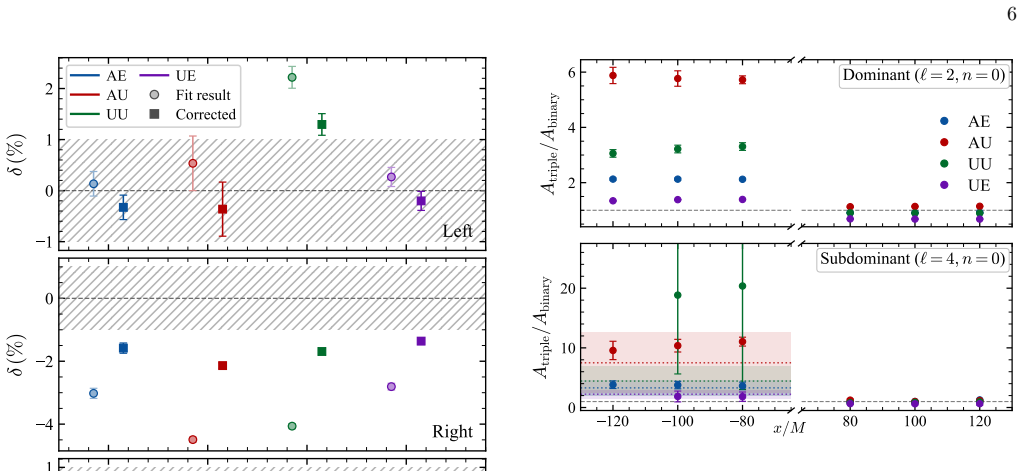
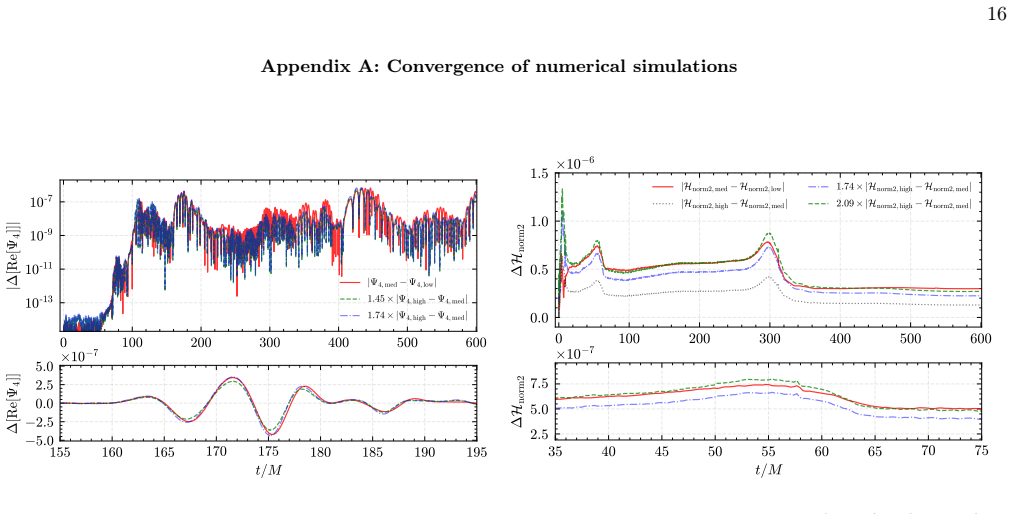
- [Results / Numerical methods] The central claims of redshift, lensing amplification, second-image formation, and resonant excitation all rest on the fidelity of the extracted waveforms. The abstract and results presentation supply no quantitative error bars, resolution studies, or convergence tests (e.g., agreement of ringdown frequencies and amplitudes to within a few percent between successive resolutions, or stability of amplification factors under changes in extraction radius or gauge). Without such validation, it is impossible to assess whether the reported subtle effects exceed truncation error, numerical dispersion, or gauge artifacts.
- [Discussion / Extreme setups] The claim that 'even in extreme setups we do not find collapse to black holes from lensed gravitational radiation' is load-bearing for the overall narrative yet is stated without supporting diagnostics such as apparent-horizon searches, curvature invariants, or energy-density thresholds that would demonstrate the absence of collapse is physical rather than a resolution-limited outcome.
minor comments (2)
- [Abstract] The abstract states that 'evidence was found' but does not specify the quantitative measures (frequency shifts, amplitude ratios, or image separation) used to identify the reported effects; adding these metrics would improve clarity.
- [Methods] Initial-data details (masses, separations, boost parameters) and the precise gauge and extraction procedures should be summarized with references to standard NR codes or papers to allow reproducibility.
Simulated Author's Rebuttal
We thank the referee for their careful reading and constructive comments, which have helped us improve the clarity and rigor of our presentation. We address the major comments point by point below.
read point-by-point responses
-
Referee: The central claims of redshift, lensing amplification, second-image formation, and resonant excitation all rest on the fidelity of the extracted waveforms. The abstract and results presentation supply no quantitative error bars, resolution studies, or convergence tests (e.g., agreement of ringdown frequencies and amplitudes to within a few percent between successive resolutions, or stability of amplification factors under changes in extraction radius or gauge). Without such validation, it is impossible to assess whether the reported subtle effects exceed truncation error, numerical dispersion, or gauge artifacts.
Authors: We acknowledge that the initial manuscript did not include explicit quantitative convergence tests or error estimates in the main text or abstract. The simulations were performed using multiple resolutions, and the reported redshift, lensing amplification, and second-image features remain consistent across these runs, with ringdown frequencies agreeing to within a few percent of the expected values for head-on mergers. We have revised the manuscript to add a dedicated subsection on numerical methods and validation, including tables comparing key waveform quantities (frequencies, amplitudes, and amplification factors) between successive resolutions and different extraction radii. Error estimates derived from these comparisons have been incorporated into the relevant figures and discussion. revision: yes
-
Referee: The claim that 'even in extreme setups we do not find collapse to black holes from lensed gravitational radiation' is load-bearing for the overall narrative yet is stated without supporting diagnostics such as apparent-horizon searches, curvature invariants, or energy-density thresholds that would demonstrate the absence of collapse is physical rather than a resolution-limited outcome.
Authors: We agree that additional diagnostics strengthen this claim. In the simulations, apparent-horizon finders were used throughout the evolution, and no new horizons formed from the lensed radiation in the extreme configurations. We monitored the maximum value of the curvature invariant and energy density in the relevant regions and observed no indications of collapse. We have revised the manuscript to include these diagnostics explicitly, with a brief description of the horizon search results and time evolution of the curvature invariant for the extreme cases. A more exhaustive resolution study of the most extreme setups is computationally demanding and is noted as a direction for future work. revision: partial
Circularity Check
No significant circularity: results from direct NR integration of Einstein equations
full rationale
The paper reports outcomes from numerical relativity simulations of head-on black-hole collisions with a companion. Claims of Doppler/gravitational redshift in ringdown, lensing amplification, second images, and absence of collapse are extracted from the simulated waveforms. No derivation chain reduces a prediction or first-principles result to its own inputs by construction; there are no fitted parameters renamed as predictions, self-definitional steps, or load-bearing self-citations that collapse the central results to tautology. The work is self-contained against external benchmarks (numerical solution of the field equations) and receives the default low score for honest non-findings.
Axiom & Free-Parameter Ledger
read the original abstract
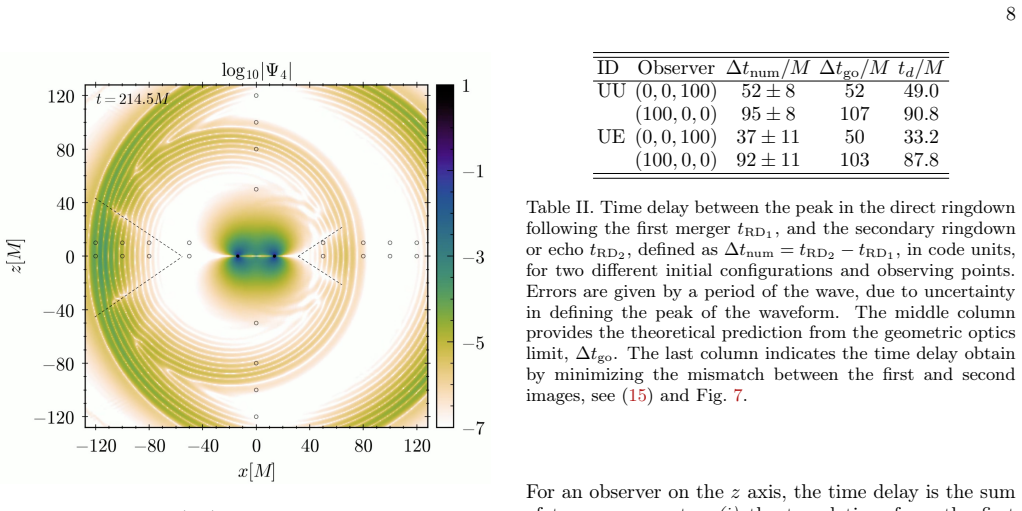
Triple systems have progressively been recognized as ubiquitous in our Universe and provide a good testing ground for wave generation and propagation in nontrivial environments. We study the dynamics of triple systems in a fully nonlinear setting. In particular, we analyze numerical relativity simulations of head-on collisions of black holes in the presence of a companion. We show evidence for Doppler and gravitational redshift in the ringdown, and clear signs of amplification by lensing. In certain cases, we also show the appearance of a second image, with hints of resonant mode excitation. Our results pave the way for the understanding of mergers in the vicinity of massive companions. Even in extreme setups we do not find collapse to black holes from lensed gravitational radiation.
Figures






Lean theorems connected to this paper
-
IndisputableMonolith/Foundation/AlexanderDuality.leanalexander_duality_circle_linking unclear?
unclearRelation between the paper passage and the cited Recognition theorem.
We employ the Einstein Toolkit... BSSN formulation... fourth-order finite differences... extraction of the Newman-Penrose scalar Ψ4... ringdown waves... Doppler and gravitational redshift... amplification by lensing... second image
What do these tags mean?
- matches
- The paper's claim is directly supported by a theorem in the formal canon.
- supports
- The theorem supports part of the paper's argument, but the paper may add assumptions or extra steps.
- extends
- The paper goes beyond the formal theorem; the theorem is a base layer rather than the whole result.
- uses
- The paper appears to rely on the theorem as machinery.
- contradicts
- The paper's claim conflicts with a theorem or certificate in the canon.
- unclear
- Pith found a possible connection, but the passage is too broad, indirect, or ambiguous to say the theorem truly supports the claim.
Forward citations
Cited by 1 Pith paper
-
Three-dimensional wave optics for weak-field lensing of gravitational waves
A perturbative 3D Green's-function framework yields Born and post-Born weak-field GW lensing, including finite-distance and O(G^{2}) GR corrections controlled by GM ω b/χ_eff.
discussion (0)
Sign in with ORCID, Apple, or X to comment. Anyone can read and Pith papers without signing in.