Forced Gap Post-Selection for Quantum LDPC Codes and their Operations
Pith reviewed 2026-06-30 17:59 UTC · model grok-4.3
The pith
A post-selection strategy that re-runs the decoder with forced complementary logical outcomes reduces logical error rates by more than a factor of four for quantum LDPC codes at fixed post-selection rate.
A machine-rendered reading of the paper's core claim, the machinery that carries it, and where it could break.
Core claim
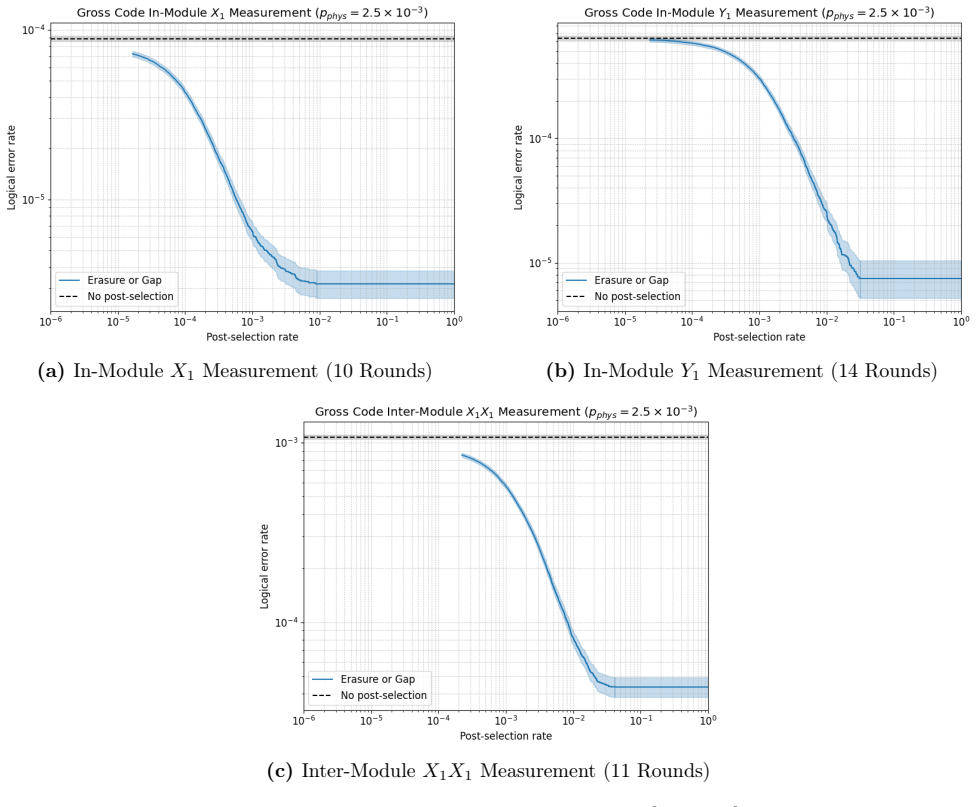
After an initial baseline decoder run, re-running once per logical observable while forcing the complementary outcome, then rejecting shots whose baseline and forced solutions have similar likelihoods, produces an improved logical error rate by over a factor of 4 on the same circuit and physical error rate at the same post-selection fraction, using only the Relay-BP decoder on bivariate bicycle codes and their surgery gadgets.
What carries the argument
The forced-gap post-selection procedure, which identifies and discards ambiguous logical outcomes by comparing likelihood scores from a baseline decoder run against forced-complementary runs.
If this is right
- The strategy remains effective when paired with a lightweight, FPGA-friendly belief-propagation decoder rather than repeated high-latency BP-OSD rounds.
- The same procedure applies directly to surgery gadgets used for logical operations on the 144-qubit code.
- Because the method only requires re-running the decoder a fixed number of times per shot, the post-selection overhead stays constant while the logical error rate drops.
Where Pith is reading between the lines
- The technique could be combined with other low-latency decoders to further reduce the resources needed for near-term fault-tolerant demonstrations.
- If the likelihood-comparison rule generalizes without bias, it may become a standard lightweight post-selection layer for any decoder that returns soft information.
- Testing the same forced-gap rule on other families of quantum LDPC codes would reveal whether the factor-of-four gain is specific to bivariate bicycle codes.
Load-bearing premise
Likelihood scores produced by the decoder on forced-complementary runs can be directly compared with the baseline score to identify ambiguous shots without introducing bias into the measured logical error rate.
What would settle it
A direct comparison, on the 72-qubit bivariate bicycle code under the same physical error model, showing that the logical error rate after forced-gap post-selection is no better than the rate obtained by the previously best post-selection method at identical post-selection fraction would falsify the central performance claim.
Figures


read the original abstract
We develop a simple and general post-selection strategy for high-rate quantum codes that is transferrable across decoders. After an initial baseline run, the decoder is re-run once per logical observable, and forced in these latter runs to provide a solution where the given observable has the complementary outcome. Shots are rejected that find logically complementary solutions with similar likelihoods compared to the baseline. Using the Relay-BP decoder, we benchmark the strategy on the $72$-qubit and $144$-qubit bivariate bicycle codes, as well as surgery gadgets for the latter. In comparison to previous post-selection strategies, our results offer an improved logical error rate by over a factor of $4$ on the same circuit and physical error rate, and at the same rate of post-selection. Our strategies are also lightweight, relying only on FPGA-friendly belief propagation, whereas the previous best used repeated rounds of a high-latency BP-OSD decoder.
Editorial analysis
A structured set of objections, weighed in public.
Referee Report
Summary. The paper proposes a forced-gap post-selection strategy for quantum LDPC codes: after a baseline Relay-BP decoder run, the decoder is re-run once per logical observable with the outcome forced to the complementary value; shots are rejected when the likelihood of the forced complementary solution is comparable to the baseline. Benchmarks on the 72-qubit and 144-qubit bivariate bicycle codes (and surgery gadgets on the latter) report more than 4× lower logical error rate than prior post-selection methods at identical post-selection rate and physical error rate, while remaining decoder-lightweight.
Significance. If the numerical claims are robust, the method supplies a practical, FPGA-friendly post-selection technique that improves logical performance on high-rate LDPC codes without repeated high-latency BP-OSD rounds. The explicit comparison at fixed post-selection rate and the transferability claim across decoders are the main contributions.
major comments (2)
- [Method / post-selection algorithm] Method section (description of forced complementary runs and likelihood comparison): the central >4× claim rests on the assumption that likelihood scores produced by the same Relay-BP decoder remain commensurable between the unconstrained baseline run and the forced-complementary runs. No explicit test or argument is supplied showing that the forcing operation does not systematically shift the likelihood distribution in a manner correlated with logical errors; if such a shift exists, the rejection rule could enrich the accepted set for shots whose decoder output happens to match the true logical value, inflating the reported improvement. A concrete diagnostic (e.g., likelihood histograms conditioned on known errors or a synthetic test with known ground truth) is required to support the claim.
- [Numerical results / tables] Results section (benchmark tables/figures for 72- and 144-qubit codes): the reported factor-of-4 improvement is presented without error bars, without the precise numerical rejection threshold used, and without a statement of the number of Monte-Carlo shots or data-exclusion criteria. Because the improvement is the load-bearing quantitative result, these omissions prevent assessment of whether the observed difference is statistically significant or sensitive to the precise threshold choice.
minor comments (2)
- [Abstract / experimental setup] The abstract states the improvement occurs “on the same circuit and physical error rate,” yet the manuscript does not explicitly list the circuit depth or the precise depolarizing error model parameters used for the surgery-gadget experiments; adding a short table or paragraph would improve reproducibility.
- [Method] Notation for the “forced gap” quantity and the likelihood ratio used for rejection is introduced without an equation number; assigning an equation label would aid cross-reference.
Simulated Author's Rebuttal
We thank the referee for the constructive feedback. The two major comments identify genuine gaps in justification and reporting that we will address in revision. We provide point-by-point responses below.
read point-by-point responses
-
Referee: [Method / post-selection algorithm] Method section (description of forced complementary runs and likelihood comparison): the central >4× claim rests on the assumption that likelihood scores produced by the same Relay-BP decoder remain commensurable between the unconstrained baseline run and the forced-complementary runs. No explicit test or argument is supplied showing that the forcing operation does not systematically shift the likelihood distribution in a manner correlated with logical errors; if such a shift exists, the rejection rule could enrich the accepted set for shots whose decoder output happens to match the true logical value, inflating the reported improvement. A concrete diagnostic (e.g., likelihood histograms conditioned on known errors or a synthetic test with known ground truth) is required to support the claim.
Authors: We agree that an explicit check on likelihood commensurability is needed. The forcing step changes only the target observable while leaving the BP message-passing rules unchanged; nevertheless, we will add to the revised Methods and Results sections a diagnostic subsection containing (i) likelihood histograms for baseline versus forced runs conditioned on known logical errors from the Monte-Carlo ensemble and (ii) a synthetic test in which the true error pattern is fixed and the decoder is run with both correct and incorrect forced observables. These plots will quantify any systematic shift and confirm that the rejection threshold does not preferentially retain shots whose decoder output matches the true logical value. revision: yes
-
Referee: [Numerical results / tables] Results section (benchmark tables/figures for 72- and 144-qubit codes): the reported factor-of-4 improvement is presented without error bars, without the precise numerical rejection threshold used, and without a statement of the number of Monte-Carlo shots or data-exclusion criteria. Because the improvement is the load-bearing quantitative result, these omissions prevent assessment of whether the observed difference is statistically significant or sensitive to the precise threshold choice.
Authors: We will revise the Results section and all associated tables/figures to include: binomial or bootstrap error bars on every logical-error-rate point; the exact numerical value of the likelihood-ratio rejection threshold employed; the total number of Monte-Carlo shots generated for each code and noise model; and a clear statement of any data-exclusion criteria (e.g., shots discarded because the decoder failed to converge within the iteration limit). These additions will allow direct evaluation of statistical significance and threshold sensitivity. revision: yes
Circularity Check
No circularity: central results are numerical benchmarks on explicit circuits, not derivations reducing to inputs.
full rationale
The paper presents a post-selection strategy and reports empirical improvements (factor of >4 in logical error rate at fixed post-selection rate) from Monte Carlo simulations on 72- and 144-qubit bivariate bicycle codes using the Relay-BP decoder. No load-bearing derivation, uniqueness theorem, ansatz, or fitted parameter is invoked whose output is then relabeled as a prediction. The strategy is defined directly in terms of decoder likelihoods on forced complementary runs, with acceptance/rejection rules stated explicitly; these rules do not reduce to self-definition or self-citation. Self-citations, if present, are not load-bearing for the reported performance numbers. The work is therefore self-contained against external simulation benchmarks.
Axiom & Free-Parameter Ledger
Forward citations
Cited by 3 Pith papers
-
Concatenating Algebraic Codes over High-Rate Quantum LDPC Codes
Concatenating quantum Reed-Solomon outer codes over the gross code using Galois qudits reaches teraquop regime at 10^{-3} physical noise with lower overhead than prior two-gross-code constructions.
-
Concatenating Algebraic Codes over High-Rate Quantum LDPC Codes
Concatenating quantum Reed-Solomon codes over the gross code via Galois qudits reaches teraquop regime at uniform 10^{-3} noise with reduced overhead.
-
Neural network decoder confidence as a learned proxy for the logical gap
GNN decoder logit outperforms MWPM logical gap for post-selection, yielding lower logical error rates on surface code syndromes under circuit-level noise.
Reference graph
Works this paper leans on
-
[1]
‘Quantum low-density parity-check codes’
[BE21] Nikolas P Breuckmann and Jens Niklas Eberhardt. ‘Quantum low-density parity-check codes’. In:PRX quantum2.4 (2021), p. 040101 (cit. on p. 1). [Ben76] Charles H Bennett. ‘Efficient estimation of free energy differences from Monte Carlo data’. In:Journal of Computational Physics22.2 (1976), pp. 245–268 (cit. on p. 7). [Bev+25] Michael E Beverland, Ma...
-
[2]
IEEE. 2009, pp. 428– 432 (cit. on p. 7). [Xie+26] Haipeng Xie, Nobuyuki Yoshioka, Kento Tsubouchi and Ying Li. ‘Simple, Efficient, and Generic Post-Selection Decoding for qLDPC codes’. In:arXiv preprint arXiv:2601.17757 (2026) (cit. on pp. 1, 5–7). [Xu+26] Shifan Xu, Kun Liu, Patrick Rall, Zhiyang He and Yongshan Ding. ‘Distilling magic states in the bicy...
-
[3]
Tour de gross: A modular quantum computer based on bivariate bicycle codes
arXiv:2506.03094 [quant-ph] (cit. on pp. 1, 4–6, 10). [Zha+26] Chen Zhao, Casey Duckering, Andi Gu, Nishad Maskara and Hengyun Zhou. ‘Towards Ultra-High-Rate Quantum Error Correction with Reconfigurable Atom Arrays’. In:arXiv preprint arXiv:2604.16209(2026) (cit. on p. 10). A Parameter Choices for the Relay-BP Decoder The Relay-BP decoder [Mül+25] is a re...
work page internal anchor Pith review Pith/arXiv arXiv 2026
discussion (0)
Sign in with ORCID, Apple, or X to comment. Anyone can read and Pith papers without signing in.