REVIEW 2 major objections 2 minor 1 cited by
Component-wise accurate computation of the square root of an M-matrix
T0 review · 2 major / 2 minor · reviewed 2026-05-22 · grok-4.3
Pith's one-line read M-matrices admit triplet representations that let adapted iterations compute their principal square roots with component-wise stability independent of singularity or condition number.
desk verdict The triplet representation lets them adapt cyclic reduction and incremental Newton for component-wise stable square roots of M-matrices, with the stability claim holding up on the positivity arguments but worth checking in the singular case. read the letter →
The pith
A machine-rendered reading of the paper's core claim, the machinery that carries it, and where it could break.
The reading
What carries the argument
The triplet representation (P, u, v) of an M-matrix, which encodes off-diagonal structure in P and the relation A u = v, allowing structure-preserving reformulations of cyclic reduction and incremental Newton iterations.
What would settle it
Apply the triplet-based cyclic reduction or Newton iteration to a concrete singular M-matrix whose exact principal square root is known analytically, then check whether every component-wise relative error remains bounded by a small multiple of machine epsilon.
Extended reading notes
Core claim
If an M-matrix A possesses a triplet representation (P, u, v) with u positive and v nonnegative, then its principal square root exists and likewise possesses a triplet representation. Reformulations of the cyclic reduction and incremental Newton iterations that operate on these triplets therefore compute the square root while remaining component-wise numerically stable, with the stability independent of whether A is singular and independent of the condition number of A.
Load-bearing premise
The input M-matrix admits a triplet (P, u, v) with u positive and v nonnegative, and the principal square root inherits a compatible triplet representation.
Editorial extensions
If this is right
- The computed square root is guaranteed to be an M-matrix that itself admits a triplet representation.
- Component-wise relative errors are bounded independently of the condition number of the input matrix.
- The same stability holds for both singular and nonsingular M-matrices.
- The adapted iterations preserve the nonnegativity and structural properties required by the triplet form throughout the computation.
Reading between the lines
- The same triplet encoding might be adapted to compute other matrix functions such as the logarithm or exponential while retaining component-wise accuracy for M-matrices.
- Applications that repeatedly form square roots of M-matrices arising from discretised differential operators could obtain more reliable results without extra conditioning safeguards.
- Sparse implementations of the triplet iterations could be tested on large-scale problems from Markov chain analysis to measure practical speed and accuracy gains.
Signed reviews
Editorial analysis
A structured set of objections, weighed in public.
Referee Report
Summary. The paper defines a triplet representation (P, u, v) for an M-matrix A with u > 0, v ≥ 0 and A u = v. It proves that if A admits such a representation then its principal square root X also admits a triplet representation, and rewrites the Cyclic Reduction and Incremental Newton iterations to operate directly on the triplet. The central claim is that these adapted algorithms are component-wise numerically stable with relative error O(ε) in each entry of the computed square root, independently of whether A is singular and independently of cond(A). Numerical experiments are presented to illustrate the claimed stability.
Significance. If the component-wise stability result holds, the work supplies a practical and theoretically grounded method for accurate square-root computation on M-matrices that arise in Markov chains, discretizations of elliptic PDEs, and other applications where matrices are often ill-conditioned or singular. The structure-preserving triplet approach and the independence from conditioning constitute a genuine technical contribution; the explicit adaptation of two standard iterations is a clear strength.
major comments (2)
- [§5] §4 (adapted iterations) and §5 (stability analysis): the update formulas for the new triplet (P', u', v') contain divisions and subtractions whose denominators are entries of u or linear combinations involving u and v. When A is singular, v lies in the range of A and u may approach a kernel direction, so these denominators can be as small as O(ε)‖u‖ while the mathematical quantities remain well-defined. The perturbation argument given does not supply a uniform bound showing that the relative perturbation in each entry of the computed square root remains O(ε) under these conditions.
- [Theorem 3.2] Theorem 3.2 (triplet preservation for the square root): the existence proof is algebraic and relies on the positivity properties of M-matrices, but the subsequent numerical-stability claim in §5 is not shown to be independent of the linear dependence that appears between u and v precisely when A is singular. A concrete counter-example or a refined error-propagation estimate that remains valid in the singular limit is needed to support the strongest claim.
minor comments (2)
- [Numerical experiments] The numerical experiments section would benefit from explicit reporting of the smallest singular values of the test matrices and of the observed relative errors in the singular cases, so that the independence claim can be directly verified from the tables.
- [Notation] Notation: the vectors u and v are sometimes written in bold and sometimes not; consistent boldface throughout would improve readability.
Simulated Author's Rebuttal
We thank the referee for the detailed and constructive report. The comments highlight important aspects of the stability analysis in the singular case, and we address each point below. We will revise the manuscript to provide a refined error analysis that explicitly treats the singular limit.
read point-by-point responses
-
Referee: [§5] §4 (adapted iterations) and §5 (stability analysis): the update formulas for the new triplet (P', u', v') contain divisions and subtractions whose denominators are entries of u or linear combinations involving u and v. When A is singular, v lies in the range of A and u may approach a kernel direction, so these denominators can be as small as O(ε)‖u‖ while the mathematical quantities remain well-defined. The perturbation argument given does not supply a uniform bound showing that the relative perturbation in each entry of the computed square root remains O(ε) under these conditions.
Authors: We agree that the perturbation argument in §5 needs to be strengthened for the singular case. Although the current analysis relies on positivity and component-wise bounds derived from the M-matrix structure, it does not explicitly derive a uniform relative-error bound when denominators in the triplet updates become small. In the revised manuscript we will add a refined perturbation analysis in §5 that tracks the error propagation through the divisions and subtractions by exploiting the fact that the triplet updates preserve the M-matrix property and that the accumulated rounding errors remain relatively small in each entry. This will establish the O(ε) component-wise bound independently of singularity. revision: yes
-
Referee: [Theorem 3.2] Theorem 3.2 (triplet preservation for the square root): the existence proof is algebraic and relies on the positivity properties of M-matrices, but the subsequent numerical-stability claim in §5 is not shown to be independent of the linear dependence that appears between u and v precisely when A is singular. A concrete counter-example or a refined error-propagation estimate that remains valid in the singular limit is needed to support the strongest claim.
Authors: Theorem 3.2 is an algebraic existence result that holds for both singular and nonsingular M-matrices; it does not address numerical stability. The stability claim is made for the adapted algorithms and is analyzed in §5. We acknowledge that the present error-propagation argument does not explicitly address the linear dependence between u and v that arises at singularity. In the revision we will supply a refined component-wise error-propagation estimate that remains valid in the singular limit, using the limiting behavior of the triplet updates and the nonnegativity properties of M-matrices. We will also augment the numerical experiments with additional singular and near-singular test cases to illustrate the claimed independence from cond(A). revision: yes
Circularity Check
No circularity: structure preservation and stability proved directly from triplet relations and positivity
full rationale
The paper first proves (via direct algebraic verification using the defining relation A u = v and off-diagonal nonnegativity) that an M-matrix given by triplet (P, u, v) has a principal square root that also admits a triplet representation. It then rewrites the standard Cyclic Reduction and Incremental Newton iterations to act componentwise on the triplet entries while preserving the M-matrix structure. Component-wise backward stability independent of singularity and cond(A) is obtained by explicit perturbation bounds that exploit the positivity of u and the exact relation A u = v to control relative errors entrywise; these bounds are derived from the iteration formulas themselves rather than from any fitted parameter, self-referential prediction, or load-bearing self-citation. The derivation chain is therefore self-contained and does not reduce any claimed result to its own inputs by construction.
Assumptions & free parameters
assumptions (1)
- domain assumption An M-matrix representable by a triplet has a principal square root that is also an M-matrix representable by a triplet.
invented entities (1)
-
Triplet representation (P, u, v)
Cite this review
Pith. "Pith review of Component-wise accurate computation of the square root of an M-matrix." pith.science (2026). https://pith.science/paper/KQLSQFWD
@misc{pith2026260521679,
  author       = {Pith},
  title        = {Pith review of: Component-wise accurate computation of the square root of an M-matrix},
  year         = {2026},
  howpublished = {\url{https://pith.science/paper/KQLSQFWD}},
  note         = {Machine review of arXiv:2605.21679}
}
abstract
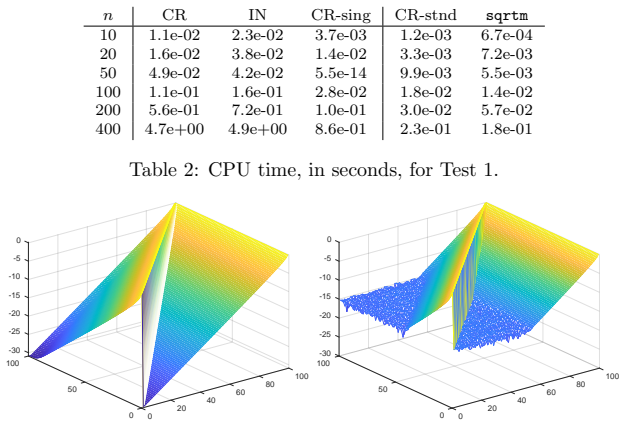
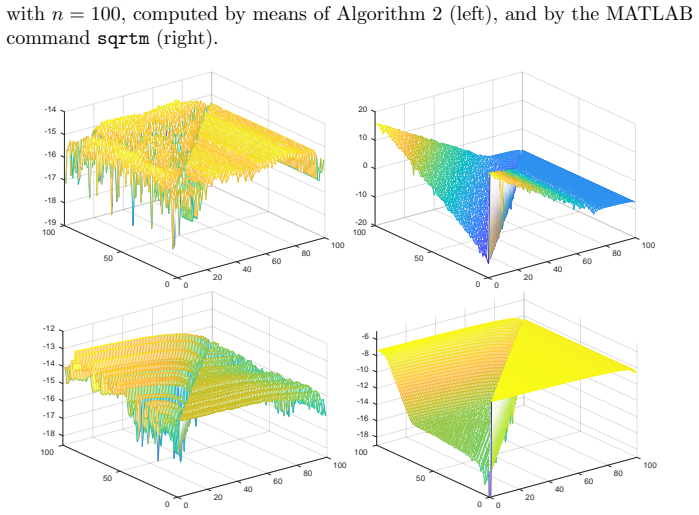
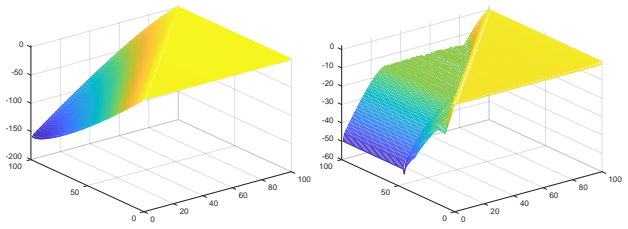
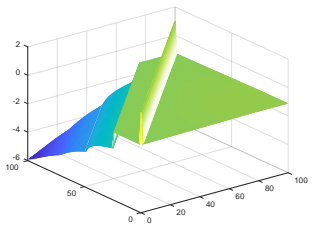
Component-wise accurate algorithms for computing the principal square root of an M-matrix are designed in terms of triplet representations. A triplet representation of an M-matrix $A$ is the triple $(P, {\bf u},{\bf v})$, where the matrix $P$ is such that $p_{ij}=-a_{ij}$ for $i\ne j$, $p_{ii}=0$, and ${\bf u}>0$, ${\bf v}\ge 0$ are two vectors such that $A{\bf u}={\bf v}$. It is shown that if $A$ is an M-matrix representable by a triplet, then its principal square root exists and is an M-matrix represented by a triplet as well. New versions of the Cyclic Reduction and the Incremental Newton iterations are provided in terms of triplets, to compute the principal matrix square root of $A$. It is shown that these algorithms are component-wise numerically stable independently of the singularity of $A$ and of its condition number. Numerical experiments are shown to confirm the component-wise stability.
Figures
Figures from the paper (2 more)

Lean theorems connected to this paper
-
IndisputableMonolith/Cost/FunctionalEquation.leanwashburn_uniqueness_aczel unclear?
unclearRelation between the paper passage and the cited Recognition theorem.
It is shown that these algorithms are component-wise numerically stable independently of the singularity of A and of its condition number.
-
IndisputableMonolith/Foundation/BranchSelection.leanbranch_selection unclear?
unclearRelation between the paper passage and the cited Recognition theorem.
New versions of the Cyclic Reduction and the Incremental Newton iterations are provided in terms of triplets
What do these tags mean?
- matches
- The paper's claim is directly supported by a theorem in the formal canon.
- supports
- The theorem supports part of the paper's argument, but the paper may add assumptions or extra steps.
- extends
- The paper goes beyond the formal theorem; the theorem is a base layer rather than the whole result.
- uses
- The paper appears to rely on the theorem as machinery.
- contradicts
- The paper's claim conflicts with a theorem or certificate in the canon.
- unclear
- Pith found a possible connection, but the passage is too broad, indirect, or ambiguous to say the theorem truly supports the claim.
Forward citations
Cited by 1 Pith paper
-
The mmatrix toolbox: componentwise accurate algorithms for M-matrices with triplet representation
A Matlab/Fortran toolbox implements unblocked, recursive and blocked GTH algorithms that deliver componentwise-accurate linear algebra on M-matrices supplied via left or right triplets.
Reference graph
Works this paper leans on
-
[1]
G. Alefeld and N. Schneider. On square roots ofM-matrices.Linear Algebra Appl., 42:119–132, 1982
work page 1982
-
[2]
A. S. Alfa, J. Xue, and Q. Ye. Accurate computation of the smallest eigenvalue of a diagonally dominantM-matrix.Math. Comp., 71(237):217– 236, 2002. 25
work page 2002
- [3]
-
[4]
A. Berman and R. J. Plemmons.Nonnegative matrices in the mathematical sciences, volume 9 ofClassics in Applied Mathematics. Society for Indus- trial and Applied Mathematics (SIAM), Philadelphia, PA, 1994. Revised reprint of the 1979 original
work page 1994
- [5]
-
[6]
D. A. Bini, G. Latouche, and B. Meini.Numerical methods for structured Markov chains. Numerical Mathematics and Scientific Computation. Ox- ford University Press, New York, 2005
work page 2005
-
[7]
C. Chen, R.-C. Li, and C. Ma. Highly accurate doubling algorithm for quadratic matrix equation from quasi-birth-and-death process.Linear Al- gebra Appl., 583:1–45, 2019
work page 2019
-
[8]
E. Deadman, N. J. Higham, and R. M. Ralha. Blocked schur algorithms for computing the matrix square root.Lecture Notes in Computer Sci- ence, 7782 LNCS:171 – 182, 2013. All Open Access; Green Accepted Open Access; Green Open Access
work page 2013
Show all 26 references
-
[9]
Druskin and L
V. Druskin and L. Knizhnerman. Gaussian spectral rules for the three-point second differences: I. a two-point positive definite problem in a semi-infinite domain.SIAM Journal on Numerical Analysis, 37(2):403–422, 1999
1999
-
[10]
Evard and F
J.-C. Evard and F. Uhlig. On the matrix equationf(X) =A. volume 162/164, pages 447–519. 1992. Directions in matrix theory (Auburn, AL, 1990)
1992
-
[11]
Frommer, G
A. Frommer, G. Ramirez-Hidalgo, M. Schweitzer, and M. Tsolakis. Poly- nomial preconditioning for the action of the matrix square root and inverse square root.ArXiv preprint arXiv:2401.06684, 2024
2024
-
[12]
W. K. Grassmann, M. I. Taksar, and D. P. Heyman. Regenerative analysis and steady state distributions for markov chains.Operations Research, 33(5):1107 – 1116, 1985
1985
-
[13]
G. Gu, L. Wang, and R.-C. Li. Highly accurate Latouche-Ramaswami logarithmic reduction algorithm for quasi-birth-and-death process.J. Math. Study, 55(2):180–194, 2022
2022
-
[14]
C.-H. Guo. On algebraic Riccati equations associated withM-matrices. Linear Algebra Appl., 439(10):2800–2814, 2013
2013
-
[15]
Guo and D
C.-H. Guo and D. Lu. On algebraic Riccati equations associated with regular singularM-matrices.Linear Algebra Appl., 493:108–119, 2016. 26
2016
-
[16]
N. J. Higham.Functions of matrices. Society for Industrial and Applied Mathematics (SIAM), Philadelphia, PA, 2008. Theory and computation
2008
-
[17]
Iannazzo
B. Iannazzo. A note on computing the matrix square root.Calcolo, 40(4):273 – 283, 2003
2003
-
[18]
Iannazzo and B
B. Iannazzo and B. Meini. The palindromic cyclic reduction and related algorithms.Calcolo, 52(1):25–43, 2015
2015
-
[19]
Liu, W.-G
C. Liu, W.-G. Wang, J. Xue, and R.-C. Li. Accurate numerical solution for structuredM-matrix algebraic Riccati equations.J. Comput. Appl. Math., 396:Paper No. 113614, 16, 2021
2021
-
[20]
C. Liu, J. Xue, and R.-C. Li. Accurate numerical solution for shiftedM- matrix algebraic Riccati equations.J. Sci. Comput., 84(1):Paper No. 15, 27, 2020
2020
-
[21]
B. Meini. The matrix square root from a new functional perspective: the- oretical results and computational issues.SIAM J. Matrix Anal. Appl., 26(2):362–376, 2004/05
2004
-
[22]
G. T. Nguyen and F. Poloni. Componentwise accurate fluid queue compu- tations using doubling algorithms.Numer. Math., 130(4):763–792, 2015
2015
-
[23]
G. T. Nguyen and F. Poloni. Componentwise accurate Brownian motion computations using cyclic reduction.arXiv preprint arXiv:1605.01482, 2016
2016 arXiv
-
[24]
Schneider
H. Schneider. An inequality for latent roots applied to determinants with dominant principal diagonal.J. London Math. Soc., 28:8–20, 1953
1953
-
[25]
Xue and R.-C
J. Xue and R.-C. Li. Highly accurate doubling algorithms forM-matrix algebraic Riccati equations.Numer. Math., 135(3):733–767, 2017
2017
-
[26]
J. Xue, S. Xu, and R.-C. Li. Accurate solutions ofM-matrix Sylvester equations.Numer. Math., 120(4):639–670, 2012. 27
2012
Reviewed May 22, 2026 · model on record in the stance chip above.
Discussion (0). Continue with ORCID to comment.