Bit flips, saturation, and quantum chaos in dissipative cat qubits
Pith reviewed 2026-06-30 15:38 UTC · model grok-4.3
The pith
Saturation of bit-flip suppression in dissipative cat qubits arises from the breakdown of reflection symmetry that triggers chaotic bursts at large photon numbers.
A machine-rendered reading of the paper's core claim, the machinery that carries it, and where it could break.
Core claim
In realistic dissipative cat qubits a memory mode interacts with a buffer cavity. Bit flips are processes that necessarily involve both modes and cannot be reduced to single-mode descriptions. A reflection symmetry produces a phase-locking condition at the semiclassical level and along quantum trajectories; this symmetry is required for regular bit-flip dynamics. Its breakdown occurs when the adiabatic approximation ceases to hold at large photon numbers and when cross-Kerr interaction together with dephasing are active, converting memory fluctuations into chaotic switching events. These events change the topology of trajectories and the relevant Liouvillian eigenmodes, and they account for
What carries the argument
Reflection symmetry that imposes phase-locking at the semiclassical level and for quantum trajectories; its breakdown converts regular bit flips into chaotic bursts when the adiabatic buffer response fails.
If this is right
- Bit-flip processes must be treated as coupled memory-buffer dynamics rather than single-mode approximations.
- Exponential suppression of bit flips holds only while the buffer follows the memory adiabatically.
- Cross-Kerr interaction and dephasing amplify fluctuations into chaotic switching once the adiabatic condition breaks.
- Changes in quantum-trajectory topology and in the Liouvillian spectrum mark the onset of the chaotic regime.
- Dissipative chaotic behavior limits the performance of bosonic error-correcting codes in current experiments.
Where Pith is reading between the lines
- Analogous saturation may appear in other bosonic encodings that rely on comparable phase-locking symmetries.
- Engineering stronger adiabatic following or weaker cross-Kerr could extend the photon-number range of useful protection.
- The chaotic-burst regime offers a concrete setting in which to study the interplay between quantum error correction and open-system chaos.
- Varying dephasing or cross-Kerr strength in experiment would isolate the predicted threshold for symmetry breakdown.
Load-bearing premise
The reflection symmetry is the main requirement for regular bit-flip dynamics, so its breakdown is what produces the saturation rather than other unmodeled effects.
What would settle it
A simulation or experiment that continues to show saturation after the adiabatic approximation is restored and cross-Kerr plus dephasing are removed, or that shows continued regular dynamics at high photon numbers while the symmetry is preserved, would falsify the claimed mechanism.
Figures



read the original abstract
Bosonic cat qubits promise hardware-efficient quantum error correction because their logical bit-flip rate is exponentially suppressed with the photon number of the cat state. However, several experiments report a saturation of this suppression at large photon numbers, thus limiting the achievable protection. Combining quantum-trajectory simulations, semiclassical analysis, and Liouvillian spectral methods, we investigate the properties of bit flips in realistic dissipative cat qubits, where a memory mode hosting quantum information interacts with a dissipative buffer cavity. We show that bit flips are dynamical processes inherently involving both the memory and buffer, and therefore cannot be captured by single-mode approximate descriptions. We identify a reflection symmetry, resulting in a phase-locking condition at the semiclassical level and for quantum trajectories, as the main requirement for regular bit-flip dynamics. Its breakdown is the origin of the saturation, and we find that it occurs when two conditions are met. First, the adiabatic approximation, where the state of the buffer instantaneously follows that of the memory, must not be valid, which typically happens at large photon numbers. Second, key parameters such as the cross-Kerr interaction and dephasing must be present, leading to irregular dynamics in which memory fluctuations are amplified by the buffer during bit flips. In this regime, we find that bit flips manifest as chaotic bursts within otherwise regular dynamics, as evidenced by both changes in the topology of quantum trajectories and in the Liouvillian spectrum and its associated eigenmodes involved in these switching events. Finally, we verify our predictions against experimental data, highlighting the detrimental role of dissipative chaotic behavior in bosonic error-correcting codes.
Editorial analysis
A structured set of objections, weighed in public.
Referee Report
Summary. The manuscript claims that saturation of the exponentially suppressed bit-flip rate in dissipative cat qubits at large photon numbers originates from breakdown of a reflection symmetry. This symmetry enforces phase-locking and regular bit-flip dynamics at the semiclassical and quantum-trajectory level; its breakdown occurs when the adiabatic approximation fails (typically at large photon numbers) in the presence of cross-Kerr interaction and dephasing, producing chaotic bursts visible in trajectory topology and the Liouvillian spectrum. The analysis combines quantum-trajectory simulations, semiclassical equations, and Liouvillian eigenmode analysis, with direct comparison to experimental saturation data.
Significance. If the central mechanism holds, the work supplies a concrete, falsifiable explanation for a widely observed limitation in bosonic cat-qubit error correction and identifies parameter regimes (adiabaticity, cross-Kerr, dephasing) where regular dynamics can be restored. The deployment of three mutually consistent numerical methods plus experimental verification constitutes a strength; the result is directly relevant to hardware-efficient quantum error correction.
major comments (2)
- [Experimental verification] Experimental comparison section: the reported agreement with saturation data is load-bearing for the claim that symmetry breakdown (rather than other unmodeled effects) is the dominant cause, yet the manuscript provides no explicit description of how cross-Kerr strength and dephasing rate were obtained from the experiment, nor error bars or sensitivity checks on those inputs.
- [Liouvillian analysis] § on Liouvillian spectrum and eigenmodes: while changes in topology and spectrum are presented as evidence for chaotic bursts, a quantitative metric linking the participation of specific eigenmodes to the observed bit-flip rate saturation across photon numbers is not supplied, leaving the causal connection partly qualitative.
minor comments (2)
- [Semiclassical analysis] The definition of the reflection symmetry and the associated phase-locking condition should be stated explicitly with an equation reference in the semiclassical section to allow readers to verify its absence in the chaotic regime.
- [Figures] Figure captions for quantum-trajectory plots should indicate the photon-number range and parameter values used so that the transition from regular to bursty dynamics is immediately reproducible from the figures alone.
Simulated Author's Rebuttal
We thank the referee for the careful reading, positive assessment, and recommendation for minor revision. The comments highlight opportunities to strengthen the experimental and spectral analyses, which we address below.
read point-by-point responses
-
Referee: [Experimental verification] Experimental comparison section: the reported agreement with saturation data is load-bearing for the claim that symmetry breakdown (rather than other unmodeled effects) is the dominant cause, yet the manuscript provides no explicit description of how cross-Kerr strength and dephasing rate were obtained from the experiment, nor error bars or sensitivity checks on those inputs.
Authors: We agree that additional documentation is needed to substantiate the experimental comparison. In the revised manuscript we will add a dedicated paragraph describing the fitting procedure used to extract the cross-Kerr strength and dephasing rate from the experimental data, together with the associated uncertainties. We will also include a sensitivity analysis showing how variations within the reported error bars affect the predicted saturation curve. revision: yes
-
Referee: [Liouvillian analysis] § on Liouvillian spectrum and eigenmodes: while changes in topology and spectrum are presented as evidence for chaotic bursts, a quantitative metric linking the participation of specific eigenmodes to the observed bit-flip rate saturation across photon numbers is not supplied, leaving the causal connection partly qualitative.
Authors: We accept that the connection between eigenmode participation and saturation remains partly qualitative in the current text. In the revision we will introduce a quantitative metric—the photon-number-dependent participation ratio of the dominant Liouvillian eigenmodes associated with bit-flip events—and demonstrate its direct correlation with the onset of saturation, thereby making the causal link more explicit while retaining the existing trajectory and semiclassical evidence. revision: yes
Circularity Check
No significant circularity
full rationale
The paper derives its central claims from standard Lindblad master equations for a two-mode dissipative cat system, using quantum-trajectory Monte Carlo, semiclassical phase-space analysis, and direct diagonalization of the Liouvillian. The reflection symmetry and its breakdown at large photon number (when adiabaticity fails) are identified as emergent properties of these simulations rather than inputs; cross-Kerr and dephasing rates are external physical parameters. Saturation is then compared to independent experimental data. No equation reduces by construction to a fitted quantity, no prediction is a renamed fit, and no load-bearing step rests on self-citation chains. The derivation is therefore self-contained against external benchmarks.
Axiom & Free-Parameter Ledger
free parameters (2)
- cross-Kerr interaction strength
- dephasing rate
axioms (2)
- standard math Open quantum system evolution is governed by a Lindblad master equation whose Liouvillian spectrum encodes switching rates.
- domain assumption Adiabatic approximation holds only below a photon-number threshold set by coupling and dissipation rates.
Forward citations
Cited by 1 Pith paper
-
Bit flips are erasures in dissipative cat qubits
Bit flips in dissipative cat qubits are accompanied by time-localized photon bursts that enable their detection as erasures via photon counting or homodyne monitoring.
Reference graph
Works this paper leans on
-
[1]
In- deed, a system is initialized iny a(t= 0) =x b(t= 0) = 0 remains on that plane, i.e.,y a(t) =x b(t) = 0
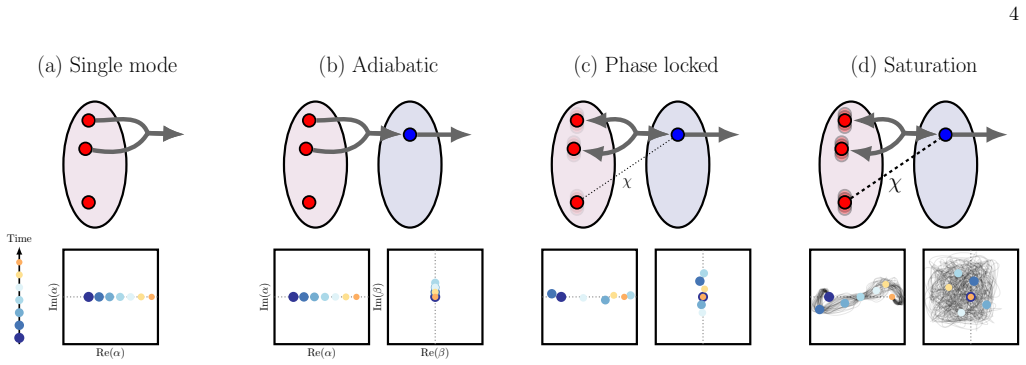
Linear system Ifχ= 0, the equations of motion are invariant under the reflection symmetry xa 7→x a, y a 7→ −y a, x b 7→ −x b, y b 7→y b.(10) This symmetry leaves invariant the reflection planey a = 0, x b = 0, which we call the phase-locked manifold. In- deed, a system is initialized iny a(t= 0) =x b(t= 0) = 0 remains on that plane, i.e.,y a(t) =x b(t) = ...
-
[2]
click-no click
Effects of nonlinearity Nonlinearities break this symmetry. A linearization procedure for the transverse variablesz ⊥ = (y a, xb)⊤ around the locked plane gives ˙z⊥ =A ⊥z⊥ +s pert,(13) whereA ⊥ ≡A ⊥(xa, yb) is the Jacobian matrix (for a detailed derivation, see Appendix C 2). Considering nonzero cross-Kerr, we get spert = χy2 b xa −χx2 ayb ! .(14) As disc...
2000
-
[3]
As discussed in Ref
has the advantage of being easy to simulate using advanced integration algorithms. As discussed in Ref. [85], to observe bit flips it is nec- essary to preform a homodyne detection scheme of the output filed of the memory. The mathematical reason for this can be understood using the single mode model. The model we consider shows a weakZ 2 symmetry. Namely...
-
[4]
Bit-flips without dephasing We study the bit-flip mechanism for the single-mode model forκ ϕ = 0
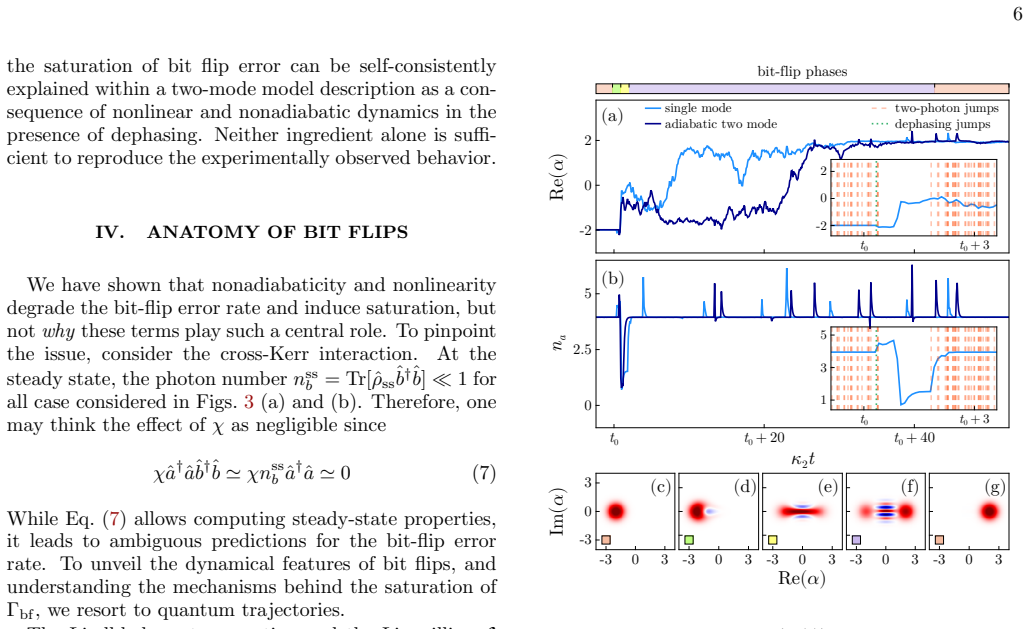
Single-mode systems a. Bit-flips without dephasing We study the bit-flip mechanism for the single-mode model forκ ϕ = 0. To compensate for the lower bit-flip rate, we increase the single-photon loss rate toκ a/κ2 = 0.1 and we slightly decrease the two-photon drive am- plitude to have⟨ˆa†ˆa⟩= 3.5 (ε2/κ2 ≃3.5). We keep all the other parameters as in Fig. 5....
-
[5]
Role of cross-Kerr and Kerr in the buffer Figure 15 further clarifies the roleχandK b in the scaling of Γ bf with respect to Fig
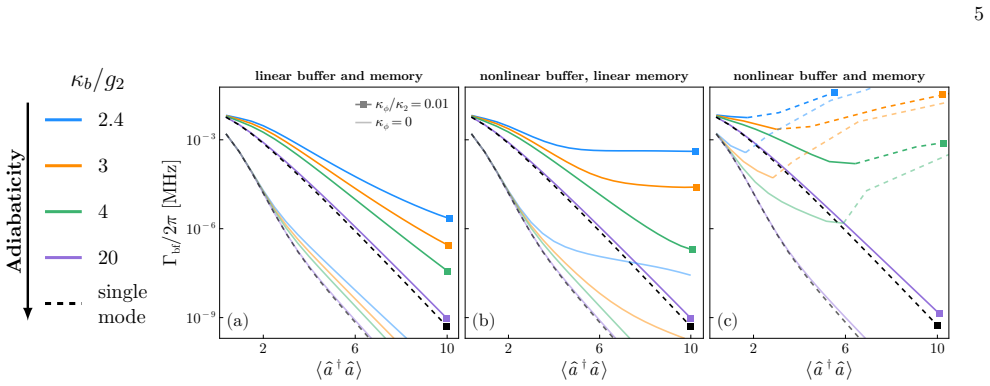
Two-mode systems a. Role of cross-Kerr and Kerr in the buffer Figure 15 further clarifies the roleχandK b in the scaling of Γ bf with respect to Fig. 3. Fig. 15 (a) shows the scaling of Γ bf with⟨ˆa†ˆa⟩whenχ= 0 and Kb/2π= 1 MHz. In this case no saturation is observed and the system qualitatively behaves as in Fig. 3 (b) (completely linear buffer mode). Th...
-
[6]
As the mem- ory is far detuned from the bistable branch, perturbative memory Kerr does not lead to the breakdown of the logi- cal qubit
We assumeK b/2π= 1 MHz andχ/2π= 0.5 MHz (nonlinear buffer with nonzero cross-Kerr). As the mem- ory is far detuned from the bistable branch, perturbative memory Kerr does not lead to the breakdown of the logi- cal qubit. Nonetheless, the saturation effect worsens with respect to the linear memory case analyzed in Fig. 3 (b): instead of exhibiting a pleate...
-
[7]
We will considerK b =χ= 0 and the same values ofg 2/2π∈ [0.6−5] MHz as in Fig
Hybrid cat qubits Finally, we briefly discuss the effect of non-adiabaticity on hybrid cat qubits, stabilized by an equal mixture of two-photon dissipation and Kerr nonlinearity. We will considerK b =χ= 0 and the same values ofg 2/2π∈ [0.6−5] MHz as in Fig. 3, but for even larger span of κb/2π∈[2.04−141] MHz following Eq. (6). We report our findings in Fi...
-
[8]
Adiabatic approximation We now derive the conditions under which the buffer mode can be adiabatically eliminated. Assumingκ b is the dominant rate, the characteristic buffer timescale isτ b ∼1/κ b.To make this assumption, we have |g2|α|2|,|χ|α| 2| ≪κ b Adiabatic elimination requires that the memory variables change only weakly over this inter- val, |˙α|τb...
-
[9]
Analysis of the stable point in the phase-locked regime The fixed points derived in Eq. (12) exist provided |εb|> κaκb 8g2 .Notice also the presence of the saddle point xa,sad = 0, y b,sad = 2|ε b|/κb.Moreover, linearizing the equations of motion along any point (x a,0,0, y b) on this plane, and considering small deviations (δya, δxb), we ob- tain the sys...
-
[10]
In all the calculations done in this paper, we impose Tr(ˆη† j ˆηj) = 1
Choice of the eigenstate normalization An important point of non-Hermitian matrices is that the bi-orthonormality condition fixes the normalization of ˆηj with respect to ˆσj, but there exists a gauge invari- ance such that Tr(ˆη† j ˆηj) is not fixeda priori. In all the calculations done in this paper, we impose Tr(ˆη† j ˆηj) = 1. This can be justified by...
-
[11]
Krantz, M
P. Krantz, M. Kjaergaard, F. Yan, T. P. Orlando, S. Gus- tavsson, and W. D. Oliver, A quantum engineer’s guide to superconducting qubits, Appl. Phys. Rev.6, 021318 20 (2019)
2019
-
[12]
Blais, A
A. Blais, A. L. Grimsmo, S. Girvin, and A. Wallraff, Circuit quantum electrodynamics, Rev. Mod. Phys.93, 025005 (2021)
2021
-
[13]
Leibfried, R
D. Leibfried, R. Blatt, C. Monroe, and D. Wineland, Quantum dynamics of single trapped ions, Rev. Mod. Phys.75, 281 (2003)
2003
-
[14]
C. D. Bruzewicz, J. Chiaverini, R. McConnell, and J. M. Sage, Trapped-ion quantum computing: Progress and challenges, Appl. Phys. Rev.6, 021314 (2019)
2019
-
[15]
P. Kok, W. J. Munro, K. Nemoto, T. C. Ralph, J. P. Dowling, and G. J. Milburn, Linear optical quantum computing with photonic qubits, Rev. Mod. Phys.79, 135 (2007)
2007
-
[16]
Flamini, N
F. Flamini, N. Spagnolo, and F. Sciarrino, Photonic quantum information processing: a review, Rep. Prog. Phys.82, 016001 (2019)
2019
-
[17]
J. Wang, F. Sciarrino, A. Laing, and M. G. Thompson, Integrated photonic quantum technologies, Nat. Photon- ics14, 273 (2020)
2020
-
[18]
P. T. Cochrane, G. J. Milburn, and W. J. Munro, Macro- scopically distinct quantum-superposition states as a bosonic code for amplitude damping, Phys. Rev. A59, 2631 (1999)
1999
-
[19]
Gottesman, A
D. Gottesman, A. Kitaev, and J. Preskill, Encoding a qubit in an oscillator, Phys. Rev. A64, 012310 (2001)
2001
-
[20]
V. V. Albert, K. Noh, K. Duivenvoorden, D. J. Young, R. T. Brierley, P. Reinhold, C. Vuillot, L. Li, C. Shen, S. M. Girvin, B. M. Terhal, and L. Jiang, Performance and structure of single-mode bosonic codes, Phys. Rev. A97, 032346 (2018)
2018
-
[21]
S. Lieu, R. Belyansky, J. T. Young, R. Lundgren, V. V. Albert, and A. V. Gorshkov, Symmetry Breaking and Error Correction in Open Quantum Systems, Phys. Rev. Lett.125, 240405 (2020)
2020
-
[22]
Leghtas, G
Z. Leghtas, G. Kirchmair, B. Vlastakis, R. J. Schoelkopf, M. H. Devoret, and M. Mirrahimi, Hardware-Efficient Autonomous Quantum Memory Protection, Phys. Rev. Lett.111, 120501 (2013)
2013
-
[23]
Mirrahimi, Z
M. Mirrahimi, Z. Leghtas, V. V. Albert, S. Touzard, R. J. Schoelkopf, L. Jiang, and M. H. Devoret, Dynamically protected cat-qubits: a new paradigm for universal quan- tum computation, New J. Phys.16, 045014 (2014)
2014
-
[24]
M. H. Michael, M. Silveri, R. Brierley, V. V. Albert, J. Salmilehto, L. Jiang, and S. Girvin, New Class of Quantum Error-Correcting Codes for a Bosonic Mode, Phys. Rev. X6, 031006 (2016)
2016
-
[25]
A. L. Grimsmo, J. Combes, and B. Q. Baragiola, Quantum Computing with Rotation-Symmetric Bosonic Codes, Phys. Rev. X10, 011058 (2020)
2020
-
[26]
Puttermanet al., Hardware-efficient quantum error correction via concatenated bosonic qubits, Nature638, 927 (2025)
H. Puttermanet al., Hardware-efficient quantum error correction via concatenated bosonic qubits, Nature638, 927 (2025)
2025
-
[27]
Leghtas, S
Z. Leghtas, S. Touzard, I. M. Pop, A. Kou, B. Vlas- takis, A. Petrenko, K. M. Sliwa, A. Narla, S. Shankar, M. J. Hatridge, M. Reagor, L. Frunzio, R. J. Schoelkopf, M. Mirrahimi, and M. H. Devoret, Confining the state of light to a quantum manifold by engineered two-photon loss, Science347, 853 (2015)
2015
-
[28]
Touzard, A
S. Touzard, A. Grimm, Z. Leghtas, S. Mundhada, P. Reinhold, C. Axline, M. Reagor, K. Chou, J. Blumoff, K. Sliwa, S. Shankar, L. Frunzio, R. Schoelkopf, M. Mir- rahimi, and M. Devoret, Coherent Oscillations inside a Quantum Manifold Stabilized by Dissipation, Phys. Rev. X8, 021005 (2018)
2018
-
[29]
Lescanne, M
R. Lescanne, M. Villiers, T. Peronnin, A. Sarlette, M. Delbecq, B. Huard, T. Kontos, M. Mirrahimi, and Z. Leghtas, Exponential suppression of bit-flips in a qubit encoded in an oscillator, Nat. Phys.16, 509 (2020)
2020
-
[30]
R´ eglade, A
U. R´ eglade, A. Bocquet, R. Gautier, J. Cohen, A. Marquet, E. Albertinale, N. Pankratova, M. Hall´ en, F. Rautschke, L.-A. Sellem, P. Rouchon, A. Sarlette, M. Mirrahimi, P. Campagne-Ibarcq, R. Lescanne, S. Je- zouin, and Z. Leghtas, Quantum control of a cat qubit with bit-flip times exceeding ten seconds, Nature629, 778 (2024)
2024
-
[31]
Marquet, A
A. Marquet, A. Essig, J. Cohen, N. Cottet, A. Murani, E. Albertinale, S. Dupouy, A. Bienfait, T. Peronnin, S. Jezouin, R. Lescanne, and B. Huard, Autoparametric Resonance Extending the Bit-Flip Time of a Cat Qubit up to 0.3 s, Phys. Rev. X14, 021019 (2024)
2024
-
[32]
Putterman, K
H. Putterman, K. Noh, R. N. Patel, G. A. Peairs, G. S. MacCabe, M. Lee, S. Aghaeimeibodi, C. T. Hann, I. Jar- rige, G. Marcaud, Y. He, H. Moradinejad, J. C. Owens, T. Scaffidi, P. Arrangoiz-Arriola, J. Iverson, H. Levine, F. G. Brand˜ ao, M. H. Matheny, and O. Painter, Pre- serving Phase Coherence and Linearity in Cat Qubits with Exponential Bit-Flip Supp...
2025
-
[33]
Minganti, N
F. Minganti, N. Bartolo, J. Lolli, W. Casteels, and C. Ciuti, Exact results for Schr¨ odinger cats in driven- dissipative systems and their feedback control, Sci. Rep. 6, 26987 (2016)
2016
-
[34]
Roberts and A
D. Roberts and A. A. Clerk, Driven-dissipative quantum kerr resonators: New exact solutions, photon blockade and quantum bistability, Phys. Rev. X10, 021022 (2020)
2020
-
[35]
Carde, R
L. Carde, R. Gautier, N. Didier, A. Petrescu, J. Cohen, and A. McDonald, Nonperturbative Switching Rates in Bistable Open Quantum Systems: From Driven Kerr Os- cillators to Dissipative Cat Qubits, Phys. Rev. Lett.136, 100402 (2026)
2026
-
[36]
Guillaud and M
J. Guillaud and M. Mirrahimi, Repetition Cat Qubits for Fault-Tolerant Quantum Computation, Phys. Rev. X9, 041053 (2019)
2019
-
[37]
S. Puri, L. St-Jean, J. A. Gross, A. Grimm, N. E. Frat- tini, P. S. Iyer, A. Krishna, S. Touzard, L. Jiang, A. Blais, S. T. Flammia, and S. M. Girvin, Bias-preserving gates with stabilized cat qubits, Sci. Adv.6, eaay5901 (2020)
2020
-
[38]
Chamberland, K
C. Chamberland, K. Noh, P. Arrangoiz-Arriola, E. T. Campbell, C. T. Hann, J. Iverson, H. Putterman, T. C. Bohdanowicz, S. T. Flammia, A. Keller, G. Refael, J. Preskill, L. Jiang, A. H. Safavi-Naeini, O. Painter, and F. G. Brand˜ ao, Building a Fault-Tolerant Quantum Computer Using Concatenated Cat Codes, PRX Quan- tum3, 010329 (2022)
2022
-
[39]
D. Ruiz, J. Guillaud, A. Leverrier, M. Mirrahimi, and C. Vuillot, LDPC-cat codes for low-overhead quantum computing in 2D, Nat. Commun.16, 1040 (2025)
2025
-
[40]
Goto, Bifurcation-based adiabatic quantum compu- tation with a nonlinear oscillator network, Sci
H. Goto, Bifurcation-based adiabatic quantum compu- tation with a nonlinear oscillator network, Sci. Rep.6, 21686 (2016)
2016
-
[41]
Goto, Universal quantum computation with a nonlin- ear oscillator network, Phys
H. Goto, Universal quantum computation with a nonlin- ear oscillator network, Phys. Rev. A93, 050301 (2016)
2016
-
[42]
S. Puri, S. Boutin, and A. Blais, Engineering the quan- tum states of light in a Kerr-nonlinear resonator by two- photon driving, npj Quantum Inf.3, 18 (2017)
2017
-
[43]
S. Puri, A. Grimm, P. Campagne-Ibarcq, A. Eickbusch, K. Noh, G. Roberts, L. Jiang, M. Mirrahimi, M. H. De- 21 voret, and S. Girvin, Stabilized Cat in a Driven Nonlin- ear Cavity: A Fault-Tolerant Error Syndrome Detector, Phys. Rev. X9, 041009 (2019)
2019
-
[44]
Grimm, N
A. Grimm, N. E. Frattini, S. Puri, S. O. Mundhada, S. Touzard, M. Mirrahimi, S. M. Girvin, S. Shankar, and M. H. Devoret, Stabilization and operation of a Kerr-cat qubit, Nature584, 205 (2020)
2020
-
[45]
Iyama, T
D. Iyama, T. Kamiya, S. Fujii, H. Mukai, Y. Zhou, T. Na- gase, A. Tomonaga, R. Wang, J.-J. Xue, S. Watabe, S. Kwon, and J.-S. Tsai, Observation and manipulation of quantum interference in a superconducting Kerr para- metric oscillator, Nat. Commun.15, 86 (2024)
2024
-
[46]
A. Hajr, B. Qing, K. Wang, G. Koolstra, Z. Pedramrazi, Z. Kang, L. Chen, L. B. Nguyen, C. J¨ unger, N. Goss, I. Huang, B. Bhandari, N. E. Frattini, S. Puri, J. Dres- sel, A. N. Jordan, D. I. Santiago, and I. Siddiqi, High- Coherence Kerr-Cat Qubit in 2D Architecture, Phys. Rev. X14, 041049 (2024)
2024
-
[47]
O. Benhayoune-Khadraoui, C. Lled´ o, and A. Blais, How the kerr-cat qubit dies – and how to rescue it (2025), arXiv:2507.06160 [quant-ph]
-
[48]
D. S. Schlegel, F. Minganti, and V. Savona, Quantum error correction using squeezed Schr¨ odinger cat states, Phys. Rev. A106, 022431 (2022)
2022
-
[49]
Hillmann and F
T. Hillmann and F. Quijandr´ ıa, Quantum error cor- rection with dissipatively stabilized squeezed-cat qubits, Phys. Rev. A107, 032423 (2023)
2023
-
[50]
Enhancing dissipa- tive cat qubit protection by squeezing
R. Rousseauet al., Enhancing dissipative cat qubit pro- tection by squeezing (2025), arXiv:2502.07892 [quant- ph]
-
[51]
Gautier, A
R. Gautier, A. Sarlette, and M. Mirrahimi, Combined Dissipative and Hamiltonian Confinement of Cat Qubits, PRX Quantum3, 020339 (2022)
2022
-
[52]
D. Ruiz, R. Gautier, J. Guillaud, and M. Mirrahimi, Two-photon driven Kerr quantum oscillator with mul- tiple spectral degeneracies, Phys. Rev. A107, 042407 (2023)
2023
-
[53]
Gravina, F
L. Gravina, F. Minganti, and V. Savona, Critical Schr¨ odinger Cat Qubit, PRX Quantum4, 020337 (2023)
2023
-
[54]
Chiral cat code: Enhanced error correction induced by higher-order nonlinear- ities
A. Labay-Mora, A. Mercurio, V. Savona, G. L. Giorgi, and F. Minganti, Chiral cat code: Enhanced error cor- rection induced by higher-order nonlinearities (2025), arXiv:2503.11624 [quant-ph]
-
[55]
F. Adinolfi, D. Z. Haxell, A. Bruno, L. Michaud, V. H. Kamrul, P. Pandey, and A. Grimm, Enhancing kerr- cat qubit coherence with controlled dissipation (2025), arXiv:2511.01027 [quant-ph]
-
[56]
Berdou, A
C. Berdou, A. Murani, U. R´ eglade, W. Smith, M. Villiers, J. Palomo, M. Rosticher, A. Denis, P. Morfin, M. Del- becq, T. Kontos, N. Pankratova, F. Rautschke, T. Per- onnin, L.-A. Sellem, P. Rouchon, A. Sarlette, M. Mir- rahimi, P. Campagne-Ibarcq, S. Jezouin, R. Lescanne, and Z. Leghtas, One Hundred Second Bit-Flip Time in a Two-Photon Dissipative Oscill...
2023
-
[57]
N. E. Frattini, R. G. Corti˜ nas, J. Venkatraman, X. Xiao, Q. Su, C. U. Lei, B. J. Chapman, V. R. Joshi, S. Girvin, R. J. Schoelkopf, S. Puri, and M. H. Devoret, Observa- tion of Pairwise Level Degeneracies and the Quantum Regime of the Arrhenius Law in a Double-Well Paramet- ric Oscillator, Phys. Rev. X14, 031040 (2024)
2024
-
[58]
Guillaud, J
J. Guillaud, J. Cohen, and M. Mirrahimi, Quantum com- putation with cat qubits, SciPost Phys. Lect. Notes , 72 (2023)
2023
-
[59]
Carde, P
L. Carde, P. Rouchon, J. Cohen, and A. Petrescu, Flux-pump-induced degradation oft 1 for dissipative cat qubits, Phys. Rev. Appl.23, 024073 (2025)
2025
-
[60]
Indeed, in the adiabatic limit and forκ a =κ ϕ = 0, this choice sets the total number of photons in the memory for a givenε 2 [23, 24]
-
[61]
Mercurio, Y.-T
A. Mercurio, Y.-T. Huang, L.-X. Cai, Y.-N. Chen, V. Savona, and F. Nori, QuantumToolbox.jl: An efficient Julia framework for simulating open quantum systems, Quantum9, 1866 (2025)
2025
-
[62]
Johansson, P
J. Johansson, P. Nation, and F. Nori, QuTiP: An open- source Python framework for the dynamics of open quan- tum systems, Comput. Phys. Commun.183, 1760 (2012)
2012
-
[63]
Guilmin, A
P. Guilmin, A. Bocquet, ´E. Genois, D. Weiss, and R. Gautier, Dynamiqs: an open-source python library for gpu-accelerated and differentiable simulation of quantum systems (2025)
2025
-
[64]
P. D. Drummond and D. F. Walls, Quantum theory of optical bistability. I. Nonlinear polarisability model, J. Phys. A: Math. Gen.13, 725 (1980)
1980
-
[65]
P. D. Drummond and D. F. Walls, Quantum theory of optical bistability. II. Atomic fluorescence in a high- Q cavity, Phys. Rev. A23, 2563 (1981)
1981
-
[66]
Bartolo, F
N. Bartolo, F. Minganti, W. Casteels, and C. Ciuti, Ex- act steady state of a Kerr resonator with one- and two- photon driving and dissipation: Controllable Wigner- function multimodality and dissipative phase transitions, Phys. Rev. A94, 033841 (2016)
2016
-
[67]
Carmichael,An Open Systems Approach to Quan- tum Optics: Lectures Presented at the Universit´ e Libre de Bruxelles October 28 to November 4, 1991, edited by H
H. Carmichael,An Open Systems Approach to Quan- tum Optics: Lectures Presented at the Universit´ e Libre de Bruxelles October 28 to November 4, 1991, edited by H. Araki, E. Br´ ezin, J. Ehlers, U. Frisch, K. Hepp, R. L. Jaffe, R. Kippenhahn, H. A. Weidenm¨ uller, J. Wess, J. Zittartz, and W. Beiglb¨ ock, Lecture Notes in Physics Monographs, Vol. 18 (Sprin...
1991
-
[68]
Haroche and J.-M
S. Haroche and J.-M. Raimond,Exploring the Quantum (Oxford University Press, 2006)
2006
-
[69]
Breuer and F
H.-P. Breuer and F. Petruccione,The Theory of Open Quantum Systems, 1st ed. (Oxford University PressOx- ford, 2007)
2007
-
[70]
A. J. Daley, Quantum trajectories and open many-body quantum systems, Adv. Phys.63, 77 (2014)
2014
-
[71]
Introducingu= ln|x|one gets ¨u−κb 2 ˙u+ 2g2 2e2u + 2g2εb − κaκb 4 = 0
Notice that this further simplifies in an equation for the radiuses and relative sign ofαandβ. Introducingu= ln|x|one gets ¨u−κb 2 ˙u+ 2g2 2e2u + 2g2εb − κaκb 4 = 0
-
[72]
H. M. Wiseman and G. J. Milburn,Quantum Measure- ment and Control, 1st ed. (Cambridge University Press, 2009)
2009
-
[73]
Haake, S
F. Haake, S. Gnutzmann, and M. Ku´ s,Quantum Signa- tures of Chaos, Springer Series in Synergetics (Springer International Publishing, Cham, 2018)
2018
-
[74]
Ch´ avez-Carlos, T
J. Ch´ avez-Carlos, T. L. M. Lezama, R. G. Corti˜ nas, J. Venkatraman, M. H. Devoret, V. S. Batista, F. P´ erez- Bernal, and L. F. Santos, Spectral kissing and its dynam- ical consequences in the squeeze-driven Kerr oscillator, npj Quantum Inf.9, 76 (2023)
2023
-
[75]
Ch´ avez-Carlos, M
J. Ch´ avez-Carlos, M. A. Prado Reynoso, R. G. Corti˜ nas, I. Garc´ ıa-Mata, V. S. Batista, F. P´ erez-Bernal, D. A. Wisniacki, and L. F. Santos, Driving superconducting 22 qubits into chaos, Quantum Sci. Technol.10, 015039 (2025)
2025
-
[76]
L. E. Mart´ ınez, I. Garc´ ıa-Mata, and D. A. Wisniacki, Fundamental Limits to Cat Code Qubits from Chaos- Assisted Tunneling, Phys. Rev. Lett.136, 120204 (2026)
2026
-
[77]
Akemann, M
G. Akemann, M. Kieburg, A. Mielke, and T. Prosen, Universal Signature from Integrability to Chaos in Dis- sipative Open Quantum Systems, Phys. Rev. Lett.123, 254101 (2019)
2019
-
[78]
Hamazaki, K
R. Hamazaki, K. Kawabata, N. Kura, and M. Ueda, Universality classes of non-Hermitian random matrices, Phys. Rev. Res.2, 023286 (2020)
2020
-
[79]
L. S´ a, P. Ribeiro, and T. Prosen, Complex Spacing Ra- tios: A Signature of Dissipative Quantum Chaos, Phys. Rev. X10, 021019 (2020)
2020
-
[80]
Dahan, G
D. Dahan, G. Arwas, and E. Grosfeld, Classical and quantum chaos in chirally-driven, dissipative Bose- Hubbard systems, npj Quantum Inf.8, 14 (2022)
2022
discussion (0)
Sign in with ORCID, Apple, or X to comment. Anyone can read and Pith papers without signing in.